
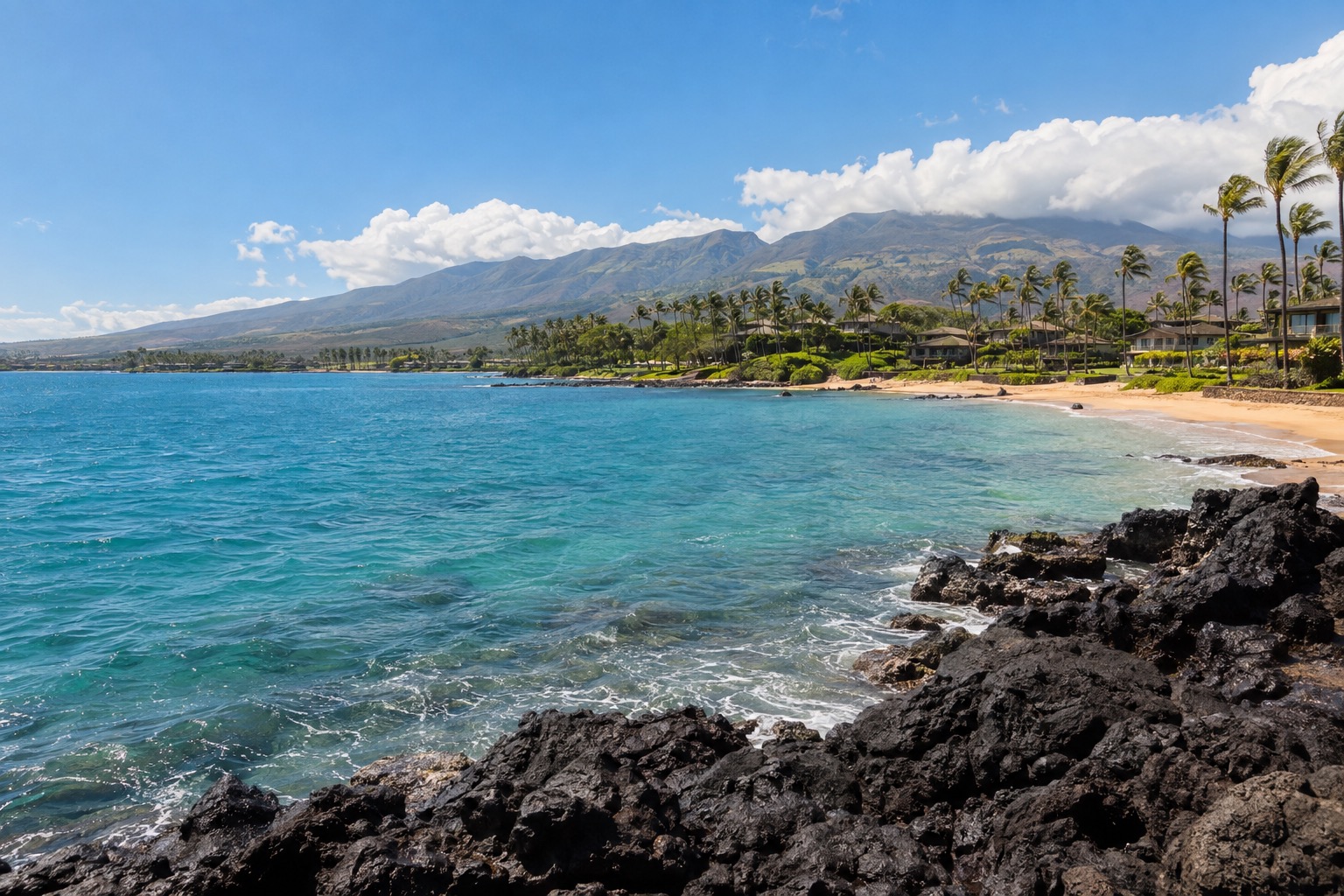
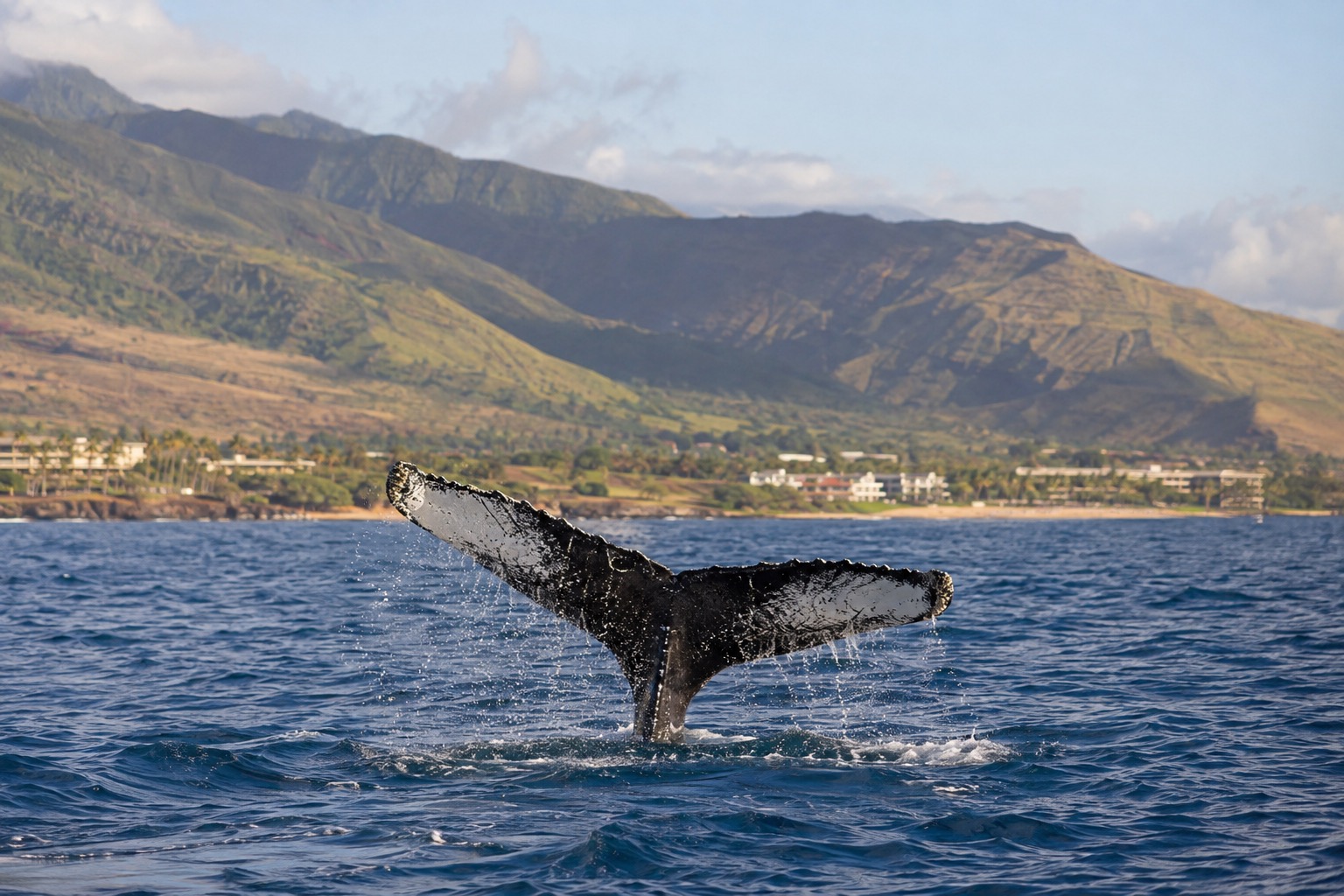
In February, a humpback tail slaps the water off Lahaina and a boat full of people goes quiet at the same moment. On shore, the trade winds rattle the palms along the Kihei beaches and the West Maui Mountains hold a ribbon of cloud above the cane-colored hills. Maui in February belongs to the whales, and to travelers who like warm days, cool evenings and a lively sea.
What is the weather like in Maui in February?
In February you get warmth and plenty of sun, plus a few brief showers, and the weather feels good enough for daytime beach time and for a light layer after dark.
| Month | Average high (°F) | Average low (°F) | Rain days | Sea (°F) |
|---|---|---|---|---|
| January | 82.2 | 63.6 | 4.0 | 77.6 |
| February | 82.2 | 63.8 | 3.8 | 76.1 |
| March | 82.9 | 65.1 | 4.5 | 75.5 |
The day opens gentle and cool, then by ten the leeward coast feels the full strength of the sun. Wailea, Kihei and Kaanapali are the dry, sunny side of the island, so the beach days there usually come easy. Afternoons are pleasant rather than hot, helped by the trade winds that blow most days.
Rain arrives as quick passing showers, more often on the windward side. Hana, Haiku and the slopes of the East Maui mountains stay green because of them, and a rainbow often follows. Up on Haleakala the air is far colder than at the shore, and it can be windy and damp at the summit.
Evenings are mild enough for dinner outdoors with a sweater or light jacket. Days are a little longer than eleven hours, so sunset comes in the early evening and the light turns gold over Lanai across the channel. Shorts and sandals do for most of the day, with one warm layer for after dark.
Can you swim in Maui in February?
Yes, the ocean is comfortable for swimming, though many people will want a few minutes to adjust before a long swim.
The sea is a bit cooler than in the summer months and winter swells often bring bigger surf to north and west shores, such as Honolua Bay and the stretch near Ho’okipa. South and west-facing beaches at Kihei, Wailea and Kaanapali are usually the gentler choices, and morning tends to be calmer before the wind builds. Snorkelers often head to the rocky edges of coves, while surfers and bodyboarders look for the beaches with waves.
Day to day the water can shift, so check the beach signs and do what the lifeguards say before you head in. For kids and anyone who feels uneasy in the water, a beach with a lifeguard tower is the best bet. A rash guard helps with the sun and a bit of chill, and mineral sunscreen is the habit for the reef.
What to do in Maui in February
The whales are the reason February feels special here. Humpback sightings in Hawaii usually span November through April, with January through March marking the height of the season. Those shallow Maui Nui waters stretching among Maui, Lanai, Molokai and Kahoolawe fall inside the sanctuary, and that is what makes this island so well suited to watching them.
Whale watching from the shore and by boat
Boats leave mainly from Lahaina and Maalaea harbors, and from Kihei in some cases. A morning trip often has calmer water, and many travelers see a breach, a tail slap or a mother with her calf. Sightings are a chance, never a promise, but February is one of the best months to hope for them.
You can also watch from land with no boat at all. The cliffs and pullouts along the Honoapiilani Highway, the lookout at McGregor Point, and the shoreline in front of Wailea are classic spots. Bring binoculars, look for a blow or a white splash, and scan the water for a few minutes before moving on. Whales must stay more than 100 yards away from you, boat or swimmer, so enjoy them from a respectful distance.
Haleakala and the upcountry
The volcano is a major day for many visitors. The summit is cold, with strong wind and sometimes cloud, so dress in layers. Sunrise requires a reservation, so plan it ahead of the trip and check the national park rules before you set an alarm.
Farther down, the upcountry communities of Makawao and Kula are cool and lush. Makawao has cowboy-town storefronts, bakeries and small galleries, while Kula has farm stands and gardens on the slope. This makes a pleasant slow afternoon after a cold sunrise.
The Road to Hana and the windward coast
A day on the Road to Hana brings curves, one-lane bridges, waterfalls, and stands where banana bread is sold. February showers keep the waterfalls full and the jungle bright, so the drive can be very beautiful, although a few slick sections call for patience. Start early to have time at the pullouts, and plan on a full day.
Along the way, the rainforest, black sand and sea cliffs change by the mile. Waianapanapa State Park has a reservation requirement for visitors, so make sure to secure it before you go. Bring a swimsuit, a towel and a rain jacket, and keep to the signs near the shore, because waves on this coast can be strong.
Back on the dry side, Maui in February suits slow beach days, a sunset at Kaanapali, a Lahaina Front Street stroll, and plate lunches at roadside trucks. Poke, shave ice and fresh pineapple fit warm afternoons. Pa’ia has a surf-town feel, with cafes and shops, and Ho’okipa often draws windsurfers and sea turtles on the sand.
A two-day itinerary for Maui in February
Day 1 starts on the dry side. Have coffee early in Kihei or Wailea, then spend the morning at a beach with a lifeguard, when the sea is usually gentler and the sun is not yet strong. Snorkel along a rocky edge if the signs say it is fine, then come ashore for a lunch of fish tacos or a plate lunch.
In the afternoon, take a whale-watching cruise from Maalaea, or sit on the shoreline with binoculars. Return for a walk on the Wailea coastal path as the light softens. Sunset is early in the evening, so plan dinner after it, at a restaurant near the water. If it rains, visit the Maui Ocean Center or browse a shopping village.
Day 2 is for the north and the uplands. Drive to Pa’ia for breakfast, watch the surfers and windsurfers at Ho’okipa, then climb to Makawao for a browse among the galleries. Lunch is a bakery or farm-stand meal, with fruit and fresh bread.
In the afternoon, continue to Kula for the gardens and views down the slope, with a jacket nearby because the air is cooler. Come down in the late afternoon to Lahaina’s waterfront for a stroll and dinner. If the weather turns gray, stay with covered stops such as cafes, galleries and a local market.
Is Maui busy in February?
Yes, February is a busy winter month, filled with mainland visitors escaping the cold and whale watchers.
Beaches in Wailea and Kaanapali are lively, harbors are active, and popular restaurants fill at dinner. Presidents Day weekend tends to bring a surge of families, so rooms and rental cars go quickly then. The weeks around it feel calmer, and the very end of the month is often easier.
Reserve rooms and cars well in advance for the holiday week, and even for ordinary weeks book far ahead of your trip, because whale season keeps demand steady. Restaurant tables for dinner are easier with a reservation, particularly at sunset hours. Boat tours are best booked a few days ahead in the peak weeks.
The things that need a reservation matter most: the Haleakala sunrise and Waianapanapa State Park both require one, so secure them as soon as your dates are set. Quieter hours exist everywhere. Early morning on a beach, a weekday on the Hana road, and late afternoon at a lookout all feel more relaxed.
What to pack for Maui in February
Pack for sun by day and a cooler breeze at night, with one layer that handles a summit morning.
- For the Hana side, bring a light rain jacket to handle passing showers.
- A fleece or warm layer, for the Haleakala summit and evenings.
- Swimsuits and a rash guard, for sun and cooler water.
- Mineral sunscreen and a hat, for strong midday light.
- Binoculars, for spotting whales from shore.
- Water shoes, for rocky entries and wet trails.
Good to know before you go
February falls outside the official hurricane season, which runs from June 1 to November 30. Winter swells can still make the north and west shores rough, so beach choice matters. A rental car makes the island much easier, and the popular reservations are worth booking first.
| Fee | Amount | Who pays |
|---|---|---|
| State transient accommodations tax | 11% | Hotel guests |
| Maui County transient accommodations tax | 3% | Hotel guests |
Maui in February vs January and March
Moving earlier to January keeps you in the whale peak, with a slightly warmer sea and a little more rain. The holiday crowds thin after the first week, so the island can feel a bit easier than at the start of the year.
Moving later to March keeps the whales in view, though the season edges toward its end as April nears. The sea cools a touch, the nights are a bit warmer, and spring break families begin to arrive, so rooms and cars tighten again.
Choose February if you want the whales near their peak with the middle of the winter rhythm. Shift to January for a longer whale window, or to March if you prefer slightly warmer nights and do not mind more families on the beaches.
Is February a good time to visit Maui?
Yes, February is a very good time to visit Maui, especially for whale lovers, beach walkers and anyone who wants warm days without summer heat.
It suits couples, families and travelers who like to mix a beach morning with a scenic drive. It suits less well anyone hoping for a big north-shore swim, since winter surf can keep those beaches rough, or anyone who wants the quietest, emptiest island.
On arrival, settle the reservations first, for the Haleakala sunrise and for Waianapanapa if you plan the Hana road. Then book a whale cruise and keep the rest loose. What makes February here is the sight of a humpback surfacing off a sunlit shore, with the trade winds in the palms and Lanai across the water.
Sources
- NOAA NCEI, monthly normals 1991-2020, station USW00022516, checked September 8, 2026
- Open-Meteo Marine API, average 2015-2024, checked September 8, 2026
- sunrise-sunset.org, sunrise and sunset calculated for the 15th of the month, checked September 8, 2026
- NOAA, Hawaiian Islands Humpback Whale National Marine Sanctuary, pages Responsible Recreation and About, checked September 25, 2026
- Hawaii Department of Taxation, Announcement 2025-03 ; County of Maui, TAT Announcement 2021-01 (mauicounty.gov/2537), checked September 25, 2026
- NWS Honolulu / Central Pacific Hurricane Center, « 2026 Central Pacific Hurricane Season Outlook », weather.gov/hfo/hurricaneOutlook2026, checked September 24, 2026