
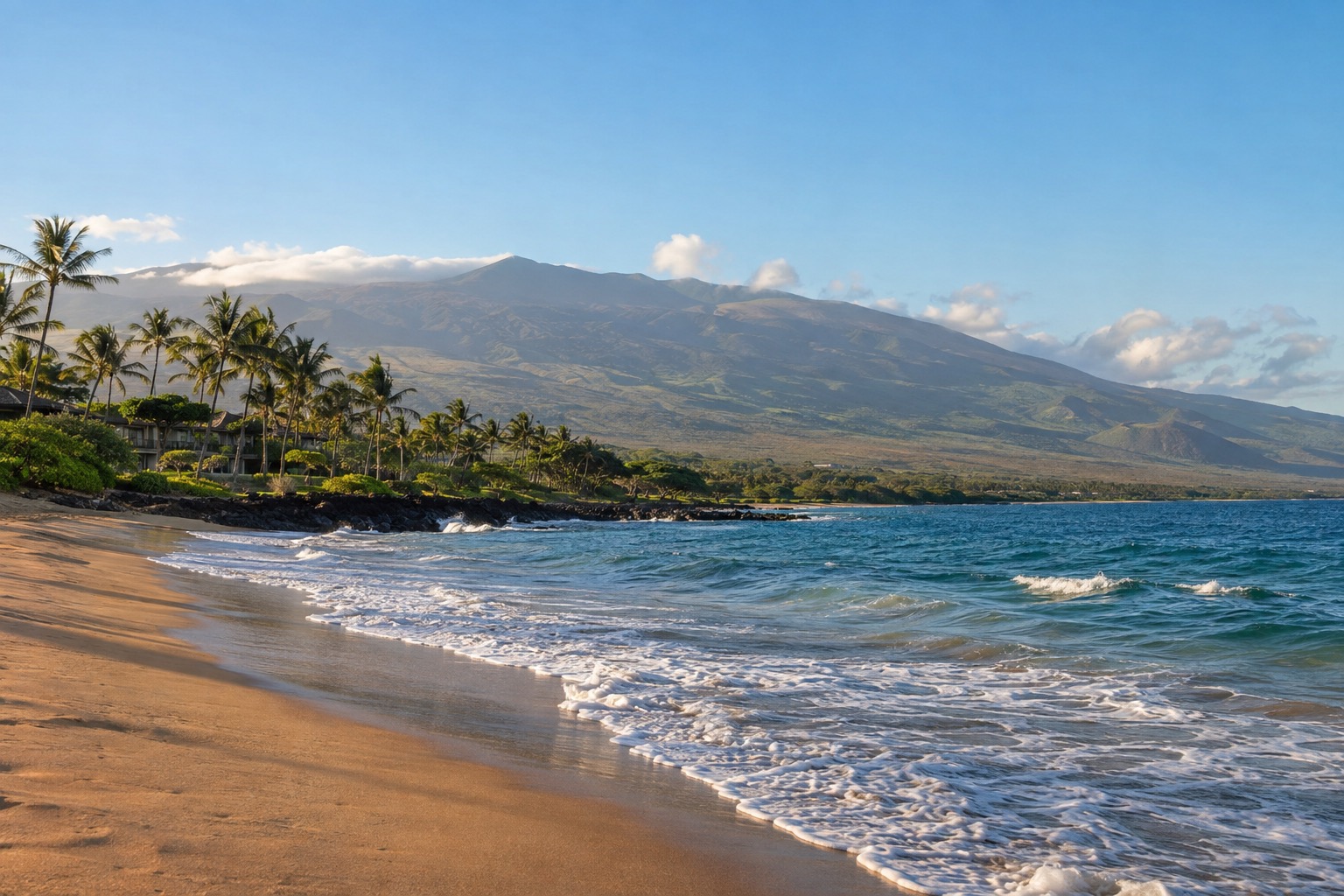
Late in the afternoon at Kaanapali Beach, a cliff diver sets torches burning along Black Rock and jumps into the ocean as the sky shifts to orange above Lanai. Maui runs on two moods: a long, hot, dry stretch of bright beach days, and a cooler, greener winter when humpback whales roll offshore. The resort coasts of West and South Maui stay sunny through most of it.
When is the best time to visit Maui?
April, May, September and October are the strongest all-around months, with dry sunny weather and thinner crowds than summer or the winter holidays. Winter is the pick if whales matter more than hot afternoons, and summer suits families tied to school calendars.
For beach days, May through October gives the driest and warmest conditions on the leeward resort coasts of Kihei, Wailea, Kaanapali and Kapalua. The sea is at its warmest in late summer and early fall, which makes snorkeling off Molokini or along the Kaanapali shoreline very pleasant. In winter, big surf often reaches north-facing shores, so south and west beaches are the ones to head for.
For sightseeing, the shoulder months are kind. The road to Hana and the Kipahulu waterfalls are green year-round, but the east side is the wet side, so a gray, showery day is possible in any month and more likely in winter. Haleakala is cold at the summit whatever the season, so sunrise visitors need a real jacket even in September.
Families should know that March is spring break season on the mainland, and beaches, restaurants and pool decks are loud and full. Late spring, just after those weeks, brings the same sunshine with more room to spread out. Summer is busy too, but the long days and warm water are hard to beat with kids.
Maui weather by month
Maui stays warm every month, and the main change through the year is how much rain falls and how warm the ocean gets.
| Month | Average high (°F) | Average low (°F) | Rain (in) | Rain days | Sea (°F) |
|---|---|---|---|---|---|
| January | 82.2 | 63.6 | 2.42 | 4.0 | 77.6 |
| February | 82.2 | 63.8 | 2.00 | 3.8 | 76.1 |
| March | 82.9 | 65.1 | 2.64 | 4.5 | 75.5 |
| April | 84.5 | 66.6 | 1.32 | 2.5 | 76.1 |
| May | 86.5 | 67.7 | 0.71 | 1.7 | 76.8 |
| June | 88.3 | 70.3 | 0.17 | 0.4 | 77.8 |
| July | 89.2 | 71.8 | 0.53 | 1.5 | 79.1 |
| August | 89.9 | 72.3 | 0.53 | 1.3 | 79.3 |
| September | 90.0 | 71.2 | 0.45 | 1.0 | 79.8 |
| October | 88.7 | 70.1 | 0.83 | 1.6 | 79.5 |
| November | 85.8 | 68.4 | 1.81 | 3.0 | 78.6 |
| December | 83.3 | 65.9 | 2.80 | 4.2 | 78.1 |
The year splits into a dry, hot half and a wetter, cooler half. From May to October, showers are rare and short, and the leeward coasts feel like a long run of sunny days. From December to March, a few days each month bring rain, usually passing showers or a gray spell that clears by afternoon, and nights turn pleasantly cool. Even then, the leeward beaches see more sun than the windward side.
When is Maui cheapest and least crowded?
Maui is quietest in late April through May, and again from September to mid-November, when the school calendar pulls families back home. Rooms are easier to find in those windows, and the beaches in Kihei and Wailea have space between towels.
The crowded weeks are easy to name: Christmas and New Year, spring break in March, Easter week, and the summer stretch when families travel from June through August. Holiday weeks bring peak-season rates and full resorts, and the popular snorkel boats and restaurants fill early.
Early December, before the holiday rush, and January after the first week are also calmer. Whale season is in full swing then, so you get the winter ocean show without the busiest crowds. Holiday periods are the ones to plan around if you want a calm beach morning.
Which months should you avoid in Maui?
No month is a bad one, but a few come with trade-offs: the peak holiday weeks for crowds, and the wettest stretch of winter for the east side.
The Central Pacific hurricane season runs from June 1 to November 30. Hawaii is rarely hit, but the season overlaps the hottest, driest months, so it is simply part of the picture for a summer or fall trip. Outside those dates, from December to May, the official season is over, though winter can bring heavy rain and big surf.
December to March is the wettest period, particularly on the windward side toward Hana and on the slopes of Haleakala. If your plan centers on the Hana road or waterfalls, a showery day is part of the experience. Rain also swells the streams and can make the road greasy, so allow slack in the schedule.
Late summer and early fall are the hottest months, with highs near 90 on the leeward coasts. Shade, water and a midday break at the pool make those afternoons easy. Winter swells are the second factor to keep in mind: strong waves sometimes hit north shores and certain beaches facing west, so check the day’s surf and currents along with any posted warnings before entering the water, and swim near a lifeguard only at spots where one is on duty.
When can you swim in Maui?
You can swim in Maui all year, because the ocean never gets truly cold, though conditions at each beach change with the season.
The water is at its warmest from July through October, when it feels like a warm bath after the first minute. The coolest stretch runs from February to April, and even then most people swim in a swimsuit without a wetsuit. Snorkelers often like a thin rash guard in the cooler months, and mineral sunscreen is the rule in Maui County.
In summer, north shores are usually gentler and south and west shores catch more swell from the south. In winter it flips: south and west beaches such as Wailea and Kaanapali are usually the friendlier choice, while north-facing bays can have heavy surf. A shore break at Big Beach in Makena is notorious, and the state cautions it can be very dangerous, so look at the posted warnings and study how surf and currents change between morning and afternoon before you go in, and only swim beside a lifeguard where one is on duty.
Festivals and events in Maui through the year
Winter whales and the holidays
Humpback whales arrive in Maui waters from about November and stay through April, with the busiest viewing from January through March. The channel between Maui, Lanai and Molokai is a sanctuary, and from a beach in Wailea or Kaanapali you can often spot spouts and breaches without leaving the sand. Boats must keep more than 100 yards away.
Christmas and New Year bring lights, shell-lei stalls and fireworks over the resort coasts, and Lahaina’s rebuilding gives the season a quieter tone. Resorts hold luaus and holiday dinners, and reservations fill early. A morning whale-watching cruise followed by a sunset on the beach is a classic winter day.
Spring and summer celebrations
May 1 is Lei Day, celebrated with flower lei, hula and music in schools and parks across the islands. It is a gentle, colorful day, and a good moment to see local crafts. June 11 is Kamehameha Day, a state holiday marked with parades and floral lei draped on statues of the king.
Summer on Maui is also the season of county and community fairs, outdoor concerts and long evenings on the beach. Snorkeling at Molokini is most reliable in the calm summer mornings, and the cliff dive at Black Rock lights up each sunset at Kaanapali all year.
Fall on the island
October is calm and sunny, with warm ocean water and lighter crowds after the summer rush. Halloween brings costumed crowds to Front Street in Lahaina in normal years, and families trick-or-treat in resort areas and neighborhoods. Today, the town is still rebuilding, so check official updates at mauirecovers.org before planning a stop there.
November marks the first whales returning and the first cooler mornings, a lovely moment for hikes in Upcountry and along the coast. Thanksgiving weekend fills the resorts, but the weeks before it are among the quietest of the year.
Sources
- NOAA NCEI, monthly normals 1991-2020, station USW00022516, checked September 8, 2026
- Open-Meteo Marine API, average 2015-2024, checked September 8, 2026
- sunrise-sunset.org, sunrise and sunset calculated for the 15th of the month, checked September 8, 2026
- DBEDT, press release « Visitor Spending Increased in December 2025 », dbedt.hawaii.gov/blog/26-04, checked September 24, 2026
- Hawaii Visitors and Convention Bureau, map Driving Times from Kahului Airport (gohawaii.com/sites/default/files/maui_drive_map.pdf, edition 2010), checked September 25, 2026
- Hawaii DOT Airports, OGG, Maui Bus (airports.hawaii.gov/ogg/getting-to-from/ground-transportation/maui-bus), checked September 25, 2026
- County of Maui, Maui Bus Fixed Route Program (mauicounty.gov/609), , checked September 25, 2026
- NPS, Haleakala National Park, Fees & Passes (nps.gov/hale/planyourvisit/fees.htm), checked September 25, 2026
- NPS, Haleakala National Park, pages Fees & Passes and Sunrise (nps.gov/hale/planyourvisit/sunrise.htm), checked September 25, 2026
- NPS, pages Puuulaula (nps.gov/places/puuulaula.htm) and Summit District, checked September 25, 2026
- Hawaii DLNR, Division of State Parks, Iao Valley State Monument (dlnr.hawaii.gov/dsp/parks/maui), checked September 25, 2026
- Hawaii Tourism Authority, Go Hawaii, Hana (gohawaii.com/islands/maui/regions/east-maui/hana), checked September 25, 2026
- Hawaii DLNR, Division of State Parks, Waianapanapa State Park, checked September 25, 2026
- Hawaii DLNR, Division of Aquatic Resources, Maui – Molokini Shoal MLCD, checked September 25, 2026
- NOAA, Hawaiian Islands Humpback Whale National Marine Sanctuary, pages Responsible Recreation and About, checked September 25, 2026
- County of Maui, Mineral Only Sunscreen Maui County (mauicounty.gov/2483), relayed by Maui Now, September 20, 2022, checked September 25, 2026
- Hawaii Department of Taxation, Announcement 2025-03 ; County of Maui, TAT Announcement 2021-01 (mauicounty.gov/2537), checked September 25, 2026
- County of Maui, Office of Recovery, « Lahaina's Front Street scheduled to reopen on Aug. 1, 2026 » (mauicounty.gov newsflash 19055, mauirecovers.org), checked September 25, 2026
- Hawaii DLNR, Division of State Parks, Makena State Park (dlnr.hawaii.gov/dsp/parks/maui/makena-state-park), checked September 25, 2026
- Hawaii Tourism Authority, Go Hawaii, Kaanapali Beach (gohawaii.com/islands/maui/regions/west-maui/kaanapali-beach), checked September 25, 2026
- Hawaii Tourism Authority, Go Hawaii, Wailea (gohawaii.com/islands/maui/regions/south-maui/wailea), checked September 25, 2026
- NPS, Haleakala National Park, pages Kipahulu District and Fees & Passes, checked September 25, 2026
- NWS Honolulu / Central Pacific Hurricane Center, « 2026 Central Pacific Hurricane Season Outlook », weather.gov/hfo/hurricaneOutlook2026, checked September 24, 2026