
Thessaloniki is the city Athens-bound travelers tend to skip, and that is their loss. Greece's second city is a port of Roman ruins, Byzantine churches, Ottoman baths and high-rise apartment blocks, all crowded together along a waterfront with Mount Olympus on the horizon on a clear day. It is also one of the largest student centers in South-Eastern Europe, so the cafés stay full and the streets feel young. Food lovers, history fans and anyone who likes a city with some grit and energy will be happy here.
What are the best things to do in Thessaloniki?
Start at the water. The promenade runs about three miles (five kilometers) and is flat, so it makes the easiest first walk. Begin near the port, where the MOMus Experimental Center for the Arts shows contemporary Greek art and the old harbor buildings charm with exposed brick, urban art and industrial chic. Just down the street, at Eleftherias Square, the Holocaust memorial called Menorah in Flames stands where the city's Jewish residents were rounded up before their deportation in 1943. The Jewish Museum nearby traces the history and legacy of one of Europe's oldest Jewish communities.
Head east past Aristotelous Square along the water, and in about 15 to 20 minutes on flat ground you reach the White Tower, a landmark you will see in many photos of the city. The Ottomans built it after taking the city in 1430, and it served as a fortress and then a notorious prison. After Greece took the city in 1912 it was whitewashed, though today it is more off-white. Inside, a museum tells the history of Thessaloniki, one theme per floor. The staircase is wide, circular and stone, there is no elevator, and the doorways are low, so watch your head.
In 2026, full admission is €4 and reduced is €2. Hours change on public holidays, and the tower closes on some of them, so check the current hours before you go. Admission is free on March 6, April 18, May 18, the last weekend of September and October 28.
A little further along, you pass the statue of Alexander the Great and then George Zongolopoulos's giant metal Umbrellas, a favorite with locals and tourists for photos and sunset watching.
Next, head inland to the Roman and Byzantine heart of the city. The walk from the promenade to the Palace of Galerius takes roughly fifteen minutes, and the best route is pedestrian Dimitriou Gounari Street, a lively student strip that climbs gently past the palace ruins, scattered among apartment blocks and cafés, to the Arch of Galerius, built to celebrate a victory over the Persians. The largest visible section of the palace is at Navarino Square. At the top of the street stands the Rotunda, the one to go inside. Built in 306 AD as a mausoleum for the emperor Galerius, it later became a church and then, under Ottoman rule, a mosque. Its walls are about 18 feet (5.5 meters) thick, and an oculus opens the dome, like the Pantheon in Rome. Some of the old mosaics survive high on the walls, and binoculars or a long lens help you see the detail.
The city has 15 monuments on the UNESCO World Heritage List and is often described as an open-air museum of Byzantine art. You don't need to see them all. Pick the Church of St. Demetrius, dedicated to the city's patron saint, for its mosaics and its careful restoration after the 1917 fire. Add Hagia Sofia, a smaller echo of the church in Istanbul, with a beautiful iconostasis, the carved wooden screen that separates the sanctuary from the nave. Together with the Rotunda, they give you a good slice of the city's history. Most of these sites are free, though the Rotunda and the castle charge admission, and some churches keep short hours that vary by season, so check before you go or you may find the doors already shut.
A block from St. Demetrius, the Roman Forum was unearthed in the 1960s when the area was dug up for a new courthouse. The courthouse went elsewhere, and the excavation revealed a theater, baths and shops.
Museums deserve a half day or more. The Archaeological Museum covers prehistory to late antiquity in a modernist building. Its most famous artifact is the bronze Derveni Krater, and its collection of golden wreaths, crafted from 24-karat gold, is a real standout. Right across the street, the Museum of Byzantine Culture displays the mosaic floors and painted walls from a house. In 2026, a combined ticket for both museums, the White Tower and the Rotunda costs €15 and is valid for three days, so buy it on your first day. Another package swaps the Rotunda for the Roman Agora site and museum and the Arched Hall of the Galerian Complex, at €15 full or €8 reduced.
Then go up to Ano Poli, the old upper town. Its castle, the Heptapyrgion, is a Byzantine and Ottoman fortress whose name means seven towers, though it has ten. It served as a prison until 1989, and today it offers a 360-degree view with Mount Olympus visible on a clear day. Take a taxi or bus to the top and walk down through the narrow streets, past the Vlatadon Monastery and the small Church of Hosios David with its mosaics and frescoes. The route is much easier downhill and far less tiring in the heat of the day.
The markets fill the streets between the square and the upper town. Kapani sells meat, fish, cheese, spices and Greek specialties, and locals do their grocery shopping there, so go in the morning to see it busy. Modiano is a glass-roofed hall of food shops and eateries that stays quiet early, so save it for dinner. Bezesteni, a six-domed Ottoman covered market, sells carpets, flowers and jewelry.
End the day with sunset at the old city walls, which face west over the harbor. Crowds, many of them locals, gather to watch the sun sink with Mount Olympus behind it, and on Fridays there is music. The walk up from downtown takes about 50 minutes, or you can take a bus. Leave a little early for the ride back if you want a seat.
What should you eat in Thessaloniki?
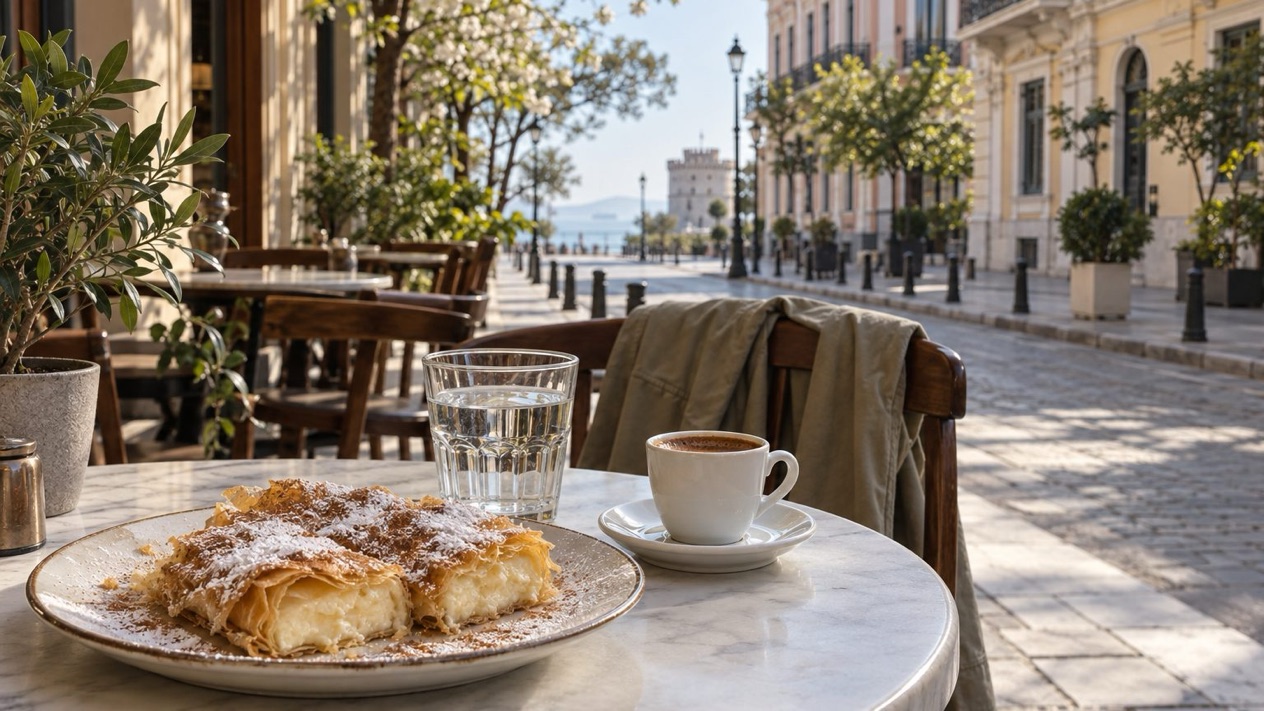
Thessaloniki is known as the gastronomic capital of Greece, and its street food is a big reason why. Start the day with bougatsa, a pie of flaky filo served warm, cut into squares and dusted with sugar and cinnamon. The sweet version is filled with custard and the savory one with meat, and locals eat both at breakfast. Specialty bakeries all over town serve it, and some still make the dough by hand. Try more than one. Serraikon near Modiano is known for crunchy filo, Bougatsa Bantis near the train station is a very local counter, and Bougatsa Giannis behind the White Tower is the place for the savory version.
For lunch, go for souvlaki. Derlicatesen all Souvlaki in the center is tiny and packed, with a queue, counter ordering and standing tables outside. Charcoal chicken is the specialty, with a side of kastanati, creamy baked potato with feta and red pepper.
Modiano Market has tavernas with blue-and-white tablecloths serving seafood and meze, a lively spot for an evening meal. Ladadika is the other good dinner area, especially Egiptou Street for meze. Afterward, a nightcap at Pantheon Bar off Aristotelous Square is easy. For coffee, try Chamam Cafe inside a historic Ottoman bath, and for a sunset drink, Kitchen Bar by the water, though it can be crowded and slow.
What are the best beaches in Thessaloniki?
The city itself has no beaches, but the sea is a short drive away. The one locals favor is Epanomi, about 15.5 miles (25 kilometers) south, which has a Blue Flag. The Epanomi shipwreck lies off this stretch of coast. You can drive carefully and walk the last bit, or book a boat tour and snorkel around it.
For a real beach day, head to the Halkidiki peninsula, reachable by rental car or bus. Locals point to Sithonia, the second of its three fingers, for the most beautiful beaches. Spathies Beach is the pick for a quiet swim, with sand rather than pebbles, a rocky coastline and plenty of shade under pine trees. Don't let the wide road or the first beach club put you off, since it gets calmer as you keep driving. Around Sarti there are more spots, such as Kavourotripes, though note that Platanitsi is a nude beach. Expect 1.5 to 2 hours of driving each way, so this is a full day and not a quick dip. Further east, Kavala is less than two hours away by car, with a ferry on to Thassos, known for its snow-white marble beach.
How many days do you need in Thessaloniki?
Three days is enough to see the biggest attractions and take in the vibe, with room for a museum morning or a day trip. Two days works if you pick carefully. One day gives you a taste, and it may leave you wanting to come back.
Day 1
Start with bougatsa, then walk the waterfront from the port, ducking into Ladadika on the way to Aristotelous Square. Spend the late morning in Kapani and the other markets, then visit Hagia Sofia. Have souvlaki for lunch. In the afternoon, tour the White Tower and continue to the Alexander statue and the Umbrellas for sunset. Finish with dinner at Modiano Market.
Day 2
Start at the castle in the morning and work your way down through Ano Poli to St. Demetrius and the Roman Forum. After a late lunch, head toward the water and walk up Dimitriou Gounari to the Rotunda. Ride a bus back up to the old city walls for sunset.
Day 3
Choose. Spend the day at the two big museums, or take a day trip. Meteora is about three hours each way by car, so it makes a long but rewarding day, and full-day tours run there from the city. Come back for a late dinner in Ladadika.
When is the best time to visit Thessaloniki?
Many visitors find the height of summer too hot and crowded for sightseeing, and even by late June the middle of the day is best spent indoors. If you do come in summer, explore early in the morning and in the evening, when the city comes alive. Late September and May are the comfortable choices. Autumn can be lovely too, since with luck you can still swim into October, but the city gets busy then, so book your hotel early. To avoid higher prices and bigger crowds, check school holiday dates in other European countries.
Winter brings lower hotel bills, and the museums stay open while neighborhood restaurants keep serving their regulars.
Where should you stay in Thessaloniki?
Each neighborhood gives you a different trip. First-timers often like staying near the center, where the main sights, markets and waterfront are an easy walk, and returning visitors can try a new area each time.
City Center, around Aristotelous Square
This is the easy choice. Aristotelous Square is the meeting point for the whole city, ringed with cream and white neoclassical facades, palm trees and café umbrellas, and the markets, churches, ruins and waterfront are all close. Electra Palace sits right on the square, and its rooftop has a pool and sea views. MonAsty, an Autograph Collection hotel, is a block away and has an outdoor pool. The Modernist, near the square and the Modiano Market, is a 4-star hotel with friendly staff, a good breakfast and rates that are budget-friendly for its class.
Ladadika
Ladadika is a small, cobbled, tree-lined quarter just west of the square, toward the port. Full of tavernas, coffee shops and bars, it is the liveliest part of the city at night. Choose it if you want to step out the door into dinner and a drink. For luxury, ON Residence pairs a 1926 mansion with a modern building.
Around the Rotunda and Navarino Square
Close to the center but very different in feel, this area is mostly residential, with few tourists and a student crowd from the university just east of the Rotunda. The Palace of Galerius and the Galerian monuments are on your doorstep, making it a quieter, more local base.
Ano Poli, the Upper Town
Ano Poli is the old town on the hill, behind the ancient walls, a maze of curving streets, trees and tavernas that escaped the great fire of 1917. It feels like a different city. The catch is that it is steep, with cobbles that get slippery and many staircases. Stay here if you want atmosphere and don't mind the climb, and pack sturdy shoes.
Agia Triada and the waterfront
Further along the sea, beyond the Umbrellas and the Archaeological Museum, this is a polished area of parks and grand mansions, and a lovely stretch for long seaside walks. Makedonia Palace faces the water and serves a well-liked breakfast.
Kalamaria and the outskirts
Kalamaria is a quiet local neighborhood near the sea, with its own beach, about a 20-minute bus or car ride from the center. It is too far to walk to the historic center comfortably. If you are driving in, another option is a hotel at the city's entrance, such as the Grand Hotel Palace, with free parking, using taxis to get in and out of the center and avoid city traffic.
How do you get to Thessaloniki and around?
Thessaloniki International Airport "Macedonia" (SKG) is about 9 miles (15 kilometers) south of the center, 20 to 30 minutes by car depending on traffic. It connects to many European airports, including Athens and Istanbul, both easy connections from the U.S. Taxis wait outside arrivals around the clock, and there are buses, private transfers and rental car desks, including Avis, Hertz and Sixt. The city bus to Aristotelous Square takes about an hour. The metro opened on November 30, 2024, but as of 2026 it does not serve the airport.
From Athens, flying takes about an hour. The direct train takes roughly 4 to 5 hours and usually runs on schedule, but delays can be long, so leave a cushion before any flight connection. Driving the toll highway from Athens takes about 5.5 hours, and the road is well maintained with modern, clean rest stops along the way. The KTEL intercity buses are comfortable and make well-timed rest stops, though the ride is long. The ferry from Piraeus takes about 27 hours.
Once you're in town, walk. The center is dense, the waterfront is flat, and crossing from Ladadika to the White Tower takes 20 to 30 minutes. For Ano Poli, take bus 22, a minivan that squeezes through the narrow streets, or a taxi. Buses are cheap but not very frequent, and the metro crosses the city from west to east, linking the center with the main train station. Buy bus tickets at newspaper kiosks and validate them on board, since riding without a valid ticket can bring a fine of up to 60 times the basic fare. For longer rides, use a metered taxi or the FreeNow or Uber apps. If you have a car, arriving before 8 a.m. helps you find free parking on side streets, and paid parking can be settled at shops with a blue THESi sticker or through the ParkPal app.
What should Americans know before going?
U.S. citizens can enter Greece without a visa for up to 90 days of tourism, with a passport that has at least three months of validity beyond your planned departure date. Greece is a generally safe destination, though pickpocketing and purse-snatching happen at tourist sites and on public transportation, especially the metro. Thieves in Greece are known to break into rental cars, so it is wise to keep passports, valuables and luggage out of a parked car. Strikes and demonstrations are common and can halt buses, taxis, ports and airports, so check the news before any tight connection.
The currency is the euro. A bank ATM is usually the easiest way to get cash, and it is smart to check the fees before you confirm. Carry your passport or a photo ID at all times, and if you plan to drive, bring both your U.S. license and an international driver's permit, which Greek law requires even if the rental company doesn't ask for it.
Sources
- quiltripping.com (https://quiltripping.com/3-days-in-thessaloniki-greece/), checked October 18, 2026
- wander-lush.org (https://wander-lush.org/one-day-in-thessaloniki-itinerary/), checked October 18, 2026
- midnightblueelephant.com (https://www.midnightblueelephant.com/weekend-in-thessaloniki/), checked October 18, 2026
- kathi-daniela.com (https://kathi-daniela.com/en/destinations/greece/thessaloniki-travel-guide/), checked October 18, 2026
- inlovewithgreece.com (https://inlovewithgreece.com/where-to-stay-in-thessaloniki), checked October 18, 2026
- U.S. Department of State (https://travel.state.gov/content/travel/en/international-travel/International-Travel-Country-Information-Pages/Greece.html), checked October 15, 2026
- thessalonikitourism.gr (https://www.thessalonikitourism.gr/), checked October 15, 2026
- Hellenic Ministry of Culture, Odysseus (http://odysseus.culture.gr/h/1/eh155.jsp?obj_id=859), checked October 15, 2026
- Visit Greece (GNTO) (https://www.visitgreece.gr/en/experiences/culture/museums/archaeological-museum-of-thessaloniki), checked October 15, 2026
- Hellenic Ministry of Culture, Odysseus (http://odysseus.culture.gr/h/1/eh155.jsp?obj_id=3272), checked October 15, 2026
- ktelthes.gr (https://ktelthes.gr/en/), checked October 15, 2026
- U.S. Department of State (https://travel.state.gov/content/tsg_aem/us/en/home/international-travel/travel-advisories/destination.grc.html), checked October 15, 2026