
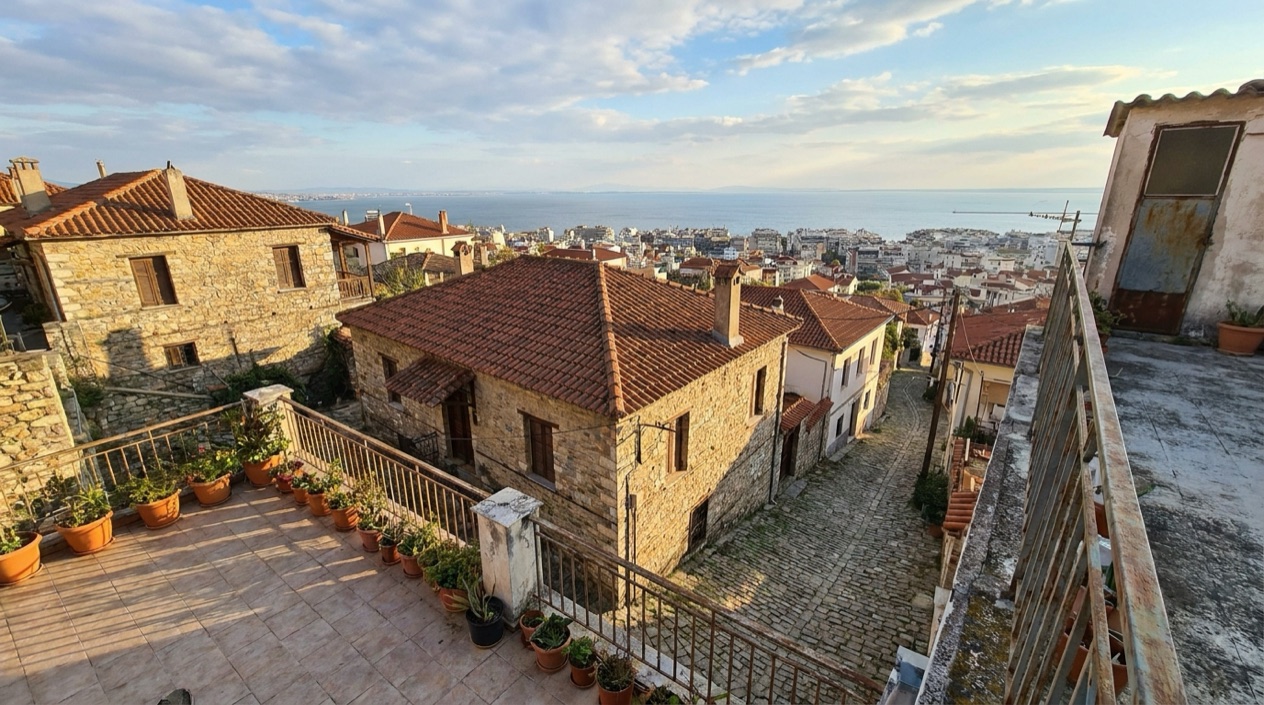
The streets climb, narrow and turn to stone, and the noise of the waterfront avenues fades behind you. Wooden-balconied houses lean over the lanes, church domes show between rooftops, and the old walls run along the ridge above. Ano Poli is the Upper Town of Thessaloniki, and visiting it means wandering a hillside district of Byzantine and Ottoman survivors, with the gulf spread out below.
Is visiting Ano Poli worth it?
Yes, for anyone who wants to see what Thessaloniki looked like before the modern city was built over it, and especially for travelers who like to wander streets more than to tick off a single monument. Ano Poli rewards slow walking, small churches, old squares and a view that keeps changing as the lanes bend.
What sets it apart from the rest of the city is survival. The Great Fire of 1917 destroyed much of the Byzantine and Ottoman street pattern elsewhere in Thessaloniki, but Ano Poli kept a great deal of it. Down on the flat ground you find broad avenues, shops and the waterfront.
Up here you find stone-paved lanes, old squares and houses in traditional Greek and Ottoman style. It is one of the most traditional areas of the city, and it has long been a gathering place for poets, intellectuals and bohemians, which you still feel in the small cafés and the quiet corners.
The district also tells a story about who lived where. In the Ottoman period this was the main quarter of the city’s Turkish residents, while Greeks, western Europeans and Jews lived lower down around the port.
Walking up from the center is, in a sense, walking from one chapter of the city into another. Add a city that counts 15 monuments on the UNESCO World Heritage List, and the Upper Town fits naturally into a day of sightseeing without competing with the rest.
What to see at Ano Poli
The Eptapyrgio and the old walls
The highest point of Thessaloniki is crowned by its acropolis, a fort of the Byzantine and Ottoman eras known as the Eptapyrgio. It dominates the whole district, and its position explains why the Upper Town grew up beneath it. From the fort and the lanes around it you look out over rooftops and domes to the sea of the Thermaic Gulf.
Remains of the old city walls still surround Ano Poli, and stretches of them appear at the end of a lane or beside a house. On clear days, Mount Olympus, about 50 miles away across the gulf, stands on the horizon. Treat that view as a chance, not a promise: haze can hide it.
Byzantine churches
The Upper Town holds a cluster of Byzantine churches, among them the Church of Prophet Elijah, the Church of St. Nicholas Orphanos, the Taxiarches church and the Church of Saint Catherine. They are modest in size and set among houses and small squares, so you come upon them rather than approach them along a grand avenue.
Look at the way the brickwork and stonework sit against the neighboring houses, and at how each church has been woven into the street around it. The Vlatades Monastery belongs to the same religious landscape, a reminder that this hill was a place of worship long before it became a place of cafés.
Ottoman traces: the bath, the mosque and the Atatürk Museum
Ottoman Thessaloniki is just as present as the Byzantine city. The Byzantine bath, the Alaca Imaret Mosque and the Atatürk Museum all stand in Ano Poli, and together they show how the quarter lived under Ottoman rule, when it was the main district of the city’s Turkish residents.
The mosque and the bath show public life: prayer, charity and washing. Seen in a single walk, the Byzantine and Ottoman buildings sit side by side, which is the real character of the district.
Streets, squares and the villas
Much of the pleasure here is the fabric itself: small stone-paved streets, old squares and houses in traditional Greek and Ottoman architecture. Among the buildings that stand out are Karipio Melathro and Villa Varvara, landmarks of the district that add a more formal note to the lanes of ordinary houses.
Let the lanes lead you. A turn often opens onto a tiny square, a church door or a view over the roofs. Cafés and tavernas sit in the squares, where a coffee, a plate of meze (small shared dishes) or a glass of ouzo or tsipouro suits the pace of the neighborhood.
Hours, tickets and rules
Ano Poli is a whole district rather than a single ticketed site, and that shapes the visit. The streets, squares and stretches of wall around the fort are the experience, and the named buildings, from the churches to the Byzantine bath and the Atatürk Museum, are the stops along the way.
The structures worth seeking out are the Eptapyrgio at the top, the Church of Prophet Elijah, the Church of St. Nicholas Orphanos, the Taxiarches church, the Church of Saint Catherine, the Vlatades Monastery, the Byzantine bath, the Alaca Imaret Mosque and the Atatürk Museum. Karipio Melathro and Villa Varvara round out the list of landmarks.
Each of these has its own character, from a fort that commands the hill to a house museum tucked among neighbors, and a visit can mix them in whatever order the lanes suggest. Since the streets themselves form the district’s main attraction, the walk is the core of the visit and the buildings are the highlights.
Visiting a house museum, a mosque or a monastery is a different experience from strolling the lanes, so it helps to think of the day as a walk with a few chosen interiors rather than a single entrance gate.
How to get to Ano Poli
Ano Poli lies north of the city center of Thessaloniki, around the city’s acropolis, so the base for the visit is the center itself, with its waterfront and the White Tower that marks it.
The position says everything about the approach. The center sits by the sea of the Thermaic Gulf, and the Upper Town is the highest part of the city, so any way you go means climbing from the flat ground up to the old walls. The streets get narrower and older as the ground rises, and the stone paving tells you when you have arrived.
Thessaloniki is the second largest city in Greece and a major hub of the country’s north, and the Upper Town is part of the city rather than a separate excursion. That means no day trip logistics, only the climb from wherever you are staying below.
Moving between them means following the streets as they twist, which is part of why the visit feels like a stroll rather than a transfer.
When to visit Ano Poli
Ano Poli is a district you can visit in any month, and the weather simply changes what you carry. Thessaloniki’s own figures show a hot July, a cool January and two milder months in April and October.
| Month | Average high (°F) | Average low (°F) | Precipitation (inches) | Days with rain (1 mm or more) |
|---|---|---|---|---|
| January | 49.3 | 35.6 | 1.99 | 7.4 |
| April | 66.7 | 47.8 | 2.25 | 9.4 |
| July | 90.1 | 69.4 | 1.63 | 6.1 |
| October | 70.7 | 54.7 | 2.32 | 6.8 |
July brings the hottest afternoons, and on a hill of stone-paved lanes with little relief from the sun, sun protection and water are the sensible companions. January is the opposite, with cold days that call for warm layers.
April has the most days with rain of the four months shown, so a rain jacket belongs in the bag. October is mild, with temperatures comfortable for climbing the lanes, and it also has a fair share of rainy days.
For views, clear days matter more than any month. Mount Olympus appears on the horizon only when the air is clear, so a bright day gives the fullest panorama across the gulf. The stone lanes, the churches and the walls are there whatever the weather, and the district keeps its character in every season.
Tips for your visit
Wear shoes that grip. The small streets are stone-paved and the district is the highest part of the city, so you will be climbing and descending on uneven ground. Carry water in the warm months and a rain jacket when the forecast calls for it.
Plan the visit as a walk with stops. Start from the center and head up toward the fort, then drift back down by a different lane, passing churches and squares. A café table in one of the old squares is a good place to pause, with coffee or a plate of meze, and the bohemian and literary reputation of the quarter makes sitting there part of the experience.
Combine the Upper Town with the rest of Thessaloniki. The White Tower on the waterfront and the city’s UNESCO-listed monuments sit down in the center, so one day can move from the old walls above to the sea below. Thessaloniki is also known as the gastronomic and cultural capital of the country, and the food of the city is worth a meal on either side of the climb.
For families and travelers with limited mobility, the hill and the paving are the main things to weigh. The lanes rise steadily and the surface is uneven, so think about how much climbing suits your group before you set out. Lower streets give a taste of the character without the full ascent.
Good to know before you go
Bring a little cash for a coffee or a snack in one of the squares, and keep the usual city habits in mind as you walk. Thessaloniki is a large university city, one of the biggest student centers in South-Eastern Europe, so the Upper Town shares its streets with locals and students as well as visitors. Take the district at its own pace, and let a good pair of shoes do the rest.
Sources
- Wikipedia, Upper Town (Thessaloniki) (https://en.wikipedia.org/wiki/Upper_Town_(Thessaloniki)), checked October 12, 2026
- Thessaloniki Airport (https://www.thessalonikiairport.gr/en), checked October 12, 2026
- Thessaloniki Tourism Organization (https://www.thessalonikitourism.gr/), checked October 12, 2026
- Visit Greece (GNTO), Thessaloniki (https://www.visitgreece.gr/mainland/macedonia/thessaloniki/), checked October 12, 2026
- Hellenic National Meteorological Service (HNMS), climatological normals 1991-2020 for Thessaloniki station (https://www.emy.gr/climatic-data), monthly mean daily maximum and minimum; rain from the ECMWF ERA5 reanalysis, 1991-2020, grid cell of Thessaloniki (Open-Meteo), checked October 12, 2026
- ECMWF ERA5 reanalysis 1991-2020, grid cell of Thessaloniki (Open-Meteo), checked October 12, 2026
To plan your stay
- Best Time to Visit Greece: September and Late May to Early June
- Arachova: Parnassus Mountain Town, Formaela Cheese, Ski Season and Saint George's Day
- American Airlines Flights to Greece: U.S. Cities, Athens Arrivals and Onward Island Flights
- Greece on a Budget: Cash Machines, Cards, Beaches and Ferries