
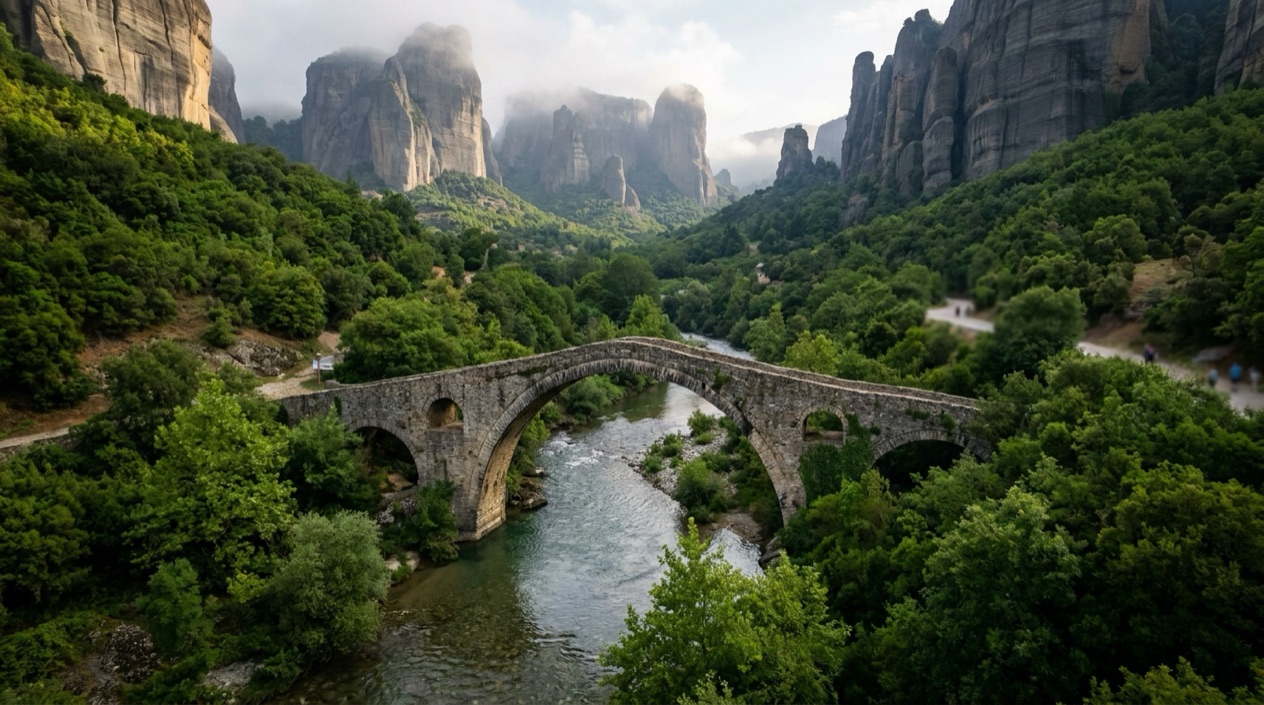
Meteora is a forest of sandstone pillars in central Greece, with monasteries perched on top as if a very patient giant had set them there. The name means "suspended in the air," and your first glimpse of the rocks from the road turns that from poetry into plain description. Monks began building up here in the 14th century, and since 1988 the whole landscape has been a UNESCO World Heritage Site.
Six monasteries are still active and open to visitors, and each is worth seeing. The rocks themselves, the light moving across them and the long views over the valley are just as memorable. Meteora rewards anyone who loves big scenery, quiet corners, early starts and a little climbing, and it is a gift for photographers.
What are the best things to do in Meteora?
Start with the monasteries, but be choosy. Two or three in a day is the sweet spot. Trying to see all six usually feels rushed, and once you've seen two, the rest can start to blur. Leave time between visits for the viewpoints, which many visitors remember longer than the interiors.
Tickets cost €5 per monastery (2026) and are paid at each entrance, so cash is the safest thing to have on hand. Wear shoes with good grip, because reaching the monasteries involves staircases and uphill walking, St. Stephen being the main exception. The dress code is the same everywhere: covered shoulders, long trousers for men, and a skirt or dress below the knee for women. Consider bringing your own wrap so you're ready at any monastery. Photography outdoors is generally fine. Inside the churches, follow the signs, since flash may be restricted.
Great Meteoron
Great Meteoron is the oldest and largest of the monasteries, and inside you'll find a lovely chapel, a museum, an old kitchen and far-reaching views. Since it's one of the monasteries many visitors put at the top of their list, it tends to be busy. Parking in front is very limited and not free, so most people leave the car at the free lot at Varlaam, walk 10 minutes, then climb more than 300 steps to the entrance. Allow about an hour inside. Arriving at opening time won't beat the crowds here. Many coach tours break for lunch at a restaurant, so the monasteries may feel a little calmer around then.
Varlaam
If you only have time for one monastery, Varlaam balances architecture, history, views and access better than most. It sits right next to Great Meteoron, so the two pair easily. Expect 142 steps to the entrance. Inside you'll see a huge old wooden water barrel, the winch once used to haul people and goods up the rock, and a museum with a short 1924 film showing how the monks lived. The terrace is a pleasant place to take in the views, and the toilets here are a welcome comfort. Varlaam is the one place where cover-ups may need to be bought rather than borrowed, so it's easiest to come dressed for the dress code.
Holy Trinity (Agia Triada)
The dramatic one, perched on its pillar and reached by a steep climb of about 145 steps. It appeared in the James Bond film "For Your Eyes Only." The church has many beautiful restored frescoes, and there's a garden and boulders you can usually clamber up for the views. Coach tours tend to skip it because of the steps, so you can visit at almost any hour.
St. Stephen (Agios Stefanos)
St. Stephen is the easiest of the monasteries to reach, since you cross a small bridge instead of climbing a long staircase. The State of Meteora's official tourism information notes that it is more accessible than the other monasteries, which makes it a good fit for families and anyone with limited mobility. That ease also makes it popular, and tour groups can queue for the chapel by mid morning. Late morning, when the buses start to leave, is a better bet. The chapel interior is beautiful, though the terrace views are not as dramatic as at some of the other monasteries. The monastery was bombed in World War II and rebuilt afterward.
Roussanou
A compact monastery on a narrow, very photogenic pillar. The small chapel holds seventeenth century frescoes of beheadings, spearings and other gruesome scenes, and the little terrace looks across to the other monasteries. Park on the road above and walk down for 10 minutes, or park below and walk up. If one spot is full, try the other. Plan on 15 to 20 minutes inside, plus about 20 minutes of walking to and from. Some tour groups include Roussanou, so early afternoon tends to be the quieter time to visit.
St. Nicholas Anapausas
The smallest active monastery is known for its frescoes by Theophanes the Cretan, and from Kastraki it is about 45 minutes away on foot via a trail. A steep 10 to 15 minute climb from a small layby across the road keeps many people away, which is exactly the appeal. Inside, you can sit in the tiny, atmospheric chapel and take in the frescoes, then climb to the roof for excellent views. If you love small and still, this may become your favorite.
Viewpoints and sunsets
Sunset is the big moment, and it draws crowds. For the classic sunset panorama, look for the viewpoint with parking right beside it, not the observation deck Google suggests. There are two panoramic spots, and only this one gives an unblocked view of the sunset. Arrive about an hour before sunset to claim a good place and watch the light change. Two hours before sunset, the light falls softly and the crowds are usually thinner. That's the moment to frame a monastery with Kalambaka glowing behind it. There's no shop or anywhere to buy water at these spots, so bring your own, along with a snack.
Sunrise belongs to early risers. A quiet ridge about a 20 minute walk from a parking area has a magical view of the sun hitting the valley, and you'll likely have it nearly to yourself. The monasteries aren't the star from there, but the dark rocks set against the bright valley are a worthy trade.
Guided tours and hikes
You don't need a tour. With a car, you can go at your own pace and pull over wherever a view catches you. Still, a local guide adds a lot, from history to hidden viewpoints. Visit Meteora runs several well-reviewed options with hotel pickup in both Kalambaka and Kastraki. The sunset tour travels by small bus and stops at an active monastery, a hidden Byzantine church and hermit caves before ending at a sunset viewpoint. The hiking tour follows the old paths up, with an hour inside Great Meteoron along the way. Tours also make it easy for solo travelers, who report feeling very safe here, to meet other people.
If you'd rather walk on your own, the old monk paths start in Kastraki. St. Nicholas is about 45 minutes on foot, and Great Meteoron and Varlaam take roughly 2 hours. Covering all six on foot is another matter, and most visitors need transport between them.
When is the best time to visit Meteora?
The monasteries are open year-round. Spring and autumn are ideal, especially if you want to hike. Mid May is usually pleasantly uncrowded. Summer brings the most tourists and real heat, so carry water and save the climbing for the cooler parts of the day. In any season, fog and rain can hide the rocks, and the pillars are much of the magic.
How many days do you need in Meteora?
Two nights is enough. Three gives you a cushion in case fog or rain rolls in, plus a slower pace. Weekends are when all six are typically open. On a weekday, rearrange the plan below so you visit any monastery that will be closed the following morning.
Day 1
Arrive, settle in, then drive or taxi up toward the monasteries a couple of hours before sunset. The road is quieter at that hour, and you can loop past all six and stop for photos from the roadside. Catch the town view in the soft light, move to the sunset panorama an hour before the sun goes down, and stay a while afterward. Dinner in Kastraki or Kalambaka follows naturally.
Day 2
Be at Varlaam's gate as it opens, so you're among the first inside. Next, drive to Holy Trinity, which is a bit less visited by coach tour groups. Return to the Varlaam car park for a picnic, then walk 10 minutes to Great Meteoron and arrive around midday, when many tour groups are at lunch. That makes three monasteries, a full and satisfying day. Spend the afternoon resting or hiking, and save the evening for an unhurried dinner.
Day 3
With two nights, this is your departure morning. With three, it's your slow day. Start with sunrise on the quiet ridge or a guided hike on the monk paths. Visit St. Stephen in late morning as the tour buses pull out, Roussanou in the early afternoon, and finish at St. Nicholas on the way down toward Kastraki. If you'd like, bring a few coins to leave for a candle. If you spot handicrafts made by the monks or nuns in a monastery shop, consider buying them then, since not every monastery carries the same things and they are often better than what the vendors sell outside the bigger sites.
Where should you stay in Meteora?
The two main bases, Kalambaka and Kastraki, sit about a 15 minute walk apart. The monasteries are roughly 3 to 6 miles (5 to 10 km) above Kalambaka, depending on which one you're heading to.
Kalambaka
The bigger town sits right below the rocks and has the most hotels, apartments, restaurants and services. The train and bus stations are both here, which makes it the easy choice without a car. Kalambaka has the nearest ATMs, about 5 minutes by car from the rocks, so it's handy to pick up cash before heading uphill. Great Meteoron is about a 15 minute drive away.
Kastraki
Smaller, prettier and a bit closer to the monasteries, Kastraki has fewer places to sleep, so book early. Many visitors who have stayed in both prefer it. The sights are a 5 to 10 minute taxi ride away, and the monk paths start right here. Doupiani House, the hotel closest to the monasteries, has plenty of parking and a garden terrace that looks straight at the pillars. Some rooms are much more basic than the common areas, though, and the beds are firm.
Outside the towns
If you have a car and want calm, a hotel set a little apart, such as The Grand Meteora Hotel, means cliff views every morning. You can still get to town easily for dinner and tours.
What should you eat in Meteora?
Meteora is known for Vlach cooking, hearty traditional dishes that leave you pleasantly full. Look for meze plates of leek sausage, kokoretsi and kebab, plus savory pies stuffed with wild greens, cornmeal and feta. For dessert, try spatula, a pie of walnuts, cream and almonds, and Thessaly's Farsala halva.
Taverna Gardenia in Kastraki earns warm praise for its kind hosts and for meals like saganaki (fried cheese), chicken souvlaki with a slice of lemon on the side, and a closing treat of portokalopita, a dense orange cake, with a glass of ouzo. At Yamas Taverna, the local house wine goes well with pork tenderloin.
Lunch takes planning, because there are no restaurants at the monasteries. Going back down to Kastraki or Kalambaka usually eats into your day, so it mostly makes sense if you want a long break and plan to head back up later in the afternoon. A vendor in front of one of the monasteries can save the day, and one spot up among the rocks, called the Eagle's Nest, has a lovely view. Otherwise, pack bread, cheese, olives, cucumbers and tomatoes and picnic with the pillars as your backdrop.
What are the best beaches in Meteora?
There aren't any. Meteora is inland, in the valley of the Pineios River east of the Pindus Mountains, so save your swimming for the coast and the islands.
How do you get to Meteora and around?
Meteora is in central Greece, roughly 4 hours from Athens by car or train and 3 hours from Thessaloniki. Head for Kalambaka, your gateway town.
From Athens Airport, the drive is about 234 miles (375 km) and takes a little over 4 hours. The train takes about 4 hours. For now, the stretch between Paleofarsalos and Kalambaka runs on a temporary air-conditioned bus, so check before booking. By bus, plan on about 6 hours, leaving from Athens' Liossion terminal near Kato Patissia metro station and changing in Trikala. Private transfers are available too, including a full-day route that stops in Delphi. On your own, Delphi to Meteora is a 3 hour drive.
From Thessaloniki Airport, Kalambaka is about 149 miles (240 km), or around 3 hours. You can go by intercity bus, train, organized excursion or private transfer, and private drivers can meet you at the airport, your hotel or the station.
Once you're there, a car is the easiest way around, though a taxi works too. Most if not all of the monasteries have a small parking area nearby, and parking is often free but can fill up during the day and at sunset. To beat the crowds, catch the first bus or drive. Walking up from Kalambaka takes at least an hour uphill, which gets tough in summer heat. The loop through the main monastery area covers roughly 15 miles (24.6 km) in about 48 minutes without stops.
What should Americans know before going?
U.S. citizens may enter Greece without a visa for up to 90 days of tourism. Your passport should have at least three months of validity beyond your planned departure date, and you should be ready to show proof of sufficient funds and a return or onward ticket if asked. Carry your passport or another photo ID at all times.
Greece is generally safe, but petty crime is common at popular tourist sites. Strikes and demonstrations can disrupt trains, buses and taxis with little notice. Forest fires are common in the dry summer months and occasionally close roads. If you drive, Greek law requires a valid U.S. license, and insurance companies may require an international driver’s permit. Thieves target rental cars for passports, valuables and luggage, so take your bags with you rather than leaving them in the car at a viewpoint.
Sources
- visitmeteora.travel (https://visitmeteora.travel/meteora-monasteries/), checked October 18, 2026
- travellingtrekker.com (https://www.travellingtrekker.com/post/the-monastries-of-meteora-travel-guide), checked October 18, 2026
- peterorsel.com (https://peterorsel.com/meteora-guide/), checked October 18, 2026
- travelingterry.com (https://travelingterry.com/meteoragreecetravelguide/), checked October 18, 2026
- community.ricksteves.com (https://community.ricksteves.com/travel-forum/greece/strategies-for-visiting-meteora), checked October 18, 2026
- U.S. Department of State (https://travel.state.gov/content/travel/en/international-travel/International-Travel-Country-Information-Pages/Greece.html), checked October 15, 2026
- Visit Greece (GNTO) (https://www.visitgreece.gr/en/routes/meteora-pilgrimage-between-heaven-and-earth), checked October 15, 2026
- U.S. Department of State (https://travel.state.gov/content/tsg_aem/us/en/home/international-travel/travel-advisories/destination.grc.html), checked October 15, 2026