
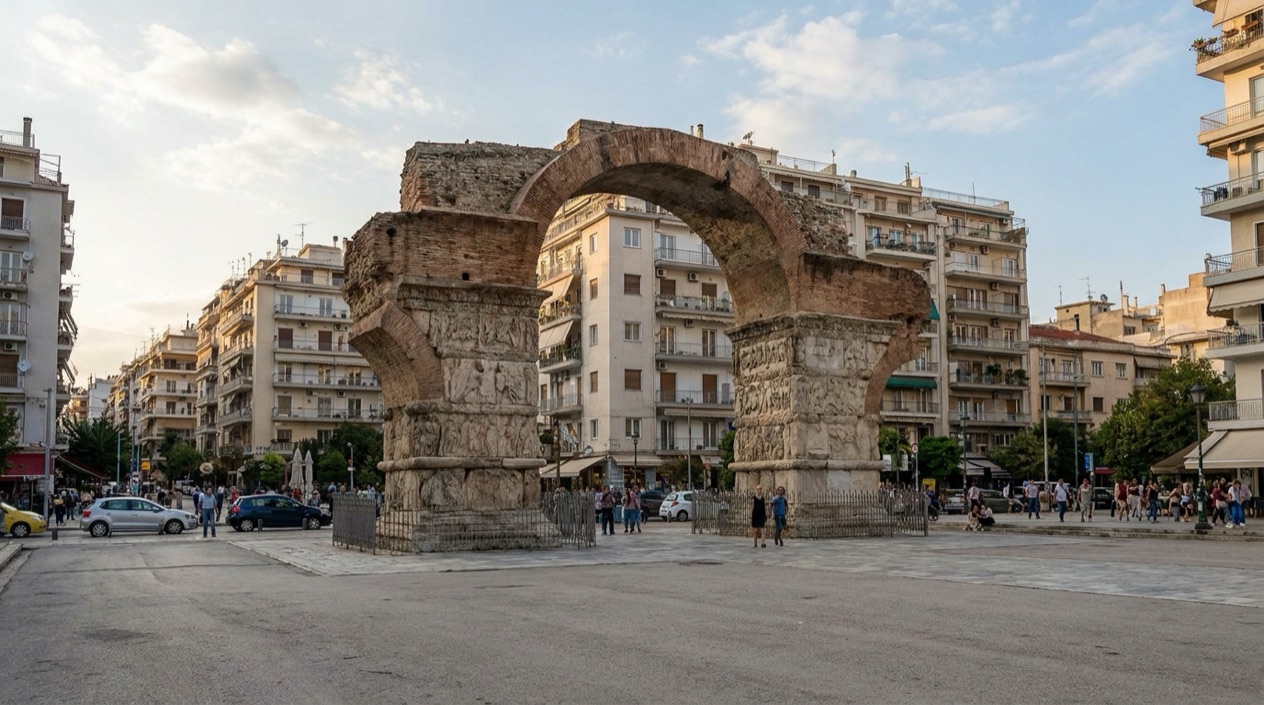
The Arch of Galerius rises at a busy crossing in Thessaloniki, where city traffic runs on both sides of its two great brick pillars and students cut between them on their way to class. Marble slabs on the pillars still carry carved scenes of soldiers and horses, worn but readable. It is a visit that fits into a stroll through the city, with another monument close by.
Is visiting the Arch of Galerius worth it?
Yes, for anyone who likes to meet history in the middle of a living city, and for travelers curious about the Roman world in northern Greece. The arch is not a site you enter through a gate. It stands in the open, at the crossing of Egnatia and Dimitriou Gounari streets, and you walk around it, look up at its pillars and read the stories carved into the marble.
What sets it apart from other ancient monuments is how closely it sits with the rest of the story. Both were inscribed on UNESCO’s World Heritage List in 1988 among the Paleochristian and Byzantine monuments of Thessaloniki, a city with fifteen monuments on that list.
Thessaloniki itself adds to the appeal. It is the country’s gastronomic and cultural capital, a big student city that overlooks the Thermaic Gulf, and the arch gives you a reason to wander through neighborhoods where cafés and bakeries sit beside Roman stone. If you come only for ancient ruins in a quiet field, this is a different experience: urban, close to the traffic, and woven into the daily life of the streets.
What to see at the Arch of Galerius
The arch and its marble reliefs
The arch was built between 298 and 299 AD and dedicated in 303 AD, a victory monument for the tetrarch Galerius. Two pillars flank the central arched passage, and on them you can still see sculpted marble slabs that show his wars against the Sassanids. Stand close and look for the panels stacked in bands, with figures, animals and scenes of battle and ceremony arranged one above another.
What survives is only part of a larger structure, so the pillars look like a gateway with the rest missing. That partial state is part of its charm: the brick core shows through where the stone has gone, and the carving that remains has a weathered softness. Walk around all sides, because each face carries different scenes, and the light changes how deep the relief appears.
The Rotunda of Galerius
The Rotunda stands 410 feet northeast of the arch and was built around 306 AD on the orders of Galerius, who meant it as his mausoleum. Its life afterward is the real story. It became a Christian basilica, then a mosque, then a Christian church and an archaeological site again, and a minaret from the mosque period is still preserved beside it.
Inside, the surviving mosaics are the highlight. A garland of fruit and evergreen plants circles the cupola, where the image of Christ is now lost. It is made of twenty-five sections with white lilies, laurels, pears, grapes and pomegranates, and the fruit has a startling freshness for something so old. The Rotunda is a monument under the Ephorate of Byzantine Antiquities of the Greek Ministry of Culture, and the Greek Orthodox Church has access on some days of the year for festivities, when it serves as the Church of Saint George.
The crossing of Egnatia and Dimitriou Gounari
, which says a lot about how Thessaloniki lives with its layers of history.
From here you can look toward the Rotunda and understand how the two monuments relate. The pairing brings together a triumphal arch and the Rotunda that Galerius intended as his mausoleum.
How to get to the Arch of Galerius
The arch is in the city of Thessaloniki, in the region of Central Macedonia in northern Greece, so you reach it by getting to the city first. Once there, the address is simple to hold in mind: it stands at the intersection of Egnatia and Dimitriou Gounari streets, and street names are the surest way to find it on a map.
The Rotunda of Galerius lies 410 feet northeast of the arch, so the two monuments can be seen in the same outing and you can move between them on foot using the streets around the crossing. Thessaloniki is built on fertile land beside the Thermaic Gulf, and its waterfront is marked by the White Tower, a useful landmark for orienting yourself when you set out toward the arch from the sea side of the city.
: set your map to Egnatia and Dimitriou Gounari, and you will find the arch standing in the open at the crossing, easy to recognize by its two tall brick pillars and the marble panels on them.
When to visit the Arch of Galerius
Because the arch stands in the open on a city street, the weather decides the pleasure of the visit more than any schedule. The seasons in Thessaloniki are clearly marked, and each changes how long you will want to stand outside looking at the reliefs.
| Month | Average high (°F) | Average low (°F) | Precipitation (in) | Days with rain |
|---|---|---|---|---|
| January | 49.3 | 35.6 | 1.99 | 7.4 |
| April | 66.7 | 47.8 | 2.25 | 9.4 |
| July | 90.1 | 69.4 | 1.63 | 6.1 |
| October | 70.7 | 54.7 | 2.32 | 6.8 |
April and October bring highs in the upper 60s and low 70s, which is comfortable for standing outside and walking between the arch and the Rotunda. April has the most rainy days of the four months shown, so a light rain jacket is sensible, and October is also on the wetter side by inches.
July is hot, with highs around 90°F, so sun protection matters when you stop to look at the carving in the open. January is cold, with highs near 49°F and lows above freezing, so warm layers are the plain consequence. If the Rotunda interests you, remember that the Church has access on some days of the year for festivities, so on those days the building serves worshippers as the Church of Saint George.
Tips for your visit
Bring comfortable shoes for pavements and a camera for the reliefs, which reward a close look. In summer add a hat and water, in the cooler months a layer, and in rainy months a jacket.
Pair the arch with the Rotunda, 410 feet to the northeast, and you have two monuments from the same ruler’s reign in one outing. Both belong to the group of Paleochristian and Byzantine monuments of Thessaloniki that UNESCO inscribed in 1988, so they read well as a pair, one built for triumph and the other for burial.
From there you can continue to the White Tower on the waterfront, a landmark of the city that overlooks the Thermaic Gulf. A walk toward the sea ends the day with the city’s other face, and the cafés and food of Thessaloniki, the country’s gastronomic capital, are never far away.
Details on parking, guides and access for those with limited mobility are not given, so go with an open plan and let the city guide the rest of your day.
Good to know before you go
Tourism in Thessaloniki mixes ancient, Byzantine and modern sights, and the Rotunda keeps its religious role on some days of the year, so a visit there can coincide with church festivities.
Sources
- Wikipedia, Arch of Galerius (https://en.wikipedia.org/wiki/Arch_of_Galerius), checked October 12, 2026
- Thessaloniki Airport (https://www.thessalonikiairport.gr/en), checked October 12, 2026
- Thessaloniki Tourism Organization (https://www.thessalonikitourism.gr/), checked October 12, 2026
- Visit Greece (GNTO), Thessaloniki (https://www.visitgreece.gr/mainland/macedonia/thessaloniki/), checked October 12, 2026
- Hellenic National Meteorological Service (HNMS), climatological normals 1991-2020 for Thessaloniki station (https://www.emy.gr/climatic-data), monthly mean daily maximum and minimum; rain from the ECMWF ERA5 reanalysis, 1991-2020, grid cell of Thessaloniki (Open-Meteo), checked October 12, 2026
- ECMWF ERA5 reanalysis 1991-2020, grid cell of Thessaloniki (Open-Meteo), checked October 12, 2026
To plan your stay
- Best Time to Visit Greece: September and Late May to Early June
- Arachova: Parnassus Mountain Town, Formaela Cheese, Ski Season and Saint George's Day
- American Airlines Flights to Greece: U.S. Cities, Athens Arrivals and Onward Island Flights
- Greece on a Budget: Cash Machines, Cards, Beaches and Ferries