
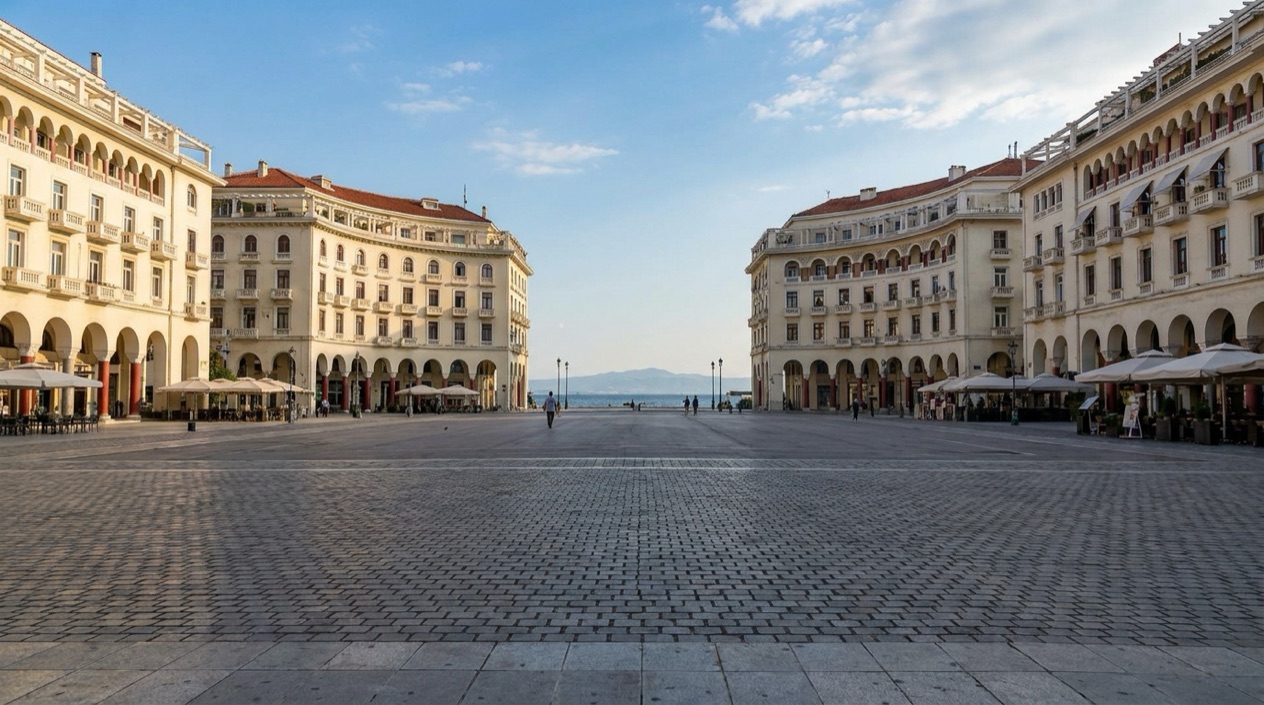
You come up from the sea along Nikis Avenue and the street suddenly opens into a wide, orderly space, framed by matching arcaded buildings with cafe tables spilling out beneath them. Waiters weave between chairs, a film poster hangs over a cinema entrance, and the Thermaic Gulf sits at the open end of the view. Aristotelous Square is the living room of Thessaloniki, a place for sitting, watching the city pass and drinking a coffee that turns into an evening.
Is visiting Aristotelous Square worth it?
Yes, if you like cities best when you can sit in the middle of them, and it suits first-time visitors to Thessaloniki, film lovers, café people and anyone traveling over Christmas or carnival time. You do not come here to tick off a monument. You come to see how the city organizes itself around one grand, planned space and to spend an hour or an evening in it.
What sets the square apart from the other places you will visit in the city is its planned character. Thessaloniki is a city of layered stone, with Roman and Byzantine monuments scattered among apartment blocks, and its seafront has the White Tower as its emblem.
Aristotelous is something different: a single composition, begun after a catastrophic fire destroyed two thirds of the city in 1917, in which the buildings, the axis toward the sea and the cafes all belong to one idea. Here you read the modern city rather than the ancient one.
It also works as a stage. Festivals, the Christmas decorations and the carnival celebrations all use the square, so on certain dates it looks entirely different from an ordinary evening. That mix of daily café life and large public events is the reason travelers pass through it more than once during a stay.
What to see at Aristotelous Square
The square is on Nikis Avenue, right on the city’s waterfront in the center, and its pleasure lies in the whole frame rather than in one object. Stand at the middle, turn slowly, and take in the two curved sides, the cinema on one hand, the hotel on the other, and the cafes underneath. The visit is made of a handful of parts, each worth a few minutes of attention.
The buildings and the Hébrard plan
The history begins with the Great Fire of 1917, which left much of the old city in ashes and gave planners a rare blank page. The French architect Ernest Hébrard drew up the design for the square in 1918, and most of it was actually built in the 1950s. That gap between drawing and construction explains the unified look: the facades follow a shared logic of arcades and rhythm rather than the mismatched styles of a street that grew by accident.
Twelve buildings make up the square, and they have been listed buildings of Greece since 1950. Look up above the ground-floor arcades to see the upper stories, then look down the axis toward the water to understand why the square feels like an opening to the sea.
Electra Palace Hotel
On the left quarter-circle side of the square stands the Electra Palace Hotel, described as one of the best five-star hotels in Thessaloniki. You do not need a room to enjoy it as part of the scene. It anchors one side of the composition and gives the curve of the square its weight, and it is a useful landmark when you are trying to explain to a friend where to meet.
Notice how the hotel’s curved front answers the opposite side. The symmetry is deliberate, and it is easier to appreciate from the middle of the open space than from a table at the edge.
Olympion Theatre and Mitropoleos Street
On the right side stands the Olympion Theatre, a cinema that hosts the annual Thessaloniki International Film Festival. When the festival is on, the square takes on a different energy, with film people crossing it and the cafes full of conversation about what was screened the night before.
Mitropoleos Street cuts the square in half right in front of the Olympion Theatre, and that is also where the taxi stands are. It is the one place where the calm of the square meets the movement of the city, so watch for traffic as you cross from one half to the other.
Cafes, bars and the Christmas ship
The numerous cafes and bars lining the square make it popular with younger generations, and a good part of any visit is simply taking a seat and ordering something. Think of a frappé, a Greek coffee, a glass of tsipouro or a plate of small bites, with the square as your view.
At Christmas the municipality decorates a giant Christmas ship in the square, following Greek tradition, a sign that the city’s festive season has begun. The annual carnival celebrations also take place here, so the square is a good address for both winter events.
Hours, tickets and rules
Aristotelous Square is a city square on Nikis Avenue rather than a single monument, so the things with a schedule are the events and the venues around it. You walk into the square from the surrounding streets and spend your time in its open space, under its arcades and at the tables of its cafes.
The venues around the square keep their own programs. The Olympion Theatre screens films and is the site of the Thessaloniki International Film Festival each year. The Electra Palace Hotel is a working five-star hotel on the left quarter-circle. The cafes and bars set their own pace, and the municipality organizes the festivals and the Christmas and carnival celebrations that take over the square.
Because the square is part of the working center of the city, it is shared by people crossing on errands, students meeting friends, couples on a date and visitors with a camera. Treat it as you would any city square: sit where there is a table, keep to the paths where an event is being set up, and let the cafes’ tables and the traffic on Mitropoleos Street guide you.
How to get to Aristotelous Square
The easiest orientation is the waterfront: the square sits on Nikis Avenue in the city center, with the Thermaic Gulf at one end of its axis. If you know the White Tower, you know the seafront this square opens onto.
By metro
Venizelou station of the Thessaloniki Metro opened in November 2023 and is within walking distance of the square on Egnatia Avenue.
From Egnatia Avenue you continue on foot to the square. The name of the station is also the name of a neighboring square, Venizelou, which is the other landmark used when people describe how buses reach the area.
By bus
The square is served primarily by buses of the Thessaloniki Urban Transport Organization, known as OASTH. Many of its lines pass through the square itself or stop by Venizelou Square, so wherever you are staying, a bus line that reaches one of the two is likely to bring you close.
By taxi
There are taxi stands on Mitropoleos Street, which cuts Aristotelous Square in half, in front of the Olympion Theatre. If you want to leave the square after an evening, that is where to look. Tell the driver the next place you are going, and you will be on your way from the middle of the square.
When to visit Aristotelous Square
The square suits any season because it is a place for sitting, but the weather changes how you use it. In the warm months the cafe tables are the draw. In winter, the main draw is the festive decorations and the cinema. The figures for Thessaloniki’s four representative months show the contrast.
| Month | Average high (°F) | Average low (°F) | Precipitation (inches) | Days with rain (at least 1 mm) |
|---|---|---|---|---|
| January | 49.3 | 35.6 | 1.99 | 7.4 |
| April | 66.7 | 47.8 | 2.25 | 9.4 |
| July | 90.1 | 69.4 | 1.63 | 6.1 |
| October | 70.7 | 54.7 | 2.32 | 6.8 |
July is hot, with highs around 90, so an afternoon in the open square calls for sun protection and a table in the shade of the arcades. The nights stay warm, which suits a long evening at a café.
October and April sit in the comfortable middle, with highs in the 60s and 70s, and both bring a fair number of rainy days, so a rain jacket belongs in the bag. January is cold, with lows just above freezing, and calls for warm layers. It is also the season when the Christmas decorations may still be on show, and carnival time follows in the weeks after.
If you want to see the square in its role as a stage, plan around the events. The annual Thessaloniki International Film Festival is based at the Olympion Theatre, and the Christmas and carnival celebrations fill the square with a different crowd. Dates for these events change, so look up the current program when you plan.
Tips for your visit
Bring comfortable shoes for the surrounding streets and a camera for the long view down the axis to the sea. In summer, add sun protection and a hat. In the months with more rain, bring a jacket you can fold away.
The square pairs naturally with the rest of the waterfront. The White Tower is the landmark that distinguishes Thessaloniki’s seafront, and the Thermaic Gulf is the view that makes the whole walk worthwhile. Thessaloniki also has 15 monuments on the UNESCO World Heritage List, so the square can be one stop in a longer day of sightseeing in a city that is the country’s gastronomic and cultural capital.
For food, let the square set the mood and then explore. Thessaloniki is known for its eating, with meze plates, bougatsa pastries and grilled souvlaki all part of the city’s table. Take a seat at a cafe for your first coffee, then follow the streets that lead away from the square toward the places where locals eat.
The city is also one of the largest student centers in South-Eastern Europe, which is part of the reason the cafes and bars around the square stay lively. Sit for a while and you will see the mix of ages that gives the place its character.
Good to know before you go
Prices at the cafes and bars are in euros, and the square is a place where you pay for the seat as much as for the drink, so settle in and take your time. Thessaloniki is the second largest city in Greece, and the square is a busy part of it, so use ordinary city habits, keep to the paths when events are being set up, and give yourself time to sit rather than rush through. If you travel in July, plan for heat, and if you come in winter, plan for cold and rain.
Sources
- Wikipedia, Aristotelous Square (https://en.wikipedia.org/wiki/Aristotelous_Square), checked October 12, 2026
- Thessaloniki Airport (https://www.thessalonikiairport.gr/en), checked October 12, 2026
- Thessaloniki Tourism Organization (https://www.thessalonikitourism.gr/), checked October 12, 2026
- Visit Greece (GNTO), Thessaloniki (https://www.visitgreece.gr/mainland/macedonia/thessaloniki/), checked October 12, 2026
- Hellenic National Meteorological Service (HNMS), climatological normals 1991-2020 for Thessaloniki station (https://www.emy.gr/climatic-data), monthly mean daily maximum and minimum; rain from the ECMWF ERA5 reanalysis, 1991-2020, grid cell of Thessaloniki (Open-Meteo), checked October 12, 2026
- ECMWF ERA5 reanalysis 1991-2020, grid cell of Thessaloniki (Open-Meteo), checked October 12, 2026
To plan your stay
- Best Time to Visit Greece: September and Late May to Early June
- Arachova: Parnassus Mountain Town, Formaela Cheese, Ski Season and Saint George's Day
- American Airlines Flights to Greece: U.S. Cities, Athens Arrivals and Onward Island Flights
- Greece on a Budget: Cash Machines, Cards, Beaches and Ferries