
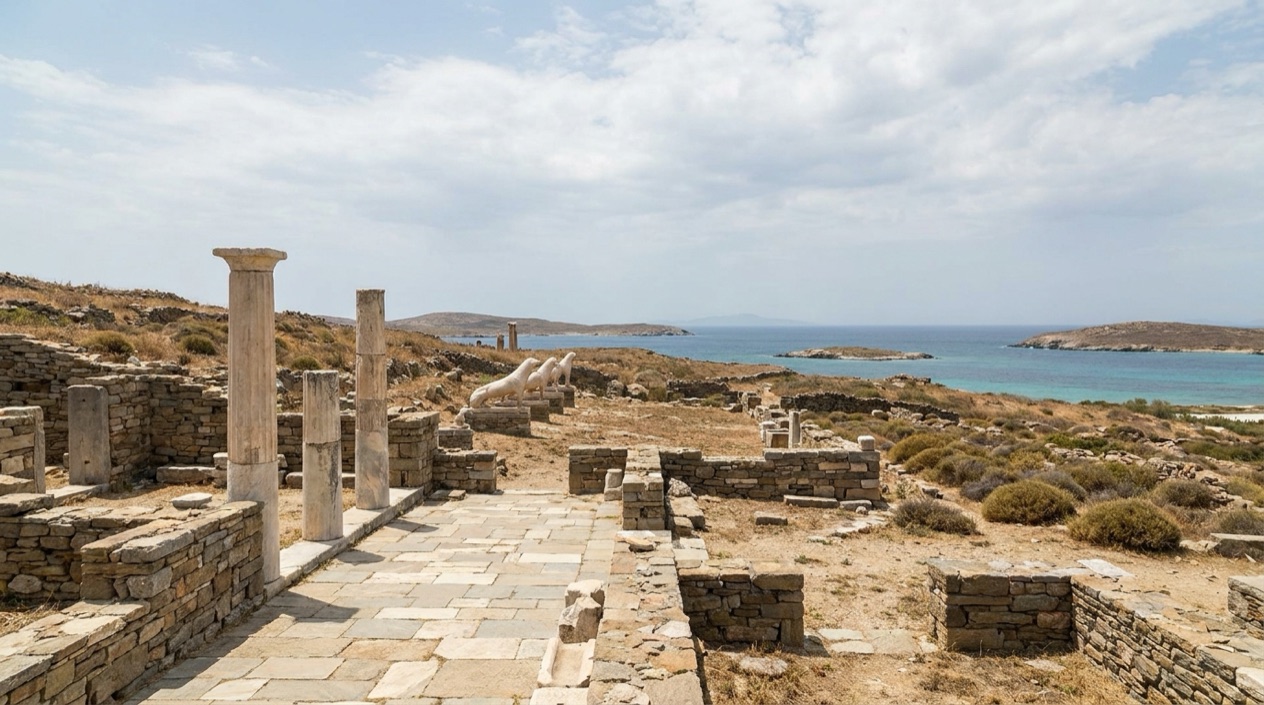
Delos comes into view as a low, bare island across the Aegean, with no village to speak of and no hotel on the shore, only ruins spread over dry ground. You step off at the Sacred Harbour and the ancient city begins almost at once, columns and paving stones scattered under an open sky. This is a visit to an archaeological island where Apollo and Artemis were said to be born, and it suits anyone staying on Mykonos who wants to see what lies beyond the beach clubs.
Is visiting Delos worth it?
Yes, for anyone who likes ancient places that you walk through rather than look at from a rope, and especially for travelers already on Mykonos, since the island lies only a few miles away. It is a whole sanctuary and port town, and you read it by wandering from one ruin to the next.
What sets it apart from other ancient sites in Greece is its scale and its emptiness of everything modern. The island is tiny, a little over a square mile, and almost nobody lives on it. The 2011 Greek census counted just 24 inhabitants. Instead of a modern town growing around the ruins, as happens at so many sites, you have the ancient city and the sea, and little else to break the picture.
It was the most important Panhellenic sanctuary, a place that drew worshippers from across the Greek world because, according to mythology, it was the birthplace of Apollo and Artemis. UNESCO added it to the World Heritage List in 1990 for an exceptional archaeological site that conveys the image of a great cosmopolitan Mediterranean port. The excavations here are among the most extensive in the Mediterranean, and they are still going on, so the place keeps revealing more of itself.
Many of the finds from the island are shown in the Archaeological Museum of Delos and in the National Archaeological Museum of Athens. If the myths and the sculpture interest you, the island and those collections make a natural pair.
What to see at Delos
The island is a sanctuary, a harbor and a residential town all in one, and the sights are best taken as stops along a loop through the ruins. A handful of structures give the visit its shape, and each tells a different part of the story.
The Sacred Harbour
Everything starts at the water. From the Sacred Harbour you can see three conical mounds on the island, hills that identified landscapes sacred to a goddess, presumably Athena. Pilgrims in antiquity saw the same silhouettes as they approached, and it is a good moment to stop and take in how the island sits in the sea before you walk inland.
The harbor also explains why Delos grew into a cosmopolitan port. Traders and worshippers arrived by ship, and the town that rose around the shore reflected that mix of origins. As you go on, look for the foundations of warehouses and houses that tell the commercial side of the story, set against the religious one.
The Terrace of the Lions
The Terrace of the Lions is the image people carry away from Delos. The people of Naxos dedicated it to Apollo shortly before 600 BC, and it is a row of marble lions crouching in a line, mouths open, seeming to watch over the sacred ground. Their worn bodies and stretched shapes have an unmistakable look against the dry earth and the sky.
Stand at the end of the row and look along it, then notice the open ground beside it where the sacred lake once lay. The gift from Naxos shows how city-states competed to honor the god here, and how far an island’s offering could be seen.
The Sacred Lake
The small sacred lake is now dry. The island’s caretakers intentionally leave it that way to suppress the spread of malaria-bearing mosquitoes, so what you see is a shallow hollow rather than water. It is still worth a pause, because in myth this was tied to the birth story of Apollo and Artemis and to the sanctuary’s identity.
Seen with the lions nearby, the empty basin helps you imagine the sanctuary as it was, with water, statues and processions. It is a small stop, but it makes the layout of the sacred area easier to follow.
The Temple of the Delians
Dedicated to Apollo, the Temple of the Delians is a classic example of the Doric order, the plainest and sturdiest of the Greek column styles. Look at the foundation lines and the stone blocks to understand how the building was laid out, even where little rises above the ground.
The temple belongs to the sanctuary zone, so it helps to read it together with the lions and the lake. Together they show a place where gifts, ritual and civic pride all met in the same sacred precinct.
How to get to Delos
Delos is an island in the Aegean Sea, a few miles southwest of Mykonos, so reaching it means crossing the water from there. Mykonos is the base the island is tied to, and it is the place to start from when planning a visit.
Because Delos is so close to Mykonos and so small, the trip is mostly about the island itself rather than about the journey. You arrive at the Sacred Harbour, the same shoreline pilgrims once used, and the ruins begin from there. That makes the first view of the island part of the visit.
Delos belongs to the Cyclades, the island group that includes Mykonos, which is why it appears so often in itineraries that center on that island. Think of it as a place you cross to and explore on its own terms, a separate world from the beaches and nightlife of its neighbor.
Once on Delos, you are walking an island of just over a square mile, with the ancient town, the sanctuary and the harbor all within that space. The finds from the island that you do not see on site wait in the Archaeological Museum of Delos and in the National Archaeological Museum of Athens.
When to visit Delos
Delos is an open-air archaeological island, so the weather you meet in the Cyclades is the weather you meet among the ruins. There is no village, no hotel and no indoor retreat to shelter in, and the site is laid out under the sky.
That makes it worth thinking about the sky when you choose your day. A clear day gives you the long view from the harbor to the three conical mounds and across the water to Mykonos.
Excavations on the island are ongoing, which means the site is a living work in progress rather than a fixed monument. What you see in one season may differ slightly from another as the archaeologists keep working.
If you want to link the visit to the story of Apollo and Artemis, any day on the island suits the mood, since the myth is part of the ground itself. The birth of the two gods is what drew pilgrims here in the first place, and it still frames how the island is understood.
Tips for your visit
Pack for an island with no village, since the ruins are the whole setting. Sun protection and sturdy shoes suit ground that is open and uneven, and a water bottle is a sensible companion for a place where you are walking among stones.
Plan your route around the highlights: the Sacred Harbour first, then the Terrace of the Lions, the dry sacred lake and the Temple of the Delians. Between them, look at the foundations of houses and warehouses, which carry the story of the port town that grew around the sanctuary.
Pair the island with the museums that hold its finds. The Archaeological Museum of Delos shows many of the artefacts found on the island, and the National Archaeological Museum of Athens displays others, so the ruins and the objects can be read as two halves of the same picture.
Delos also combines naturally with time on Mykonos, which is only a few miles away. The contrast is part of the appeal: one island holds a sanctuary that was among the most important in the Greek world, the other holds the beaches and the town you came to enjoy.
Good to know before you go
Delos is a World Heritage site where the ruins are the main event, so bring what you need for a day among stones and sea. The island has almost no permanent residents, which means the visit is about the antiquities and the open landscape rather than shops or cafés on the shore. Treat the ground with care, since excavations continue and the site is a working archaeological landscape.
Sources
- Wikipedia, Delos (https://en.wikipedia.org/wiki/Delos), checked October 12, 2026
- Visit Greece (GNTO), Delos (https://www.visitgreece.gr/islands/cyclades/delos/), checked October 12, 2026
- Wikivoyage, Delos (https://en.wikivoyage.org/wiki/Delos), checked October 12, 2026