
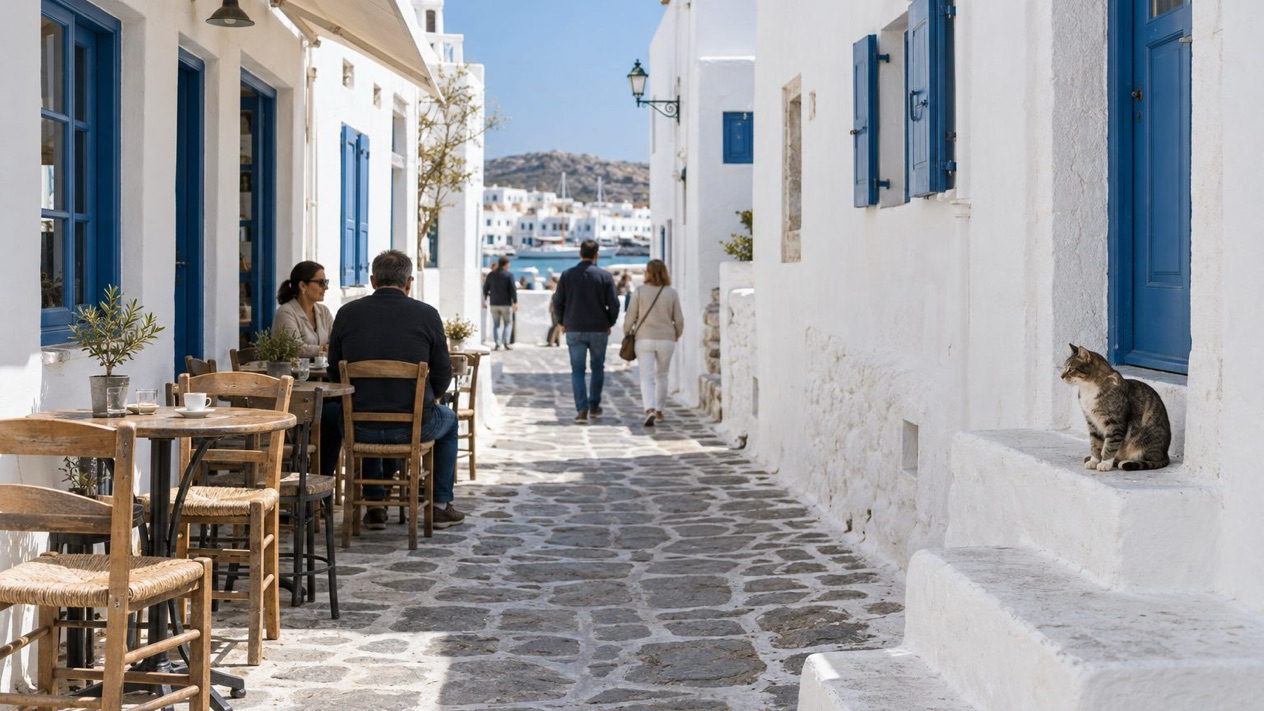
Paros sits at the center of the Cyclades and feels like a toned-down Mykonos with all the charm kept in: whitewashed lanes, harbor tavernas, bougainvillea spilling over walls, and a nightlife that stays chilled rather than relentless. Families, couples and groups of friends all do well here. It is a lovely choice for a first trip to the Cyclades, with beautiful beaches and a blend of cosmopolitan feel and authentic island tradition. Add hilltop villages, a serious food scene and a quieter sister island a short ferry ride away, and it's easy to see why so many visitors wish they had booked more nights.
Where should you stay in Paros?
The island is small enough that you can sleep almost anywhere and still reach the rest. The real choice is the kind of evening you want.
Naoussa
Naoussa is the pick for first-timers who want evening life on their doorstep. It began as a fishing village, and brightly colored boats still bob in the harbor. Today it is the island's polished hub, with bars spilling onto the lanes and restaurants a short stroll from wherever you sleep. You can walk to dinner and back without thinking about taxis.
The party doesn't really start until after midnight, and it gets lively. If you want sleep, choose a place about a 10-minute walk from the center. Quiet lodgings are plentiful at that distance, and some sit steps from the sea. Naoussa suits couples, friends and anyone who likes a night out. For groups, villa rentals sleeping six to ten people are easy to find within walking distance of the harbor.
Parikia
Parikia is the capital and main ferry port, and it often gets written off as a place you just pass through. That's a mistake. Behind the port cafes, the old town is a quieter, more local-feeling tangle of whitewashed houses and flowering walls, and the lanes are often nearly empty. Many day-trippers fill the waterfront during the day, and the town tends to quiet down late at night, which makes it a lovely spot for an evening stroll. It is the practical base if you plan to hop between islands or keep an eye on costs. Accommodation in Parikia tends to cost less, and staying near the port means you can skip a taxi when a late ferry comes in. It has less polish than Naoussa and more everyday island life.
Piso Livadi and the quieter coast
On the southeast coast, Piso Livadi is a fishing village with seafood tavernas and a peaceful beach with calm water. It's the easy choice for families with young children. The beachside east coast as a whole feels more relaxed, with villages up and down the shore to explore. For real tranquility, look at houses on quieter beaches such as Kalmia or Aliki. The remote south can feel too far from the action on a first trip, and you'll want a car there.
Lefkes
Lefkes, the former capital, sits in the green hills in the middle of the island. It's utterly charming for a day, but for a first visit there isn't enough to fill several.
What are the best things to do in Paros?
Start with an evening in Naoussa. Walk down to the harbor about an hour before sunset, get a drink, and watch the light change, the town fill up and the fishing boats come in. Then wander the cobbled lanes behind the harbor, lit by lanterns after dark. The boutiques stay open late and sell ceramics, jewelry and linen clothing from independent makers rather than the usual souvenirs. The Venetian fortress by the water, once a lookout against pirates, makes a quick stop, and it's just as lovely admired from a taverna across the harbor with a cocktail in hand. If you're in town on August 23, you'll catch the Night of the Corsairs, the town's party marking the locals' victory over pirates in 1532.
Lefkes is the village worth the detour: marble-paved streets, flower-filled alleys, and a square where locals play cards over coffee. Give it an hour or two without a plan, and stay for lunch with a view. If you want a short hike, the Byzantine Way, a marble-paved path of about 2.4 miles (3.9 km), links Lefkes with the village of Prodromos. Lefkes holds the Festival of Karavolas at the end of August. Marpissa, about a 10-minute drive away, is a quieter inland village of whitewashed houses and windmills, with a monastery that has wide views over the island. It stages a Passion Play on Good Friday.
In Parikia, head to the Church of 100 Doors, Panagia Ekatontapyliani, one of the major Byzantine monuments in Greece. Go in the morning, when the harbor's fish market is also running. The Byzantine Museum, in the same complex, shows rare icons. If you like ancient things, the Archaeological Museum in Parikia displays Parian sculpture and pottery, including the "Fat Lady" figure from about 5000 BC, found on the islet of Saliagos. Paros grew rich on its fine white marble, the stone of the Venus de Milo and Praxiteles' Hermes. The museum is open from 8:30 a.m. to 3:30 p.m., with last entry 20 minutes before closing; check the hours before you go. Tickets cost €5, or €3 reduced (2026). Many museums and collections on the island close on Tuesdays, and this one is closed that day too, so plan around it.
Then there's Antiparos, quieter and far less visited than Paros. The ferry from Pounta takes about 7 minutes, and foot passengers can also sail from Parikia. Spend the day swimming, cliff jumping if you're brave, and lunching at a table on the sand. Boat tours from Pounta include lunch and drinks, and some take you through sea caves.
Water sports are strong here too. Windsurfing and sailing are popular, and the calm morning water around Santa Maria and Paralia suits waterskiing. Try to go in the morning, since the wind tends to pick up later in the day. On summer evenings, an open-air cinema near Monastiri beach shows films under the stars.
What are the best beaches in Paros?
Kolymbithres
Kolymbithres is famous for its granite boulders, sculpted by wind and waves into natural pools and sheltered coves, with clear, fairly calm water that is great for snorkeling. It's near Naoussa and family-friendly, with both sand and rock pools, plus several beach bars. It gets crowded in peak season. Head over early in the morning, before the day-trip boats from Parikia show up, and you may find it nearly empty.
Santa Maria
A long stretch of sand near Naoussa with calm, shallow water, chairs along the beach and plenty of food nearby. It's the easy pick for families.
Golden Beach
This is where windsurfers go. The east coast beach is known for steady, strong winds, and a lively beach club scene keeps the energy up on shore. Come for the wind, not a quiet swim. It's roughly 50 to 55 minutes from Parikia by bus.
Faragas and Aliki
The south-facing beaches are naturally sheltered from the summer wind, which makes them good for young children. Faragas is the more secluded of the two, with a beach bar and loungers but without the crowds.
Molos
A quiet beach with crystal-clear water, still largely untouched by mass tourism. Pick it when you want to get away from the crowds.
Kalogeros clay beach
A natural clay beach that's fun for its novelty. Cover yourself in clay taken straight from the beach rocks, a bit like a natural spa day. The beach is rockier and more exposed than the others, so it suits a short, curious visit better than a long lazy day. There's no food nearby, so bring water and snacks.
What should you eat in Paros?
Paros has a reputation as a foodie island, and Naoussa has the widest choice, from casual tavernas to sushi and French. Greeks eat late. Embrace it. You'll adapt fast.
One tip saves money in Naoussa: resist the waterfront tables. The setting is lovely, but the food right on the harbor tends to be pricier and less special than what you'll find a few streets back, where small places set tables on the cobbles. Make sure at least one of your dinners happens in that kind of spot. Matina & Stavros is a warm, unpretentious taverna of exactly this type.
Away from Naoussa, Markakis sets its tables on the sand just feet from the water. Order the catch of the day. In Aliki, To Balcony tou Aki, by a windmill, serves fish the owner catches himself, along with local meat, vegetables and its own wines. In Drios, family-run Taverna Julia is rumored to make the island's best moussaka. For sunset, Siparos on Santa Maria beach changes its menu with the season. Reserve ahead, because locals fill it too.
Barbarossa in Naoussa is the home of the "white napkin party," when diners wave napkins and dance on tables from about 10 p.m. Book the restaurant if you want to join in, and go for the fun, not the food.
For a lazy lunch, grab souvlaki or market supplies and eat them on a quiet beach. Hot loukoumades, light honey doughnuts drizzled with local honey and cinnamon, make a good afternoon stop at To Paradosiako. In Parikia, Cafe Symposium is a calm espresso bar for a slow morning, and Zen cocktail bar suits sunset.
Outside Santorini, Paros is one of the better Cyclades islands for wine made from local grape varieties. Moraitis, a fourth-generation family winery just outside Naoussa, runs tours and tastings.
How many days do you need in Paros?
Plan on four days if you can. Three is the minimum, and many visitors don't schedule enough time. Four lets you do Naoussa properly, see Parikia and Lefkes, make the Antiparos trip and still have dedicated beach days.
Day 1
Arrive and settle in Naoussa. Wander the lanes, then head to the harbor for sunset. Have dinner a few streets back from the water, then a cocktail at Sante, the bar that sprawls under a huge tree and serves drinks with popcorn.
Day 2
Go to Kolymbithres first thing and swim in the rock pools. Have lunch at a beach bar. In the afternoon, visit the winery or head to Santa Maria for calm shallows. Finish with a slow evening in town.
Day 3
Drive inland to Lefkes in the morning and walk the Byzantine Way toward Prodromos if you feel like a hike. Have coffee in the square, then continue to Marpissa. End in Parikia's old town lanes with a sunset drink.
Day 4
Take the ferry from Pounta to Antiparos. Swim, linger over lunch, and be back in Naoussa for a last late dinner. With a fifth day, add Golden Beach for wind sports.
When is the best time to visit Paros?
The season runs from May through October. June, especially the first two weeks, is a lovely time to visit: the sea is inviting for a swim, the sunshine is dependable without the peak intensity of high summer, and Naoussa feels lively without being overrun. September is a close second if budget matters, since prices drop noticeably and the island quiets down, and shoulder season brings sales in the boutiques. July and August are hot and crowded, and the Meltemi wind blows hard. It takes the edge off the heat, but it can disrupt ferries and make exposed beaches unpleasant, and it can linger into early September.
How do you get to Paros and around?
Flights from Athens are short, and there are also flights from Thessaloniki. The airport sits south of Parikia, near Aliki. It's tiny and processes one flight at a time, so arriving 45 minutes to an hour before departure is plenty.
Ferries are the classic route. Ferries from Piraeus all arrive at Parikia, with up to about 9 sailings a day, and crossing times run from about 2 hours 35 minutes on the fastest boats to 5 hours 35 minutes on the slowest. High-speed boats also run from Rafina. From Paros, Naxos is 20 to 30 minutes away, Mykonos 45 minutes to 2 hours, and Santorini 2 to 3 hours. Ferries are abundant in July and August, regular but less frequent in May, June and September, and trickier from October to March. Bad weather and the summer Meltemi can change schedules, so leave slack in your plans.
On the island, a rental car gives you plenty of flexibility, and many places can be reached by car in under 35 minutes. Book ahead in peak season. If you arrive by ferry, choose a rental company at Parikia port so the office is a short walk away. Parking is easy on town back roads. An ATV works if you'll stay near your base, and a scooter suits beach hopping from Naoussa.
Buses are cheap and reliable. The main hub is at Parikia port, with the station just to the right as you leave the ferry terminal. Routes run to Naoussa, Aliki, Lefkes and Pounta for the Antiparos ferry, and some reach beaches. Tickets bought on board cost more, at €2.80 or €4 (2026), so it is worth buying ahead if you can. Taxis are pricey and hard to find, one more reason to choose your base carefully.
What should Americans know before going?
U.S. citizens may enter Greece without a visa for up to 90 days of tourism. Your passport should have at least three months of validity beyond your planned departure date, and you may be asked for proof of funds and a return ticket. A passport you've reported lost or stolen won't get you in. To rent a car, Greek law requires a valid U.S. driver's license, and insurance companies may require an international driver’s permit. Greece has one of the highest traffic fatality rates in the European Union, so drive carefully. Motorcyclists must wear helmets, and using a phone while driving is illegal. Forest fires are common in dry summers and occasionally close roads. Strikes can interrupt ferries, taxis and airports, so keep some flexibility in your plans. Greece is generally safe, but petty crime is common at tourist spots. Thieves in Greece are known to break into rental cars to steal passports, valuables and luggage, so avoid leaving them inside. The U.S. State Department also advises carrying your passport or another form of photo ID at all times.
Sources
- finduslost.com (https://finduslost.com/the-complete-paros-greece-travel-guide/), checked October 18, 2026
- thewanderlusteffect.com (https://www.thewanderlusteffect.com/mini-guide-to-paros-greece/), checked October 18, 2026
- postcardsbyhannah.com (https://postcardsbyhannah.com/things-to-do-in-paros/), checked October 18, 2026
- wherestherooftop.com (https://wherestherooftop.com/2024/07/04/paros-island-what-to-do-and-where-to-stay/), checked October 18, 2026
- greece-like-a-local.com (https://www.greece-like-a-local.com/travel-guide/what-to-do/travel-guide-paros), checked October 18, 2026
- U.S. Department of State (https://travel.state.gov/content/travel/en/international-travel/International-Travel-Country-Information-Pages/Greece.html), checked October 15, 2026
- Visit Greece (GNTO) (https://www.visitgreece.gr/en/islands/cyclades/paros), checked October 15, 2026
- archaeologicalmuseums.gr (https://archaeologicalmuseums.gr/en/museum/5df34af3deca5e2d79e8c198), checked October 15, 2026
- imagine.paros.gr (https://imagine.paros.gr/en/what-to-do/shmeia-endiaferontos/museums.html), checked October 15, 2026
- Visit Greece (GNTO) (https://www.visitgreece.gr/islands/cyclades/antiparos/), checked October 15, 2026
- hellenicseaways.gr (https://www.hellenicseaways.gr/en-gb/highspeed-3/ferry-tickets-to-paros), checked October 15, 2026
- cyclades.culture.gov.gr (https://cyclades.culture.gov.gr/en/hours-prices/), checked October 15, 2026