
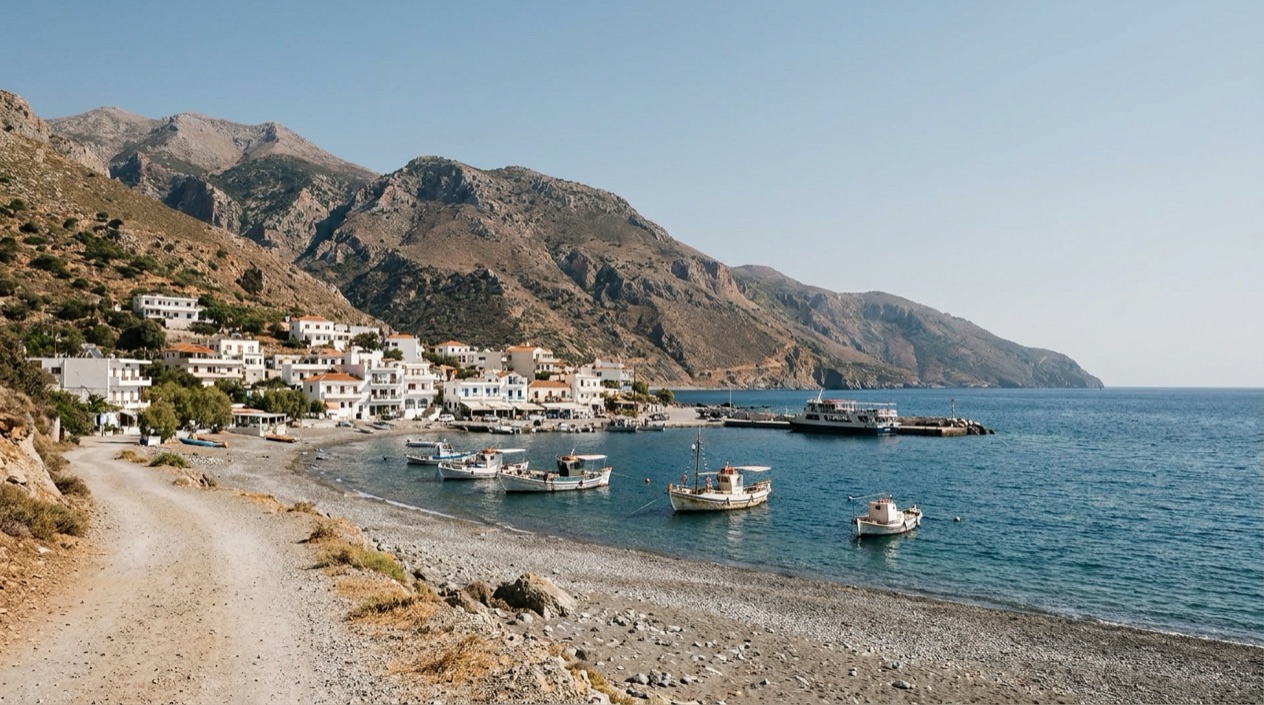
Walkers come down out of the Samaria Gorge with dusty boots and sore knees, and the first thing they meet is the water at the end of the village, with a row of tavernas waiting along it. Agia Roumeli is a tiny place on the southwest coast of Crete, and its streets run parallel to the sea. It is a stop for the gorge walkers, and for anyone who likes small villages with a long past.
Is visiting Agia Roumeli worth it?
Yes, if you want a village on the Libyan Sea that shows you something more than a beach, and it suits hikers above all, since the village sits at the exit of the Samaria Gorge.
Many places on the island’s coast are bigger, but Agia Roumeli has just 78 residents according to the 2021 census. It is made of two parallel streets along the water, a handful of restaurants and souvenir shops, and a hill with an old fortress on top. Behind it the mountains rise, and the long gorge path arrives from them.
What sets it apart from other villages of Sfakia is the combination of an ancient name, a ruined castle and a plant reserve on its beach, all within the same small settlement. Many beaches in Sfakia do not see the numbers of tourists of the northern coast, and Agia Roumeli belongs to that quieter side of the island’s tourism.
A visit gives you time at the table, a walk up to the fortress and a look at the shoreline where an ancient city-state once stood. It rewards curiosity more than a packed schedule.
What to see at Agia Roumeli
The two streets along the water
The village is laid out as two parallel streets running beside the sea. Along them you find several restaurants and souvenir shops, and the layout is easy to take in because there is so little of it. Tables look out over the water, and many walkers sit down here as soon as they arrive from the gorge.
Order what a Cretan taverna usually serves: a Greek salad with a slab of feta, grilled fish or meat, fried vegetables, and a plate of dakos or local cheese pies if they are on the menu. A small carafe of raki often arrives at the end of a meal. Wander the souvenir shops for postcards and local goods, then walk to the end of the street where the village meets the shore.
Castle Agia Roumeli
An old fortress called Castle Agia Roumeli sits on top of a hill to the west of the village. From a distance it reads as a stone outline against the slope, and it tells you that this coast was once a place worth guarding. Ruined walls on a rocky height like this give a good sense of how exposed the southern shore of Crete has always been.
Look for the way the walls follow the line of the hill, and for the view back over the two streets and the water, which shows how small the village really is. The sea stretches out in front of you, and the mountains close in behind.
Tarra and the story of the village
Agia Roumeli was originally known as Tarra, an ancient city-state that Homer mentions in the Iliad as one of the Hundred Cities of Greece. That gives this little shore a place in the oldest literature of the Greek world, though what you see today is a modern village of tavernas and shops.
A later chapter came in 1867, when Turkish soldiers landed on Crete and burned down the town of Agia Roumeli after failing to reach the Samaria Gorge. The village you see is the product of that history of burning and rebuilding, which gives the walk along the shore a little more weight.
Fournoti beach and its plant micro-reserve
Near Agia Roumeli, on Fournoti beach, there is a plant micro-reserve for a rare shrub called Hypericum aciferum. It protects a small plot with more than a hundred plants of this vulnerable species, so the shore here is a living botanical site as well as a place by the sea.
If you go, look at the vegetation rather than at the sand, and treat the plot as a protected area. It is a good reminder that the wild south coast of Crete holds plants that grow in very few places.
Hours, tickets and rules
Agia Roumeli is a village, so you walk its two streets and its shoreline as you would any other settlement, with no gate at the entrance. The fortress on the hill and the beach with the plant reserve are places you see and walk toward, and the village itself is a place to wander and eat in.
What matters in practice is how the visit fits with the Samaria Gorge, since the village sits at its exit and the hiking path arrives from the inland mountains. Restaurants and souvenir shops are the businesses you deal with on the spot, and each sets its own way of working.
The one protected area is the plant micro-reserve on Fournoti beach, home to the rare shrub Hypericum aciferum. It is a reserve for a vulnerable species, which is reason enough to look at the plants without disturbing them.
How to get to Agia Roumeli
There are two ways in. One is the direct ferry from Hora Sfakion, a harbour village in the southwest of Crete with about 475 inhabitants and the capital of the Sfakia region. The other is on foot, along the hiking path out of the Samaria Gorge, which comes down from the mountainous inland region and ends at Agia Roumeli.
By ferry from Hora Sfakion
A direct ferry runs from Hora Sfakion to Agia Roumeli, and it is also the place where the trek through the Samaria Gorge can be started. Hora Sfakion is the port to head for, with the sea between it and the village.
Getting to Hora Sfakion comes first. Halfway from Vryses to Hora Sfakion lies the fertile plateau of Askifou, surrounded by high mountain peaks. From there to Hora Sfakion the road is particularly spectacular, hugging the western slope of the Imbros Gorge, so the approach is part of the trip.
On foot through the Samaria Gorge
Agia Roumeli sits at the exit of the Samaria Gorge, where a long hiking path from the mountainous inland region ends. Walkers reach the village at the end of that path, and most then continue by boat.
Going the other way is known as the Lazy Way, but people call it the Crazy Way, because visitors arrive about noon and start walking in the hot sun up to the park entrance. The nickname says what the reverse walk feels like.
When to visit Agia Roumeli
The part of the day matters most here, because of that nickname: people who arrive at noon and walk up toward the gorge entrance do it in the hot sun. If you plan to go beyond the village, keep the heat of the day in mind, and let it shape when you start walking.
The village runs on Eastern European Time (UTC+2), and Eastern European Summer Time (UTC+3) during summer, so the clock changes with the season. Plan your ferry and your meals by the local clock.
Since Agia Roumeli is a small place, a visit is as much about pace as about date. Time for a meal by the water, a look at the fortress and a stroll to Fournoti beach is what makes the stop worthwhile, whatever the month.
Tips for your visit
Bring what you would for a day at the sea and in the mountains: sun protection, since the walk up from the village is done in hot sun, and sturdy shoes if you will be on the hiking path. Water and a hat are sensible companions for anyone who plans to walk.
Combine Agia Roumeli with the Samaria Gorge, which ends here, and with Hora Sfakion, where the ferry leaves. On the way to Hora Sfakion, the Askifou plateau and the road along the Imbros Gorge are worth a pause for the mountain scenery.
Beaches in Sfakia see fewer visitors than those of the northern coast, so the shoreline here fits a slower stop. Leave time to sit at a table, to climb toward the castle hill and to look at the plants on Fournoti beach.
Good to know before you go
Agia Roumeli is a village of 78 residents with two streets, so its shops and restaurants are limited, and it helps to treat it as a stop rather than a base. Bring what you need for the walk or the boat, and use the sun and heat as your guide to pacing the day. The hillside castle and the reserve on Fournoti beach are the places to look at with care.
Sources
- Wikipedia, Agia Roumeli (https://en.wikipedia.org/wiki/Agia_Roumeli), checked October 12, 2026
- Wikipedia, Sfakia (https://en.wikipedia.org/wiki/Sfakia), checked October 12, 2026
- Wikivoyage, Sfakia (https://en.wikivoyage.org/wiki/Sfakia), checked October 12, 2026
To plan your stay
- Best Time to Visit Greece: September and Late May to Early June
- Arachova: Parnassus Mountain Town, Formaela Cheese, Ski Season and Saint George's Day
- American Airlines Flights to Greece: U.S. Cities, Athens Arrivals and Onward Island Flights
- Greece on a Budget: Cash Machines, Cards, Beaches and Ferries