
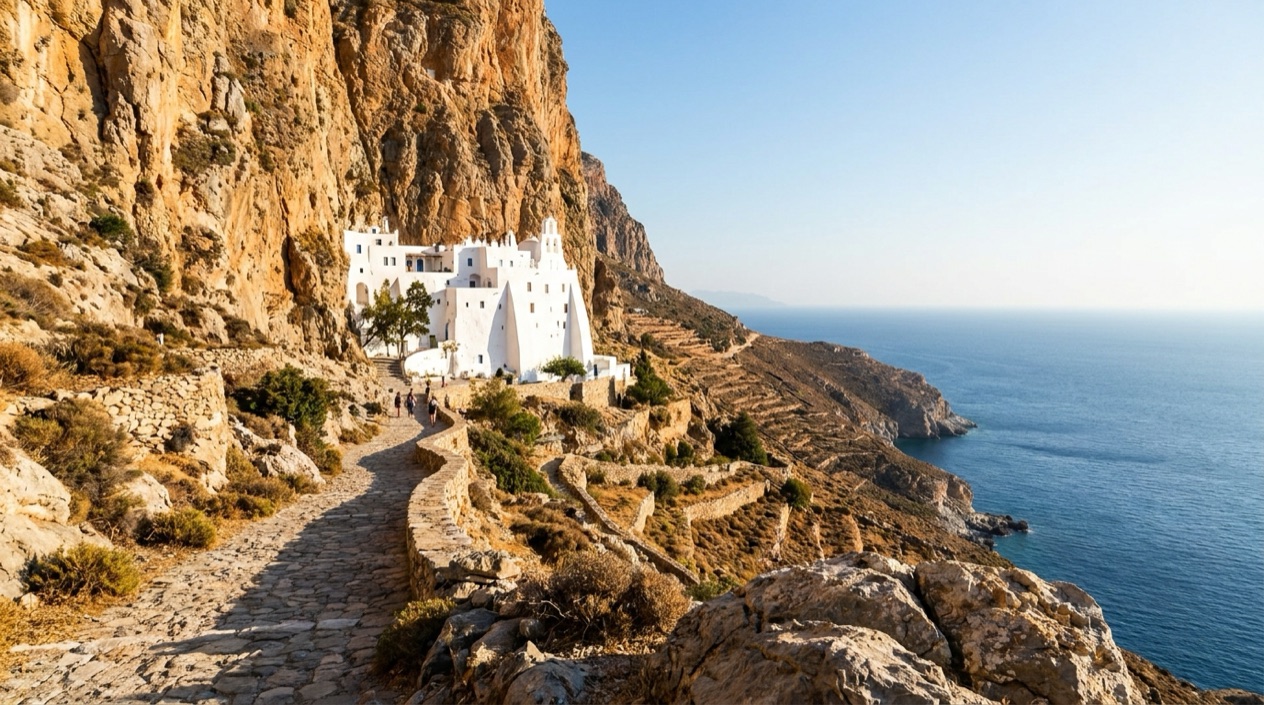
From the road on the south coast of Amorgos, you first see a pale, narrow wall stuck to a vertical cliff, its small windows facing the Aegean far below. It looks less like a building than like something the rock grew by itself. Panagia Hozoviotissa is a working Orthodox monastery on the island’s steep south coast, and visiting it means climbing a stairway into the cliff to reach the rooms inside.
Is visiting the Hozoviotissa Monastery worth it?
Yes, if you want one stop on Amorgos that is part architecture, part pilgrimage and part view, and you are happy to climb stairs to get it.
What separates it from other island monasteries is the way it is built. Most Cycladic churches and chapels stand on a hilltop or in a village square.
Hozoviotissa is wedged into the face of the rock itself, as a long, thin structure of many levels, so the visit is a vertical one: you climb 271 steps, then keep going up and down inside through stairways cut into the stone. The monastery is dedicated to the Presentation of Theotokos, the Virgin, and it is the patron saint of the whole island. That gives the place weight for Amorgos in a way few other sites on the island have.
It also has a clear, tellable history: an icon that, according to local tradition, came by sea, a name carried from a monastery in the Holy Land, and an imperial charter from the eleventh century. You leave with a story you can repeat over dinner in Katapola or Aegiali.
Visitors come to see the building and the view, and many come for both. The monastery is open in two periods each day, so it fits around a day of beaches or hiking.
What to see at the Hozoviotissa Monastery
The monastery is a single, continuous structure, and the best way to take it in is in the order you meet it: the cliff, the stairway, the doorway and the rooms, then the icon at the center of it all.
The building on the cliff
The first thing you see is the shape. The building is very long and very narrow, a thin ribbon of whitewashed masonry laid against the rock, so that from a distance the cliff and the walls seem to be one thing. Small windows pierce it at different heights, and the rock face rises above and falls away below on the south coast of Amorgos, high over the sea.
Take a moment at the foot of the climb to look up at it before you start. From here you can see how the levels step upward, and the whole logic of the place becomes clear: there was no room to build outward, so the monks built up, in, and along the cliff.
The stairway and the entrance
From the access point, visitors climb 271 steps to the monastery. The stairway turns along the slope and the view over the open Aegean widens with every landing, so the climb has its own reward.
The doorway itself sits high above the ground. In the monastery’s early centuries it was reached by a hanging ladder, which could be pulled up when needed. Today a stone stairway does the work, but you can still feel the idea of a refuge behind that high entrance: the building was made to be hard to reach, and it still is a little.
The eight levels inside
Inside, the monastery has eight levels, joined by staircases that are either built or carved directly into the rock. Rooms are small and low, and passages narrow and twist. You move from a chapel to a corridor to a tiny room with a window onto the sea, and in places the rock itself forms the wall or the ceiling.
This is a place of living faith and not a museum, so the atmosphere is hushed and the spaces are close. Visitors are traditionally welcomed with a small treat, a custom of Greek monasteries that lends a human note to the climb. Take it as a gesture of hospitality and let the stairways slow you down.
The icon of Panagia and the monastery’s story
At the heart of the monastery is the icon of Panagia Hozoviotissa. According to local tradition, it arrived by sea in the bay of Agia Anna, near the monastery, during the Byzantine Iconoclasm, the long dispute over religious images. The monastery is believed to have been built in the ninth century, around the time the icon arrived, and the icon is the reason the building exists.
The name has its own journey. It comes from Hozeva, the place known today as Wadi Qelt in Palestine, where the Orthodox monastery of Saint George stood. In 1088, Emperor Alexios I Komnenos granted the monastery stauropigian rights by royal chrysobull, placing it under direct church authority. Panagia Hozoviotissa is the patron saint of Amorgos, and the monastery celebrates on November 20 and 21.
How to get to the Hozoviotissa Monastery
Amorgos is reachable only by boat, so every route to the monastery starts at one of the island’s two ports, Katapola or Aegiali. The island lies in the east of the Cyclades, and the monastery stands on its steep south coast.
Blue Star boats travel to Amorgos all year, and the journey from Piraeus, the port of Athens, takes about 9 hours. Katapola and Aegiali are the two ports, and which one your boat uses is a matter for your own ticket.
From Katapola and Chora
Katapola is one of the three main tourist bases on the island, with Aegiali and Chora. The village of Chora is 3.1 miles from Katapola, which makes Katapola the nearer of the two ports to Chora, and Chora is the village that sits closest to the monastery area in terms of where people stay.
What matters at the end of the trip is the climb. However you reach the access point, the last stretch is on foot: 271 steps up to the monastery entrance. Wear shoes that suit stairs and bring water for the climb.
From Aegiali
Aegiali is the island’s other port and another of its three main tourist bases. Chora is 9.3 miles from Aegiali, noticeably farther than from Katapola, so a stay in Aegiali means a longer trip to the south coast than a stay in Katapola or Chora.
Many travelers choose a base for its own character, with Katapola by the harbor, Aegiali on its bay and Chora up in the village, and then fit the monastery into a day. Whichever you pick, plan around the monastery’s two daily opening periods.
When to visit the Hozoviotissa Monastery
The monastery opens every day, in two separate periods, a long one earlier in the day and a short one in the evening. Between them it is closed, so the day divides naturally into a visit before the break and one after.
| Site | Open |
|---|---|
| Panagia Hozoviotissa Monastery | Daily, 8:00 a.m. to 1:00 p.m. and 5:00 p.m. to 7:00 p.m. |
Blue Star boats run to the island all year, so the monastery can be part of a trip in any month that your ferry schedule allows. No figures here describe crowds, heat or the light, so those are not promised. What can be said is that a climb of 271 steps asks something of you, and you may want to plan it for the part of the day that feels best to you.
The feast days in November
The one fixed date for the monastery is its feast, celebrated on November 20 and 21 for the Presentation of Theotokos. For an island whose patron saint is Panagia Hozoviotissa, this is the day that matters most, and the monastery is the center of it.
If you are on Amorgos in late November, the feast is the moment when the building’s religious purpose comes forward. Greek feast days of this kind are usually marked with services and gatherings of the faithful. Details such as times and the order of the day are not given, so ask locally on the island once you are there.
Tips for your visit
The best preparation is for the stairs. The climb is 271 steps, and inside there are eight levels linked by more staircases, so the visit is a lot of up and down. Comfortable shoes, water and a camera are the sensible things to carry, and a free hand for the handrails helps.
Fitting it into a day on Amorgos
Because the monastery has two opening periods, you can pair it with something else on either side of the midday break. A morning swim or a hike on the island, then the monastery in the evening, makes one kind of day. The other is the monastery first, then lunch in a village taverna, with a meze plate of cheeses, local vegetables and grilled fish.
Amorgos has three ancient cities, Minoa, Arcesine and Aegiali, and the island is where the French film The Big Blue was shot in the 1980s, which made it famous around the world. Both are good reasons to spend more than a day here. The monastery is the one place that gathers the island’s religious history under one roof.
Families and mobility
It is reached by 271 steps from the access point, its entrance stands well above the ground, and its eight levels are connected by staircases built or carved into rock. Anyone with difficulty on stairs should know this before setting out.
Guide service, parking and any rule about photography are not covered here, so none is promised. Treat the monastery as a place of worship, speak softly in the corridors and let the monks’ routine set the pace. The standing of the place is not that of a sightseeing attraction but of a house of prayer that receives visitors.
Good to know before you go
Amorgos is reached only by boat, and Blue Star runs to the island all year, so the sea is the way in and the way out. The monastery is on the south coast, high above the water, and a climb of this kind is felt more on a hot day, so carry water.
Tavernas and shops in Katapola, Aegiali and Chora are where you will deal with food and money, and the monastery has no fee listed here. The feast on November 20 and 21 is the one date to keep in mind if your trip is in late autumn.
Sources
- Wikipedia, Panagia Hozoviotissa Monastery (https://en.wikipedia.org/wiki/Panagia_Hozoviotissa_Monastery), checked October 12, 2026
- Visit Greece (GNTO), Amorgos (https://www.visitgreece.gr/islands/cyclades/amorgos/), checked October 12, 2026
- Wikipedia, Amorgos (https://en.wikipedia.org/wiki/Amorgos), checked October 12, 2026
- Wikivoyage, Amorgos (https://en.wikivoyage.org/wiki/Amorgos), checked October 12, 2026