
FLORIDA · TROY SPRING · FEBRUARY
A Florida spring does not keep a calendar. The country around Troy Spring spends February at 69.6°F in the afternoon and 45.2°F before dawn, while the water in the basin sits near 71.4°F the way it sits there in July. That gap is the whole trip. In August you get in to cool off. In February you get in because the water is, quite often, the warmest thing outdoors.
So the February question is not whether you can swim. It is whether you want to walk back to the car in mid-40s air with wet hair. The answer depends on what you drove up for: a dive, a float, half an hour of trail, or one stop on a longer Florida road trip.
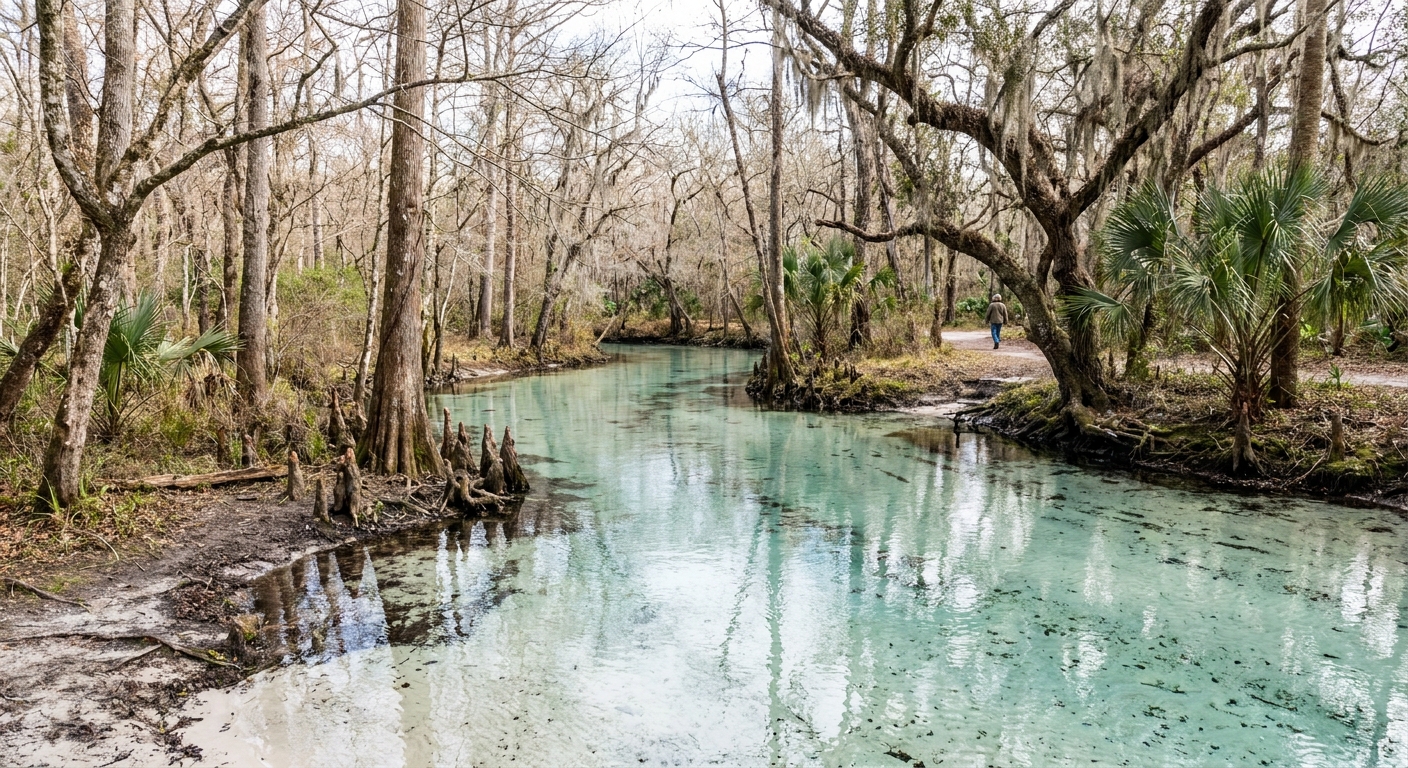
THE MONTH AT A GLANCE · TROY SPRING · FEBRUARY
Come for the water rather than the sunbathing: February pairs a 71.4°F basin with 69.6°F afternoons, the driest month of its three-month run, and a 25-space lot nobody is fighting over.
AVERAGE HIGH 69.6°F · SPRING WATER NEAR 71.4°F · 4.8 WET DAYS · 25 PARKING SPACES
Go for: diving and paddling in 71.4°F water with the lot at its calmest, 2.96 inches of rain across the whole month, and 11 hours 11 minutes of daylight to work with.
Think twice before: building the day around drying off in the sun: dawns average 45.2°F and 4.1 nights a month reach freezing.
Air: NOAA NCEI 1991–2020, Cross City AP · Water: USGS gauge 02320250 · Facilities: Florida DEP inventory
On this page
- Troy Spring water temperature in February71.4°F, and why it barely moves
- Average high, lows and rain days69.6°F and 4.8 wet days
- Parking and crowds at the spring25 spaces, and when they matter
- Things to do at Troy Spring in FebruaryThe swim area, the launch and the trail
- A two-day plan around the springHour by hour on 11 hours of daylight
- February, January or March?How the three months compare
- Is February a good time to visit?Our verdict, for divers and for families
Settle one thing before the rest: the numbers below split into two families. The air figures come from a NOAA station 27 miles away at Cross City Airport, and they move every month. The water figure comes from a USGS gauge in the spring itself, and it hardly moves at all. Nearly every February decision here, from what you book to what you pack, lives in the gap between those two.
Troy Spring weather in February: average highs, lows and rain days
| February normal, 1991–2020 | Value |
|---|---|
| Average high | 69.6°F |
| Average low | 45.2°F |
| Precipitation | 2.96 in |
| Days with 0.10 in or more | 4.8 |
| Days with 1.00 in or more | 0.8 |
| Nights at 32°F or below | 4.1 |
| Daylight on February 15 | 11 h 11 min |
Every figure here comes from one thermometer, and the thermometer is not at the spring. NOAA’s 1991–2020 monthly normals for station USW00012833, Cross City Airport, put February’s average high at 69.6°F, the average low at 45.2°F and the month’s precipitation at 2.96 inches. The airport sits about 27 miles (44 km) from the basin, so read these as the region’s air rather than conditions at the water’s edge. They are station normals from a real instrument, not a modeled grid cell, and that difference shows up whenever the two sources disagree.
In an average February, 4.8 days record at least a tenth of an inch, so roughly one day in six arrives wet. Only 0.8 of a day crosses a full inch. Call it one real soaking in four Februaries out of five. In practice most of the rain is a passing hour, and a short trail and 50 feet of boardwalk shed it fast. What a wet day complicates is the drive, not the swim.
The swing between those two normals is 24.4°F, wider than most visitors pack for. Morning at the launch can want a fleece and a knit hat. The same spot at three in the afternoon wants sunscreen. Bring two towels, a change of clothes in a dry bag, and something warm to pull on the second you are out of the water, because 45-degree air on a wet swimsuit is the part of February that sends people home early.
On February 15 the sun rises at 7:10 a.m. and sets at 6:21 p.m. local time: 11 hours 11 minutes of daylight. That is a short day by Florida standards, and it gives you one good swim window instead of two. Work backward from the sunset when you plan the drive home, especially if the day already includes a couple of hours on the road.
How warm is Troy Spring in February?
Afternoons average 69.6°F, dawns 45.2°F, 24.4 degrees apart. The water takes no part in that. The USGS gauge at the spring, station 02320250, read 71.4°F (21.9°C) on September 11, 2026, and it reads close to that every day of the year. That is a single instantaneous reading rather than a monthly mean, and we have no February series for it, so treat it as the spring’s steady state rather than as a February measurement.
Dress for the air, then, not for the water. At eight in the morning you want long pants, a fleece and dry shoes; by one in the afternoon, at 69.6°F under sun, a T-shirt does the job. Anyone planning more than a quick dip tends to want neoprene, since 71.4°F is cold enough to make most people gasp on the first step. A shorty wetsuit or a hooded rash guard turns that gasp into a comfortable hour.
February also freezes here. NOAA counts 4.1 nights at or below 32°F in an average February at Cross City. That is four mornings of scraping a windshield before a nine o’clock arrival, and a decent argument for sleeping close by rather than starting the drive in the dark. Our where-to-stay guide covers the bases across the state.
How busy is Troy Spring in February? Crowds and prices
February falls inside Florida’s dry season, November through April, and that is a calendar fact rather than a price. We found no occupancy series and no monthly room-rate series for this corner of the Suwannee valley, so we crown no month cheapest and none most expensive. What we can say about a Florida budget at state level sits in our trip-cost guide.
The constraint at Troy Spring is not the room, it is the lot. The state counts 25 parking spaces, and when they fill the gate closes. Nothing in our sources counts February visitors, so take this as inference rather than measurement: 25 spaces are a hard ceiling on a July Saturday and a formality on a cold weekday. Aim to arrive before 11 a.m. on a weekend, or take a midweek day and stop watching the clock. If you are flying in, time the airport drive first and let the itinerary follow it.
We could not verify a lodging-tax rate for the county, so we give no percentage. The same applies at the gate: floridastateparks.org returned 403 to our automated reads on September 11, 2026, so we publish no entrance fee and no opening hour for Troy Spring State Park. Fees vary by park and by season in Florida, and a price copied from another spring does not transfer. Check the park’s own page the morning you leave.
One line of spending genuinely changes a February day here, and it is not the room. The water reads 71.4°F whether you sleep in a cabin or a tent, so the upgrade that pays is thermal: a shorty wetsuit, a hooded top, neoprene socks for the walk in. Buy or rent it before the drive, and the coldest month of the water’s year becomes the one with the most room around you.
Things to do in Troy Spring in February
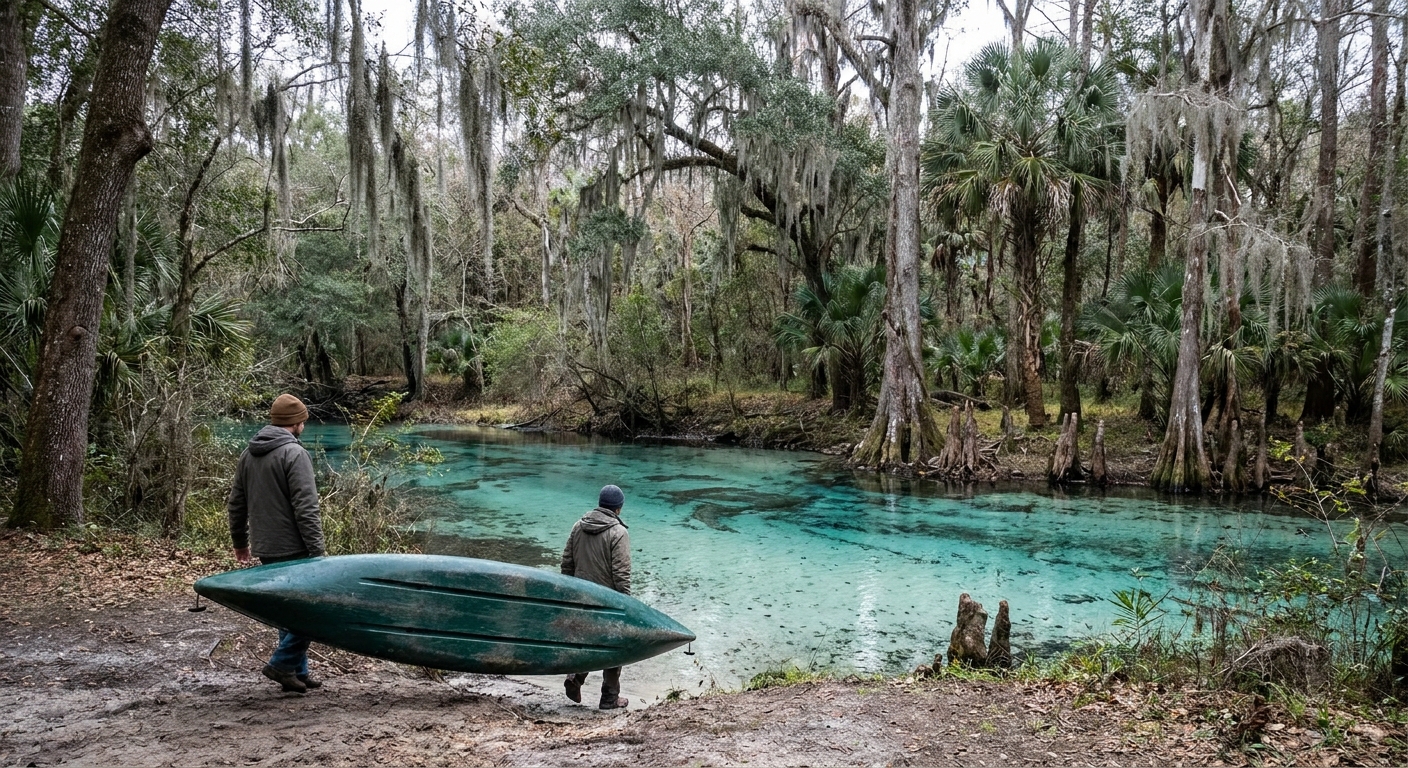
February gives you the spring without the competition for it. Divers get the clearest benefit: room on the bank to gear up, and a basin that has not changed temperature since the summer. The trade is the exit. Air that keeps other people away is the same air you step out into, so the month rewards anyone who plans the day around getting dry rather than around getting wet.
The park is small, and the state has counted it: 1 designated swimming area, 1 launch for canoes, kayaks and tubes, 0.3 miles of hiking trail and 50 feet of boardwalk, all served by those 25 parking spaces. Florida law puts the spring in a protected class called Outstanding Florida Springs, defined in Florida Statutes 373.802(5), which covers every historic first-magnitude spring plus six named by hand in the statute.
None of that inventory changes with the month, and neither does the water. What changes is the distance between the two numbers. In July the spring is the cold thing you step into. On a February morning at 45.2°F it is the warm thing, about 26 degrees above the air. By afternoon, with the air at 69.6°F, water and air are within two degrees of each other and the swim stops being a shock.
What is free here we cannot fully name, because we could not read the park’s fee schedule. The trail and the boardwalk ask nothing beyond whatever is collected at the entrance, and the swimming area is not a separately ticketed attraction. Manatees are the other winter draw in Florida’s springs, though no count for Troy Spring appears in our sources. Our manatee guide names the places that do publish theirs.
Troy Spring in February: a two-day itinerary
Day one runs on a 7:10 a.m. sunrise and a 6:21 p.m. sunset. Take coffee at eight, reach the park between nine and ten while the lot is empty, and walk the 0.3 miles of trail first so you arrive at the water warm. Get in around eleven, once the air is climbing toward 69.6°F, and give the swim area an hour. Eat off the tailgate at one, paddle in the early afternoon, and be changed and dry by four, when the light goes long and the temperature starts its 24-degree slide.
Day two puts the morning back in the water and the afternoon on the road, since the sun is gone by 6:21. The odds favor you: 4.8 days in an average February see a tenth of an inch or more, and only 0.8 of a day sees a full inch. A wet morning means driving first and swimming after lunch. A real cold front, on one of the month’s 4.1 freezing nights, is the cue to spend the day indoors instead, and St. Augustine absorbs a rainy one well.
Troy Spring in February vs January and March
| Normal, 1991–2020 | January | February | March |
|---|---|---|---|
| Average high | 65.9°F | 69.6°F | 74.9°F |
| Average low | 41.8°F | 45.2°F | 49.6°F |
| Precipitation | 3.38 in | 2.96 in | 3.53 in |
| Days with 0.10 in or more | 5.7 | 4.8 | 4.6 |
| Spring water | near 71.4°F | near 71.4°F | near 71.4°F |
Side by side, February is the driest of the three and sits neatly in the middle on warmth. Its 69.6°F average high runs 3.7 degrees above January and 5.3 below March. Its 2.96 inches of rain is the lowest of the run, against 3.38 in January and 3.53 in March. Wet days go 5.7, then 4.8, then 4.6. The spring reads near 71.4°F through all of it, so the air is the only variable that actually moves.
Shift four weeks earlier and you give up 3.7 degrees of afternoon warmth and take on almost a full extra wet day, with the compensation of an even quieter lot. Our January page has those figures in full. Shift four weeks later and March hands you 74.9°F afternoons and 49.6°F nights with the freeze risk mostly gone, at the cost of more rain and Florida’s spring-break traffic. For a diver the three are close to interchangeable. For kids who will sit on the bank afterward, March is worth the extra half-inch.
Is February a good time to visit Troy Spring?
Yes, if you are coming for the water and will dress for the air. The month is the driest of the three around it, the 25-space lot behaves, and 71.4°F is 71.4°F in any week of the year. No, if your picture of a spring day involves lying on a towel afterward. At 45.2°F before nine, with 4.1 freezing nights in the month, the drying-off half of the day is the weak half.
If that second description fits your group, move the trip to March. Afternoons at 74.9°F and lows at 49.6°F make the exit from the water bearable in a way February’s numbers do not, and 3.53 inches of rain spread across the month is a fair price for it. Anyone locked into February dates can fix most of the problem with neoprene, a second towel and a thermos in the car.
What February alone offers is the combination: water that has not shifted since August, the lowest rainfall of the three months at 2.96 inches, and a lot of 25 spaces behaving for once like a large one.
The last word
Decide on the neoprene before you decide on the dates. February’s forecast only tells you what to wear between the car and the water; the water settled its own temperature a long time ago. One number still unspent: the state counts 0.4 miles of paddling trail off the launch. That is short enough for one rented tandem and an unhurried afternoon to cover twice over. Take the midweek day if your itinerary bends, pack the dry layer for the walk back, and treat the cold hundred yards to the parking lot as the price of a 71.4°F swim in the middle of winter.
Sources & data for this guide
- February air normals, rain days and freezing nights · NOAA NCEI monthly normals 1991–2020, station USW00012833, Cross City AP, FL US · checked Sep 24, 2026
- January and March normals used in the comparison · same NOAA NCEI 1991–2020 series · checked Sep 24, 2026
- Daylight, sunrise and sunset on February 15 · sunrise-sunset.org, converted to local time · checked Sep 24, 2026
- Spring water at 71.4°F (21.9°C) · U.S. Geological Survey, National Water Information System, station 02320250 Troy Spring, instantaneous reading · checked Sep 24, 2026
- Parking spaces, swimming area, launch, trails and boardwalk · Florida Department of Environmental Protection, Recreational Facilities Inventory, 2024 annual report · checked Sep 24, 2026
- Outstanding Florida Springs definition · Florida Statutes 373.802(5) · checked Sep 24, 2026
- We could not verify an entrance fee, an opening hour or a manatee count for Troy Spring: floridastateparks.org returned 403 to our reads and the FWC manatee page renders client-side · checked Sep 24, 2026
- Clothing, gear and timing advice is editorial; fees and hours change · check the park before you drive.