
TROY SPRING · JANUARY · NORTH FLORIDA
Of the three winter months, January is the one in which the spring most out-warms the air. The sky above this corner of north Florida averages a high of 65.9°F and a low of 41.8°F, while the USGS gauge inside Troy Spring read 71.4°F on the day it was checked. A spring keeps no calendar. The air over it does, and that gap is the reason a January trip works at all.
What the month takes back is comfort on the bank. An average January sends 8.5 nights to 32°F or below, spreads measurable rain across 5.7 days, and gives you 10 hours 28 minutes of daylight to work with on the 15th. The 25-space lot that shuts the gate on a busy summer Saturday is a different problem in winter, and the swim itself is unchanged.
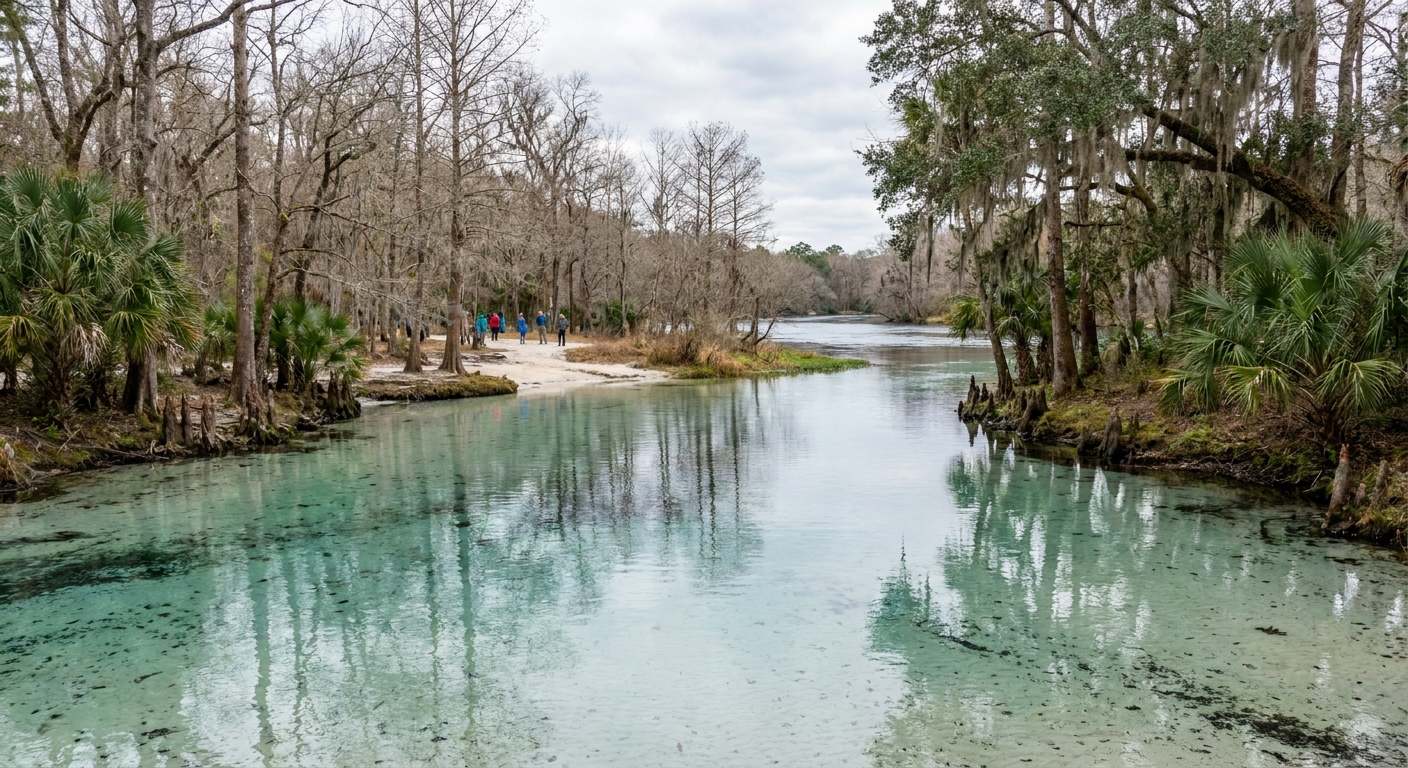
THE MONTH AT A GLANCE · TROY SPRING · JANUARY
Come in January for a 71.4°F swim under a 65.9°F sky, and come dressed for a morning that averages 41.8°F.
AIR 65.9°F / 41.8°F · WATER 71.4°F AT THE GAUGE · 5.7 WET DAYS · 10H 28M OF DAYLIGHT
Go for: water reading 71.4°F while the average afternoon air sits at 65.9°F, a 0.4-mile paddling trail served by one launch, and a lot of 25 spaces that summer Saturdays fill.
Think twice before: planning a sunrise swim: 8.5 January nights fall to 32°F or below, and the sun does not rise until 7:27 a.m.
Air: NOAA NCEI 1991-2020, Cross City AP · Water: USGS gauge 02320250 · Park counts: Florida DEP 2024 inventory · full sources at the end
On this page
- Troy Spring weather in January65.9°F days, 41.8°F nights, 5.7 wet days
- How cold the water feels in winter71.4°F at the gauge, and 8.5 freeze nights
- Crowds, parking and what a visit costs25 spaces, and the fee we could not read
- Things to do at the parkOne swim area, one launch, 0.4 miles of paddling trail
- A two-day plan for a January visitHour by hour on 10h 28m of daylight
- January, December or February?How the three months compare
- Is January worth the drive?Who it suits, and who should wait for February
The dated questions get their answers below. The rest lives in other guides: our month-by-month verdict for the state places January in the dry season, the manatee guide handles the winter wildlife question, and the main Troy Spring guide covers the park in any month of the year.
Troy Spring weather in January: average highs, lows and rain days
| Measure | January | Source |
|---|---|---|
| Average high | 65.9°F | NOAA NCEI 1991-2020, Cross City AP |
| Average low | 41.8°F | NOAA NCEI 1991-2020, Cross City AP |
| Precipitation | 3.38 in | NOAA NCEI 1991-2020, Cross City AP |
| Days with 0.10 in or more | 5.7 | NOAA NCEI 1991-2020, Cross City AP |
| Days with 1 in or more | 0.8 | NOAA NCEI 1991-2020, Cross City AP |
| Nights at 32°F or below | 8.5 | NOAA NCEI 1991-2020, Cross City AP |
| Daylight on Jan 15 | 10h 28m | sunrise-sunset.org |
| Spring water | 71.4°F, one instantaneous reading | USGS gauge 02320250 |
Every air figure here comes from one place: NOAA NCEI’s 1991-2020 monthly normals for station USW00012833, the airport at Cross City, about 27 miles (44 km) from the spring. That is a real thermometer rather than a grid cell of reanalysis, and it is the nearest station with a full normals record. It also measures air. January’s 65.9°F high and 41.8°F low describe the sky over the spring, never the pool under it.
Rain reaches 0.10 inch on 5.7 days of an average January, so count on measurable rain roughly one day in five. The 3.38 inches that fall over the month mostly arrive in small installments, because only 0.8 day reaches a full inch, which puts one genuine soaking in roughly four Januaries out of five. Drizzle at 71.4°F water temperature costs a swimmer very little, and it costs a picnic the whole afternoon.
Day and night sit 24.1°F apart, a wide spread for Florida and wide enough to change the bag twice in one visit. Pack for 41.8°F at the car door and 65.9°F by mid-afternoon: a fleece and a windproof shell over the swimsuit, a wool hat for the first hour, one towel per person and a dry change of clothes. Closed shoes beat flip-flops on a 41.8°F morning.
On January 15 the sun rises at 7:27 a.m. and sets at 5:55 p.m. local time, which gives 10 hours 28 minutes of daylight, according to sunrise-sunset.org. The usable stretch is shorter, since the air needs the morning to climb from its overnight low toward the 65.9°F peak. Treat 11 a.m. to 4 p.m. as the swimming window and build the drive home around a 5:55 p.m. sunset.
How warm is Troy Spring in January?
The month’s two poles are 65.9°F in the afternoon and 41.8°F before dawn, 24.1°F apart. The water sits above both. The USGS gauge at Troy Spring read 71.4°F (21.9°C) on September 11, 2026, and it reads close to that on any day of the year, because the aquifer feeding it has no season. That is a single instantaneous reading rather than a monthly average, and we found no monthly series for the spring, so take 71.4°F as the order of magnitude and not as a forecast.
In practice you arrive in a coat and swim in the middle of the day. The first hour at the lot is fleece-and-beanie work, and by noon a long-sleeve layer over shorts is plenty. The step in still shocks: 71.4°F is cold enough that most people gasp, even though the pool runs warmer than the average January afternoon they left on the bank. Getting out is the cold part, with wind on wet skin at 65.9°F, so stage the towel and the dry layer before you go in.
Freezing nights are real this far north: 8.5 of them in an average January, roughly one night in four, measured at Cross City. None of them touch the water. They touch the walk back to the car, the wet towel and anything left outside overnight. If you are sleeping nearby, that is the number to plan around; if you are driving in for the day, the freeze is long gone by the time you park.
How busy is Troy Spring in January? Crowds, prices and the demand peak
Where January sits in the price year is something we cannot rank. We found no occupancy series and no monthly room-rate figures for the area around the spring, so we crown no month cheapest and none expensive. What the state does publish is a capacity: Florida DEP’s 2024 facilities inventory counts 25 parking spaces at Troy Spring State Park, and that number, not an opening hour, is what decides a summer Saturday, because when the lot fills the gate closes.
That reframes the booking question for a winter visit. Twenty-five spaces cannot be reserved, so the lead time that matters in January is measured in hours: aim for the first half of the 11-to-4 window rather than rolling up at two o’clock. For a bed within driving distance we have no rate data and will not invent a number of weeks, and our Florida trip-cost guide handles the budget side of a winter week.
We could not verify a lodging-tax rate for the county, so we give no percentage. We could not read an entrance fee or an opening hour either: floridastateparks.org answered our automated reads with a 403 on September 11, 2026, and the FWC manatee pages render client-side. Call the park the morning you drive, and carry both cash and a card for a gate whose price we are unable to quote.
One outlay does change the month, and it is thermal. A shorty or a full wetsuit turns a ten-minute January swim into an hour of snorkeling over the vent, where a rash guard will not. We have no rental price to give you. Second best, and cheaper: a changing robe, a thermos and a second towel in the trunk, because the difficult minutes come after the swim rather than during it.
Things to do in Troy Spring in January
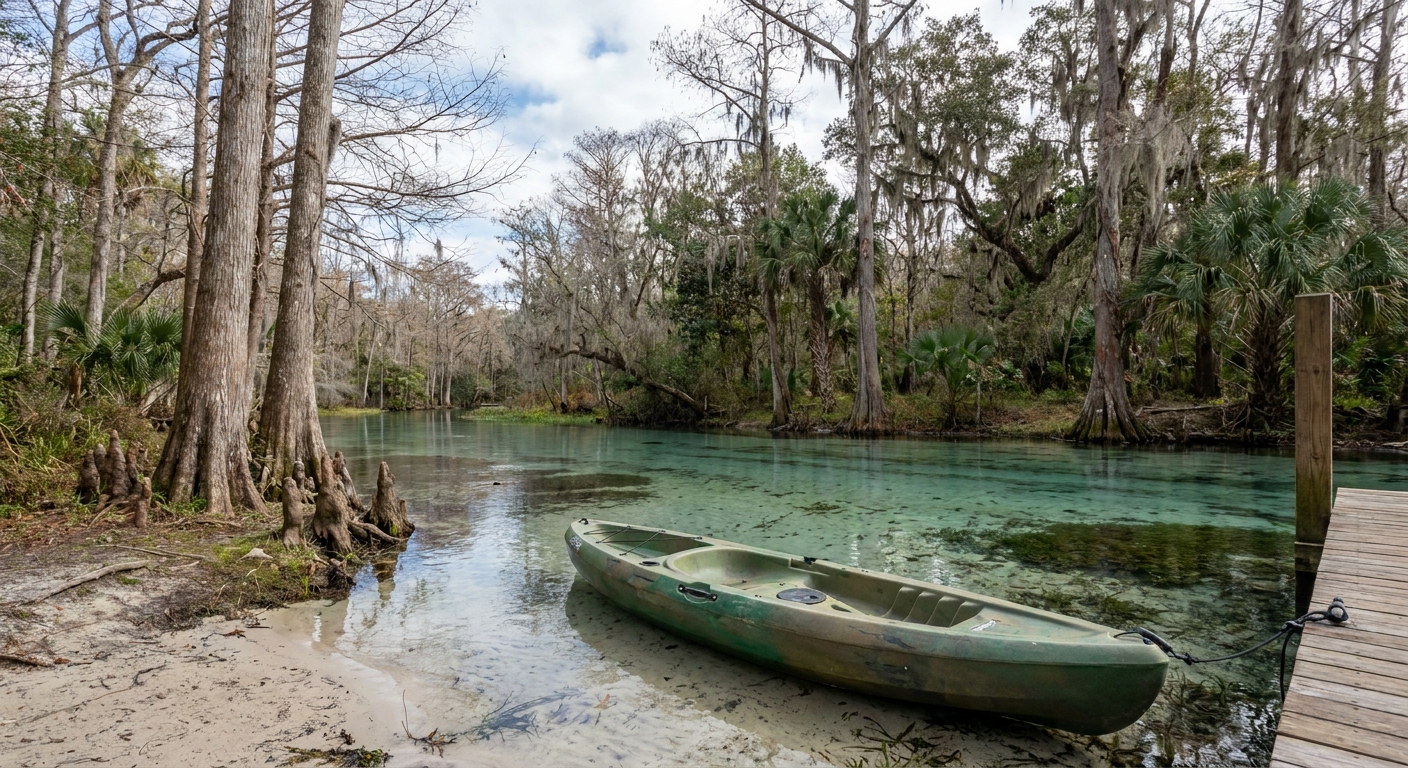
What January allows, and high summer does not, is the reversal of the gap. With the spring at 71.4°F under a 65.9°F sky, the water becomes the warm place, so the swim leads the day instead of cooling it down at the end. Snorkeling and free-diving stay available all winter for the same reason: the spring never drops. So does the paddle, since a 41.8°F dawn changes nothing about the run itself.
Florida DEP’s 2024 inventory counts the whole park in one short list: 1 designated swimming area, 1 launch shared by canoes, kayaks and tubes, 0.4 miles of paddling trail, 0.3 miles of hiking trail, 50 feet of boardwalk and 25 parking spaces. That is a half-day park with a first-rate pool, not an all-day one, and it pairs naturally with a second stop from our statewide shortlist.
Across the three winter months the spring holds its 71.4°F while the average afternoon moves from 68.2°F in December to 65.9°F in January and 69.6°F in February. January therefore puts the pool 5.5°F above the sky, the widest margin of the three. The equipment follows the air rather than the water: 0.3 miles of hiking works as a warm-up before the swim in January, and 50 feet of boardwalk is a place to leave a towel where the sun reaches it.
As for what costs nothing this month, we can only report what we could and could not read. The DEP inventory lists facilities, never prices. The state park website refused our automated reads on September 11, 2026 with a 403, so we have no entrance fee, no winter rate and no fee-free day to pass on. Anything free at the gate in January will have to be confirmed at the gate.
Troy Spring in January: a two-day itinerary
Day one runs on the light. Leave late enough that the 41.8°F low is behind you and reach the lot around 10 a.m., while the air is still climbing. Walk the 0.3-mile trail first to warm up, swim between 11 and 2 when the air is nearest 65.9°F, then eat in the sun afterward rather than in the shade before. Be dressed and dry by 4 p.m.: sunset on January 15 falls at 5:55 p.m., and a mid-afternoon finish keeps the drive out in daylight.
Day two belongs to the launch. One ramp serves canoes, kayaks and tubes, and 0.4 miles of marked paddling trail is a slow hour, not an expedition, which leaves the afternoon for the road. If the weather turns you are looking at one of the month’s 5.7 wet days, and drizzle costs a paddler far less than it costs a picnicker. If a front drops the air as well, swap the water day for driving and let our getting-around guide sort the route.
Troy Spring in January vs December and February
| Measure | December | January | February |
|---|---|---|---|
| Average high | 68.2°F | 65.9°F | 69.6°F |
| Average low | 44.4°F | 41.8°F | 45.2°F |
| Precipitation | 2.95 in | 3.38 in | 2.96 in |
| Days with 0.10 in or more | 4.6 | 5.7 | 4.8 |
| Spring water | 71.4°F at the gauge | 71.4°F at the gauge | 71.4°F at the gauge |
All three columns come from the same NOAA NCEI 1991-2020 series at Cross City, so the months are directly comparable. January is the coldest by day, 2.3°F under December and 3.7°F under February, and the coldest by night, 2.6°F under December and 3.4°F under February. It is also the wettest of the three, by 0.43 inch over December and about one extra wet day. The spring reads 71.4°F through all of it. That constant is what tilts the comparison.
Shift four weeks forward and February hands back 3.7°F of afternoon, 3.4°F of night and 0.42 inch of rain, while taking away nothing you can measure in the water. Shift four weeks back and December is 2.3°F warmer by day with 0.43 inch less rain, though its final two weeks are the holidays and the lot still holds 25 cars. Either way the air moves less than 4°F and the swim stays identical.
Is January a good time to visit Troy Spring?
Yes, for anyone who came for the water. The swim area, the launch and the 0.4-mile paddling trail all work under a 65.9°F afternoon, and 71.4°F is 71.4°F in January exactly as in July. No, for anyone whose day depends on the bank rather than the pool: a long lazy float, a picnic in a breeze, small children who will be out of the water in ten minutes and cold in eleven. No, too, for sunrise people, with first light at 7:27 a.m. and 8.5 nights at or below freezing.
If that is you, February is the better fix, not December: 69.6°F afternoons, 45.2°F nights, 4.8 wet days instead of 5.7, the holiday weeks well behind and the same 71.4°F water waiting. December beats January by 2.3°F in the afternoon and runs drier, but Christmas and New Year land inside it, and the gate still closes when 25 cars are parked.
Only January lifts the spring 5.5°F above the average afternoon, the widest margin of the three winter months, which means the water is the warmest place you will stand all day.
The last word
Pick your day rather than your week: with 5.7 wet days in the month, January leaves you 25 dry ones to choose from, and the swim is the same on every one of them. Call the park before you set off, since we could not read its hours or its entrance fee. One thing worth knowing on the drive up: Florida law keeps a protected class it calls Outstanding Florida Springs, defined in Statute 373.802(5) as every historic first-magnitude spring the Florida Geological Survey determines, plus six named by hand in the statute. We did not verify which side of that line Troy Spring sits on, and the gauge reads 71.4°F either way.
Sources & data for this guide
- January air normals: high 65.9°F, low 41.8°F, 3.38 in, 5.7 days at 0.10 in, 0.8 day at 1 in, 8.5 nights at 32°F or below · NOAA NCEI monthly normals 1991-2020, station USW00012833, Cross City AP, FL, about 27 miles (44 km) from the spring · checked Sep 24, 2026
- December and February normals used in the comparison · same NOAA NCEI 1991-2020 series, same station · checked Sep 24, 2026
- Daylight of 10h 28m, sunrise 7:27 a.m. and sunset 5:55 p.m. local on January 15 · sunrise-sunset.org · checked Sep 24, 2026
- Water temperature of 71.4°F (21.9°C), a single instantaneous reading rather than a monthly mean · U.S. Geological Survey, National Water Information System, station 02320250 Troy Spring · read Sep 11, 2026
- Counts of parking spaces, swimming area, launch, paddling trail, hiking trail and boardwalk · Florida Department of Environmental Protection, Recreational Facilities Inventory, 2024 annual report · checked Sep 24, 2026
- Definition of Outstanding Florida Springs · Florida Statutes 373.802(5) · checked Sep 24, 2026
- We could not verify an entrance fee, an opening hour, a county lodging-tax rate or a manatee count: floridastateparks.org returned 403 to our automated reads and the FWC manatee pages render client-side · Sep 11, 2026