
FLORIDA · JULY · NOAA 1991-2020 NORMALS
In January the state pulls itself apart: our best-time verdict has Jacksonville near 65°F while Miami holds 76. July does the opposite. Every one of the six cities HERE posts a July average high between 90.0°F and 92.0°F, so the map stops arguing about daytime heat and starts arguing about nights, rain gauges and water temperature.
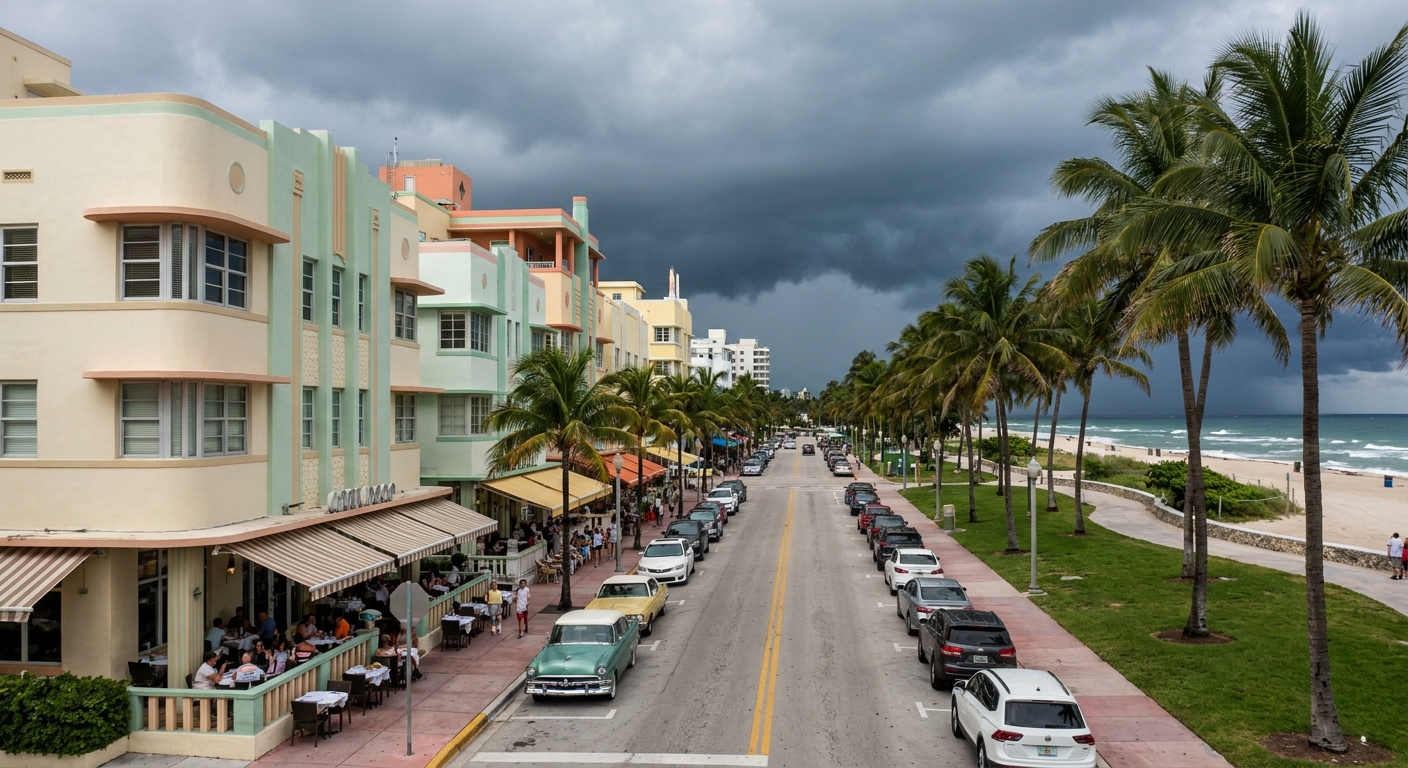
This is wet-season Florida: bath-warm water on both coasts, sun on the sand until 8:29 p.m. in Tampa, a thunderstorm on most afternoons, and a hurricane season that has been open since June 1. It suits a swimming trip and punishes a walking one.
FLORIDA IN JULY · AT A GLANCE
July gives Florida its warmest, calmest swimming and daylight past 8 p.m., and charges for it with 90-degree heat from Key West to Jacksonville and a storm most afternoons.
WET SEASON: MAY–OCT · HURRICANE SEASON OPEN SINCE JUNE 1 · SIX NOAA STATIONS · SWIM, DON’T HIKE
Go for: Gulf and Keys swimming at 88 to 90°F, beach evenings that run past 8 p.m., the interior springs, and a theme-park week built around a pool.
Think twice before: planning an Everglades walking day, a midday inland hike, or a non-refundable week if a named storm would wreck your budget.
Normals: NOAA NCEI 1991-2020 · Sea: Open-Meteo Marine · Hurricanes: NOAA NHC · full sources at the end
On this page
- July temperatures in Miami, Orlando and TampaHighs of 90.0°F to 92.0°F, city by city
- Is July the rainy season in Florida?Wet season, May through October
- Sea temperature in July, Atlantic vs Gulf88.1°F off Fort Lauderdale, 89.9°F off Tampa
- How busy Florida is in JulyJuly against the February to April peak
- Things to do in Florida in JulyFree trolleys, $20 at Vizcaya, $35 park entry
- Best region to visit in JulyThe Gulf coast and the Keys
- Florida in July vs June and AugustMiami’s gauge: 10.51 in June, 7.36 in July
- Is July a good time to visit Florida?Good for water, poor for wildlife trails
Every figure HERE comes from a named gauge: NOAA’s official 1991-2020 monthly normals for six real stations, from Key West International (USW00012836) to Jacksonville International (USW00013889), rather than a modeled grid. The sea readings come from the Open-Meteo Marine archive, averaged over 2015 to 2024. For the full twelve-month picture, and the case for the dry season, see our best-time verdict.
Florida weather in July: highs, lows and rain in six cities
| City (NOAA station) | Avg high | Avg low | Rain | Days ≥ 0.10 in |
|---|---|---|---|---|
| Miami (Miami Intl, USW00012839) | 90.6°F | 77.5°F | 7.36 in | 11.1 |
| Fort Lauderdale (FLL, USW00012849) | 90.0°F | 77.6°F | 5.41 in | 10.6 |
| Key West (Key West Intl, USW00012836) | 90.2°F | 80.6°F | 3.63 in | 6.8 |
| Orlando (Orlando Intl, USW00012815) | 92.0°F | 73.2°F | 7.46 in | 11.5 |
| Tampa (Tampa Intl, USW00012842) | 91.0°F | 76.6°F | 7.75 in | 11.2 |
| St. Augustine (Jacksonville Intl, USW00013889) | 91.9°F | 73.2°F | 6.77 in | 9.9 |
The eleven-degree January gap between Jacksonville and Miami almost vanishes in July. The six highs HERE run from 90.0°F at Fort Lauderdale to 92.0°F at Orlando, a spread of two degrees across roughly 400 miles of latitude. The difference relocates to the night: Key West averages a low of 80.6°F while Orlando and St. Augustine both average 73.2°F, a gap of 7.4 degrees that decides whether a 7 a.m. walk is a pleasure or a chore.
The state sorts by function rather than by compass this month. Orlando and St. Augustine are the daytime furnaces at 92.0°F and 91.9°F, with the coolest nights of the six. Key West is mildest by day and warmest by night. Tampa holds the wettest gauge at 7.75 inches, and Fort Lauderdale, up the same Atlantic shore, records nearly two inches less rain than Miami. One caveat: St. Augustine has no long-record station of its own, so its numbers are Jacksonville International’s.
Wet days are the season’s signature, and they are not lost days. Orlando averages 11.5 July days with at least 0.10 inch of rain but only 2.0 with an inch or more, which is the difference between a storm that clears the pool for an hour and one that ends the afternoon. Miami reads 11.1 and 2.2, Tampa 11.2 and 2.3. Key West lives in another climate at 6.8 and 0.8, barely one wet day in five.
The day-to-night swing decides what goes in the bag. Orlando drops 18.8 degrees overnight, Key West only 9.6, and nothing among the six falls out of the 70s after dark, so a jacket is dead weight. What earns its place: a rain shell that folds into a pocket, a dry second shirt for after the four o’clock downpour, water shoes for the Gulf shallows, and more sunscreen than you think.
Daylight is the month’s quiet advantage. On July 15 St. Augustine gets 13 hours 55 minutes of it, Orlando 13:49, Tampa 13:47, Miami 13:38 and Key West 13:33. In practice, Miami’s sun is up at 6:38 a.m. and down at 8:15 p.m., and Tampa keeps the beach lit until 8:29 p.m., which is how a family still gets a swim in once the storms have rolled through.
Is July in Florida’s dry season or wet season?
July belongs to the wet season. Statewide, the dry season runs November through April and the wet season May through October, so July sits in the middle third of the wet run rather than on its edge. It is not the wettest of the six, either: Miami’s gauge records 10.51 inches in June, the peak of its year, against 7.36 in July.
A wet-season day has a predictable shape. Mornings tend to be clear, heat and humidity build inland through late morning, and the storm arrives in the afternoon, hard and brief. Miami’s 2.2 days at an inch or more are the ones that cancel a boat trip; the other nine wet days rearrange a schedule instead. Anything that must happen outdoors goes before noon, and timed-entry tickets go in the morning slot.
The Atlantic hurricane season is open in July, which is a calendar fact and not a forecast. NOAA runs it from June 1 to November 30, with the statistical peak on September 10 and most activity between mid-August and mid-October. July falls inside the window and ahead of that busy stretch. Neither reason to cancel, nor reason to book as though the season did not exist.
Two moves cover it at the reservation stage. Take the refundable rate when the gap is small, and check the tropics in the week before departure rather than the month before, since nothing useful is knowable at 30 days. Insurance earns its cost far more in September than in July, and our know-before-you-go notes spell out what a named storm does to a booking.
Can you swim in Florida in July? Sea temperature by coast
Both coasts swim in July, and the Gulf wins the thermometer. Off Tampa the surface averages 89.9°F, off Key West 88.7, off Miami 88.2 and off Fort Lauderdale 88.1. The far north of the Atlantic shore is the outlier at 84.5°F off St. Augustine, more than five degrees cooler than Tampa Bay, which in a month like this reads as a feature.
One nuance about those five figures. They are means of DAILY MAXIMA from the Open-Meteo Marine archive over 2015 to 2024, so they sit a shade above a true 24-hour average, and they describe open surface water rather than the shallow, sun-baked strip where children actually stand. Use them to compare coasts, accurate to a degree or so, not as a lifeguard’s reading at 7 a.m.
How busy is Florida in July?
Florida’s demand cycle peaks in the dry season, not in July. Our best-time verdict puts February through April at the top of the year, with holiday weeks and March spring break as the loudest single stretches. July arrives with school out, which fills the theme-park corridor and the Gulf family beaches while the winter destinations, the Everglades and Naples among them, run quiet.
That changes what needs booking first. Orlando resorts, Gulf rental weeks and anything containing the Fourth of July move earliest, while a Miami Beach room is easier to find in July than in March. Watch the add-ons more than the rate: Miami Beach hotels commonly stack a nightly resort fee on the room, quoted anywhere from about $25 on average up to $35 or $95 by property, and South Pointe Park’s lot goes to a $20 flat day rate on weekends and public holidays.
What cannot be put in a number: Florida publishes no monthly visitor series we would stand behind, city-level occupancy for July is a commercial product rather than an official statistic, and theme-park attendance calendars are proprietary. So we make no claim about July being the second or the fifth busiest month of the state’s year. Anyone who gives you that figure has estimated it.
Things to do in Florida in July
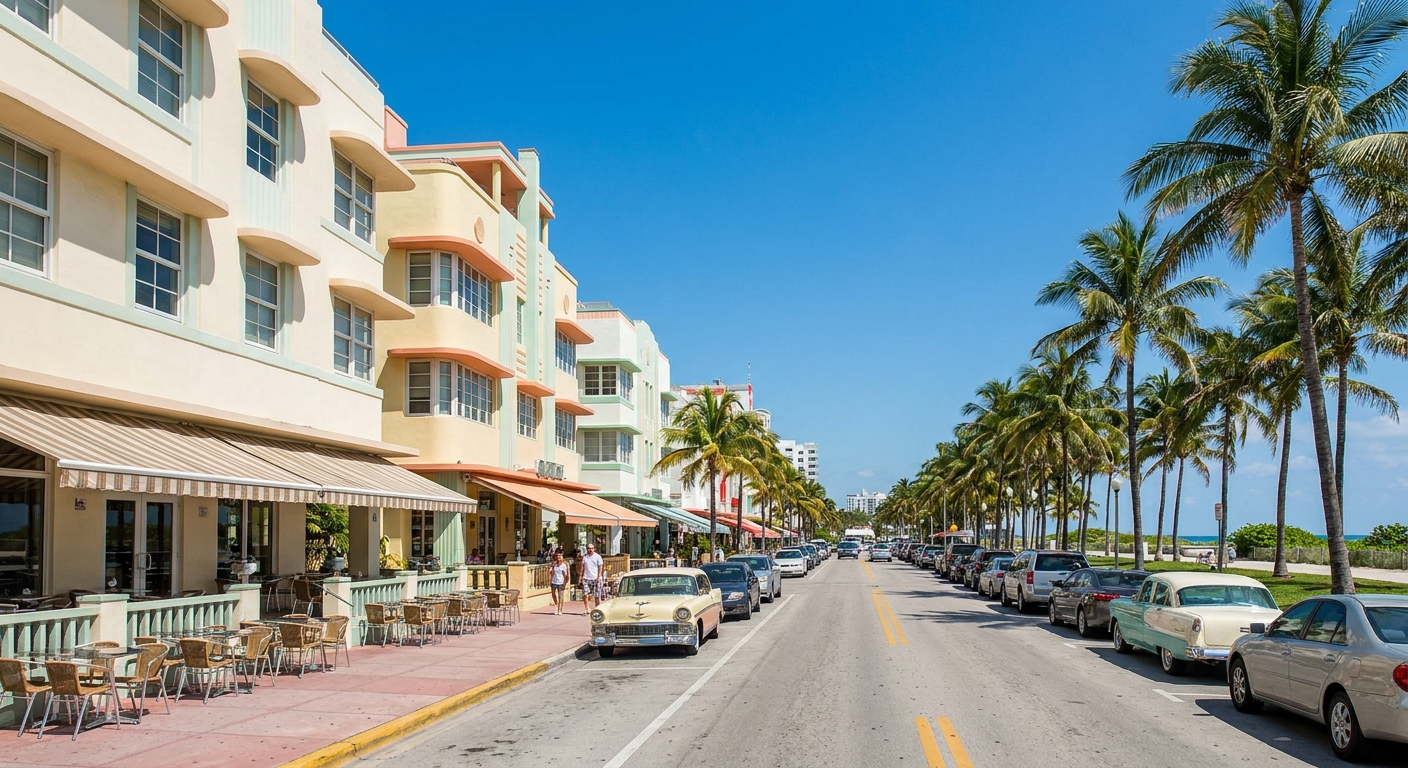
July permits two things the dry season does not. Swimming with no hesitation on either coast, at 88.1°F off Fort Lauderdale and 89.9°F off Tampa, and a real evening on the sand: sunset falls at 8:29 p.m. in Tampa on July 15 and 8:15 p.m. in Miami. The interior springs are also at their most welcome in the heat, which is why our statewide list pushes them to the front of a summer week.
Four fixtures with hours and a price, for a month where the afternoon needs a plan. Vizcaya Museum and Gardens in Coconut Grove opens Wednesday to Monday from 9:30 a.m., last admission 4:30 p.m., closed Tuesdays: $20 for adults during the restoration work, down from $25, and $5 for ages 6 to 12. The Miami Beach trolley is free, 8 a.m. to 11 p.m. daily, roughly every 20 minutes on five routes. Lummus Park, the beach fronting Ocean Drive from 5th to 15th, is free and open 24 hours with lifeguards. Parking at Crandon Park on Key Biscayne runs $7 on weekdays, $10 at weekends.
Where to go in Florida in July: best regions and beaches
The Gulf coast takes the month. Tampa’s July normal is 91.0°F by day with the warmest water in our set at 89.9°F, and the west-coast sea runs calmer than the Atlantic side, which matters when small children are standing in it. Siesta Key and the Panhandle strand around South Walton are the classic July beds, and both put a morning swim within walking distance of the room.
The Everglades lose, and they lose for a specific traveler. Entry costs $35 per private vehicle for seven days, the three entrances and the Flamingo Visitor Center sit at least an hour’s drive apart, and the wildlife that made the park famous concentrates in the dry season, when the water level drops. A July day out there is heat, mosquitoes and driving. Wildlife photographers and anyone planning an inland walking day should read the Everglades guide and then book December.
The Keys follow neither the north nor the center. Key West records 3.63 inches of July rain across 6.8 wet days, against Orlando’s 7.46 inches and 11.5, so the islands run drier in the wet season than the peninsula they hang off. The trade is the night, with an average low of 80.6°F and no cool morning window at all. Key West stays viable in July, and so does the boat out to the Dry Tortugas.
If you read one line: swim on the Gulf side or in the Keys, be on the sand before 9 a.m., and hand the three o’clock hour to a museum, a pool or the drive to dinner. The seven-day route still works this month with one substitution, Gulf beaches where the winter version sends you inland, and the family notes cover the pool-versus-park math.
Florida in July vs June and August
| Month | Miami rain, NOAA 1991-2020 | Position in hurricane season |
|---|---|---|
| June | 10.51 in · the wettest month of Miami’s year | Season opens June 1 |
| July | 7.36 in · 11.1 days at 0.10 in or more | Inside the season, ahead of its active stretch |
| August | Not among the normals pulled | Mid-August begins the most active stretch, which runs to mid-October |
On rain, the comparison is clean at one gauge: Miami International records 10.51 inches in June against 7.36 in July, so July is more than three inches drier there than the month before it. On air and sea temperature we hold July values only for the six stations, and August’s normals are not among them, so no August high or water figure appears in this comparison. Naming the hole beats filling it with a guess.
Shift four weeks earlier and you trade July’s rain for June’s, Miami’s wettest month of the year, in exchange for a hurricane calendar that has only just opened on the 1st. Shift four weeks later and the water stays warm while the calendar turns against you: mid-August is where NOAA’s most active stretch begins, and it does not release until mid-October.
By profile, then. Swimmers and divers can take any of the three, since July’s readings run 88.1°F to 89.9°F on both coasts and the neighboring months sit in the same summer regime. Families locked to school dates take July and plan around the afternoon storm. Anyone booking non-refundable, or flying on a fare that cannot move, takes June over August and leaves September alone, since the peak lands on the 10th.
Is July a good time to visit Florida?
Yes, with conditions. July works if the trip is built around water, air conditioning and early starts: Gulf or Keys swimming, a park week with a pool in the middle of it, a spring, an aquarium at three in the afternoon. It works badly if the plan is inland walking, the Everglades in daylight, or a fortnight of non-refundable bookings made without a glance at the tropics.
When the answer comes out no, the alternative is the dry season, November through April, when the humidity drops, the mosquitoes retreat and the wildlife gathers at the water that remains. The twelve-month verdict argues it out month by month, and the where-to-stay guide shows how much the region choice shifts with the season.
The last word
In July the hour matters more than the region: book your mornings, keep 2 to 6 p.m. loose, and the month behaves. One fixture worth writing into a storm evening is the Pérez Art Museum Miami, free from 5 to 9 p.m. every Thursday and free all day on the second Saturday of the month, with art-making from 11 a.m. to 3 p.m. A washed-out Miami afternoon has a $0 answer with a bay view attached.
Sources & data for this guide
- July normals for Miami (USW00012839), Key West (USW00012836), Orlando (USW00012815), Tampa (USW00012842), Fort Lauderdale (USW00012849) and Jacksonville Intl (USW00013889) · NOAA NCEI 1991-2020 monthly normals · checked Sep 14, 2026
- Sea surface figures, means of daily maxima 2015-2024 · Open-Meteo Marine API · checked Sep 14, 2026
- Sunrise, sunset and daylight length on July 15 · sunrise-sunset.org, converted to America/New_York · checked Sep 14, 2026
- Hurricane season dates, Sept 10 peak and the mid-August to mid-October stretch · NOAA National Hurricane Center · checked Sep 14, 2026
- Dry season November-April and wet season May-October · our Florida best-time page · checked Sep 14, 2026
- Everglades entry fee and entrance spacing · National Park Service · checked Sep 14, 2026
- Vizcaya hours and admission · vizcaya.org · Pérez Art Museum free hours · pamm.org · Miami Beach free trolley · City of Miami Beach · checked Sep 14, 2026
- Beach and park parking rates (South Pointe, Crandon) and Miami Beach resort fees · city and county pages plus fee comparators · checked Sep 14, 2026 · rates change and the resort-fee range is wide by property
- St. Augustine has no long-record NOAA station: the figures given are Jacksonville International’s, the nearest gauge with a full 1991-2020 series. No monthly visitor or occupancy series for Florida was used, because none we found is official; August normals were not pulled for this guide.