
FLORIDA · AUGUST · NOAA 1991-2020 NORMALS
By nine in the morning the sand at Lummus Park is already too hot for bare feet, and by three the sky inland has built a white wall that will drop an inch of rain on somebody. August runs Florida on that schedule, day after day, from the Panhandle to the last bridge before Key West. The water, meanwhile, sits at bath temperature on both coasts, which is the whole argument for coming.
The state is not one climate, it is six. In August the daytime highs converge inside a degree and a half from Jacksonville to Key West, while the nights spread seven degrees apart and the rain totals nearly double between the Keys and Miami. So the useful question is never the temperature of Florida. It is which latitude, and which coast.
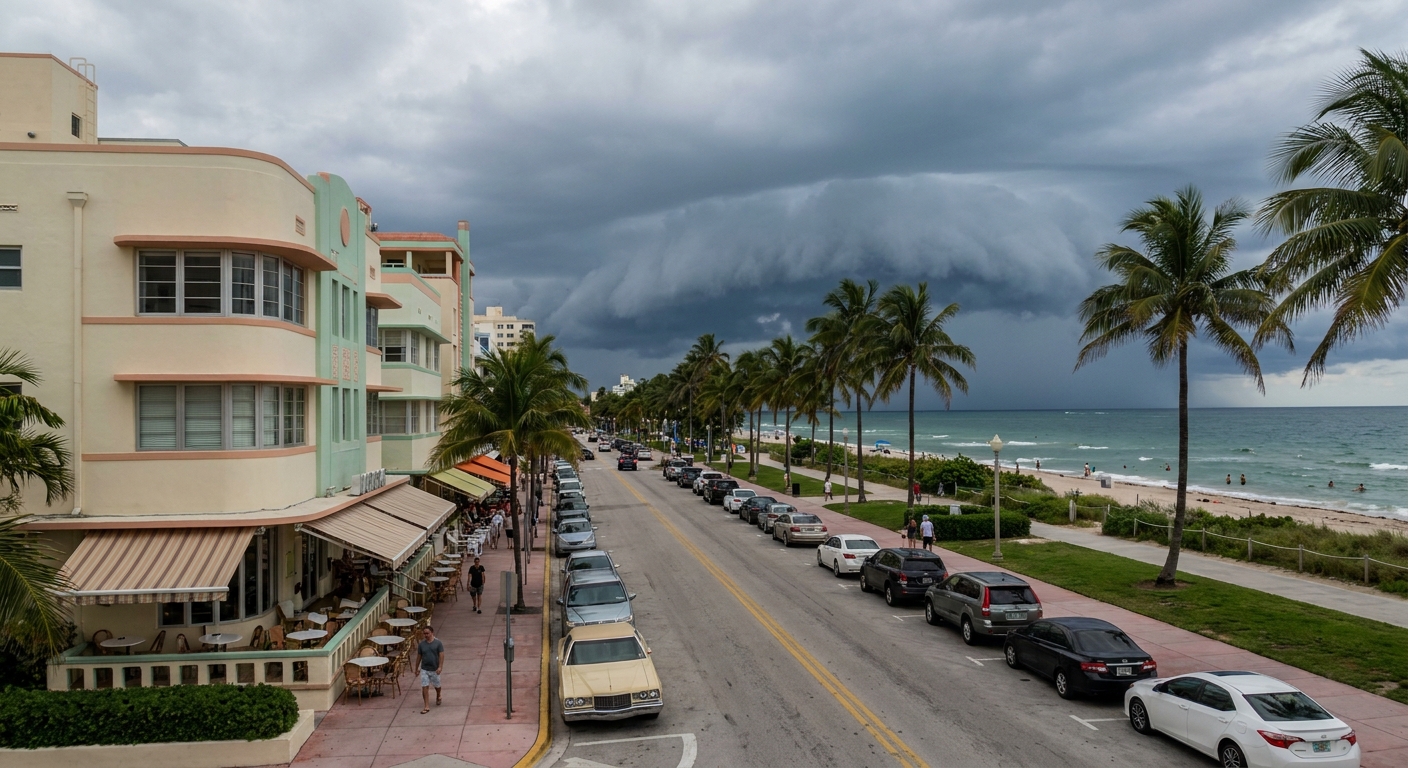
THE MONTH AT A GLANCE · FLORIDA IN AUGUST
August gives you the warmest water of the trip and the loudest afternoons: swim early, plan indoor hours from two to five, and keep the back half of the booking refundable.
WET SEASON · SEA 88 TO 89°F · HURRICANE WINDOW OPEN
Go for: sea at 88 to 89°F on both coasts, dawn swims, beach evenings that run past 8 p.m. on the Gulf, and the Keys’ driest month total of the six cities tracked here.
Think twice before: building the week around outdoor hours from noon to five, Everglades wildlife, or any hotel rate you cannot cancel.
Climate: NOAA NCEI 1991-2020 station normals · Sea: Open-Meteo Marine · Storms: NOAA National Hurricane Center · full sources at the end
On this page
- Average temperatures and rainfall by citySix NOAA stations, August normals
- Dry season or wet season in AugustWet season, May through October
- Sea temperature for swimming88°F Atlantic, 89°F Gulf
- How busy the state is in AugustWinter and spring hold the demand peaks
- Things to do in the heatVizcaya, PAMM, the free Metromover
- Where to go in AugustThe Keys, the northeast coast, Orlando
- August against July and SeptemberThe September 10 hurricane peak
- Is August a good time to visit?Who should go, who should wait
Six cities carry the month here, each with its own airport gauge: St. Augustine, Orlando, Tampa, Fort Lauderdale, Miami and Key West. The twelve-month view of the state lives in the best-time guide, and the practical layer of driving, tolls and beach parking lives in getting around Florida.
Florida weather in August: average temperatures and rainfall by region
| City (NOAA station) | Avg high | Avg low | Rain | Days ≥0.10 in | Sea, daily max avg |
|---|---|---|---|---|---|
| St. Augustine (Jacksonville Intl) | 90.8°F | 73.4°F | 6.88 in | 10.3 | 84.0°F |
| Orlando (Orlando Intl) | 91.6°F | 73.7°F | 7.69 in | 11.5 | Inland |
| Tampa (Tampa Intl) | 91.2°F | 76.8°F | 9.03 in | 11.2 | 89.2°F (Gulf) |
| Fort Lauderdale (FLL) | 90.0°F | 77.9°F | 7.89 in | 11.2 | 88.2°F (Atlantic) |
| Miami (Miami Intl) | 90.7°F | 77.7°F | 9.58 in | 13.3 | 88.3°F (Atlantic) |
| Key West (Key West Intl) | 90.6°F | 80.5°F | 5.37 in | 9.1 | 88.8°F (Atlantic) |
Daytime highs barely move across 450 miles of state: 90.0°F at Fort Lauderdale-Hollywood, 91.6°F at Orlando International, a spread of 1.6 degrees. The nights are where Florida splits in two. The St. Augustine area gauge averages 73.4°F overnight, Key West 80.5°F, seven degrees apart. Compare that with January, when the north sits around 65°F in the daytime against Miami’s 76°F (the twelve-month view has the full curve). August erases the daytime gap and moves the whole difference after dark.
Every figure here is a NOAA NCEI monthly normal for 1991-2020, read off named airport stations rather than pulled from a reanalysis grid: Miami International (USW00012839), Key West International, Tampa International, Orlando International, Fort Lauderdale-Hollywood, and Jacksonville International, which serves as the official gauge for the St. Augustine stretch. Across the six, one pattern holds: everybody is near 91°F by day, and only the overnight low and the rain total tell them apart.
Miami records 13.3 days of at least a tenth of an inch in an average August, Key West only 9.1. The heavier count matters more for a plan: 2.9 days at Miami International and 2.9 at Tampa International reach a full inch or more. That is the shape of a wet-season afternoon. The rain builds after lunch, comes down hard for half an hour, and leaves the pavement steaming. It rarely takes the whole day, and it rarely spares the three o’clock plan.
The swing between afternoon and dawn runs from 10.1 degrees at Key West to 17.9 at Orlando. Nothing in that range asks for a sweater outdoors. The chill you will actually feel comes from indoors, where restaurants, park queues and rental cars run their air-conditioning hard. Pack a light long-sleeve for the inside, quick-dry clothes for the outside, a dry bag for the storm hour, and shoes you don’t mind soaking. Sunscreen is equipment at these latitudes.
On August 15, Miami gets 13 hours 04 minutes of daylight, sunrise at 6:52 a.m. and sunset at 7:57 p.m. Eastern. St. Augustine takes the longest day of the six at 13 hours 15 minutes, Key West the shortest at 13 hours 01. Tampa holds light until 8:09 p.m., which buys a whole Gulf beach evening once the storms have moved through.
Is August in Florida’s dry season or wet season?
August sits squarely in the wet season. Statewide, Florida’s dry season runs November through April and the wet one May through October, the split we use across every Florida page. August is the fourth month of the wet half, and the totals show it: 9.58 inches at Miami International, 9.03 at Tampa, 7.69 at Orlando, and 5.37 down in Key West.
In practice the wet season reorganizes the clock instead of canceling the day. Heat builds through the morning, sea breezes collide over the interior, and storms fire between roughly two and six in the afternoon. Put the boat trip, the beach and the walking before noon. Put lunch, the museum and the nap in the middle. Outdoor rides and boardwalks pause during lightning, one more argument for a morning-first version of the same itinerary.
The Atlantic hurricane season runs June 1 to November 30, with most activity between mid-August and mid-October and a statistical peak on September 10, per the NOAA National Hurricane Center. August falls inside that window, and its second half falls inside the busier stretch of it. Treat that as a calendar fact. Most August trips see nothing worse than the daily thunderstorm, and the ones that get disrupted are usually disrupted by a named system tracked for several days before it arrives.
So book as though you might have to move. A refundable room rate and a changeable fare cost a little more in August and earn it back the one time they matter. Watch the National Hurricane Center’s five-day outlook in the week before departure, not the long-range chatter. Rebooking decisions typically get made 48 to 72 hours out, when the forecast cone narrows (est.). Our know-before-you-go page covers the insurance side.
Can you swim in Florida in August? Sea temperature by coast
Yes, and warmly. Off Tampa the sea averages 89.2°F in August, the warmest water covered here. On the Atlantic side, Key West runs 88.8°F, Miami 88.3 and Fort Lauderdale 88.2. Go north along that same Atlantic shore and it finally drops: St. Augustine averages 84.0°F, better than four degrees cooler than Miami, which makes the northeast the only genuinely refreshing swim in the state this month.
One caveat on those numbers. They are the mean of daily maxima across 2015-2024 in the Open-Meteo marine series, so they sit a shade above a true 24-hour average, and they describe open surface water rather than a shallow Gulf flat baking all afternoon. Read them as the midday figure, then add a degree or two of imagination for the ankle-deep water at three o’clock.
How busy is Florida in August?
Florida’s demand cycle peaks in winter and spring. The holiday weeks and spring break are the state’s loudest stretches, and Miami Beach spends March running a traffic plan, garage closures and a $548 non-resident towing rate in the Art Deco District (those were the announced 2026 measures, adjusted each winter). August carries none of that machinery.
What that changes at the booking stage: rooms in the beach towns are easier to find than in February, and the real constraint becomes cancellability rather than availability. Book refundable inside the hurricane window and you keep both. Orlando stays the exception, running on the school calendar rather than the weather, and the back-to-school weeks of late August thin family traffic in much of the country (editorial reading, drawn from calendars rather than a visitor series).
What no one here can put a number on: monthly occupancy and monthly room rates for the state. No official monthly price series for Florida exists in our sources, and the market summaries contradict each other. The clearest example is the Miami Beach resort fee, quoted anywhere between roughly $25 a night on average and $35 to $95 by property. Anyone ranking Florida’s months by price is estimating, and so would we be. The tier logic sits in what a Florida trip costs.
Things to do in Florida in August
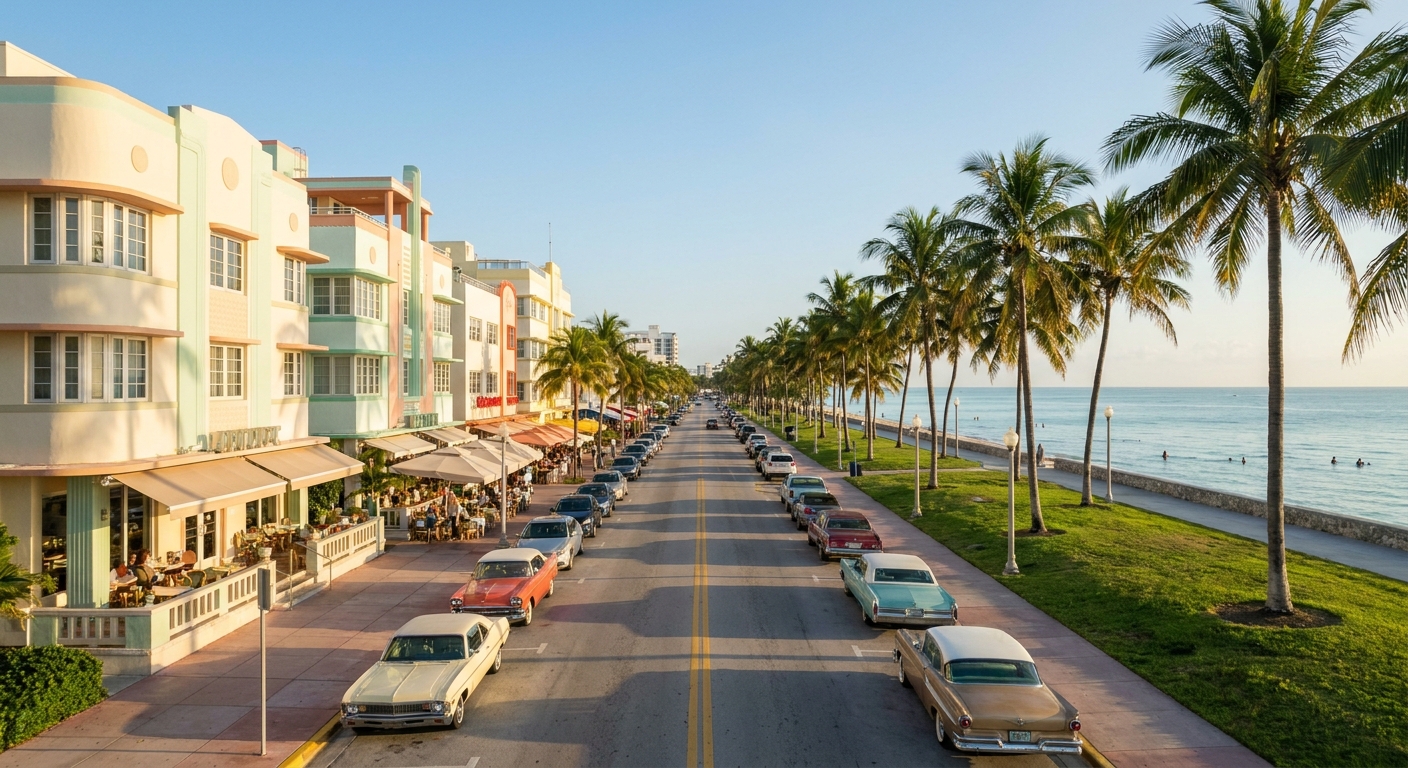
What August gives that the dry season cannot is bathwater. At 88 to 89°F on both coasts, the sea takes no acclimatizing: dawn swims with no shock, snorkeling with no shorty, children who have to be called out. Daylight holds past 8 p.m. on the Gulf, so a beach evening survives the storm that ruined the afternoon. And the Keys post the driest sheet of the six cities, 5.37 inches for the whole month.
For the two-to-five block, three fixed points with hours attached. Vizcaya Museum and Gardens in Coconut Grove: Wednesday to Monday, 9:30 a.m. to a 4:30 p.m. last admission, closed Tuesdays, $20 adult during restoration work and $5 for ages 6 to 12. Pérez Art Museum Miami: free Thursdays 5 to 9 p.m., free all day the second Saturday, art-making 11 a.m. to 3 p.m. The Metromover: free, air-conditioned, every 90 seconds at rush hour through Downtown and Brickell. Everglades National Park still charges $35 per vehicle for seven days, though its wildlife gathers in the dry season.
Where to go in Florida in August by region
The northeast coast takes the month on comfort. Its gauge averages 73.4°F overnight, seven degrees cooler than Key West, and the ocean off the old town runs 84.0°F instead of 88. Add 6.88 inches of rain against Miami’s 9.58, and 13 hours 15 minutes of daylight on the 15th, and you get the most usable mornings in the state. St. Augustine is compact and shaded, which counts for a lot at 90.8°F.
The interior loses this month, and it loses for one specific traveler. Orlando is the hottest of the six at 91.6°F, has no coast to temper it, and records 11.5 rain days. Anyone whose plan involves standing in an outdoor queue for eight hours pays that bill in full. The Everglades charge the same $35 in August as in February and deliver sawgrass and mosquitoes instead of the dry-season concentrations of birds and alligators. Families locked to school dates can still make Orlando work on a pool-at-two schedule, as the kids guide lays out.
The Keys behave like nowhere else on the list. Key West records 5.37 inches and 9.1 wet days, the lowest of the six by a wide margin, so the afternoon washout stops being a daily fixture. The trade comes at night. An average low of 80.5°F means the island never truly cools, and water at 88.8°F offers no relief either. Divers and boat people take that deal happily, and Key West keeps its bars cold.
One line if that is all you keep: swim in the Keys or on the Gulf, sleep and walk in the northeast, and save the Everglades for January.
Florida in August vs July and September
| Month | Statewide season | Hurricane calendar | Numbers carried here |
|---|---|---|---|
| July | Wet (May to Oct) | Inside Jun 1 to Nov 30, before the mid-August ramp | Not carried · see the best-time guide |
| August | Wet (May to Oct) | Busiest stretch opens mid-month | Miami 90.7°F / 77.7°F · 9.58 in · sea 88.3°F |
| September | Wet (May to Oct) | Holds the September 10 statistical peak | Not carried · see the best-time guide |
All three months sit inside the wet season and inside the hurricane season, so what separates them is position on the calendar. The busier half of the storm record opens in mid-August, September holds the September 10 peak, and July sits ahead of the ramp. Only August’s normals are documented on this side of the site: 90.7°F by day in Miami, 77.7°F at night, 9.58 inches of rain, sea at 88.3°F. For July and September figures, the twelve-month guide is the place.
Moving four weeks earlier keeps the warm water and the daily storms while stepping back from the busiest part of the storm record. Moving four weeks later lands you on September 10 itself, in exchange for quieter beach towns. Neither shift buys a dry afternoon. The wet season does not close until the end of October, and the dry one opens in November.
By profile: divers, snorkelers and late-notice bookers do well in August with a refundable rate. Families tied to school dates are better off in July, ahead of the mid-August ramp. Anyone whose dates can genuinely move should skip all three and take the dry season, November through April, when the same beaches come without the two o’clock cloud.
Is August a good time to visit Florida?
Yes for water-first travelers. Sea at 88 to 89°F, mornings that work before ten, a state running none of its winter crowd machinery: that adds up to a strong week if the plan is swimming, boats and air-conditioned afternoons. No for anyone building the trip around midday hiking, long outdoor queues or Everglades wildlife. And no if the booking has to be non-refundable, given where August sits in the hurricane calendar.
If that reads as a no, aim at November through April. January puts Miami around 76°F in the daytime with the humidity gone and the Everglades at its best, at the price of the state’s peak demand. February and March hand the beaches to spring break. Late November and early December land inside the dry season while the crowds are still assembling, which is the quiet corner of the good half of the year.
The last word
Book the water first and the roof second. Two airports 25 miles apart make the case: Miami International logs 9.58 inches of August rain, Fort Lauderdale-Hollywood 7.89, an inch and two-thirds of difference inside a single metro area. Take the morning swim, hold the afternoon loosely, keep the last three nights cancellable, and the month pays you back in water temperature every single day.
Sources & data for this guide
- Miami August normals (90.7°F / 77.7°F, 9.58 in, 13.3 days ≥0.10 in) · NOAA NCEI 1991-2020, station USW00012839 Miami International · checked Sep 10, 2026
- Key West normals (90.6°F / 80.5°F, 5.37 in, 9.1 days) · NOAA NCEI 1991-2020, station USW00012836 · checked Sep 10, 2026
- Orlando (91.6°F / 73.7°F, 7.69 in), Tampa (91.2°F / 76.8°F, 9.03 in), Fort Lauderdale (90.0°F / 77.9°F, 7.89 in) · NOAA NCEI 1991-2020, stations USW00012815, USW00012842, USW00012849 · checked Sep 10, 2026
- St. Augustine figures are measured at Jacksonville International (USW00013889), the nearest official station, not in the old town itself · NOAA NCEI 1991-2020 · checked Sep 10, 2026
- Sea surface temperatures, mean of daily maxima 2015-2024 · Open-Meteo Marine API · checked Sep 10, 2026
- Hurricane season dates and the September 10 peak · NOAA National Hurricane Center · checked Sep 10, 2026
- Daylight and sunrise/sunset for August 15, converted to America/New_York · sunrise-sunset.org · checked Sep 10, 2026
- Everglades entrance fee ($35 per vehicle, seven days) · National Park Service · checked Sep 10, 2026
- Vizcaya hours and admission, PAMM free Thursdays and second Saturdays, Metromover frequency · vizcaya.org, pamm.org, Miami-Dade County · checked Sep 10, 2026
- Spring break parking and towing measures are the ones Miami Beach announced for 2026 and are adjusted each winter · City of Miami Beach · checked Sep 10, 2026
- We hold no official monthly price or occupancy series for Florida, so this guide ranks no month by cost; resort-fee ranges come from market comparators and disagree widely.