
ICHETUCKNEE SPRINGS · FLORIDA · THE 12-MONTH VERDICT
The spring run holds its temperature all year. What moves is the air above it: 90.1°F in July, 65.9°F in January at the nearest official thermometer, with 8.5 January nights that drop to 32°F or below. That gap decides your day at Ichetucknee far more than the river does, because it governs the walk in, the picnic table, the wait for a ride back and the drive home in wet clothes.
The short answer is October: 82.2°F days, 2.23 inches of rain spread over 3.7 wet days, and 11 hours 29 minutes of daylight on the 15th. Four other months have a real case, and one of them, August, earns every warning it gets: 8.10 inches of rain and nights that average 72.9°F.
THE YEAR AT A GLANCE · ICHETUCKNEE SPRINGS
October is the month to book: 82.2°F afternoons, 3.7 wet days and nearly eleven and a half hours of daylight, over water that is exactly the same as it was in August.
BEST MONTH: OCTOBER · WETTEST: AUGUST, 8.10 IN · AIR NORMALS FROM CROSS CITY AP, ABOUT 27 MILES AWAY
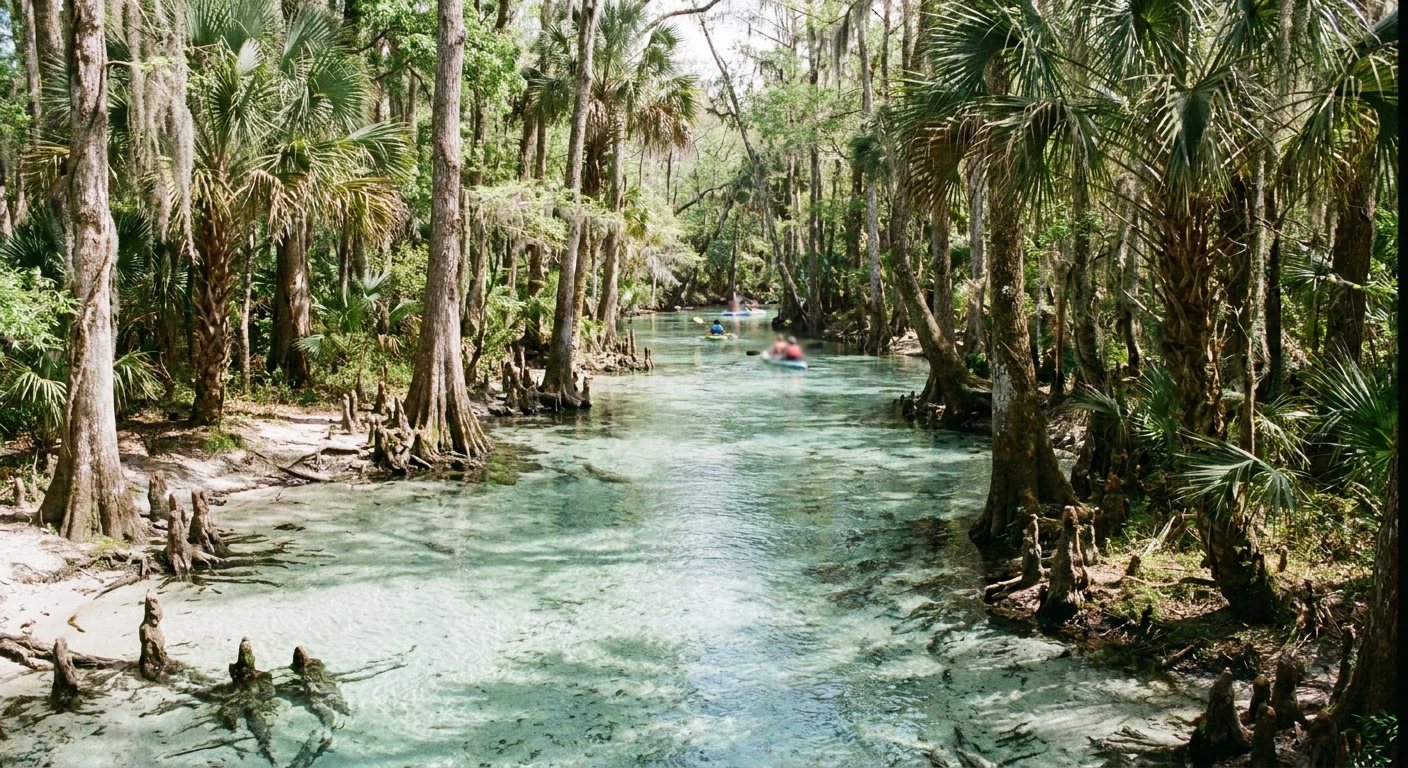
Go for: water that ignores the calendar, a fall window with under four wet days a month, and weekends in December and January when the riverbank belongs to almost nobody.
Think twice before: planning an August trip around anything on land: 11.5 days of the month record 0.10 inch or more, and 2.4 of them record an inch or more.
Air normals 1991-2020: NOAA NCEI, Cross City AP · Daylight: sunrise-sunset.org · full sources at the end
On this page
- One month, with the numbers behind itWhy October wins
- Highs, lows and rain days for all twelve monthsThe 12-month table
- Summer heat at the springs89.9°F days and 72.9°F nights
- The quietest weeks of the yearDecember to February, and their frost nights
- The month to skipAugust: 8.10 inches, 11.5 wet days
- Shoulder months worth a weekendApril, May and October compared to July
One caveat travels with every figure here. The normals come from the NOAA station at Cross City AP, about 27 miles (44 km) from the spring, and they measure air: temperature, precipitation, and the count of days recording 0.10 inch or more. The water itself has no season, which is the reason this trip works in February at all.
Ichetucknee Springs weather month by month: highs, lows and rainfall
| Month | Avg high | Avg low | Rain | Days ≥0.10 in |
|---|---|---|---|---|
| January | 65.9°F | 41.8°F | 3.38 in | 5.7 |
| February | 69.6°F | 45.2°F | 2.96 in | 4.8 |
| March | 74.9°F | 49.6°F | 3.53 in | 4.6 |
| April | 80.1°F | 55.0°F | 2.90 in | 4.1 |
| May | 86.7°F | 62.7°F | 2.74 in | 4.7 |
| June | 89.5°F | 70.6°F | 7.00 in | 9.1 |
| July | 90.1°F | 72.5°F | 7.77 in | 11.6 |
| August | 89.9°F | 72.9°F | 8.10 in | 11.5 |
| September | 88.0°F | 69.8°F | 5.82 in | 7.6 |
| October | 82.2°F | 59.9°F | 2.23 in | 3.7 |
| November | 74.4°F | 49.2°F | 2.10 in | 3.4 |
| December | 68.2°F | 44.4°F | 2.95 in | 4.6 |
The year runs in two halves rather than four seasons: June through September sits between 88.0°F and 90.1°F with 5.82 to 8.10 inches of rain a month, while every month from October to May stays under 3.6 inches.
Two hinges do the work. May closes at 2.74 inches over 4.7 wet days and June opens at 7.00 inches over 9.1, a near doubling of wet days in the space of a week. The swing back is sharper still: September’s 5.82 inches fall to 2.23 in October, and wet days go from 7.6 to 3.7.
August is the month that punishes the land half of the visit. Rain totals 8.10 inches, 11.5 days record 0.10 inch or more, and 2.4 record a full inch. Nights average 72.9°F, so nothing dries and nothing cools down. In the water you will not care. Waiting for a ride, eating lunch, or driving two hours home soaked, you will.
What the source actually measures: 1991-2020 monthly normals from NOAA NCEI, recorded at an airport weather station about 27 miles (44 km) away, with rain counted at the 0.10 inch and 1 inch thresholds and freezing nights counted at 32°F or below. None of it describes the river. Air is the variable at Ichetucknee, and the numbers below are air.
When is the best time to visit Ichetucknee Springs?
Go in October. Afternoons average 82.2°F, warm enough that stepping out of the water is pleasant instead of punishing, and mornings sit at 59.9°F. Rain totals 2.23 inches across 3.7 wet days, the second-lowest count of the year. On October 15 the sun is up from 7:32 AM to 7:01 PM local, 11 hours 29 minutes, which is a full day on the river plus the drive at either end.
Compare the neighbors. September looks similar on a brochure and behaves nothing like it: 88.0°F days, 69.8°F nights, and 5.82 inches over 7.6 wet days, so October arrives with 3.59 inches less rain and 3.9 fewer wet days. November is drier still at 2.10 inches, but it costs 7.8°F of afternoon warmth and 48 minutes of daylight.
Where this fits a longer trip: October is also the opening of the statewide dry season, mapped out in our Florida month-by-month verdict. Two or three nights near the springs slot neatly into a north Florida loop with St. Augustine, and the road-trip guide handles the driving distances the weather tables cannot.
How hot does Ichetucknee Springs get in summer?
June averages 89.5°F, July 90.1°F, August 89.9°F, and for three straight months the overnight low never averages below 70°F: 70.6°F, 72.5°F, 72.9°F. The air does not reset between days. Daylight is long compensation, with the sun up from 6:39 AM to 8:34 PM on July 15, 13 hours 55 minutes, and a cold spring run at the end of it.
Now the part our source does not cover, said straight: the NOAA normals carry no humidity, no heat index and no water-temperature reading for this spring. The figure that would tell you how a July afternoon truly feels was not in the data we read, so we are not printing one. Florida State Parks posts the current water conditions and the dates of the summer tubing season, and that is the number to check before you book.
When is Ichetucknee Springs quietest?
December, January and February, by the calendar rather than by any price list. School is in session outside the holiday fortnight, the air tops out at 68.2°F, 65.9°F and 69.6°F, and north Florida’s outdoor season is at its low ebb. Weekend nights in the area are at their easiest to book, and the parking lots empty accordingly.
What you get for it is the riverbank close to yourself and dry ground most days: February records 4.8 wet days and December 4.6, leaving roughly three weeks a month without measurable rain. Days are short but usable, with the sun up from 7:18 AM to 5:34 PM on December 15. Winter is also when Florida’s springs draw manatees, a season covered in our manatee guide.
What you give up is named precisely: 8.5 January nights at or below freezing, a 41.8°F average low, and an afternoon that reaches only 65.9°F. January is also the wettest month outside the summer, 3.38 inches over 5.7 wet days, more wet days than May. Getting out of the water into that air is a decision, not a detail, and it needs a towel plan and dry clothes in the car.
Which month should you avoid at Ichetucknee Springs?
August, and specifically for families with young children, anyone driving more than an hour each way, and anyone whose plan includes trails, picnics or photography. The month collects 8.10 inches of rain, 11.5 days at 0.10 inch or more, and 2.4 days at an inch or more, on top of 89.9°F afternoons and 72.9°F nights. It also lands in the summer school weeks, so the crowd peaks at the same time as the discomfort.
Its defense is real, though. Those same 11.5 wet days leave roughly 19 days of the month without measurable rain, daylight runs 13 hours 15 minutes on August 15 with the sun up from 6:57 AM to 8:13 PM, and the spring does not notice the heat at all. A 90-degree afternoon is precisely what makes a cold river feel like the best idea in Florida, which is the case a family trip can be built on.
Is the shoulder season worth it at Ichetucknee Springs?
The shoulder months are April, May and October, and the gap to high summer is wide. Against July’s 90.1°F days and 72.5°F nights, April runs 10.0°F cooler by day and 17.5°F cooler at night, at 80.1°F and 55.0°F. May keeps the heat at 86.7°F but drops the nights to 62.7°F. October lands at 82.2°F and 59.9°F.
Rain is where the shoulder pays off. April records 4.1 wet days, May 4.7 and October 3.7, against July’s 11.6, and monthly totals of 2.90, 2.74 and 2.23 inches against 7.77. That is the difference between planning a picnic and hoping for one, and it turns the land half of the day, the trails and the drive, into something you would choose.
The cost is daylight and morning chill. April 15 gives 12 hours 58 minutes against July’s 13 hours 55, and October 15 gives 11 hours 29, two and a half hours shorter than midsummer. April mornings average 55.0°F. Seasonal park operations also vary outside summer, and we could not verify the current tubing dates, so confirm them with the park before committing a weekend.
Cut it this way. If the trip is a full day in the water with kids, take late May: 86.7°F air, 2.74 inches of rain and 13 hours 43 minutes of daylight on the 15th. If it is a two-night weekend built around one long float and a drive, take October and accept the earlier sunset.
The last word
Book October, pack a towel you can actually dry off with, and stop watching the forecast for the river. One month deserves a second look before you commit: November is the driest of the twelve at 2.10 inches with only 3.4 wet days, and the sun still sits up from 6:55 AM to 5:36 PM on the 15th. It trades 7.8°F of afternoon warmth for the emptiest riverbank of the fall.
Sources & data for this guide
- Monthly normals 1991-2020: highs, lows, precipitation, days at 0.10 inch and at 1 inch, nights at 32°F or below · NOAA NCEI, station USW00012833, Cross City AP, FL · checked Sep 13, 2026
- Sunrise, sunset and daylight length on the 15th of each month · sunrise-sunset.org, UTC values converted to local EST/EDT · checked Sep 13, 2026
- Station distance: about 44 km from the spring, given here as about 27 miles · NOAA NCEI station metadata · checked Sep 13, 2026
- Editorial admission: our data set carries no humidity, heat index or water-temperature reading for Ichetucknee, and no visitor-count series. Crowd statements here rest on the school calendar, not on attendance figures.
- Park fees, tube rentals, shuttle operation and the dates of the summer tubing season change · confirm with Florida State Parks before you drive.