
FANNING SPRINGS · THE SPRING GUIDE · NATURE COAST
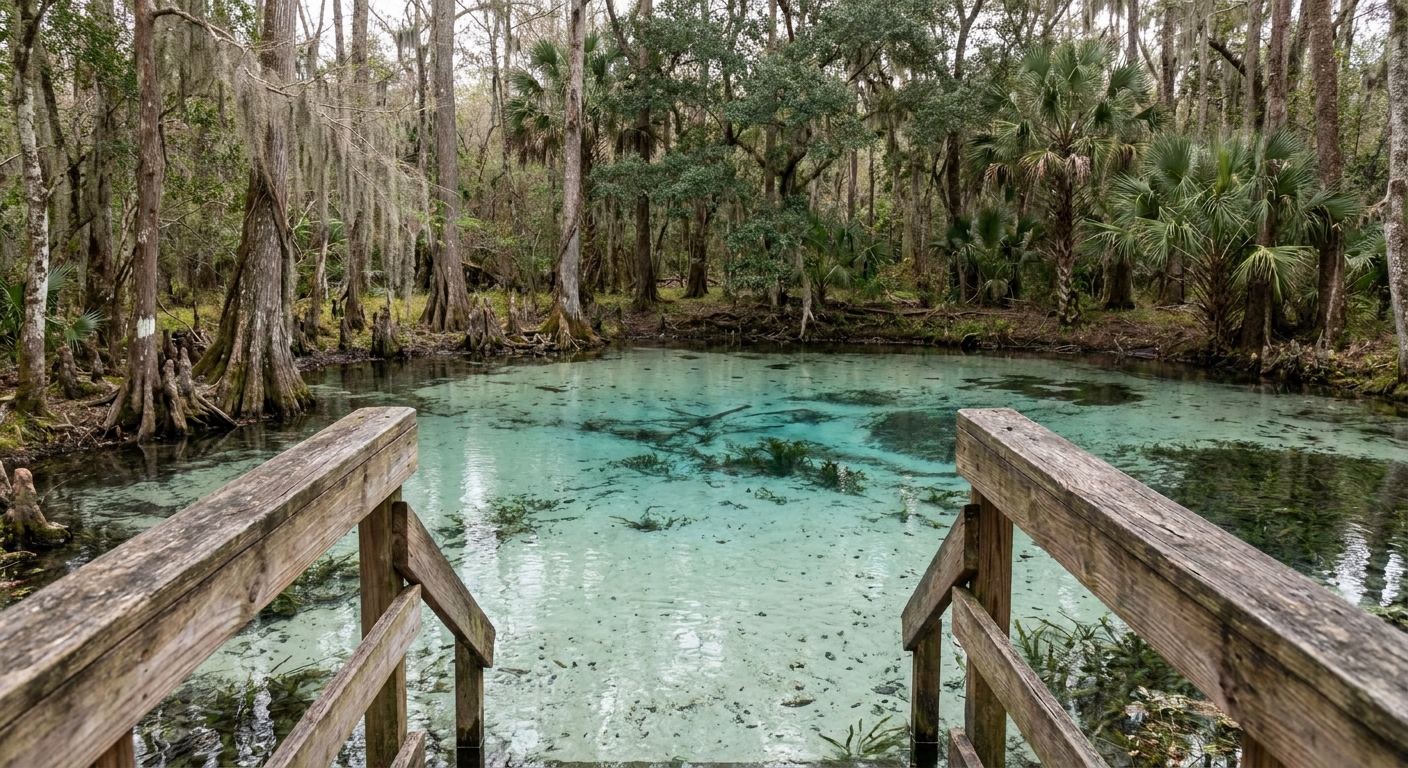
The USGS gauge on the spring run read 73.4 °F (23.0 °C) at Fanning Springs on September 11, 2026, and that one number does most of the explaining. Lower yourself off the steps and your breath catches, then it passes, and you stay in. The reading hardly moves across the calendar, because a spring does not have seasons, only the air above it does. What changes between July and January is whether 73.4 °F arrives as relief or as a dare.
The same gauge measured 41 cubic feet per second leaving the vent that day. That is why you can count pebbles under your feet and watch a fish hold station below your knees: the basin is replaced faster than it can cloud. Everything else here is small. The state’s inventory counts one designated swimming area, 715 feet of boardwalk and 130 parking spaces, and the Nature Coast State Trail runs past the park, so some of the people in the water arrived on a bicycle.
THE SPRING AT A GLANCE · FANNING SPRINGS
A small, clear swimming hole sitting near 73.4 °F all year with only 130 parking spaces: come in the morning in summer, and confirm fees and hours with the park, because our sources carry neither.
SMALL PARK · 130 PARKING SPACES · 1 SWIMMING AREA · WATER NEAR 73.4 °F YEAR-ROUND
Go for: water you can see the bottom of, a short boardwalk out to the Suwannee, and a swim you can reach by bicycle off the Nature Coast State Trail.
Think twice before: driving here on a hot Saturday afternoon, or trusting a price you read for another spring: we could not read this park’s fee or its hours.
Water: USGS station 02323502 · Facilities: Florida DEP inventory 2024 · full sources at the end
On this page
- How cold the water is73.4 °F, and why it barely moves
- Where the swimming area is1 designated basin, shared
- What to do besides swim715 feet of boardwalk, 1 launch, 5 cabins
- Parking on a summer Saturday130 spaces, then the gate shuts
- Is it worth the drive?Size, season and the state’s spring category
- Other clear springs in north FloridaThe Florida springs guide
The park is two things stacked together: a basin of clear water with one set of steps into it, and a boardwalk that walks you away from the swimmers toward the Suwannee River. The Nature Coast State Trail, the rail-trail crossing this stretch of north Florida, passes the park, so riders turn in mid-ride for a swim and a shaded sit. Nothing here asks for a full day.
How cold is Fanning Springs?
73.4 °F (23.0 °C) is what the gauge showed on one September morning in 2026, an instantaneous reading rather than an average, and the distinction matters less than you would expect: water leaves the aquifer at close to the same temperature all year. In August, with heavy hot air on your shoulders, it lands like stepping into a cooler, and your forearms go to goosebumps before your waist is wet. On a cold January morning mist hangs over the same surface and the water is warmer than the air above it. Children go in first. Adults stand on the steps and negotiate.
Can you swim at Fanning Springs?
The state counts exactly 1 designated swimming area in the park, and that single number shapes the visit. Everyone who came to swim is in the same basin: no second cove to spread into, no far end to claim as yours. On a quiet weekday morning one family owns the water. By Saturday afternoon a dozen groups share it within earshot of each other. If your picture of a spring day involves a private ledge, the springs guide sorts the bigger options.
Clarity is what you get in exchange. With 41 cubic feet per second pushing out of the vent, the basin stays flushed, so goggles do real work: pale limestone edges, sand turning gently, the occasional fish that ignores your legs. Our sources carry no manatee count for Fanning Springs, and the state wildlife pages that would supply one do not render for automated reading, so treat a winter sighting as possible rather than scheduled. The manatee guide covers where the winter habit is documented and the rules around the animals.
What is there to do at Fanning Springs?
| What the state counts | How many | What it means at the park |
|---|---|---|
| Designated swimming area | 1 | Everybody swims in the same basin |
| Canoe, kayak and tube launch | 1 | One place to put a boat or a tube in |
| Boardwalk | 715 feet | Shaded walking to the river, no swimsuit needed |
| Observation platform | 1 | The river view for whoever stays dry |
| Cabins | 5 | The only beds counted on site |
| Parking spaces | 130 | The ceiling on a hot Saturday |
The 715 feet of boardwalk is the part people skip on arrival and talk about afterward. It leaves the basin on pilings, runs through floodplain forest, and finishes at 1 observation platform over the Suwannee, where the river is dark, slow and nothing like the water you just swam in. A few minutes each way, no swimsuit required, which makes it the fallback for whoever in the group refuses to get in.
The inventory also lists 1 canoe, kayak and tube launch. That is the second shape a day here can take: put in, drift the short run, walk back up. The same inventory counts no rental concession at the park, so plan on bringing your own boat or tube, or ask the park what operates nearby before you count on renting one.
Five cabins change the arithmetic of a long drive. A spring this small is a thin reason for four hours in the car until you sleep beside it and have the basin to yourself before the first day-trippers park. Five units go fast in spring and fall (est.), so reserve before you build the route. Parents assembling a Florida week with water in it will find springs weighed against the big-ticket days in our kids guide.
How busy does Fanning Springs get?
130 parking spaces is the entire capacity of the place, and the number behind the most common disappointment here. When the lot fills, the gate closes. No clock is involved in that decision, only cars and asphalt.
Hot weekends are when a lot that size runs out. Two family gatherings, a youth group and the trail’s Saturday riders can account for most of it (est.). On a July or August Saturday, plan to be parked in the morning and keep a second swimming hole in the phone before you leave the house.
We cannot give you an opening hour, and the gap is real rather than lazy: the Florida state parks site answers automated reading with a 403 error, and fees across the state differ by park and by season. Check the park’s own page in a browser or phone the ranger station the day before, particularly if your plan depends on being at the gate early.
Arriving by bicycle sidesteps the problem entirely, since a bike on the Nature Coast State Trail needs none of the 130 spaces. If you do find the gate shut, the springs guide lists the other clear-water swimming holes in this part of north Florida, several of them with far bigger lots. Getting around Florida covers the driving distances between them.
When to go. The month-by-month case for Fanning Springs — what the normals say, when the sea is warm enough to swim and which weeks fill up — sits on the best time to visit Fanning Springs.
Is Fanning Springs worth visiting?
Sources & data for this guide
- Water temperature 73.4 °F (23.0 °C) and flow 41 cubic feet per second, instantaneous readings · USGS National Water Information System, station 02323502 Fanning Springs · checked Sep 11, 2026
- 130 parking spaces, 1 designated swimming area, 1 canoe, kayak and tube launch, 715 feet of boardwalk, 5 cabins, 1 observation platform · Florida Department of Environmental Protection, Recreational Facilities Inventory, 2024 annual report (PDF, 374 pages) · checked Sep 11, 2026
- Definition of Outstanding Florida Springs · Florida Statutes 373.802(5) · checked Sep 11, 2026
- No entrance fee, no opening hour and no manatee count could be read for this park: floridastateparks.org returned a 403 error to automated reading and the FWC manatee pages render client-side · checked Sep 11, 2026
- Trail setting, cabin demand and crowd timing are editorial estimates, marked (est.) in the text · confirm fees and hours with the park before you drive.
Florida law protects a category it calls Outstanding Florida Springs: every historic first-magnitude spring, as the Florida Geological Survey determines them, plus six springs named by hand in the statute. Whether Fanning Springs belongs to that list is the Survey’s determination and not ours. The 41 cubic feet per second on the gauge that September day is one reading taken at one moment, and a single reading does not classify a spring.
Measured against Florida’s headline springs, this is a modest park: one basin near 73.4 °F, 715 feet of boardwalk, one platform over the river. Empty, that smallness is the whole appeal. Full, it is 130 cars’ worth of people arranged around one set of steps. The same park delivers two completely different afternoons depending on what time you turned in at the gate.
Riders on the Nature Coast State Trail get the best version of it, swimming mid-ride without needing a parking space at all. Families with young children get the next best, because one designated swimming area means nobody drifts out of sight. Divers and long-distance paddlers will want a larger run than this one.
Season shifts the visit more than the spring ever does. In August the 73.4 °F water is the entire point and the 130 spaces are the obstacle. In January the water is warmer than the air, the lot has room, and the boardwalk to the Suwannee becomes the better half of the day. Our month-by-month Florida guide lays out the dry and wet seasons behind that swing.
Come on a weekday morning if your calendar allows it. Park, swim while the basin still belongs to three people, then walk the boardwalk wet and let the shade dry you on the way to the platform. Pack goggles for the clarity that 41 cubic feet per second buys you, carry both a card and cash because we could not read this park’s fee, and call for the hours the day before. The water will be near 73.4 °F whatever the date.