
FLORIDA · FANNING SPRINGS · JANUARY
The water at Fanning Springs pays no attention to the calendar. On September 11, 2026 the USGS gauge at the vent read 73.4°F, and it reads close to that on any day of any month. January changes the air above it instead: NOAA’s 1991-2020 normals give an average high of 65.9°F and an average low of 41.8°F, which is the widest contrast you will feel between cold skin and warm spring water all winter.
That contrast is the whole reason to come in January rather than April. You get a swim that begins warmer than the air, a park with a hard parking limit that only bites in high summer, and a sunset at 5:55 pm that ends the day earlier than most visitors plan for. What the month takes back is mornings: 8.5 nights in an average January drop to 32°F or below.
THE MONTH AT A GLANCE · FANNING SPRINGS · JANUARY
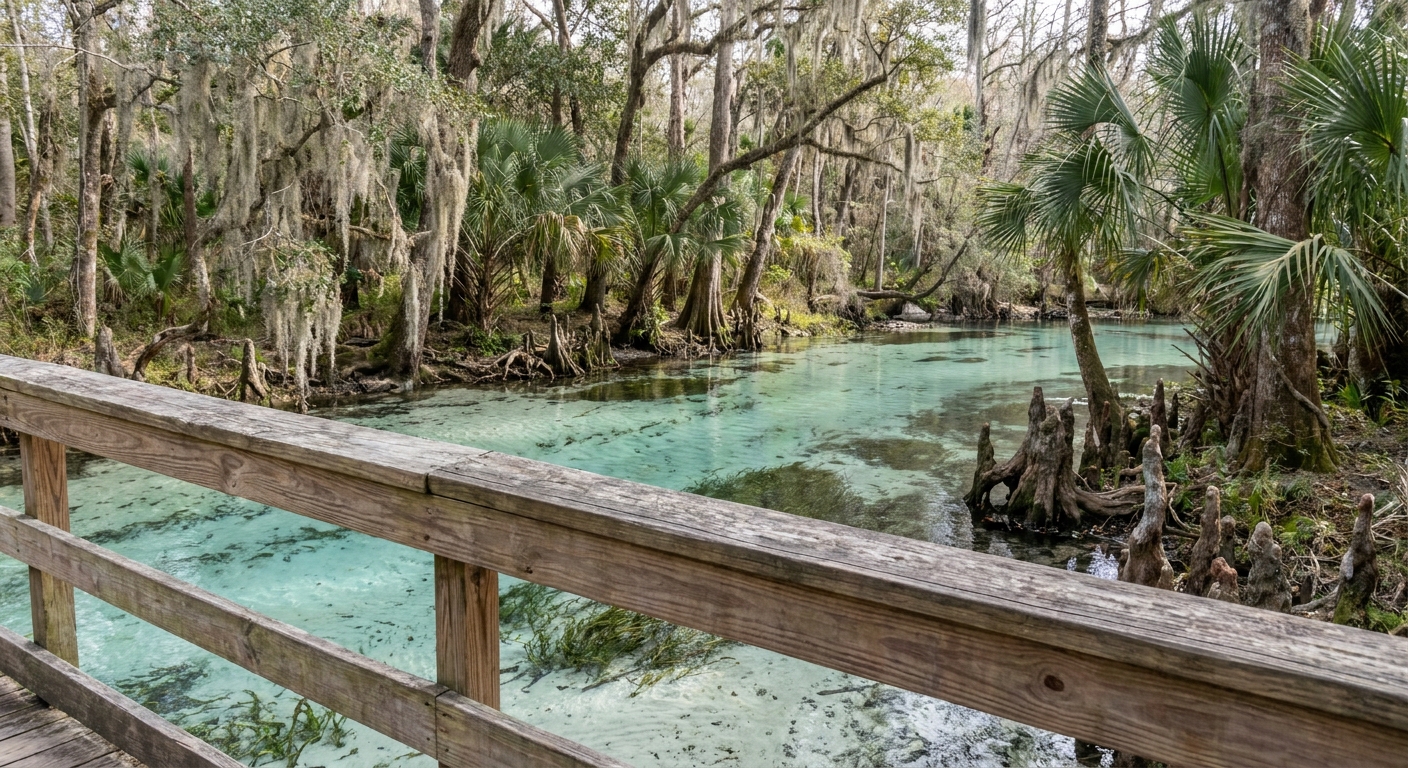
January gives you the winter’s widest gap between cold air and 73.4°F spring water: dress for 41.8°F at dawn, swim in the early afternoon, and be off the boardwalk before 5:55 pm.
AVG HIGH 65.9°F · AVG LOW 41.8°F · WATER 73.4°F · 10H30 OF DAYLIGHT
Go for: a swim that starts at 73.4°F while the air sits in the 60s, the 715-foot boardwalk down to the Suwannee, and a parking limit that constrains summer Saturdays rather than winter ones.
Think twice before: tent camping: an average January brings 8.5 nights at 32°F or below, and we could not verify the park’s fees or opening hours.
Air: NOAA NCEI 1991-2020, Cross City AP · Water: USGS gauge 02323502 · Facilities: Florida DEP 2024 inventory
On this page
- Fanning Springs weather in January65.9°F highs, 41.8°F lows, 5.7 rain days
- How cold are the mornings?41.8°F at dawn and 8.5 freezing nights
- Crowds, parking and what we could price130 spaces, five cabins, no gate price we could read
- Things to do at the spring in January715 feet of boardwalk, one swim area, 73.4°F water
- A two-day plan around the lightBoardwalk at 9, swim at 1, dark at 5:55
- January vs December and FebruaryHow the three sets of normals differ
- Is January a good month to go?Yes for swimmers, no for tent campers
- The rest of Florida this winterFlorida month by month
Every figure here for the air comes from one thermometer: NOAA’s 1991-2020 monthly normals at Cross City AP (station USW00012833), about 27 miles from the spring. That is a real station record rather than a modeled grid cell, and 27 miles of north Florida can move a morning low by a few degrees. The water number is different in kind: a single USGS instantaneous reading at the vent, not a monthly average.
Fanning Springs weather in January: average highs, lows and rain days
| Measure | January (1991-2020 normal) |
|---|---|
| Average high | 65.9°F |
| Average low | 41.8°F |
| Precipitation | 3.38 inches |
| Days with 0.10 inch or more | 5.7 |
| Days with 1 inch or more | 0.8 |
| Nights at 32°F or below | 8.5 |
| Daylight, January 15 | 10 h 30 min · 7:26 am to 5:55 pm |
NOAA’s normals put the January high at 65.9°F, the low at 41.8°F and the month’s rainfall at 3.38 inches. Those are thirty-year averages, so they describe a typical January rather than the one waiting for you: a passing front can hand you a 75°F Tuesday or a 38°F afternoon, and neither would be unusual at this station.
Rain arrives on 5.7 days in an average January, counting days that collect at least 0.10 inch. That works out to measurable rain roughly one day in five. Only 0.8 day reaches a full inch, so a genuinely soaked afternoon is a once-a-month event at most. In practice that means a rain jacket in the trunk rather than a canceled plan.
The 24.1°F spread between the average low and the average high is the number that decides your bag. You want a fleece or a hoodie you expect to shed by lunchtime, a knit hat for the first hour, water shoes for the limestone, and a towel plus dry warm layers for the walk back to the car. Getting out of 73.4°F water into 50-degree air is the part people underpack for.
On January 15 the sun rises at 7:26 am and sets at 5:55 pm Eastern, giving 10 hours 30 minutes of daylight. Air temperature falls quickly once the light goes, so the usable outdoor day runs roughly 10 am to 4:30 pm. Anything you want to photograph on the river should happen before four.
How warm is Fanning Springs in January?
Read the two numbers against the water and the month makes sense. At dawn, 41.8°F air sits 31.6°F below the 73.4°F the gauge recorded at the vent. By mid-afternoon the 65.9°F average high closes that gap to 7.5°F. The spring never moves; the air swings 24.1°F between breakfast and two o’clock, and your comfort swings with it.
So dress in two acts. Morning wants long sleeves, closed shoes and something over them, because 40-something degrees in damp river air feels colder than the same reading in Miami. Early afternoon wants a t-shirt in the sun and a swimsuit under it. Changing once, around noon, beats layering all day.
Frost is normal here: 8.5 nights in an average January fall to 32°F or below, which is a fact worth knowing before you book a tent site. The state’s 2024 inventory counts five cabins at the park, and whether those cabins are heated is something we did not verify, so ask when you reserve.
How busy is Fanning Springs in January?
January falls inside Florida’s dry season, which is a calendar fact rather than a crowd measurement. We found no occupancy series and no attendance series for this park, so we crown no month busy and no month cheap. What the state does publish is capacity: 130 parking spaces. When that lot fills the gate closes, and the inventory makes clear that the squeeze belongs to summer Saturdays.
On-site lodging is five cabins in total. Five is the entire inventory, not a sample, so treat one as something you reserve well before you drive rather than something you try for on a Friday. For beds off park, our Florida lodging guide handles the choice between a motel base and a state-park cabin.
We could not verify the local lodging-tax rate, so we give no percentage. We also could not read the park’s entrance fee or its opening hours: floridastateparks.org answers automated requests with a 403. Budget the day with our Florida cost guide and confirm the gate price with the ranger station when you arrive.
One upgrade genuinely changes January, and it is sleeping on site. A cabin puts you at the water at nine, when a day-tripper is still driving, and it removes the pressure of a 5:55 pm sunset from the end of the afternoon. Everything else, gear included, matters less than a towel and a dry sweatshirt.
Things to do in Fanning Springs in January
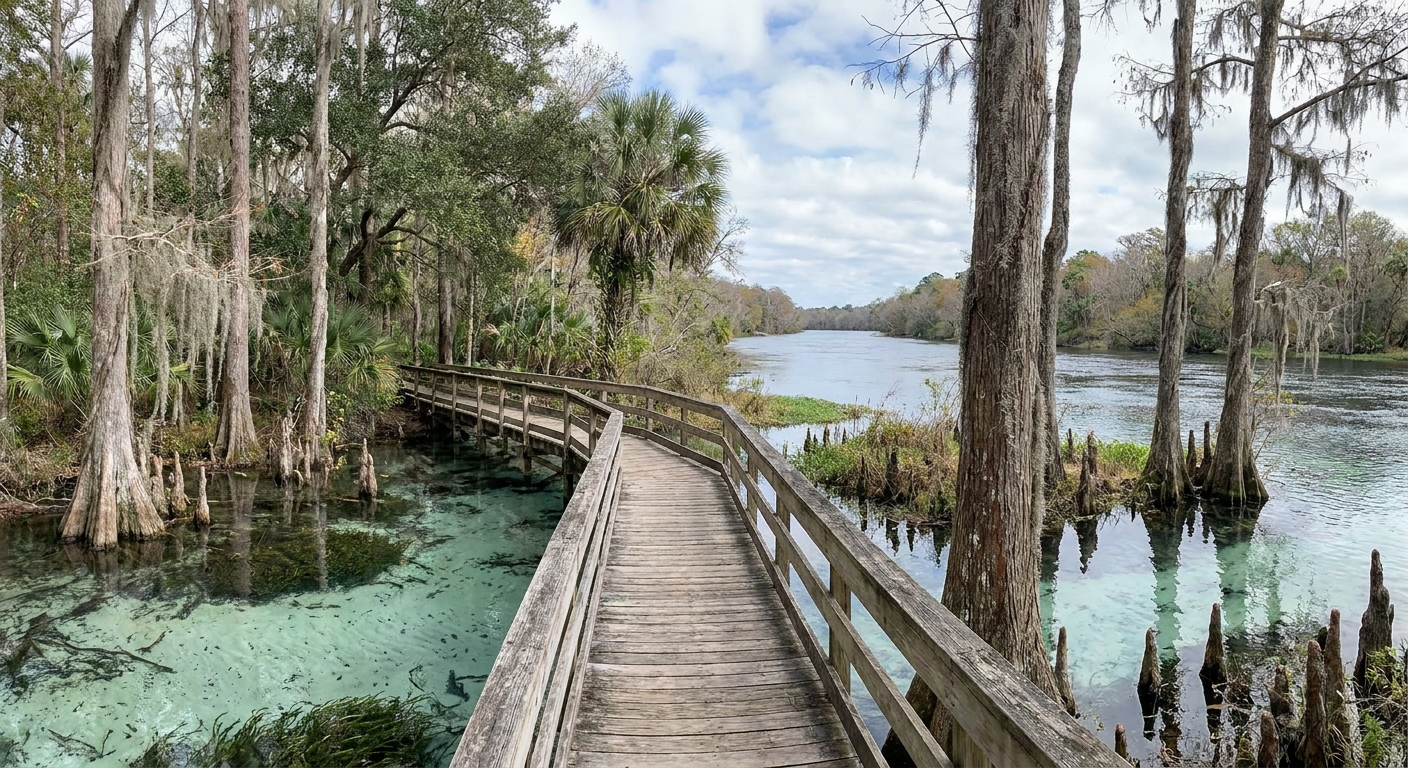
Winter is the only time of year the swim feels like a decision. In July the air is warmer than the water and the spring reads as cold; in January the same 73.4°F reads as warm, and the shock is on the way out instead of the way in. Manatees are the great winter subject at Florida springs, and we could not verify a count or a sighting record here, so we promise none. Our manatee guide covers that separately.
The park itself is compact and the state counts it precisely: 715 feet of boardwalk, one observation platform, one designated swimming area, one launch for canoes, kayaks and tubes, five cabins and those 130 parking spaces. The boardwalk is the spine of a visit, running from the spring toward the Suwannee River, and the platform is where you stand when you do not feel like getting wet.
January changes the air around all of that and nothing in the water. At two in the afternoon the spring runs 7.5°F warmer than the average high; at dawn it runs 31.6°F warmer than the average low. The clarity holds too: the same USGS gauge measured 41 cubic feet per second leaving the vent, a volume that replaces the water faster than it can cloud.
Nothing inside the fence carries a separate charge in the state’s 2024 facilities inventory, though that document counts equipment rather than prices. The boardwalk, the platform and the swim area come with whatever the gate costs, and the gate cost is the figure we could not read. Bring a card, and expect the launch to be the one place where your own gear or a rental sets the bill.
Fanning Springs in January: a two-day itinerary
Day one runs on the light. Arrive around 9 am in a fleece, with the air somewhere near 45°F, and walk the 715 feet of boardwalk to the river while the sun does its work. Take the observation platform at eleven. Change at noon, swim between 1 and 3 pm when the air is closest to its 65.9°F average high, then get dry immediately. By 4:30 the temperature is already heading back down toward the overnight low, and full dark follows 5:55 pm.
Day two belongs to the launch: put a kayak or a tube in the water in the late morning and paddle while the afternoon is at its warmest. If rain shows up, remember it falls on 5.7 days in an average January and only 0.8 of those days brings an inch. A short band means waiting it out in the car. A full inch means driving instead, and our Florida list has the indoor options within reach of the Suwannee valley.
Fanning Springs in January vs December and February
| Measure | December | January | February |
|---|---|---|---|
| Average high | 68.2°F | 65.9°F | 69.6°F |
| Average low | 44.4°F | 41.8°F | 45.2°F |
| Precipitation | 2.95 in | 3.38 in | 2.96 in |
| Days with 0.10 in or more | 4.6 | 5.7 | 4.8 |
| Spring water vs afternoon air | +5.2°F | +7.5°F | +3.8°F |
All three columns come from the same station and the same 1991-2020 period, and January loses on every line. Its afternoons run 2.3°F below December and 3.7°F below February. Its nights run 2.6°F below December and 3.4°F below February. It is also the wettest of the three, at 3.38 inches across 5.7 rain days against 2.95 inches across 4.6 days in December. The spring, meanwhile, holds 73.4°F through all three.
Shift four weeks forward and you buy 3.7°F of afternoon warmth and about one fewer wet day, and you sell the contrast: the water sits only 3.8°F above February’s average high instead of 7.5°F above January’s. Shift four weeks back and December hands you milder numbers plus the holiday weeks, a calendar fact rather than a measured crowd. We have no attendance data either way.
Is January a good time to visit Fanning Springs?
Yes, if you came to swim and you enjoy the moment when 73.4°F water feels tropical. Yes for walkers, paddlers and anyone booking one of the five cabins. No if your picture of Florida involves lying in a swimsuit at ten in the morning, and no for tent campers who would rather not meet 8.5 freezing nights a month, or for families who need a long evening outdoors after a 5:55 pm sunset.
If that second list sounds like your trip, take February instead. Its 69.6°F average high and 45.2°F average low make mornings livable, and it drops to 4.8 days of 0.10-inch rain against January’s 5.7. You give up the shock value of the water, and you keep everything else the park offers.
Of the three winter months, January is the one where the spring feels warmest against the air, by a margin of 7.5°F at the hottest hour of an average day.
The last word
Decide the one thing that shapes a January visit here: a cabin on site, or a day trip timed so you are in the water between one and three. Everything else follows from the gap between 41.8°F air and 73.4°F water. For context on the water itself, Florida law keeps a protected class it calls Outstanding Florida Springs, defined in Statute 373.802(5) as every historic first-magnitude spring plus six written into the law by hand.
Sources & data for this guide
- January normals: 65.9°F high, 41.8°F low, 3.38 in, 5.7 days at 0.10 in, 0.8 day at 1 in, 8.5 nights at 32°F or below · NOAA NCEI monthly normals 1991-2020, station USW00012833, Cross City AP, FL · checked Sep 24, 2026
- December and February normals (68.2/44.4 and 69.6/45.2) · same station, same 1991-2020 period, NOAA NCEI · checked Sep 24, 2026
- Daylight, sunrise 7:26 am and sunset 5:55 pm on January 15 · sunrise-sunset.org, converted from UTC to Eastern · checked Sep 24, 2026
- Water temperature 73.4°F (23.0°C) and flow of 41 cubic feet per second · USGS National Water Information System, station 02323502 Fanning Springs, instantaneous reading of Sep 11, 2026
- Park facilities: 130 parking spaces, 715 feet of boardwalk, 1 swimming area, 1 canoe, kayak and tube launch, 5 cabins, 1 observation platform · Florida DEP Recreational Facilities Inventory, 2024 annual report · checked Sep 24, 2026
- Outstanding Florida Springs definition · Florida Statutes 373.802(5), leg.state.fl.us · checked Sep 24, 2026
- Editorial admission: we could not read the entrance fee, the opening hours or any manatee count. floridastateparks.org returns 403 to automated requests, and the FWC manatee page renders client-side · Sep 11, 2026