
You step out of the arrivals hall at Juan Santamaria and the air is the first surprise: mild and soft, more like spring than the tropics, because the Central Valley sits high above the coast. Drivers and shuttle staff stand near the doors, and a line of orange cars waits at the curb. Anyone landing at San Jose can reach the city, or the road beyond it, without a wasted hour.
How do you get from the airport to San Jose?
For most travelers the easiest way is an official orange taxi or a pre-booked shuttle, both of which wait just outside the arrivals hall. The airport is not actually in San Jose. It sits in the town of Alajuela, and the ride to the center takes about 20 to 30 minutes in normal traffic, which is a short hop on paper and a slower one when the capital is jammed.
What decides the choice is mostly your group and your hour of arrival. A couple with two suitcases and a hotel in the center will be happy with a taxi.
A family with car seats and bulky bags tends to prefer a pre-arranged transfer, so the driver is waiting when you walk out. If you plan to leave the capital right away for the beaches or the mountains, a rental car may suit your plans.
Rush hour changes everything. A ride that takes a short half hour at midday can stretch much longer when the roads fill with commuters, so a late-afternoon landing is worth planning around. After a long flight, having a driver waiting for you can make the arrival easier.
If your real destination is a beach or a volcano town, the capital may only be a pillow for the night.
Your options from the airport
Official taxi
The official taxis at San Jose are orange, and they line up outside the arrivals hall. This is a simple option with ordinary luggage: you walk out, give the name of your hotel, and ride straight to the door. The trip to central San Jose takes about 20 to 30 minutes in normal traffic.
It suits travelers arriving at an ordinary hour who want no planning at all. Look for the orange color so you know you are in an official car, and have your hotel address written down or saved on your phone to avoid confusion.
Pre-booked shuttle or private transfer
Pre-booked shuttles also wait outside the arrivals hall. A shuttle is a good fit if you are heading to a hotel or a resort and prefer to settle the ride before you leave home, so no one is negotiating at the curb after a night flight. A private transfer gives you the vehicle to yourselves, which helps with larger groups, surfboards or lots of bags.
The same arrangement works for the longer trips. A driver can take you from the airport area to La Fortuna in about 3 hours, to Manuel Antonio in 3 to 3.5 hours or to Jaco in 1.5 to 2 hours, longer in traffic or rain. Many travelers who land tired choose this over a first day behind the wheel.
Rental car
Rental-car desks are in or next to the terminal. This makes sense if your plan is a loop through the country with stops at volcanoes, coffee farms and beaches, and you want to go at your own pace.
Think about the roads before you commit. Some beaches and rural places may only be reachable with a four-wheel drive vehicle, some roads can be blocked by landslides in the rainy season, and travelers are advised to avoid driving outside urban areas at night.
Visibility at intersections can be poor, and motorcyclists may pass on the right or weave through traffic. If you land after dark, a taxi to a hotel for the night and a car the next morning is a calmer start.
Airport transfer options compared
| Option | Best for | Time to town | How to book |
|---|---|---|---|
| Official taxi (orange) | Couples and small groups with ordinary luggage | About 20 to 30 minutes in normal traffic | Walk up outside the arrivals hall |
| Pre-booked shuttle | Hotel or resort stays, arrivals at any hour | About 20 to 30 minutes to central San Jose, in normal traffic | Arrange ahead; it waits outside the arrivals hall |
| Rental car | Road trips starting right away | About 20 to 30 minutes to central San Jose, in normal traffic | Desk in or next to the terminal |
The trade-offs are small but real. A taxi asks nothing of you in advance and is ideal when your plans are loose, while a pre-booked shuttle removes the question of who is waiting for you at the curb. A rental car gives freedom but adds the work of navigating, parking in the center and driving on roads that can be steep, wet and busy.
If San Jose is only a stop, think about where you sleep. Staying near the airport on the first night is a reasonable choice for an early departure.
Arriving at the airport
Juan Santamaria International, known by its code SJO, is the main gateway for visitors to Costa Rica. It stands in Alajuela, in the Central Valley, and most travelers land here and move on within a day or two. The other major airport is Daniel Oduber Quiros at Liberia, in the northwest, which is closer to the Guanacaste beaches.
At San Jose the official taxis are orange, an easy sign to spot among the vehicles at the curb.
Think about your clock as well. Costa Rica stays on UTC-6 all year and does not change its clocks. In winter it matches U.S. Central Standard Time, one hour behind the East Coast, and in summer it is one hour behind the U.S. Central zone and two hours behind the East Coast, so your arrival time on the ticket may feel different from what your body expects.
If you are going on to the coast, remember how far the beaches are from the capital. Jaco is about 1.5 to 2 hours by road, La Fortuna about 3 hours, Manuel Antonio 3 to 3.5 hours, Monteverde 3.5 to 4.5 hours and Puerto Viejo 4 to 5 hours, all longer in traffic or rain. Tamarindo is much closer to Liberia, about 1 to 1.5 hours, than to San Jose, where it takes 4.5 to 5.5 hours, which is why beach-bound travelers sometimes fly into the other airport.
Good to know before you go
The U.S. State Department rates Costa Rica Level 2, ‘Exercise increased caution,’ due to crime; it says petty crime is common throughout Costa Rica and that violent crime also affects tourists, including armed robbery, homicide and sexual assault.
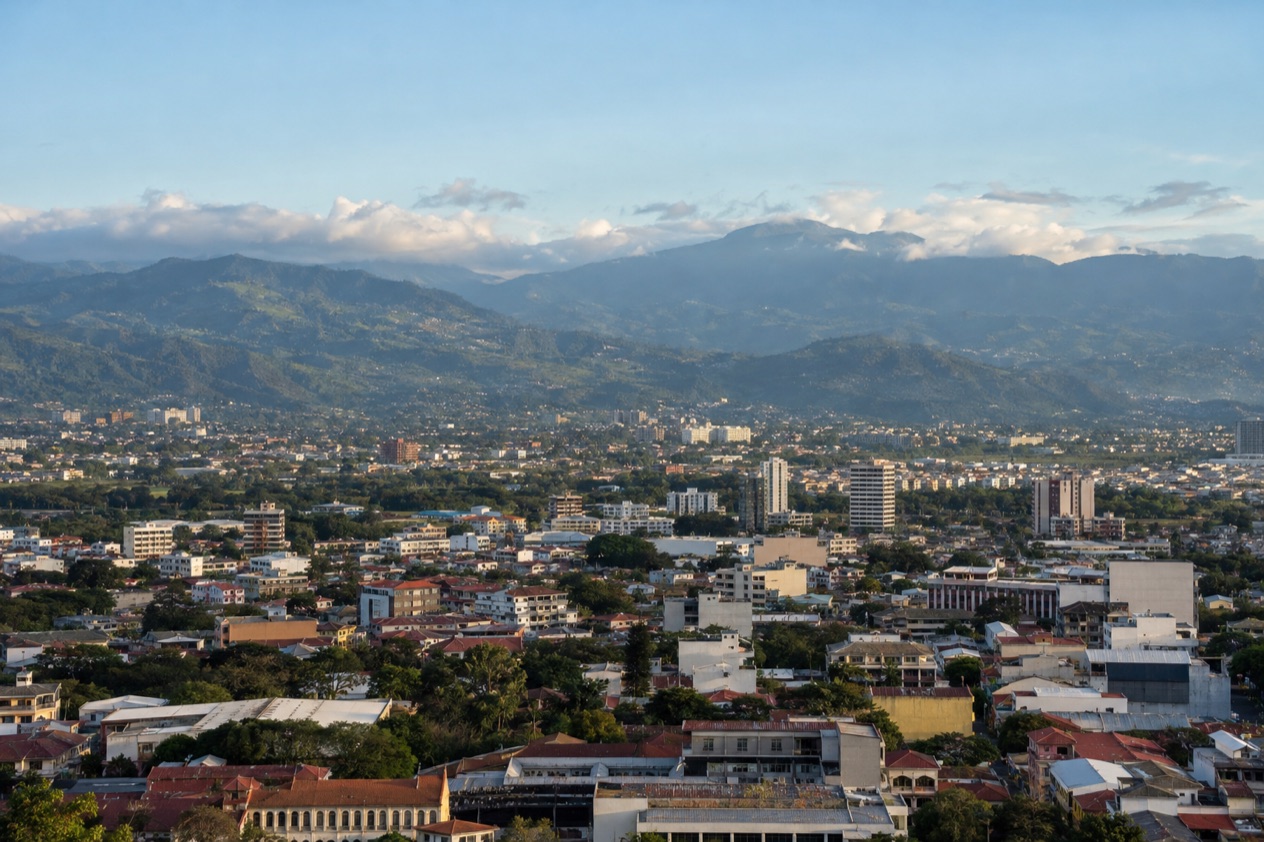
The capital sits at about 3,800 feet, so the air is cooler and gentler than on the coast, and a light layer is welcome in the evening. Keep your phone, bags and documents close in busy places such as the market and the bus stops.
Sources
- U.S. Department of State, Costa Rica Travel Information, Traveling and transportation (https://travel.state.gov/content/travel/en/international-travel/International-Travel-Country-Information-Pages/CostaRica.html), checked October 8, 2026
- U.S. Department of State, Costa Rica Travel Advisory, issued April 1, 2026 (https://travel.state.gov/content/travel/en/traveladvisories/traveladvisories/costa-rica-travel-advisory.html), read via the State Department open data API on October 8, 2026
To plan your stay
- Best Time to Visit San Jose: Dry Season, Green Season, Weather by Month and Festivals
- Things to Do in San Jose: National Theater, Gold Museum, Poas Volcano and Casados
- Where to Stay in San Jose: Best Areas, Barrio Escalante, Escazu and Airport Options
- San Jose in January: Dry-Season Weather, Theaters and Museums, and Day Trips