
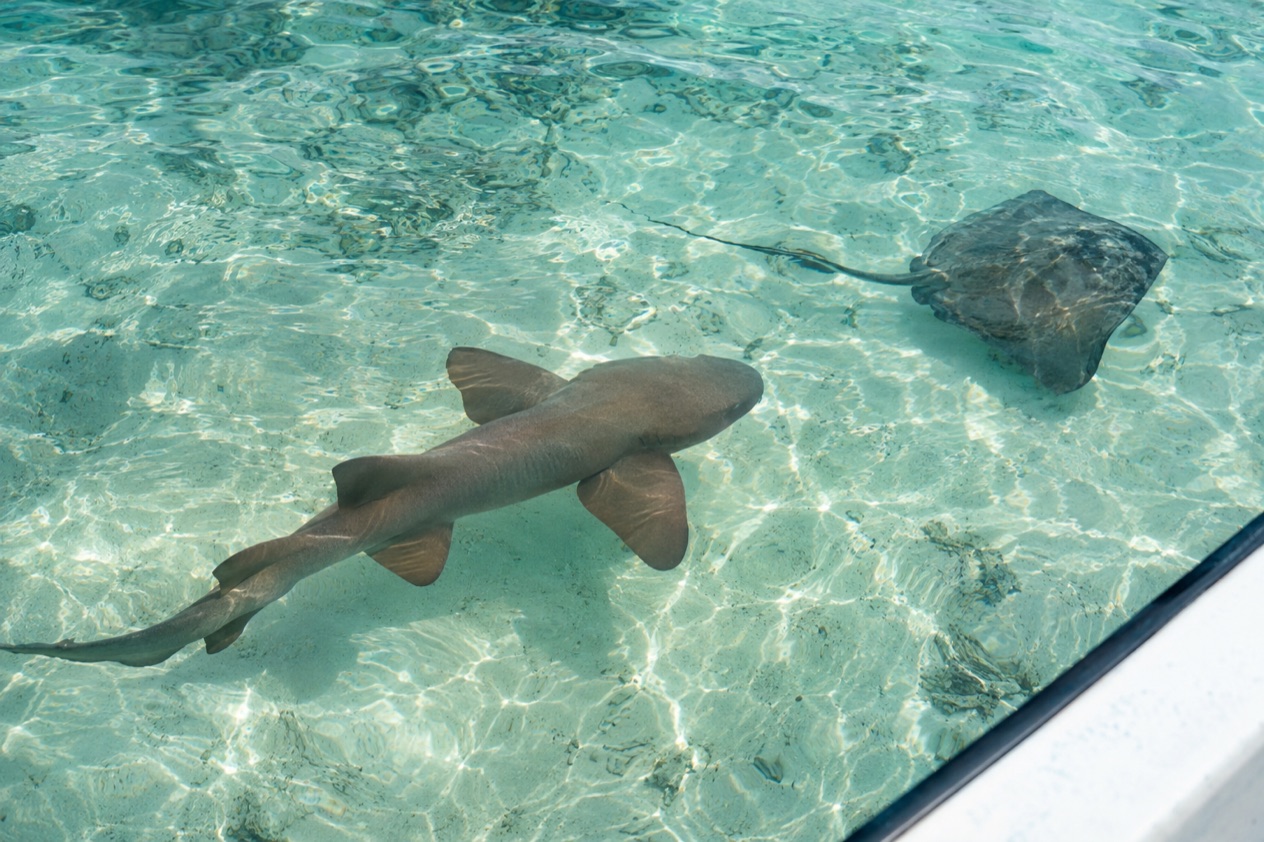
The water around Shark Ray Alley turns pale green and shallow, and the first thing you notice is the shapes gliding along the sandy bottom: broad, flat stingrays and the long, muscular outlines of nurse sharks. Snorkelers slip in over the side, masks down, and the fish crowd in almost at once. It is a short stretch of sea inside Hol Chan Marine Reserve off Ambergris Caye, and it makes a vivid stop for anyone who wants to float among big animals in shallow water.
Is visiting Shark Ray Alley worth it?
Yes, if you want to swim with sharks and rays without going into deep water, and it suits families as much as confident snorkelers. One local tourism source describes Shark Ray Alley as an area with typically only eight feet of water, a perfect place for snorkeling and swimming for the entire family.
That shallow, open setting is the heart of the experience. You are not descending to a wall or a wreck. You are floating above the animals and watching them move.
What sets it apart from the other snorkeling stops near San Pedro and Caye Caulker is the way the animals gather. Hol Chan itself is a story of coral, a narrow cut in the reef and schools of reef fish, while Shark Ray Alley is about large animals at a feeding point.
In 1999 it was folded into the reserve precisely to protect the sharks and rays that collect there. The result is a place where the wildlife is the main event, and where the rules of the reserve shape how you behave in the water.
It also pairs naturally with the rest of the reserve. Travelers who snorkel or dive from San Pedro commonly name Hol Chan and Shark Ray Alley together, and the Caye Caulker side of the coast treats them as nearby excursions too. Think of Shark Ray Alley as the animal encounter and Hol Chan as the reef, two different moods in one marine park.
What to see at Shark Ray Alley
Nurse sharks and stingrays
The stars are the nurse sharks and the stingrays, and the reason the spot has its name. Nurse sharks are slow, stout, tan-brown fish that often rest or drift near the bottom, and stingrays glide over the sand with a soft rippling of their wings. You may see both close below you, sometimes within arm’s reach of one another, and the sight of a shark that size at such close range tends to stay with people long after the trip.
Look for the way the animals move rather than just how big they are. Rays often settle and bury themselves in sand with only their eyes showing, and nurse sharks have small barbels near the mouth that give their faces a whiskered look. Wildlife is never guaranteed, but this is a place where the animals have gathered at a feeding point for years, which is exactly why the reserve protects it.
The shallow sandy flats
The setting is as memorable as the animals. The seabed is pale sand, the water is clear in the sun, and because the depth is typically only eight feet, light reaches the bottom and the whole scene seems lit from below. Small reef fish dart between the larger animals, and you may spot schools passing through the edges of the group.
This shallowness is what makes the stop approachable for the whole family, as that tourism description puts it. You float flat on the surface and watch, with no descent and no gear beyond the basics. It is a gentle contrast to the deeper, more demanding corners of the reserve and a good place to simply hover and look.
A protected corner of Hol Chan
Shark Ray Alley belongs to Hol Chan Marine Reserve, which was established in July 1987 as the first marine protected area in the country. Its name comes from the Maya for little channel, a nod to the narrow cut through the reef in the reserve’s main snorkeling area. The reserve covers coral reef, sea-grass meadows and mangrove swamp, and more than 160 species of fish have been recorded there, along with three species of sea turtle.
The reserve now has eight zones, up from the original four. In the older four-zone layout, Shark Ray Alley was the fourth, a second charged snorkeling area alongside the reef itself. Knowing that history helps you read the place: this is not a random patch of sea but a managed corner set aside so that people and animals can share it.
The view from above
Not every visitor sees Shark Ray Alley from the water. The Great Blue Hole scenic tour includes views of the barrier reef, Shark Ray Alley, Turneffe Atoll, an ocean freighter wreck and Lighthouse Reef. From that height the shallow flats show as a bright pale patch against the darker reef, a different way to understand how the place sits within the larger coastline.
If you take that flight, the glimpse of Shark Ray Alley is one stop among several, so treat it as a preview or a memory of the swim rather than the encounter itself. It adds context to a day in the reserve and shows how close these shallow flats lie to the open reef.
Hours, tickets and rules
Shark Ray Alley is a snorkeling area inside a marine reserve, not a gated site with a gate and a ticket booth, and its rules are about how you behave in the water. Snorkeling here is a charged activity, as is the neighboring reef area, and in both cases you may only dive or snorkel in the recreational zones after registering and being informed of the rules of the reserve.
| Area | Snorkeling and diving |
|---|---|
| Reef and Hol Chan Cut (Zone A) | No fishing. Snorkeling and diving permitted on payment of a fee. |
| Shark Ray Alley | A second charged snorkeling area. |
Inside the reserve, no one may remove or disturb any flora or fauna, including rocks, dead corals, shells or sand, unless authorized by the fisheries administrator. Discharging or depositing waste, toxic material, garbage or litter into the water or on land is prohibited.
Long lines, fish traps, seine nets, gill nets and spear fishing are prohibited, and fishing of any kind without a valid license is not allowed. Casting or dragging an anchor in a way that may damage coral or other sensitive habitat is also prohibited.
How to get to Shark Ray Alley
You reach Shark Ray Alley from the two bases that sit closest to it, San Pedro on Ambergris Caye and Caye Caulker. Travelers can snorkel or dive at Hol Chan Marine Reserve and Shark Ray Alley from San Pedro, and the reserve and the alley are nearby excursions from Caye Caulker as well. The reserve itself lies off the coast, close to both islands.
From San Pedro the reserve is located about four miles south of town on Ambergris Caye, so you are starting from a base that is already near the water you will visit. That proximity is why so many travelers fold a day in the reserve into a stay on the island, with the snorkeling stop becoming one chapter of a longer visit to the caye.
Caye Caulker offers the same kind of excursion from a smaller, slower island. Staying there puts you close to the reserve while keeping the quiet, barefoot feel of the caye, and the outing to Hol Chan and Shark Ray Alley becomes the natural highlight of a stay.
The alley also appears on the Great Blue Hole scenic tour, which passes over the barrier reef, Turneffe Atoll and Lighthouse Reef. That is a view rather than a swim, but it is another way of encountering the same stretch of water from the air.
When to visit Shark Ray Alley
The calendar that matters most here is the Atlantic hurricane season, which runs from June 1 to November 30. A visit from December through May falls outside the official hurricane season, while a trip between June and November sits inside it, and that is worth weighing when you plan a stay on the cayes. Storms can change a plan on the water at any point in those months.
Because Shark Ray Alley is a shallow sandy area rather than a deep dive, the sun matters to how it looks. Clear light helps you see the sandy bottom and the shapes moving across it, so a bright day suits the stop well. The sharks and rays are the draw whatever the month, but the scene is most vivid when the light reaches the seabed.
Time of day is a matter of what you want from the swim. Early on, the light is softer and the water feels fresh, and later in the day the sun is higher and brighter over the flats. Choose the hour by the mood you prefer, then give yourself a flexible day so that a change in the weather does not squeeze the trip.
Sea conditions change from one day to the next, so treat any plan as a chance rather than a promise. The animals gather at a feeding point, which makes sightings likely, but nothing in nature is guaranteed, and a flexible attitude is part of the pleasure of snorkeling here.
Tips for your visit
Think of Shark Ray Alley as a swim in shallow water with large animals, and pack accordingly: a mask, a snorkel and a willingness to float quietly. The water is typically only eight feet deep, so there is no need for deep-water gear, and a calm, slow approach lets you watch the animals without startling them. Remember that the reserve forbids removing or disturbing anything in it, including shells and sand, so leave every souvenir where you find it.
Combine the alley with the rest of Hol Chan. The reserve covers 102,400 acres of coral reef, sea-grass meadows and mangrove swamp, and the reef area has a narrow channel known as the Hol Chan Cut, about 75 feet wide and 30 feet deep. That gives you a contrast within a single outing: the open sandy flats with big animals, then the reef and its schools of fish.
Families have a natural fit here, since the shallow water has been described as a place for snorkeling and swimming for the entire family. Children who are comfortable with a mask can look down on the sharks and rays from the surface, which turns an ordinary swim into a story they tell for years. Watch the youngest swimmers closely, as with any open water.
Keep the rules of the reserve in mind when you plan the day. You may only snorkel in the recreational zones after registering and being informed of the rules, and fishing, littering and anchor damage are all prohibited. Respect for the animals is part of the experience, and the sight of sharks and rays at close range is the reward for it.
Good to know before you go
The U.S. State Department rates Belize Level 2, “Exercise increased caution”, because of crime, and says the south side of Belize City has historically had the highest concentration of violent crime.
Shark Ray Alley sits within a protected reserve, and the Atlantic hurricane season runs from June 1 to November 30, so keep that window in mind when you set dates. Follow the reserve’s rules in the water, take nothing from the sea or the sand, and enjoy one of the most memorable shallow-water encounters on the Belize coast.
Sources
- Belize Fisheries Department, Hol Chan Marine Reserve (https://fisheries.gov.bz/hcmr/), checked October 11, 2026
- Wikipedia, Hol Chan Marine Reserve (https://en.wikipedia.org/wiki/Hol_Chan_Marine_Reserve), checked October 11, 2026
- San Pedro Belize Express Water Taxi, San Pedro (https://belizewatertaxi.com/destinations/san-pedro/), checked October 11, 2026
- Tropic Air, Caye Caulker (https://www.tropicair.com/caye-caulker-cuk/), checked October 11, 2026
- Maya Island Air, San Pedro flights (https://www.mayaislandair.com/belize-flights-san-pedro/), checked October 11, 2026
- Maya Island Air, Great Blue Hole tour (https://www.mayaislandair.com/the-great-blue-hole-tour/), checked October 11, 2026
- Wikipedia, San Pedro Town (https://en.wikipedia.org/wiki/San_Pedro_Town), checked October 11, 2026
- U.S. Department of State, Belize Travel Advisory, Level 2, March 11, 2026 (https://travel.state.gov/), checked October 11, 2026
- NOAA National Hurricane Center, Climatology (https://www.nhc.noaa.gov/climo/), checked October 11, 2026