
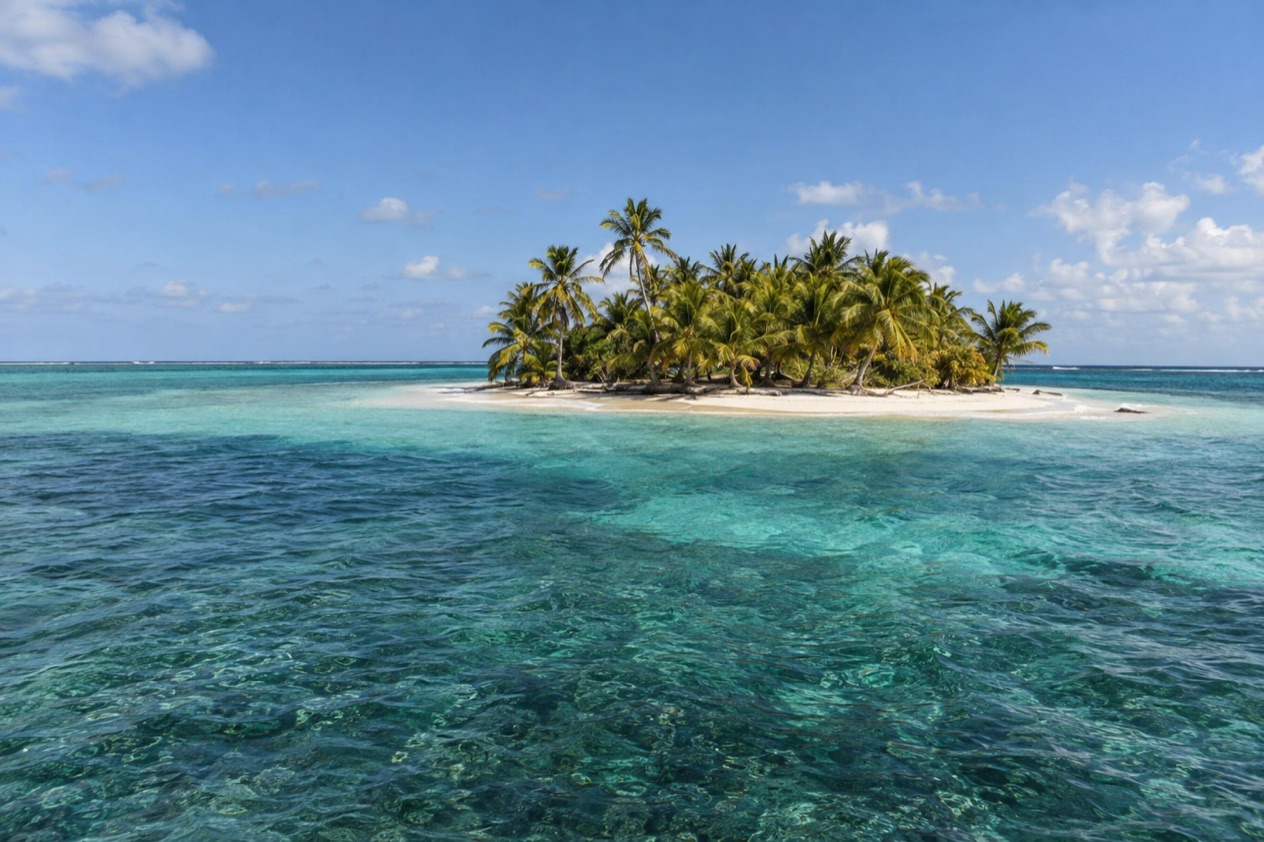
A scrap of sand and palms sits alone on the water off the southern coast, with reef showing pale green and turquoise around it and no building in sight. Laughing Bird Caye is uninhabited, a tiny national park set on a reef ridge in the Stann Creek District. This is a visit from Placencia built around the reef, the history of the gulls that gave the caye its name, and the larger marine reserve around it.
Is visiting Laughing Bird Caye worth it?
Yes, if what you want from Belize is a small, uninhabited island rather than a resort caye, and a sense of how the southern reef is put together. Laughing Bird Caye suits travelers staying around Placencia who like the idea of a protected spot where the story is the reef itself, not shops, bars or boardwalks.
It is also one of those places where the name carries a piece of history. Laughing gulls once bred here, and the call of a colony gave the island its name. As human activity grew, the gulls moved to more deserted islands. That tells you a lot about the place: it is small, and it is fragile.
What sets it apart from the cayes farther north is the setting. This is not a lived-in island with guesthouses and a main street.
It is a national park, part of the Belize Barrier Reef Reserve System that joined the World Heritage List in 1996, and it belongs to the Southern Belize Reef Complex, a group that also takes in South Water Caye and the Sapodilla Cayes Marine Reserve. If you came to Belize for the reef, and you like places with a story and no crowds of buildings, this is a good reason to spend time on the water off Placencia.
What to see at Laughing Bird Caye
The first thing you notice is how little there is, and that is the point. The caye covers under two acres, so the whole park is a patch of land with the sea on every side. What you see is color: pale sand, green palms and the changing blues of the shallows around the reef.
The caye and its reef setting
Laughing Bird Caye sits on an unusually long, narrow ridge of reef called a faro, an angular atoll on the continental shelf with a lagoon at its center. That shape is rare, and it explains the look of the water here, with a ring of reef holding a calmer-looking lagoon inside. Look at the way the color shifts from pale to deep blue and you are reading the reef’s outline.
The park was declared in December 1991 and is only 1.8 acres, which makes it among the smallest protected places in the country. It is part of a World Heritage reef system, so the land you stand on is the smallest part of what is being protected. Most of the interest lies in the water and in the reef beneath it.
The gulls that named the island
The name comes from laughing gulls, black-headed birds with a call that sounds like a cackle, which used to nest here in numbers. Their calls are what early visitors remembered. Today the gulls have moved away to more deserted islands because of the increase in human activity on the caye.
It is a small lesson in how a place changes when people arrive. You will not come here promised a colony, but the island still carries the name, and knowing the story makes the quiet more meaningful. Other seabirds and shorebirds may pass through, as they do along this coast, though that is a chance and never a promise.
The wider reserve around it
Beyond the caye lies Gladden Spit and Silk Cayes Marine Reserve, which protects a fish spawning site, the congregating whale sharks and the tourism value of the Silk Cayes. More than 30 species of fish, grouper and snapper among them, gather in the thousands at full moon. The Southern Environmental Association handles day-to-day management of that reserve.
That context makes a visit to Laughing Bird Caye richer. You are on the edge of one of the more important marine areas in Belize, and the caye is the visible, walkable piece of a much bigger protected landscape under the water.
Hours, tickets and rules
Laughing Bird Caye is a national park with no village, no gate house and no shops, and its upkeep sits with the Southern Environmental Association. The association is responsible for day-to-day management of the surrounding marine reserve, including patrols and fee collections, so fees on this stretch of reef are collected by that organization.
The park was declared on December 21, 1991, and it forms part of the reef system on the World Heritage List. Each marine reserve in the country is guided by a management plan, and the Gladden Spit and Silk Cayes reserve was originally established in May 2000 before being designated a Marine Reserve in 2003. The first co-management agreement was signed in 2001, with help from Friends of Nature, the group now known as the Southern Environmental Association.
What that means for you is simple. This is a protected place with an organization behind it, patrols on the water and a plan that governs what happens in the reserve. Treat the caye as the fragile, uninhabited reserve it is, and follow whatever the park managers ask when you arrive.
How to get to Laughing Bird Caye
You start from Placencia, the nearest city to the caye and the base for the southern reef. The island lies 12 miles off the coast of Placencia village, in open water and out of sight of the village streets. Everything about the trip begins on the peninsula.
Placencia as the starting point
Placencia is a small village at the southern tip of an 18-mile peninsula that also holds Riversdale Village, Maya Beach Village and Seine Bight, running from north to south in that order. The peninsula is served by Placencia Airport, so you can fly to the village instead of making a long journey on land.
The village counts a little over 1,500 permanent residents, which gives you a sense of scale. It is a place of sandy streets, small restaurants and local art galleries, with a strong link to the sea. For the caye, the village is where the outing begins and ends.
The route out to the reef
Once you leave the coast you are heading for a reef ridge in open water. The caye is part of the Southern Belize Reef Complex, close to the Gladden Spit and Silk Cayes reserve, so the same stretch of sea holds several reef destinations that start from the village.
Placencia offers kayaking, snorkeling, diving, saltwater fly fishing and light tackle fishing, so the village is used to people heading out to sea for the day. That is where your plans for the caye belong, in the same hands as the rest of the reef activities.
When to visit Laughing Bird Caye
The caye is a place for any month of the year in which you are on the southern coast, but the calendar around it has real texture. It is the whale shark season at Gladden Spit, tied to the full moons between April and July.
Whale shark months, April to July
Whale shark watching in Placencia happens around the full moons between April and July. The Gladden Spit spawning aggregation draws one of the largest predictable whale shark congregations in Belize, and it matters a great deal to Placencia and other coastal communities. If you plan your trip for those months, you can pair the caye with that outing.
The same full moons bring grouper and snapper to the spawning site in the thousands. Seeing whale sharks is a chance, never a promise, but the pattern is well established enough that the whole village plans around it.
Hurricane season and the shoulder months
The Atlantic hurricane season runs from June 1 to November 30, so an October visit falls inside it and the last weeks of the season still lie ahead. Placencia knows what a storm can do. On October 8, 2001, Hurricane Iris hit southern Belize with 145 mph winds and damaged nearly 95% of the buildings in the village.
If you travel between June and the end of November, keep an eye on the forecast as you would anywhere on this coast. December to March and the weeks around the whale shark full moons give you other ways to line up a trip. Events in the village, including the Lobster Fest, the Peninsula Arts Festival and Easter Week celebrations, add reasons to choose a particular time.
Tips for your visit
Think of the caye as one piece of a few days in Placencia, not an isolated stop. The reef, the whale shark waters and the village each fill their own outing, and the caye fits naturally with the first of those.
Pairing the caye with other outings
If the season is right, pair the reef with the Gladden Spit whale shark outing, since both sit in the same marine area. On the village side, Placencia Lagoon has manatees, dolphins, rays and mangrove forests, with birding by canoe or kayak and fishing for juvenile tarpon, snook and barracuda. It gives you a quiet counterpart to a day on open water.
Inland, Cockscomb Basin Wildlife Sanctuary is a day trip from Placencia. The Maya sites of Nim Li Punit and Lubaantun, in the Toledo District, are also a day trip from the peninsula. Together they show how much the area offers beyond the reef, from rainforest to ruins.
Respecting a small, fragile place
The island is uninhabited and tiny, and the gulls left because of human activity. Go as a visitor who wants the place to stay as it is. Follow what the park managers ask, and treat the caye as a protected reserve and not a beach club.
Keep your plans simple, and let the setting do the work. Bring your attention to the reef, the color of the water and the story of the gulls, and the visit will feel complete even though the island is small.
Good to know before you go
The U.S. State Department rates Belize Level 2, “Exercise increased caution”, because of crime, and says the south side of Belize City has historically had the highest concentration of violent crime.
Laughing Bird Caye has no village, so the practical side of the day lives in Placencia, where the restaurants, galleries and tour desks are. The Southern Environmental Association collects fees for the reserve and runs patrols, so expect the visit to be organized around that. Hurricane season runs through the end of November, which matters if you travel in the fall.
Beyond that, pack for a day on the water and for a small, quiet island. A visit here is about the reef and the story of a protected place, and it fits comfortably into a longer stay on the Placencia Peninsula.
Sources
- Wikipedia, Laughing Bird Caye (https://en.wikipedia.org/wiki/Laughing_Bird_Caye), checked October 11, 2026
- Belize Fisheries Department, Gladden Spit and Silk Cayes Marine Reserve (https://fisheries.gov.bz/gsscmr/), checked October 11, 2026
- Wikipedia, Placencia (https://en.wikipedia.org/wiki/Placencia), checked October 11, 2026
- U.S. Department of State, Belize Travel Advisory, Level 2, March 11, 2026 (https://travel.state.gov/), checked October 11, 2026
- NOAA National Hurricane Center, Climatology (https://www.nhc.noaa.gov/climo/), checked October 11, 2026