
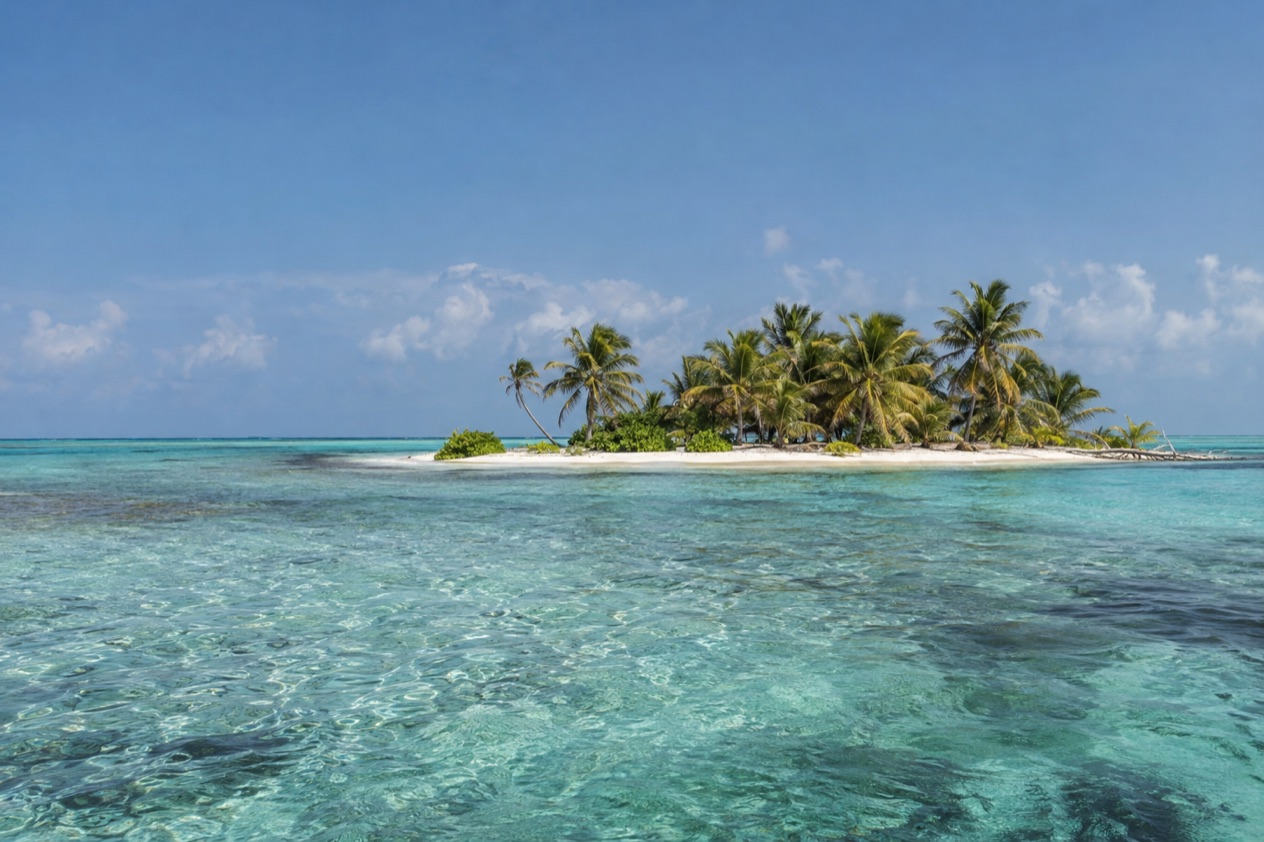
The first thing you notice on Half Moon Caye is the sound: hundreds of seabirds calling from the treetops while the surf breaks on the reef edge just offshore. Ashore, a sandy shore gives way to a woodland of siricote trees with orange flowers, and a few frigatebirds hang in the wind overhead. It is a tiny island at the southeast corner of Lighthouse Reef Atoll, and a visit here is about birds, turtles, reef and quiet.
Is visiting Half Moon Caye worth it?
Yes, if you care about wildlife and the reef more than about hotels, restaurants or a lively beach scene. Birders, snorkelers, divers and anyone who likes small wild islands will find a lot here. If you want services and nightlife, this is the wrong stop.
What sets it apart from the other cayes you may be visiting is its job. Half Moon Caye was designated a bird sanctuary in 1924, which makes it Belize’s oldest site of wildlife protection.
It later became the first nature reserve set up in Belize under the National Park Systems Act in 1981, and the first marine protected area in Central America. Today it is a Natural Monument and part of the Belize Barrier Reef Reserve System World Heritage Site.
The island is small, half a mile long and a fraction of that wide, so everything sits within a short stretch of sand and forest. It holds a nesting colony of red-footed boobies that may be the only viable breeding colony of its kind in the western Caribbean, a rookery of magnificent frigatebirds, nesting sea turtles in season and some of the healthiest reef in the Caribbean right off the beach. Few places in Belize combine all of that on one speck of land.
What to see at Half Moon Caye
The red-footed booby colony and frigatebirds
The birds are the reason the island was protected in the first place. A nesting colony of about 4000 red-footed boobies lives in the trees, and the white-phase birds here are the ones that give the island its reputation among birders. Magnificent frigatebirds keep a rookery on the island too, and the males, with their red throat pouches, are a striking sight when they display.
The caye was first set aside as a crown reserve in 1928 to protect these nesting colonies. The island is also part of a very large Important Bird Area recognized by BirdLife International, so other species turn up as well: white-crowned pigeons, roseate terns, Yucatan vireos, black catbirds and, among the passage birds, golden-winged and cerulean warblers. Bring binoculars and look up into the canopy.
The siricote forest and its small residents
The western half of the caye holds a rare surviving atoll forest of siricote trees, the orange-flowered species that gives the woodland its color. This littoral forest is a fragile and endangered habitat, and it is what the booby colony depends on for nesting.
Look low as well as high. The island shelters the Belize leaf-toed gecko, also called the Belize atoll gecko, which is found only in Belize, along with Allison’s anole lizard. They are small and easy to miss, so a slow pace pays off under the trees.
The turtle nesting beach
The southeast-facing beach is where loggerhead, green and hawksbill turtles have all been recorded nesting. The southeastern part of the island serves as a nesting ground from May to November each year, and all three species are endangered.
Even outside those months, the beach is a good place to read the sand and think about what comes ashore here. Seeing a turtle is a chance, never a promise.
Diving and snorkeling around the caye
The natural monument includes five dive sites: the Half Moon Caye Wall, Angelfish Wall, Elkhorn Forest, Tarpon Caves and Eagle Landing. At Angelfish Wall, divers may see parrotfish, horse-eye jacks, eagle rays and an occasional shark.
Tarpon Caves can be a shallow dive in 30 to 50 feet of water or a deep dive along the wall from 60 to 130 feet. Eagle Landing, at the southeast tip of Lighthouse Reef Atoll, offers a shallow dive with abundant tropical reef fish, Queen Conch and stingrays. Snorkeling is one of the activities visitors can take part in on the island, and Lighthouse Reef is considered one of the best developed and healthiest reefs in the Caribbean.
Hours, tickets and rules
The monument is open during the day, from morning to late afternoon, and the entrance fee is charged per day. Belizean nationals pay a much smaller fee than visitors from abroad.
| Site | Open | Admission |
|---|---|---|
| Half Moon Caye Natural Monument | 8:00am to 4:30pm | BZD 2.50 per day (Belizean nationals), BZD 20 per day (non-nationals) |
The activities the monument lists for visitors are birding, camping, diving, snorkeling and picnicking.
How to get to Half Moon Caye
The island lies 55 miles east of Belize City, out on the southeast corner of Lighthouse Reef Atoll. It sits in the Belize District, but it is well out to sea, so the way there is by boat.
The most common way to reach Half Moon Caye is with a tour operator. Departures run from San Pedro, Caye Caulker, Hopkins and Placencia, and also from resorts within the Turneffe and Lighthouse Reef atolls. Whichever base you start from, the operator takes you to the island as part of the trip.
Lighthouse Reef itself is an atoll about 22 miles long from north to south and about 5 miles wide, enclosing a shallow sandy lagoon. Half Moon Caye sits at its southeast end, and the same atoll is home to the Great Blue Hole, so outings in this area often share the same stretch of sea.
When to visit Half Moon Caye
The monument is open from 8:00am to 4:30pm, so your visit falls within those hours. Arriving earlier in that window gives you more of the island’s daytime life, with the birds active in the trees.
For turtles, the nesting season runs from May to November, which is when loggerhead, hawksbill and green turtles use the southeast beach. That window overlaps with the Atlantic hurricane season, which runs from June 1 to November 30, so a trip in those months is a matter of weighing the nesting season against the storm season.
The booby and frigatebird colonies are the island’s year-round attraction, and the reef is there in every month. Birders may also want to think about the passage birds, such as the warblers, which are part of what the surrounding Important Bird Area supports.
Tips for your visit
Bring binoculars, a camera and your snorkel gear if the operator does not provide it. The island’s activities include birding, picnicking, snorkeling, diving and camping, so you can shape the visit around whichever you prefer.
Because the island is small, it combines naturally with the rest of the atoll. Lighthouse Reef is known for dive sites such as Half Moon Caye Wall, Long Caye Aquarium, Silver Caves, Tres Cocos and West Point, and it is home to the Great Blue Hole, which is also a Natural Monument and World Heritage Site.
The reserve protects fragile ground. Despite protection, Lighthouse Reef suffers from human impact in the form of uncontrolled fishing and tourism, which is one more reason to keep to the island’s footpaths and treat the nesting areas gently. Plan on a simple, natural visit.
Good to know before you go
The U.S. State Department rates Belize Level 2, “Exercise increased caution”, because of crime, and says the south side of Belize City has historically had the highest concentration of violent crime.
Half Moon Caye is a protected island with no town around it, so the visit is built around the boat trip and the monument’s daytime hours. The Atlantic hurricane season runs from June 1 to November 30, which matters when you pick your dates.
Sources
- Belize Audubon Society, Half Moon Caye Natural Monument (https://belizeaudubon.org/hmcnm/), checked October 11, 2026
- Wikipedia, Half Moon Caye (https://en.wikipedia.org/wiki/Half_Moon_Caye), checked October 11, 2026
- Wikipedia, Lighthouse Reef (https://en.wikipedia.org/wiki/Lighthouse_Reef), checked October 11, 2026
- U.S. Department of State, Belize Travel Advisory, Level 2, March 11, 2026 (https://travel.state.gov/), checked October 11, 2026
- NOAA National Hurricane Center, Climatology (https://www.nhc.noaa.gov/climo/), checked October 11, 2026