
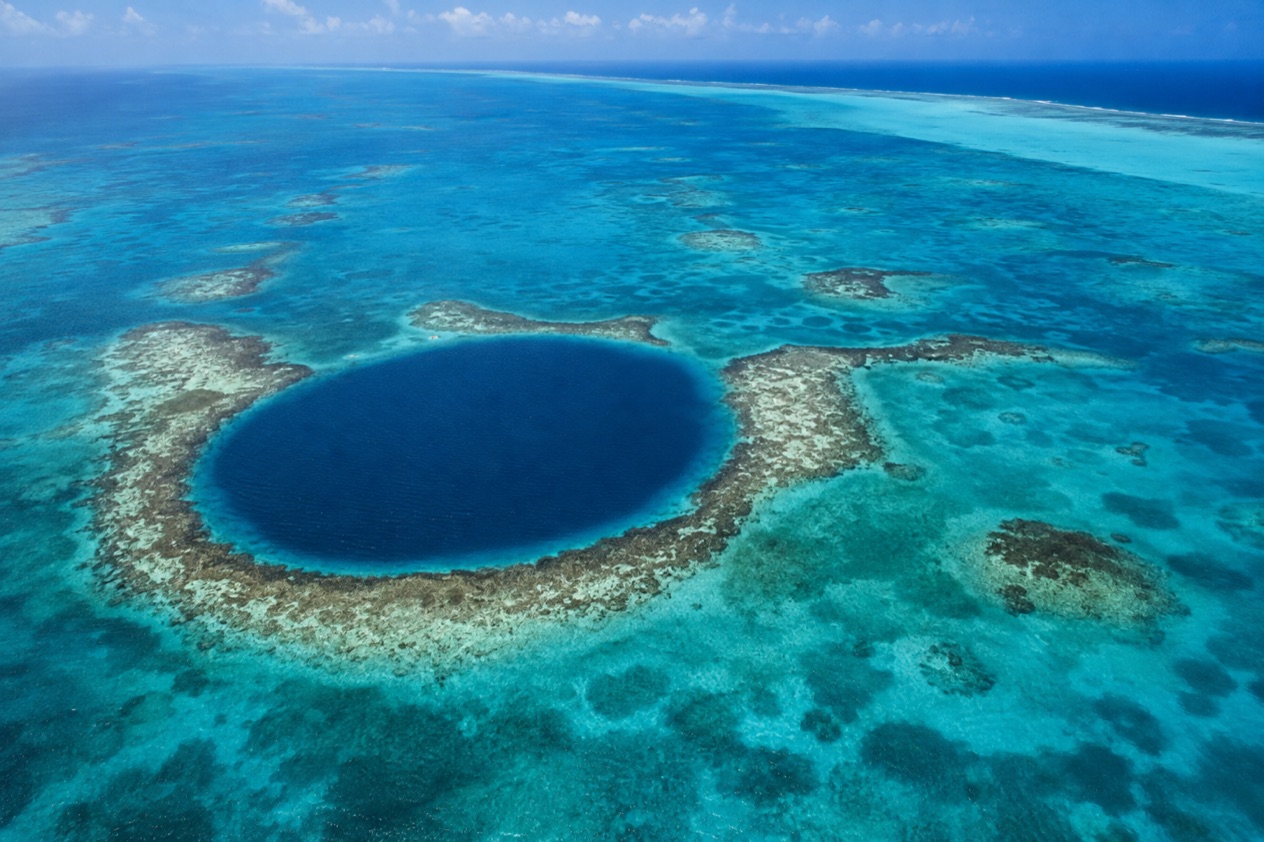
From the boat, the Great Blue Hole looks like a pupil set into the pale turquoise of Lighthouse Reef: a perfect circle of deep indigo ringed by shallow, sunlit coral. Nothing on the horizon prepares you for it, only open sea and the low line of the atoll. This is a visit made by boat to a marine monument far out on the reef, and it is built around the water.
Is visiting the Great Blue Hole worth it?
Yes, for travelers who care about the sea itself, above all divers, and for anyone who wants to see one of the great natural landmarks of the Caribbean from the water. The primary focus here is diving the sinkhole, and divers and snorkelers also report sightings of green, hawksbill and loggerhead turtles. If you want a beach, a boardwalk or a visitor center, this is not that kind of place.
What sets it apart from the other reef sites nearby is its shape and its scale. The sinkhole is a karst limestone formation, flooded as sea levels rose, and its sheer size is something no ordinary reef dive can match. The Blue Hole Natural Monument includes no land, so the experience is entirely afloat, with only mooring buoys for dive boats.
It sits at the heart of Lighthouse Reef, an atoll considered one of the best developed and healthiest reefs in the Caribbean. Discovery Channel ranked it number one on its list of the 10 most amazing places on Earth in 2012, and Jacques Cousteau made it famous in 1970.
Visitors generally pair it with Half Moon Caye, which adds birds and forest to a day that is otherwise all blue water. That combination is what makes the long trip out feel like a full excursion rather than a single stop.
What to see at the Great Blue Hole
The sinkhole itself
The hole is circular, 318 meters (1,043 feet) across and 124 meters (407 feet) deep. From the surface, the color change is the show: the deep center is a dark, saturated blue, and the shallow rim around it glows pale green and turquoise. The Great Blue Hole is part of the Belize Barrier Reef Reserve System, a UNESCO World Heritage Site.
Its story is written in stone. Stalactites found inside show that the cave formed over several stages, dating back 153,000, 66,000, 60,000 and 15,000 years ago, when this was dry land above a lower sea. Ledges at 69, 161 and 299 feet record those stages as the sea rose.
The reef rim and its fish
The rim supports coral and tropical fish. The shallow reef edge sits at about 16 feet, slopes gently to about 33 feet, then drops away as a near-vertical cliff into the blue. That staircase from reef to abyss is what you look for from the surface or on a dive.
Groupers, squirrelfish, angelfish, butterflyfish and midnight parrotfish live here, along with reef sharks, including nurse, Caribbean reef and blacktip sharks. Occasional visitors include great hammerheads, an endangered species, as well as lemon and bull sharks. Sightings are chances, not promises.
The deep, dark layer
Below about 300 feet, a layer of hydrogen sulfide turns the water dark, oxygen-free and lifeless, as a December 2018 submarine expedition found. That is far beyond where recreational visitors go, but it explains the hole’s reputation for mystery. The same expedition located the bodies of two divers on the bottom, out of three believed missing here, and reported them to Belizean authorities.
Half Moon Caye
Visitors to the monument generally include Half Moon Caye in the same itinerary. Its western half holds a rare surviving atoll forest of siricote trees, and the caye hosts a rookery of magnificent frigatebirds and a nesting colony of about 4,000 red-footed boobies. Both the caye and the Blue Hole are designated Natural Monuments within the World Heritage reef system.
Hours, tickets and rules
The monument is open during the day, and entry is charged in Belize dollars, with a much lower rate for Belizeans than for visitors from abroad. Because there is no land and no building, the fee is simply the price of being on the water here.
| Site | Open | Admission |
|---|---|---|
| Blue Hole Natural Monument | 8:00am to 4:30pm | BZ$60 for non-nationals, BZ$2.50 for nationals |
The monument has no visitor facilities other than mooring buoys provided for dive boats. Mariners are required to contact Half Moon Caye park rangers on VHF Channel 16 before hitching onto a mooring or anchoring within the Half Moon Caye and Blue Hole Natural Monuments.
How to get to the Great Blue Hole
You reach it by sea. The sinkhole lies near the center of Lighthouse Reef, an atoll about 50 miles southeast of Belize City and the most easterly diving area in Belize. The atoll is roughly 22 miles long from north to south and about 5 miles wide, enclosing a shallow sandy lagoon.
Tour operators run to the monument from San Pedro, Caye Caulker, Hopkins and Placencia, and from resorts within the Turneffe and Lighthouse Reef atolls. Choose the base that suits the rest of your trip, since the boat is the way in from each of them.
There is no landing and no facility at the sinkhole, so your boat ties up to one of the mooring buoys. Turneffe Atoll, the nearest of the three atolls to Belize City, lies directly east of the city, while Lighthouse Reef is the farthest out, which is part of why a trip here feels like a true expedition.
When to visit the Great Blue Hole
The monument is open from 8:00am to 4:30pm, so every visit happens in daylight. The color contrast between the shallow rim and the deep center reads best when the sun is high, but the hours themselves are the only fixed rule.
The Atlantic hurricane season runs from June 1 to November 30, and a trip planned inside those months should keep that in mind when choosing dates. Outside them, the calendar is open. Belize has a dry season and a wetter one, and the sea around the atoll can change with the weather, so conditions on the day shape how the visit feels.
For wildlife, think in terms of chances. Turtles, reef sharks and the occasional hammerhead are reported here, and the red-footed boobies and frigatebirds of Half Moon Caye are the draw for anyone adding the caye to the day.
Tips for your visit
Plan for a day built around the water. Since the monument has no land and no facilities, everything you need comes with the boat, and the primary activity is diving the sinkhole. Snorkelers and divers both report seeing turtles here, so a mask and snorkel have a use even if you stay near the rim.
Combine it with Half Moon Caye, as visitors generally do. The caye adds a walk among siricote trees and a look at nesting seabirds, which balances the open-water hours. Lighthouse Reef also has dive sites such as Half Moon Caye Wall, Long Caye Aquarium, Silver Caves, Tres Cocos and West Point.
Lighthouse Reef suffers from uncontrolled fishing and tourism despite protection, so treat the reef gently. The Belize Barrier Reef is home to 70 hard coral species, 36 soft coral species and 500 species of fish, and it is worth seeing with care.
Good to know before you go
The U.S. State Department rates Belize Level 2, “Exercise increased caution”, because of crime, and says the south side of Belize City has historically had the highest concentration of violent crime.
Belize banned bottom trawling completely in December 2010, and protection of the reef continues to shape how visitors use these waters. The Atlantic hurricane season runs from June 1 to November 30.
Sources
- Wikipedia, Great Blue Hole (https://en.wikipedia.org/wiki/Great_Blue_Hole), checked October 11, 2026
- Belize Audubon Society, Blue Hole Natural Monument (https://belizeaudubon.org/bhnm/), checked October 11, 2026
- Wikipedia, Lighthouse Reef (https://en.wikipedia.org/wiki/Lighthouse_Reef), checked October 11, 2026
- Wikipedia, Belize Barrier Reef (https://en.wikipedia.org/wiki/Belize_Barrier_Reef), checked October 11, 2026
- U.S. Department of State, Belize Travel Advisory, Level 2, March 11, 2026 (https://travel.state.gov/), checked October 11, 2026
- NOAA National Hurricane Center, Climatology (https://www.nhc.noaa.gov/climo/), checked October 11, 2026