
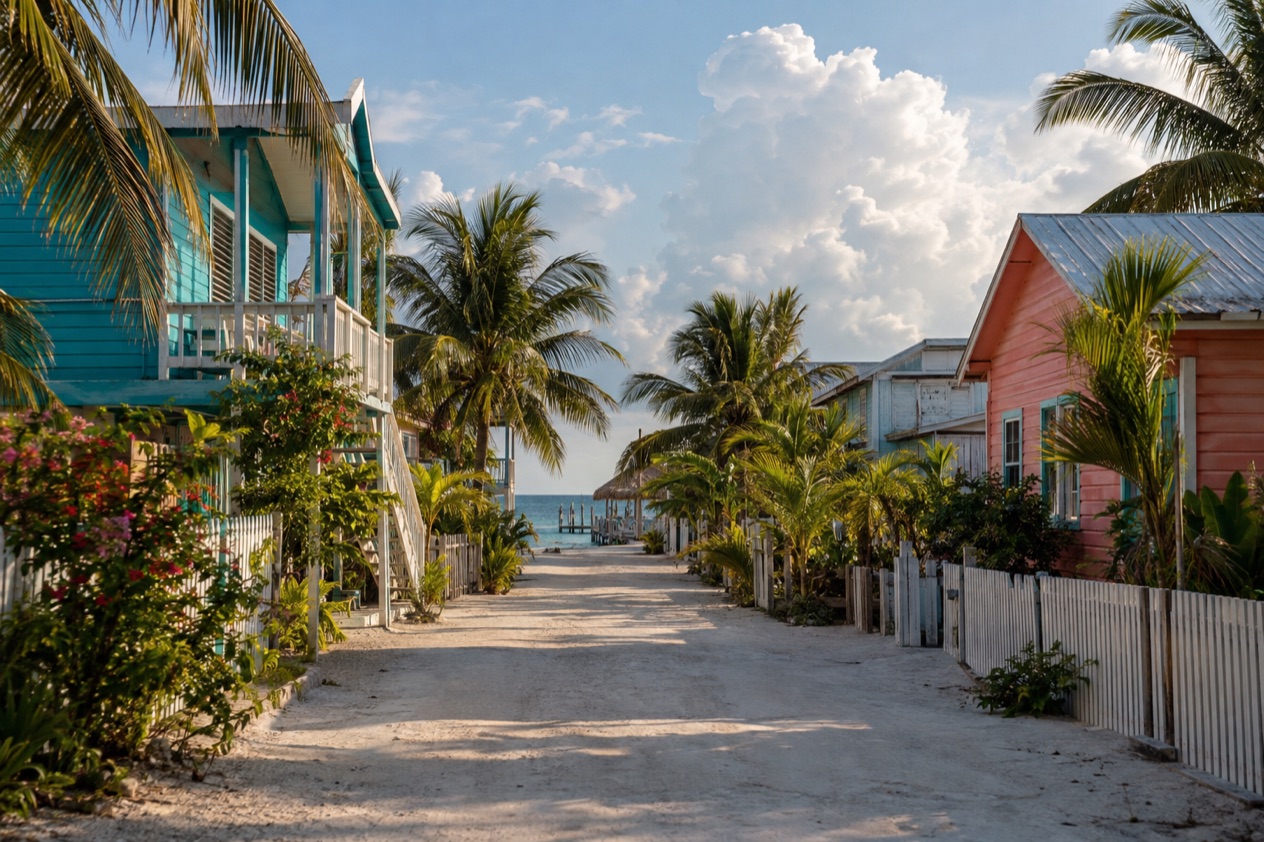
In June, the sandy lanes of Caye Caulker fill with the sound of bicycle bells and flip-flops, and the pastel wooden houses sit under a sky that can turn from glare to gray cloud and back again. Fishing boats rock at the docks, and the one traffic sign on the island still asks bikers and pedestrians to go slow.
June is the first month of hurricane season and the last month of the lobster closed season, which gives the island a particular edge of waiting. It is a month for people who want warm water, the barrier reef close by and an unhurried island.
What is the weather like in Caye Caulker in June?
June on Caye Caulker is hot, humid and bright, with a sea as warm as the air and days that stretch well into the evening. The table sets it beside the months on either side.
| Month | Sea at Caye Caulker (°F) | Daylight on the 15th (hours and minutes) |
|---|---|---|
| May | 84.9 | 13 h 01 min |
| June | 86.8 | 13 h 14 min |
| July | 85.7 | 13 h 07 min |
In Belize City, highs average close to 89°F in June. Rain falls there on about ten days of the month, so a gray, showery day is a real possibility, and it is worth keeping a plan for the hours indoors. On an island with no hills and little shade from buildings, the sun does most of the work on the days it shows up.
The sea is the better guide to how June feels on the water. It sits in the mid-80s, which means you can slip in without a gasp and stay in for a long while. Light, quick-drying clothes, a hat and a swimsuit under your shirt suit the month better than anything with sleeves.
The daylight is generous. The long evenings let you finish dinner while the sky is still pale over the water, and the walk back along the sandy streets happens in the last of the light. June is also the month when the Atlantic hurricane season opens, and a storm somewhere in the basin can bring wind and rain to the coast.
Can you swim in Caye Caulker in June?
The sea in June is warm enough for a long swim, sitting in the mid-80s. The reef itself is described as easily accessible from the island, which is why most of the water-based outings around Caye Caulker revolve around it.
The Caye Caulker Marine and Forest Reserve, established in April 1998, covers over 9,000 acres of the Mesoamerican Barrier Reef System. Its rules were gazetted in December 2008. Beyond it runs the Belize Barrier Reef, a series of coral reefs along the coast that lies roughly 300 metres (980 ft) offshore in the north and 25 miles offshore in the south.
Farther out, the reef system includes three atolls: Turneffe Atoll, Glover’s Reef and Lighthouse Reef. Turneffe Atoll Marine Reserve is a nursery ground for Queen conch, Caribbean spiny lobster and many reef fishes. Lighthouse Reef is the most easterly diving area in Belize and is home to the Great Blue Hole, made famous by Jacques Cousteau in 1970. In Belize it is illegal to take or kill whale sharks or nurse sharks.
What to do in Caye Caulker in June
June on Caye Caulker is about the water and the island’s slow rhythm. The place has been on the backpacker circuit since the 1960s, and a growing number of hotels now cater to a wider variety of visitors. You still find sandy beaches, clear water and none of the hustle and bustle of bigger Caribbean destinations. Nothing is hurried here, and that is the main attraction.
The month’s strongest thread is the lobster. For all of Belize, the closed season for lobster runs from March 1 to June 30, so June is the last month of the pause. Caye Caulker became home to lobster fisheries in the early twentieth century, and the trade shaped the island’s docks, its families and its tables. When the season reopens in July, the island’s relationship with the sea comes back into focus.
The reef and the marine reserve
The barrier reef is the reason most people come, and the Caye Caulker Marine and Forest Reserve is the stretch of it that belongs to the island. Boats go out from the docks into the reserve, and snorkelers and divers find themselves over coral gardens and seagrass beds that are part of the larger Mesoamerican Barrier Reef System.
June’s warm sea suits a long time in the water, and the longer days leave room for more than one outing. If you want to go farther, the atolls named above (Turneffe, Glover’s Reef and Lighthouse Reef with its Great Blue Hole) are the names that divers and snorkelers talk about when they plan a bigger reef day.
Streets, docks and the Go Slow spirit
The island itself is the other attraction. Wooden houses painted in sun-faded colors line the sandy streets, and the one local traffic sign instructs bikers and pedestrians to go slow. Walk or bike along the waterfront and watch the docks, where fishing boats come and go and pelicans wait for scraps.
Small restaurants and street stands serve what the Caribbean coast of Belize is known for: grilled fish, ceviche, rice and beans with stewed chicken, fry jacks at breakfast and fruit punch or rum punch at sunset. On a June evening, with the daylight lingering, the waterfront bars fill with a mix of travelers and islanders.
Sargassum and the shoreline
Sargassum is a brown algae that floats in sometimes mile-long clumps and gives off a rotten-egg smell when it washes onto a beach. Satellite imagery in 2015 showed it blooming off Brazil and being pushed by currents into the Caribbean. Some seasons it reaches shores, and it is a reason to keep a flexible plan for your beach time.
If the shoreline looks uninviting on a given day, the reef outings and the town itself still give you plenty to do. The island has more to offer than a strip of sand, and the water beyond the shore is where most of the days are spent.
A two-day itinerary for Caye Caulker in June
Day 1 begins on foot. Walk the sandy streets in the morning while the light is soft, stop for a fry jack breakfast at a small café and let the island set the pace. Spend the middle of the day on the water in the Caye Caulker Marine and Forest Reserve, where the warm sea and the nearby barrier reef are the point of the trip.
Come back for a slow afternoon at the docks, then have dinner at a waterfront restaurant. With more than thirteen hours of daylight, you can stay out on the pier well into the evening and walk home along the sandy streets in the dusk.
Day 2 is for the other side of the island. Start with coffee and a bike ride past the pastel houses, stopping where the fishing boats tie up. Late morning is a good time for a second swim or a stretch of reading in the shade, then a lunch of ceviche or grilled fish at a small place near the water.
If the weather turns gray, which it can in June, keep the day indoors with a long lunch, a rum punch and a browse through the small craft and souvenir shops. When the sky clears, go back to the waterfront for the last light and a final dinner of rice and beans with stewed chicken.
Is Caye Caulker busy in June?
Caye Caulker stays free of hustle and bustle in June, as the island’s character suggests. It is a small place with a wide range of visitors, from backpackers who have come since the 1960s to travelers staying in the newer hotels.
The mood in the streets is easygoing. Bikers and pedestrians share the sandy lanes at a go-slow pace, and the docks and waterfront restaurants are where people gather in the evening. The closing weeks of lobster season give the fishing community a pause before the harvest returns in July, and the start of the hurricane season adds a note of attention to the forecast.
The water is where the island opens up. The reef outings, the marine reserve and the longer trips to the atolls spread visitors across a wide area, so even when the streets are lively the sea feels open. For a quieter pace, wander the island’s back lanes in the morning or take a seat at the end of a dock.
What to pack for Caye Caulker in June
Pack for heat, salt water and the chance of a gray, wet day, and keep it light.
- Swimsuits and a snorkel mask, since the warm sea and the nearby reef are the reason for the trip.
- Light, quick-drying clothes for the humid days and the evenings out.
- A rain jacket or a compact umbrella, because June brings showery days.
- Sandals that dry fast for the sandy streets and the docks.
- A hat and sunscreen for the long hours of daylight.
- A dry bag for boat outings to the reef.
Good to know before you go
The U.S. State Department rates Belize Level 2, “Exercise increased caution”, because of crime, and says the south side of Belize City has historically had the highest concentration of violent crime.
June is the first month of the Atlantic hurricane season, which runs from June 1 to November 30. An average Atlantic season brings 14 named storms, so it is sensible to follow the forecast as you plan. Hurricane Keith in September 2000 and Hurricane Earl, which made landfall in Belize on August 4, 2016, are reminders that the season’s heart lies later in the year. The peak of the season is September 10.
The lobster closed season ends on June 30, and lobster must have a minimum carapace length of 3 inches and a minimum tail weight of 4 ounces. Nurse sharks and whale sharks are protected, and it is illegal to take or kill them.
Caye Caulker in June vs May and July
Moving the trip to May means a slightly cooler sea and a drier month, with about half as many rain days in Belize City. The Atlantic hurricane season has not yet opened, though the lobster closed season is in effect. The days are a few minutes shorter.
July brings a sea a shade cooler than June, though still very warm, and rain on roughly twelve days in Belize City. The lobster closed season has ended, so the island’s fishing tradition is back on the water and on the plate. The hurricane season is well underway.
Travelers who put the driest days first should lean toward May. Those who want the warmest sea and the end of the lobster pause will like June, and anyone who wants lobster back in the kitchens should choose July.
Is June a good time to visit Caye Caulker?
Yes, June suits travelers who want a warm sea, the barrier reef at their doorstep and an island that moves at its own pace. It is a good fit for snorkelers, divers, slow walkers and anyone who likes the idea of an island that asks you to go slow.
Travelers who want the driest weather possible, or who are uneasy about the start of hurricane season, may prefer another month. The showery days are part of the picture, and the forecast deserves a look before you go.
On arrival, take your first walk along the sandy streets and the waterfront to find your bearings and see where the boats leave from. Then plan your reef outing. June’s special quality is in the timing: the sea is at its warmest, the days are long, and the lobster closed season runs out on June 30, so the island is turning toward the harvest as the month ends.
Sources
- Open-Meteo Marine API, average 2015-2024, checked October 11, 2026
- sunrise-sunset.org, sunrise and sunset calculated for the 15th of the month, checked October 11, 2026
- NOAA NCEI, GHCN-Daily station BHM00078583 (Philip S. W. Goldson International Airport, Belize City), normals 1991-2020 computed from the daily record (https://www.ncei.noaa.gov/access/services/data/v1?dataset=daily-summaries&stations=BHM00078583), checked October 11, 2026
- NOAA National Hurricane Center, Climatology (https://www.nhc.noaa.gov/climo/), checked October 11, 2026
- Wikipedia, Hurricane Hattie (https://en.wikipedia.org/wiki/Hurricane_Hattie), checked October 11, 2026
- Wikipedia, Hurricane Keith (2000) (https://en.wikipedia.org/wiki/Hurricane_Keith_(2000)), checked October 11, 2026
- Wikipedia, Hurricane Dean (https://en.wikipedia.org/wiki/Hurricane_Dean), checked October 11, 2026
- Wikipedia, Hurricane Lisa (2022) (https://en.wikipedia.org/wiki/Hurricane_Lisa_(2022)), checked October 11, 2026
- Wikipedia, Hurricane Earl (2016) (https://en.wikipedia.org/wiki/Hurricane_Earl_(2016)), checked October 11, 2026
- Wikipedia, Hurricane Iota (https://en.wikipedia.org/wiki/Hurricane_Iota), checked October 11, 2026
- San Pedro Belize Express Water Taxi, Caye Caulker (https://belizewatertaxi.com/destinations/caye-caulker/), checked October 11, 2026
- Belize Fisheries Department, Bacalar Chico Marine Reserve (https://fisheries.gov.bz/bcmr/), checked October 11, 2026
- Belize Fisheries Department, Turneffe Atoll Marine Reserve (https://fisheries.gov.bz/tamr/), checked October 11, 2026
- Belize Fisheries Department, Regulations (https://fisheries.gov.bz/regulations/), checked October 11, 2026
- Belize Tourism Board, Sargassum resource (https://www.belizetourismboard.org/tourism-resources/sargassum-resource/), checked October 11, 2026
- Belize Fisheries Department, Gladden Spit and Silk Cayes Marine Reserve (https://fisheries.gov.bz/gsscmr/), checked October 11, 2026
- Tropic Air, Caye Caulker (https://www.tropicair.com/caye-caulker-cuk/), checked October 11, 2026
- Maya Island Air, Caye Caulker flights (https://www.mayaislandair.com/belize-flights-caye-caulker/), checked October 11, 2026
- Wikipedia, Belize Barrier Reef (https://en.wikipedia.org/wiki/Belize_Barrier_Reef), checked October 11, 2026
- Belize Fisheries Department, Caye Caulker Marine Reserve (https://fisheries.gov.bz/ccmr/), checked October 11, 2026
- Caye Caulker Village Council, Traffic (https://www.cayecaulkervillagecouncil.org/traffic), checked October 11, 2026
- Wikipedia, Climate of Belize (https://en.wikipedia.org/wiki/Climate_of_Belize), checked October 11, 2026
- U.S. Department of State, Belize Travel Information, Entry and exit requirements (https://travel.state.gov/), checked October 11, 2026
- U.S. Department of State, Belize Travel Advisory, Level 2, March 11, 2026 (https://travel.state.gov/), checked October 11, 2026
To plan your stay
- Things to Do in Caye Caulker: The Split, Reef Snorkeling, Manatees and Fresh Lobster
- Where to Stay in Caye Caulker: Village Center, the Split, the North Side and the Lagoon Shore
- Caye Caulker from Belize City: Water Taxi, Small Plane and What to Do on Arrival
- Know Before You Go to Caye Caulker: Entry Rules, Money, Water Taxis and Health