
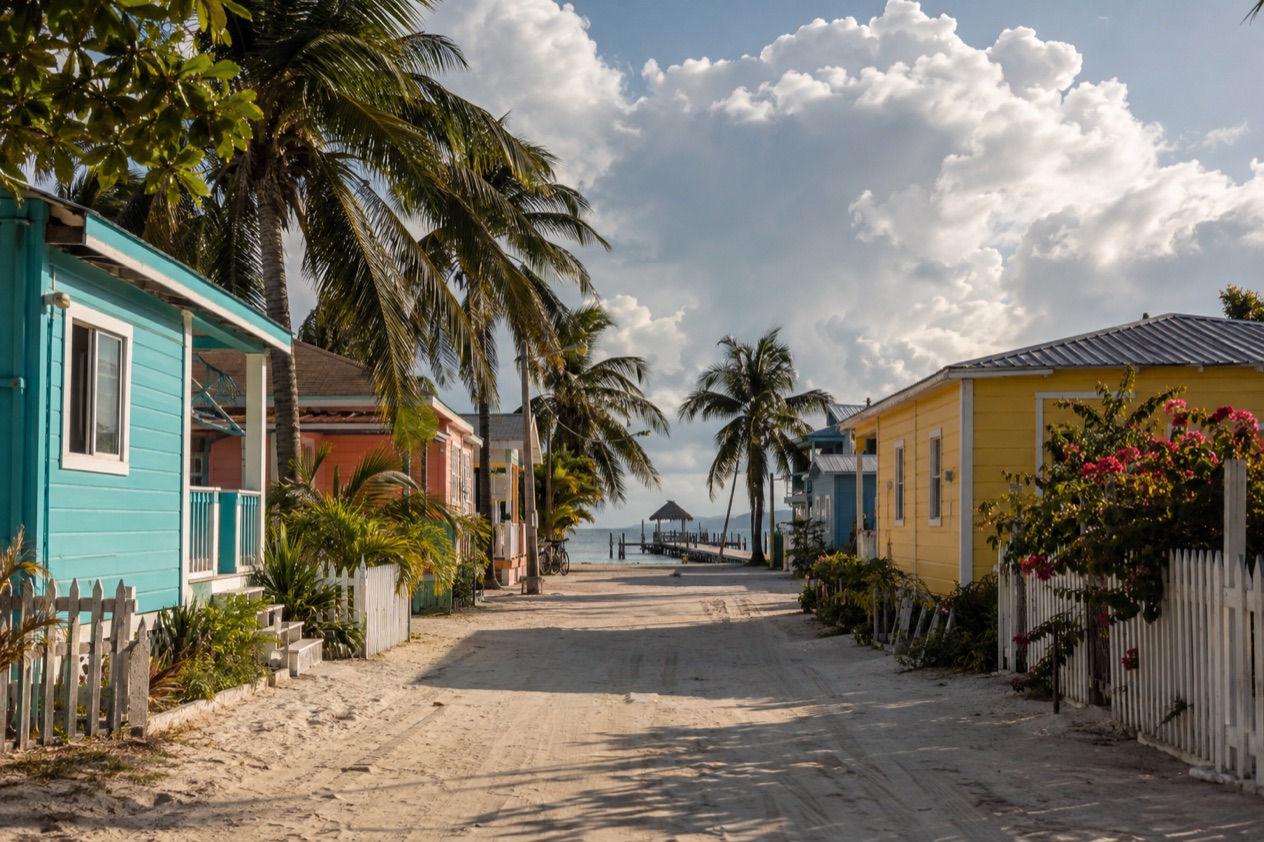
In July, Caye Caulker moves at the pace of its one local traffic sign, which asks bikers and pedestrians to go slow. Sandy lanes stay quiet in the morning, boats pull away from the docks toward the reef, and the water off the Split is as warm as it gets all year. The month brings long light, a very warm sea and the early weeks of the Atlantic hurricane season to a five-mile-long island.
What is the weather like in Caye Caulker in July?
July is hot, bright and humid, with a sea so warm it barely cools you off and days that stretch long into the evening.
| Month | Sea at Caye Caulker (°F) | Daylight on the 15th (hours and minutes) |
|---|---|---|
| June | 86.8 | 13 h 14 min |
| July | 85.7 | 13 h 07 min |
| August | 86.9 | 12 h 45 min |
The sea sits in the mid-80s, which means you slip into it without any hesitation and stay in as long as you like. July’s water is a shade cooler than June’s and August’s on paper, though you will not feel the difference on a snorkel trip. The light is generous, so there is plenty of time between breakfast and the last glow over the water.
In Belize City, highs average about 89°F in July, with rain falling on a bit under twelve days of the month. On an island with almost no shade on the sandy main lanes, that translates into a plain routine: sunscreen, a hat and a bottle of water before you leave the room, and a swim whenever the heat builds.
Evenings stay warm enough for a T-shirt and sandals, with the sun setting over the western side of the island. Because July sits inside the Atlantic hurricane season, a look at the forecast before any boat day is a sensible habit, but the month itself is mostly about heat, color and water.
Can you swim in Caye Caulker in July?
The sea is warm enough for a long swim, at about 86°F, and July is a month built around being in the water.
The Belize Barrier Reef runs along the coast, and on Caye Caulker it is described as easily accessible, which is why snorkeling and diving trips leave from the island’s docks. The reef lies roughly 300 meters offshore in the north of the country and sits farther out as you go south.
Nearby marine reserves belong in the same outing. Bacalar Chico Marine Reserve restricts fishing in its General Use Zones, so it is a place of protected waters. Turneffe Atoll Marine Reserve is an important nursery ground for Queen conch, Caribbean spiny lobster and many reef fishes. Farther out, Lighthouse Reef is the most easterly diving area in Belize and is home to the Great Blue Hole.
What to do in Caye Caulker in July
July on Caye Caulker is about the water, the lanes and the table. The island has been on the backpacker circuit since the 1960s, and it still feels like it: flip-flops, bicycles, painted wooden buildings and a rhythm that never speeds up.
One thing is specific to this month. The closed season for lobster across Belize runs from March 1 to June 30, so July is when lobster is back on the menu. The island became home to lobster fisheries in the early twentieth century, and that history shows on blackboard menus and grills along the main street. Minimum sizes apply to what can be taken, 3 inches of carapace and 4 ounces of tail.
Reef and marine reserve outings
Boat trips are the center of the island’s day. Snorkelers head for the barrier reef, which lies close enough to be an easy outing from the dock by the island’s own description, and divers look further out toward the atolls. With the sea in the mid-80s, you spend long stretches in the water without feeling chilled.
Turneffe Atoll, Glover’s Reef and Lighthouse Reef are the three atolls of the reef system, and Lighthouse Reef carries the Great Blue Hole that Jacques Cousteau made famous in 1970. Hurricane season is underway in July, so keep your plans flexible when a tropical system is in the forecast.
Lanes, bikes and the waterfront
Caye Caulker is free of hustle and bustle, with sandy beaches and clear water. The main pleasure is wandering: a bicycle or a slow walk along the sand lanes, past guesthouses, bars with swings for seats and small shops with hand-painted signs.
With long days in July, you can fit a morning on the water, a pause in the shade and a late wander before dinner. The sea at your feet is the warmest of the year, so a dip is never far away.
Eating on the island
Seafood leads the table. Grilled fish, lobster in season and conch dishes appear on beachside menus, usually with rice and beans and a cold drink. Small grills set up along the main street in the evening, and the smell of charcoal carries down the lane.
Rum punch, fresh juices and cold beer fit the heat. Choose a table with a view of the water and let dinner run long, since nobody here is in a hurry.
Sargassum and the shoreline
Sargassum is a brown algae that floats in clumps and can smell like rotten eggs when it washes onto a beach. It is part of the Caribbean story in recent years, and it can shape how a particular stretch of shore looks on a given day. Boat trips to the reef put you in open water, away from anything on the sand, so a day on the water is a good answer to a day of seaweed on the shore.
A two-day itinerary for Caye Caulker in July
Day 1 is for the island itself. Start early with breakfast at a small café on the main lane, before the sun climbs, then walk the sand streets with a hat and water. Spend the middle of the day in the sea, since the water is the best relief from the heat, and linger on a dock over lunch.
As the afternoon softens, wander the shops and the waterfront, then settle in for sunset on the western side. Daylight lasts a little over thirteen hours, so there is no rush. Dinner at a beachside grill, with lobster on the menu now that the closed season has ended, finishes the day.
Day 2 is for the reef. Take a snorkeling or diving boat out toward the barrier reef, which is described as easily accessible from the island. A marine reserve outing, with the nursery waters of Turneffe Atoll or the protected zones of Bacalar Chico, adds a second kind of day on the water.
Back on land, rinse off, rest in the shade and have a slow late meal. If the weather turns, spend the time in a café or a small gallery, then return to the dock when the sky clears and watch the light change over the sea.
Is Caye Caulker busy in July?
Caye Caulker stays an easygoing island in July, with a mix of backpackers and a growing number of hotel guests drawn to its relaxed pace.
The island has long been a backpacker stop, and more hotels now cater to a wider range of visitors. That mix gives the lanes a friendly, mixed feel, with travelers from many places sharing the same docks and tables.
As a habit, book rooms earlier for any holiday week you plan around and later when your dates are more flexible. Reef and marine reserve boat outings are worth arranging early in your stay so a change in the weather can be absorbed by a spare day.
What to pack for Caye Caulker in July
Think light, sun-ready and water-ready for an island where most of the day happens outdoors.
- Swimsuits, since the sea is warm and you will be in it often.
- A mask and snorkel if you like your own gear for the reef outings.
- A wide-brimmed hat and sunscreen for the open lanes and docks.
- A light rain jacket for the days when showers pass through.
- Sandals or flip-flops for sandy lanes and boat docks.
- Insect repellent for the evenings outdoors.
Good to know before you go
The U.S. State Department rates Belize Level 2, “Exercise increased caution”, because of crime, and says the south side of Belize City has historically had the highest concentration of violent crime.
July falls inside the Atlantic hurricane season, which runs from June 1 to November 30, with the peak later, around September 10. An average season brings 14 named storms, so it makes sense to keep plans flexible on boat days. Getting to the island is by ferry from Belize City, which takes about 45 minutes, by the ferry from San Pedro, about 30 minutes, or by Tropic Air flights using the code CUK.
Caye Caulker in July vs June and August
Moving earlier to June brings a slightly warmer sea and a longer day, with more than thirteen hours of light. The lobster closed season runs through the end of June, so July is the first month with lobster back on the menu.
Moving later to August gives a sea that is a touch warmer again and a shorter day, a little under thirteen hours. The hurricane season gets closer to its peak as the weeks pass, so flexibility matters more.
If lobster on the plate matters to you, July is the safer choice over June. If you want the longest light for the lanes and the water, lean toward June, and if you like the warmest sea, August is the pick.
Is July a good time to visit Caye Caulker?
Yes, July suits travelers who want warm water, long days and an unhurried island, and who are comfortable with the heat and a flexible plan during hurricane season.
Swimmers, snorkelers, divers and anyone who likes a slow lane and a seafood grill will enjoy it. Travelers who dislike humid heat, or who need fixed outdoor schedules, may prefer another month.
On arrival, drop your bags, walk to the water and get in. July on Caye Caulker is about lobster back on the grill, a sea in the mid-80s and a main street where the only sign tells you to go slow.
Sources
- Open-Meteo Marine API, average 2015-2024, checked October 11, 2026
- sunrise-sunset.org, sunrise and sunset calculated for the 15th of the month, checked October 11, 2026
- NOAA NCEI, GHCN-Daily station BHM00078583 (Philip S. W. Goldson International Airport, Belize City), normals 1991-2020 computed from the daily record (https://www.ncei.noaa.gov/access/services/data/v1?dataset=daily-summaries&stations=BHM00078583), checked October 11, 2026
- NOAA National Hurricane Center, Climatology (https://www.nhc.noaa.gov/climo/), checked October 11, 2026
- Wikipedia, Hurricane Hattie (https://en.wikipedia.org/wiki/Hurricane_Hattie), checked October 11, 2026
- Wikipedia, Hurricane Keith (2000) (https://en.wikipedia.org/wiki/Hurricane_Keith_(2000)), checked October 11, 2026
- Wikipedia, Hurricane Dean (https://en.wikipedia.org/wiki/Hurricane_Dean), checked October 11, 2026
- Wikipedia, Hurricane Lisa (2022) (https://en.wikipedia.org/wiki/Hurricane_Lisa_(2022)), checked October 11, 2026
- Wikipedia, Hurricane Earl (2016) (https://en.wikipedia.org/wiki/Hurricane_Earl_(2016)), checked October 11, 2026
- Wikipedia, Hurricane Iota (https://en.wikipedia.org/wiki/Hurricane_Iota), checked October 11, 2026
- San Pedro Belize Express Water Taxi, Caye Caulker (https://belizewatertaxi.com/destinations/caye-caulker/), checked October 11, 2026
- Belize Fisheries Department, Bacalar Chico Marine Reserve (https://fisheries.gov.bz/bcmr/), checked October 11, 2026
- Belize Fisheries Department, Turneffe Atoll Marine Reserve (https://fisheries.gov.bz/tamr/), checked October 11, 2026
- Belize Fisheries Department, Regulations (https://fisheries.gov.bz/regulations/), checked October 11, 2026
- Belize Tourism Board, Sargassum resource (https://www.belizetourismboard.org/tourism-resources/sargassum-resource/), checked October 11, 2026
- Caye Caulker Village Council, About (https://www.cayecaulkervillagecouncil.org/about), checked October 11, 2026
- Tropic Air, Caye Caulker (https://www.tropicair.com/caye-caulker-cuk/), checked October 11, 2026
- Maya Island Air, Caye Caulker flights (https://www.mayaislandair.com/belize-flights-caye-caulker/), checked October 11, 2026
- Wikipedia, Belize Barrier Reef (https://en.wikipedia.org/wiki/Belize_Barrier_Reef), checked October 11, 2026
- Wikipedia, Climate of Belize (https://en.wikipedia.org/wiki/Climate_of_Belize), checked October 11, 2026
- U.S. Department of State, Belize Travel Information, Entry and exit requirements (https://travel.state.gov/), checked October 11, 2026
- U.S. Department of State, Belize Travel Advisory, Level 2, March 11, 2026 (https://travel.state.gov/), checked October 11, 2026
To plan your stay
- Things to Do in Caye Caulker: The Split, Reef Snorkeling, Manatees and Fresh Lobster
- Where to Stay in Caye Caulker: Village Center, the Split, the North Side and the Lagoon Shore
- Caye Caulker from Belize City: Water Taxi, Small Plane and What to Do on Arrival
- Know Before You Go to Caye Caulker: Entry Rules, Money, Water Taxis and Health