
On the first of August the crawfish season opens, and the word spreads fast along the waterfront: lobster salad is back on the lunch boards, and the smell of garlic, thyme and butter drifts out of kitchens around Port Lucaya. The sea has reached its warmest and the days are long and bright. Freeport and Grand Bahama in August is a month for warm water, slow afternoons and seafood, with the hurricane season building toward its peak.
What is the weather like in Freeport and Grand Bahama in August?
Hot and humid, with a sea as warm as the air and long days made for the water, but with a stormy edge as the Atlantic hurricane season approaches its busiest weeks.
| Month | Sea at Freeport and Grand Bahama (°F) | Daylight on the 15th |
|---|---|---|
| July | 87.2 | 13 h 41 min |
| August | 87.3 | 13 h 06 min |
| September | 86.7 | 12 h 20 min |
In Nassau, afternoons climb to about 91°F, nights hold in the mid-70s, and rain falls on a little over a dozen days of the month, usually as a heavy shower that passes. That is a useful picture of the northern Bahamas in high summer, and on Grand Bahama you plan around it: the sun is strongest in the middle of the day, and clouds tend to build later.
Mornings are the kindest hours. Light comes early, the air is still soft, and a walk on the sand or a coffee on a terrace feels easy before the heat settles in.
Around early afternoon, shade, a pool or the sea itself becomes the sensible choice. Evenings stay warm enough for dinner outdoors without a layer, and with daylight lasting a little over thirteen hours, there is time for a late swim or a waterfront stroll before dark.
Rain in August often comes as a short, noisy downpour that clears the sky and leaves the roads steaming. A few days can be grayer and more unsettled, particularly if a tropical system passes through the Atlantic. Wear light, loose cotton, and keep a small rain shell in the bag rather than an umbrella, since gusts can come with the showers.
Can you swim in Freeport and Grand Bahama in August?
The sea is warm enough for a long, lazy swim, with water temperatures in the upper 80s that feel closer to a bath than a refreshment. You will not need a wetsuit, and a light rash guard is there for the sun rather than the cold.
Grand Bahama has a long run of sand along its south shore, with the Lucaya and Taino Beach areas close to Freeport and Gold Rock Beach farther east inside Lucayan National Park. The ocean here is open Atlantic, so the surface can be glassy one morning and choppier the next, and that can differ from one stretch of coast to another. Early hours tend to be the quietest on the water, and a day after a passing storm is often livelier.
Bring reef-safe sunscreen, a hat and a mask and snorkel if you like looking at fish. Water this warm and sun this high mean you burn faster than you expect, especially on the shoulders and the back of the neck. Children and nervous swimmers do best going in with someone close, and a shaded spot on the beach for breaks keeps the day comfortable.
What to do in Freeport and Grand Bahama in August
The month’s own pleasure is food. Crawfish season runs from the first of August to the end of March, so the Bahamian spiny lobster reaches menus again, and on many menus the words crawfish and lobster mean the same thing.
Look for it as crawfish salad, with onion, sweet pepper and lime juice folded through diced meat and served over greens or in a sandwich, or in a stew simmered in a rich brown gravy. A cold local beer and a plate of cracked conch fill out the table.
Around the island, the rhythm is easy and outdoors. Mornings suit nature and long beach walks, midday belongs to shade and water, and late afternoon is the hour for harbor strolls. August includes Emancipation Day, the first Monday of the month, a public holiday marked by Bahamian celebrations and family gatherings.: fish fries, family gatherings on the sand and dinners on open terraces.
Lucayan National Park and Ben’s Cave
Lucayan National Park sits on the south shore, near Freeport, and covers 40 acres of forest, mangrove and limestone. Beneath the trails runs a flooded cave network counted among the world’s largest, though what you see on a visit is the green world above it: pine, palm, leaf litter and the still, dark water of two inland blue holes.
Ben’s Cave is one of those blue holes, named for Ben Rose, a figure from the early days of the local dive operator UNEXSO. Go in the morning, when the forest is cooler and the light angles through the trees, and wear shoes you do not mind getting dusty.
In August the humidity is high, so carry water and bug spray. The park suits walkers who like quiet and anyone curious about the island beyond the beaches.
Gold Rock Beach
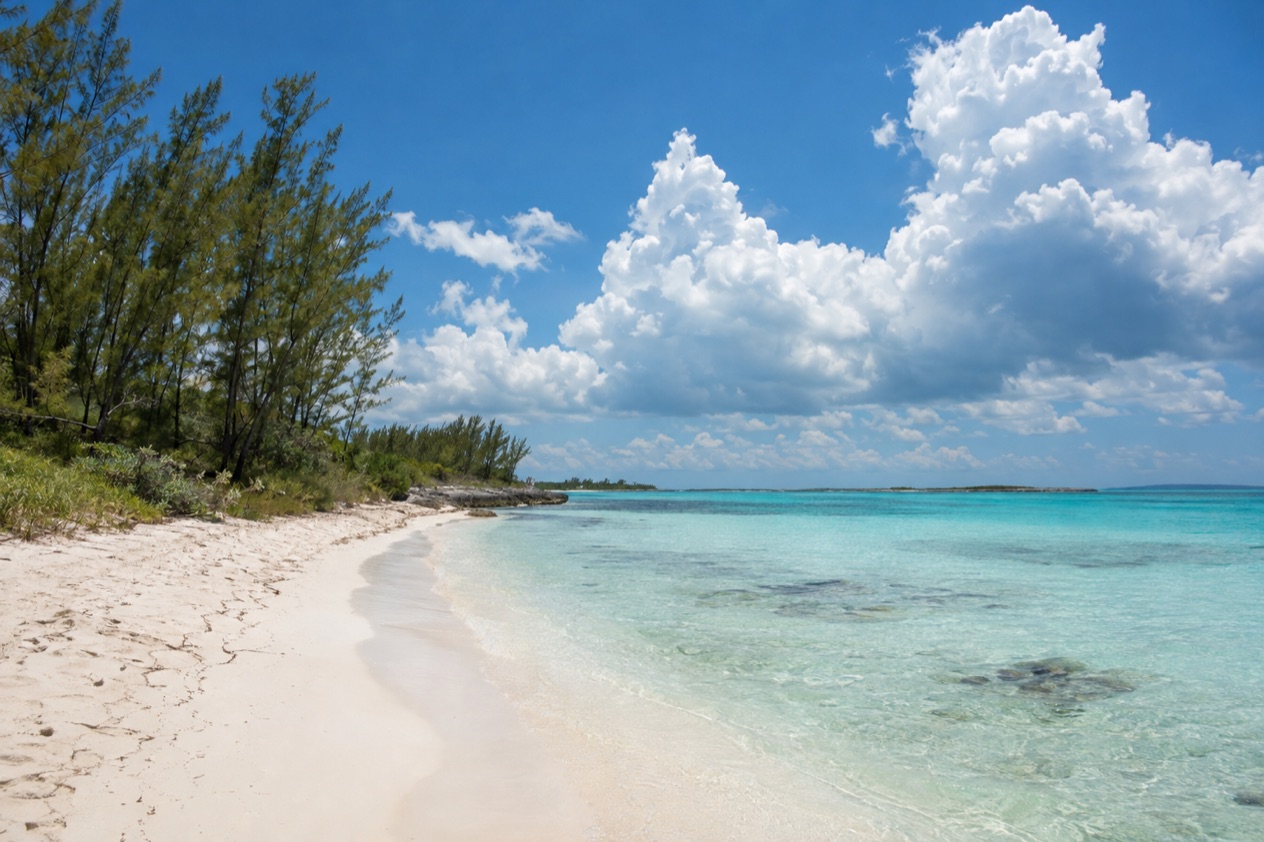
Gold Rock Beach lies about 25 miles from Freeport and is part of the national park, protected by the Bahamas National Trust. It is a wide, pale, open beach framed by casuarina trees, with little built around it. When the tide goes out, a broad flat of sand stretches far toward the water, and people have nicknamed it the island’s welcome mat.
It is a place for a full morning or a picnic afternoon, and a beach where you bring everything you need. Wander the sand flats at low tide, look for shells and watch the light change on the water. The sun is hard here in August with little shade, so a hat and a long-sleeved cover-up are worth packing.
Port Lucaya and Taino Beach
Port Lucaya is the waterfront heart of the tourist side of the island, built around a harbor with restaurants and bars facing the boats. The Our Lucaya resort, which includes the Radisson and Reef Village properties, sits in the same area. Evenings are the best time here, when the heat eases, music comes from open doorways and the first crawfish plates of the season go out to tables.
Taino Beach lies within Freeport and has a community park used by both Bahamians and visitors, with the feel of a local weekend. On a sunny afternoon you may find families grilling and groups playing games by the water. It pairs well with a late lunch in Port Lucaya, and the shade of the sea grape and palms is welcome.
A two-day itinerary for Freeport and Grand Bahama in August
Day 1 is for the water and the harbor. Start early at Taino Beach while the air is soft, with coffee in hand and the sand nearly empty. Swim before the sun gets high, then retreat at midday to shade, a pool or a long lunch of crawfish salad in Port Lucaya, where the restaurants face the boats.
In the afternoon, when heat and a possible shower arrive together, stroll the harbor area and duck into a shop or bar if the sky darkens. Come back for the long summer evening, since daylight lasts past the dinner hour. Stew lobster or grilled fish at a waterfront table suits the end of the day, with music from the bars carrying across the harbor.
Day 2 is for the park and the long beach. Be on the trails at Lucayan National Park early, when the forest holds some coolness, and visit Ben’s Cave before the day warms. Carry water and wear closed shoes. The walk is humid, so keep a steady pace.
Continue east to Gold Rock Beach, about 25 miles from Freeport, for a picnic and a slow wander along the sand flats. This is the place to spend the hot hours, though shade is thin, so bring a hat. Return toward Freeport by late afternoon. If rain sets in, switch to a covered restaurant for a long meal or a rest at your hotel, and keep the beach for the next dry spell.
Is Freeport and Grand Bahama busy in August?
August is a summer month, shaped more by family vacations and the opening of crawfish season than by any festival, and the island has a relaxed, lived-in feel. The beaches and restaurants around Lucaya are the places where visitors gather, while the national park trails and the long eastern beach stay quiet and spread out.
With school out for many families, the island’s resort area tends to feel lively, especially on weekends. The weeks that fall around school-break dates are the ones to plan early for, with rooms, rental cars and dinner tables, and later weeks of the month give more room to decide at the last minute. The hurricane season adds one more reason to keep plans loose, because a storm in the Atlantic can change a week.
For the outings in the park and along the south shore, the main thing is timing within the day rather than a reservation. Mornings are quiet everywhere, and the middle of the day brings the heat and the biggest crowds to the beach and the harbor. If you want a table on a waterfront terrace at sunset, aim a little before the evening rush.
What to pack for Freeport and Grand Bahama in August
Pack for heat, sun and the odd downpour, with clothes that dry quickly and shoes that handle both sand and forest.
- Lightweight cotton or linen clothes, because the air is hot and humid.
- Reef-safe sunscreen and a wide-brimmed hat, for beaches with little shade.
- A rash guard and a mask and snorkel, for long hours in warm water.
- Closed shoes for the park trails, where the ground is rough and damp.
- A light rain jacket, for the sudden showers.
- Bug spray, for the forest and the mangroves.
Good to know before you go
The U.S. State Department rates the Bahamas Level 2, “Exercise increased caution”, and says most crime occurs in Nassau on New Providence and in Freeport on Grand Bahama.
August sits inside the Atlantic hurricane season, which runs from June 1 to November 30, with most activity between mid-August and mid-October. Grand Bahama took a direct hit from Hurricane Dorian in 2019, and the Bahamas Ministry of Tourism and Aviation keeps watch on Atlantic storms and urges travelers to follow the Bahamas.com hurricane page. Keep plans flexible, especially for the second half of the month.
For entry, U.S. citizens need a passport and no Bahamian visa for a visit, along with a return or onward ticket. Arriving by air, the Bahamas Department of Immigration asks for a passport with at least six months of validity, and passport cards are not accepted. The old health visa and COVID testing requirement are gone.
Freeport and Grand Bahama in August vs July and September
Moving a month earlier brings the longest days of the summer and a sea just as warm, but crawfish season has not yet opened. July is also a touch quieter in rainfall, with fewer wet days in Nassau, so afternoons tend to be a little steadier. Go in July if you want the most daylight and are not set on lobster.
A month later, daylight shortens by close to an hour, the sea cools slightly, and the hurricane peak arrives around September 10. The island is in its quietest stretch, and rooms are easier to find as the summer break ends. September suits flexible travelers who like empty beaches and can accept that plans may change with the weather.
August sits between the two. It gives you the warmest water of the year, crawfish on the menu from the first day and long evenings, with more weather risk than July and more company than September. Choose it if lobster and warm water matter most, and shift if you want either the longest days or the quietest island.
Is August a good time to visit Freeport and Grand Bahama?
Yes, for travelers who love hot weather, warm water and seafood, and who are comfortable with a loose plan in the hurricane season. If you want cool evenings, dry skies or a guaranteed calm sea, another month will suit you better.
People who spend their days in the water, on the beach and at the table will love it. Families on a summer break and anyone chasing lobster have the most to gain. Visitors who dislike humidity or sudden showers, or who need fixed outdoor plans, should look to the cooler months.
On arrival, spend the first morning in the water at Taino Beach and the first evening in Port Lucaya, with a plate of crawfish at the table. Keep the park and Gold Rock Beach for early starts on the following days. August on Grand Bahama is the month when the sea is warmest and the lobster comes back to the menu.
Sources
- Open-Meteo Marine API, average 2015-2024, checked October 10, 2026
- sunrise-sunset.org, sunrise and sunset calculated for the 15th of the month, checked October 10, 2026
- NOAA NCEI, GHCN-Daily station BF000078073 (Nassau Airport), normals 1991-2020 computed from the daily record (https://www.ncei.noaa.gov/access/services/data/v1?dataset=daily-summaries&stations=BF000078073), checked October 10, 2026
- Bahamas Ministry of Tourism, crawfish season (https://www.bahamas.com/blog/its-crawfish-season), checked October 10, 2026
- NOAA National Hurricane Center, Climatology (https://www.nhc.noaa.gov/climo/), checked October 10, 2026
- Bahamas Ministry of Tourism, Investments & Aviation (bahamas.com), Hurricane and storm information (https://www.bahamas.com/hurricane-storm-information), checked October 10, 2026
- Wikipedia, Hurricane Dorian (https://en.wikipedia.org/wiki/Hurricane_Dorian), checked October 10, 2026
- Bahamas Ministry of Tourism, Investments & Aviation (bahamas.com), travel blog, Abacos and Grand Bahama after Hurricane Dorian (https://www.bahamas.com/blog/things-to-know-when-visiting-the-bahamas-after-dorian), checked October 10, 2026
- Wikipedia, Grand Bahama (https://en.wikipedia.org/wiki/Grand_Bahama), checked October 10, 2026
- Wikipedia, Lucaya (https://en.wikipedia.org/wiki/Lucaya,_Bahamas), checked October 10, 2026
- Bahamas Ministry of Tourism, Investments & Aviation (bahamas.com), Lucayan National Park (https://www.bahamas.com/natural-wonders/lucayan-national-park), checked October 10, 2026
- Bahamas Ministry of Tourism, Investments & Aviation (bahamas.com), Gold Rock Beach (https://www.bahamas.com/natural-wonders/gold-rock-beach), checked October 10, 2026
- Bahamas Ministry of Tourism, Investments & Aviation (bahamas.com), Taino Beach (https://www.bahamas.com/natural-wonders/taino-beach), checked October 10, 2026
- Bahamas Ministry of Tourism, Investments & Aviation (bahamas.com), Bens Cave (https://www.bahamas.com/natural-wonders/bens-cave), checked October 10, 2026
- Wikipedia, Geography of the Bahamas (https://en.wikipedia.org/wiki/Geography_of_the_Bahamas), checked October 10, 2026
- Bahamas Ministry of Tourism, Investments & Aviation (bahamas.com), Island FAQ (https://www.bahamas.com/plan-your-trip/island-faq), checked October 10, 2026
- U.S. Department of State, The Bahamas Travel Information, Safety and security (https://travel.state.gov/), checked October 10, 2026
- Bahamas Department of Immigration, Entry requirements (https://www.immigration.gov.bs/entry-requirements/), checked October 10, 2026
- Bahamas Department of Immigration, Before your arrival (https://www.immigration.gov.bs/entry-requirements/before-your-arrival/), checked October 10, 2026
- U.S. Department of State, The Bahamas Travel Advisory, Level 2 (https://travel.state.gov/), checked October 10, 2026
To plan your stay
- Things to Do in Grand Bahama: Lucayan National Park, Diving, Beaches and Port Lucaya
- Where to Stay in Grand Bahama: Lucaya, Freeport, West End and How to Pick a Hotel
- Freeport and Grand Bahama from Miami: Ferry, Flights, Cruise Ships and a Day in Lucaya
- Know Before You Go to Grand Bahama: Entry, Money, Getting Around and Sun