
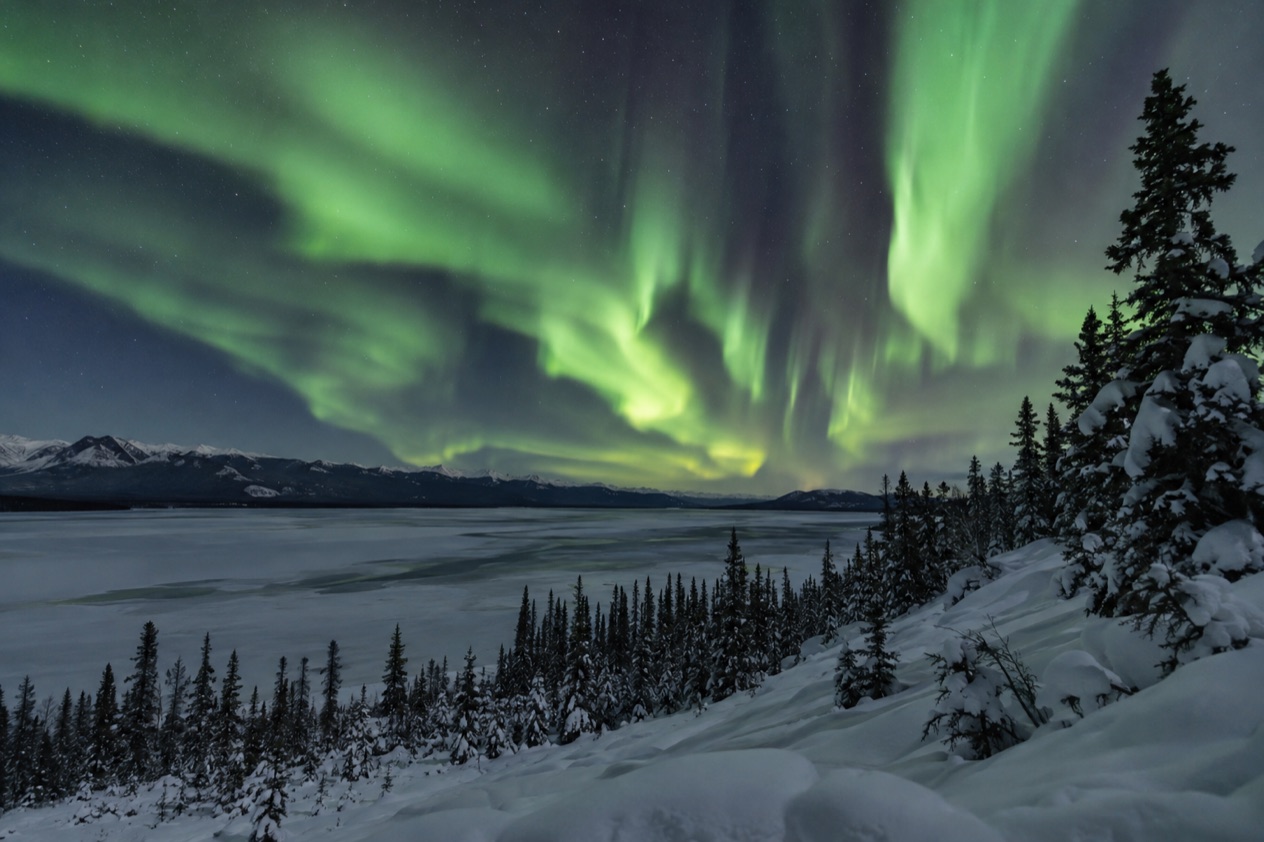
Out past the last streetlights of Fairbanks, the cold goes quiet and people stand with their heads tipped back, waiting for a pale green smear overhead to start moving. When it does, it folds into curtains and ribbons that brighten and fade over the spruce. This is the aurora season in Interior Alaska, which begins when the nights finally turn dark again in late summer and runs into spring.
Why is Fairbanks a good place for the aurora?
Fairbanks sits far enough north, in the middle of Interior Alaska, that it has a long stretch of dark nights and a strong chance of clear skies. The aurora viewing season here runs from roughly late August to late April. University of Alaska aurora forecasters say that if the weather is clear and you stay for at least three nights, it is highly likely that you will see the aurora.
The word that matters there is “clear.” The lights are always overhead somewhere, but clouds hide them, so the nights people talk about are the cold, still, cloudless ones. Local visitor guides point to September through mid-April as the stretch for those cold clear nights.
The dark season and the bright season
From late April to the third week of August, the sky in Fairbanks never gets dark enough to show the aurora, even when the display is spectacular. This is the midnight sun season. In June the sun is up from early morning until almost one the next morning, and it never gets fully dark.
That is why the lights belong to the other half of the calendar. Late August brings the first real darkness back, and evenings begin to feel like evenings again. By midwinter the daylight is short, with the sun up only from mid-morning to early afternoon, so the long nights give you plenty of time to stand outside and wait.
The hours around midnight
In winter, the best time to watch is typically between nine in the evening and three in the morning. The three or four hours centered on midnight carry the highest probability of spectacular displays. People who see the aurora at its brightest are out well past their normal bedtime.
That shapes how a night goes. You have dinner in town, nap or soak, and head out when the sky is at its darkest. A display can start as a faint gray arc low on the horizon, then swell into green with hints of pink at the edges. Often it fades after a few minutes, and sometimes it surges again.
Equinoxes and the moon
Auroral activity tends to be stronger around the fall and spring equinoxes than at either solstice. The statistical likelihood of seeing aurora over Interior Alaska is roughly twice as high at the equinox. That makes September and March natural months to aim for, and September has the added comfort of milder nights than the deep winter.
The moon plays a double role. A full or nearly full moon adds ambient light that may hide dim auroral features. Moonlight can also enhance colors by activating the cone cells in your eyes, so a bright night is not necessarily a lost one.
Winter in town between the lights
A trip built around the aurora fills the daytime with winter in Fairbanks. During the week of December 21, the Winter Solstice Celebration takes over Downtown Fairbanks, with fireworks that cannot be seen in the summertime. From mid-February through March, ice art sculptures appear around the city, and the World Ice Art Championships brings more than eighty sculptures by international carvers.
The International Ice Art Classic adds ice slides and an ice playground to the sculptures. Around the turn from February to March, Denali Winterfest offers dog sledding, a 5K race, snowshoeing, hiking and park ranger programs. Fairbanks also lists dog mushing, flightseeing and hot springs among its winter activities, which gives the days a rhythm that the lights fill out at night.
Getting to the dark
Fairbanks International Airport has domestic flights from Chicago, Dallas, Denver, Minneapolis and Seattle-Tacoma, operated by Alaska Airlines and Horizon Air, American, Delta and United. Fairbanks is also a base for exploring Interior Alaska, with local businesses that help visitors reach remote areas, plan adventures or supply equipment.
The Aurora Winter Train links Anchorage and Fairbanks, calling at Wasilla, Talkeetna, Hurricane, Healy and Nenana. It operates on weekends from mid-September to mid-May, northbound to Fairbanks on Saturday and back to Anchorage on Sunday, with select mid-week departures as well. Along a stretch of roadless backcountry south of Hurricane Gulch it offers flagstop service. By road, the George Parks Highway from Anchorage passes through Denali National Park.
How do the aurora tours work?
Aurora viewing season at the resort runs from late August to mid-April. The idea is simple: get away from town glow to a high, open spot and wait under the sky with warmth close at hand.
The Aurora Viewing Tour to Charlie Dome
Guests ride a SUSV, a tracked vehicle, up to Charlie Dome, where the open sky gives 360-degree views. Heated yurts and hot drinks are provided, so the long wait for the lights happens in comfort, and you step outside whenever the sky changes. The ride itself, grinding up through the winter forest in the dark, is part of the evening.
A night like this suits families with small children as well as couples, because riders must be at least two years old. Plan for a late night, since the best hours for displays are centered on midnight. Whether the lights appear depends on the weather and the sun, as always, but the setting gives you a wide, dark horizon to watch.
| Experience | Price | Duration | Ages |
|---|---|---|---|
| Winter aurora viewing tour | $125 per person | 5 hours | 2 and up |
| Aurora Ice Museum Tour | $20 adults, $15 children | 45 minutes | 6 and up |
Soaking under the sky
The resort’s natural hot springs are open for soaking year-round, including beneath the aurora borealis. In winter, that means steam rising into frozen air while you float and watch the sky, which visitors count as the signature Fairbanks night. Whether the lights show up or not, a hot soak after a long cold evening is its own reward.
Accommodations include lodges, private cabins and yurts, all steps from the hot springs. Staying overnight means you can step out in the middle of the night when the sky is best, then go straight back inside. The resort also uses geothermal heat to power its buildings and greenhouses, so the warmth around you comes from the ground.
| Pass | Adults | Children |
|---|---|---|
| Pool House day pass | $20 | $17 |
Silent snowmachines and the ice museum
In winter the resort also runs Electric Snowmachine tours on silent, electric snowmobiles through pristine trails. Without an engine roar, the loudest thing is often the snow squeaking beneath the skis, which suits anyone who wants the stillness of the forest as much as the ride. It pairs well with a daytime outing before an evening watch.
The Aurora Ice Museum Tour is a daytime or evening detour among ice sculptures, and it gives younger travelers a way to take in the cold without waiting for the sky. Summer has its own activities at the resort, from the Electric ATV Tour along Monument Creek Trail to the Dog ATV and Side x Side ATV tours, but those belong to the bright season, when no aurora is possible.
Fairbanks businesses and the aurora tracker
Beyond Chena, Fairbanks-based businesses guide visitors around town, plan adventures and provide equipment, and aurora viewing is one of the activity categories alongside dog mushing, flightseeing, wildlife viewing and gold rush history. The city also keeps an aurora tracker and a list of viewing locations, so planning a night is part of the local routine.
Mixing the two works well. Spend a day on a winter activity such as dog mushing, a museum or flightseeing, then use the evening for a tour or a drive to one of the dark spots around town. If clouds roll in on your first night, you have the same set of choices the next night, which is why a stay of several nights pays off.
Where do people watch?
People watch from a handful of dark, open spots around Fairbanks, from lake recreation areas to hilltops and highway turnouts, all chosen because they sit away from the glow of the city. Recommended sites include Chena Lakes Recreation Area, Tanana Lakes Recreation Area, Cleary Summit, Ester, Wickersham and Murphy Domes, Haystack Mountain, and several turnouts along the highways.
Lake recreation areas
Chena Lakes Recreation Area and Tanana Lakes Recreation Area give you open sky over frozen water and a low horizon, which is what you want when the lights spread wide. The flat edge of a lake lets the aurora arc across a big stretch of sky, and a reflection on the ice can add to the scene on bright nights.
These areas suit anyone who wants a night nearer to town, with the option of heading back to a warm bed soon after. Treat them as a first-night choice, a way to learn what a display looks like and how your eyes adjust to the dark, before you go farther out on later nights.
Cleary Summit and Ester
Cleary Summit is a hilltop spot recommended for aurora watching, with a wider view than the valley floor. Height helps because the horizon opens up and low glow from town drops away. When the lights are strong, you can see them rise over the ridgelines, and that is a very different feeling from watching over a lake.
Ester is another recommended site, a small community with its own mining-town history. Both places give you the sense of being in the Interior rather than in the city. Pair them with a late dinner, since the best displays tend to arrive between nine at night and three in the morning, with the strongest chance around midnight.
The domes and Haystack Mountain
Wickersham and Murphy Domes are rounded hills known to aurora watchers around Fairbanks, and Haystack Mountain on the Elliot Highway is another recommended spot. These places reward people who like a bit of a trip out of town, with open ground and a dark sky all around.
On a good night you might see the whole sky turn, with curtains moving from one side to the other. When the moon is bright, the colors can still stand out, as moonlight may sharpen what your eyes can pick up. Bring patience, because the lights often come and go in waves.
Highway turnouts
Turnouts along the Elliot, Steese and Parks Highways, along Chena Hot Springs Road, along Nordale Road, and the Ballaine Road turnout near the Goldstream Creek bridge are all on the recommended list. They give you a place to stop and look up without needing a formal viewing area, and each has a different outlook over the surrounding forest and hills.
A turnout works when the sky is clear and you have a flexible evening. Pick one, watch for a while, and move on if clouds drift in. Because the aurora tracker and the local list of viewing locations point to many of these same places, you can follow the sky as the night goes on.
Good to know before you go
There is no sales tax in Fairbanks, so the price on a tag is what you pay at the register. The aurora is a chance, not a promise, and it needs dark, clear skies, so a trip of several nights gives you the best odds.
The winter days are short, with only a few hours of sun, which leaves the evenings for the sky. After the season closes in late April, the sun takes over, and the midnight sun season begins.
Sources
- University of Alaska Fairbanks Geophysical Institute, Aurora forecast (https://www.gi.alaska.edu/monitors/aurora-forecast), checked October 11, 2026
- Explore Fairbanks, winter events (https://www.explorefairbanks.com/events/winter-events/), checked October 11, 2026
- Chena Hot Springs Resort, activities (https://www.chenahotsprings.com/activities), checked October 11, 2026
- Explore Fairbanks, activities, attractions and tours (https://www.explorefairbanks.com/things-to-do/activities-attractions-and-tours/), checked October 11, 2026
- Wikivoyage, Fairbanks (https://en.wikivoyage.org/wiki/Fairbanks), checked October 11, 2026
- Alaska Railroad, Aurora Winter (https://www.alaskarailroad.com/ride-a-train/our-trains/aurora-winter), checked October 11, 2026