
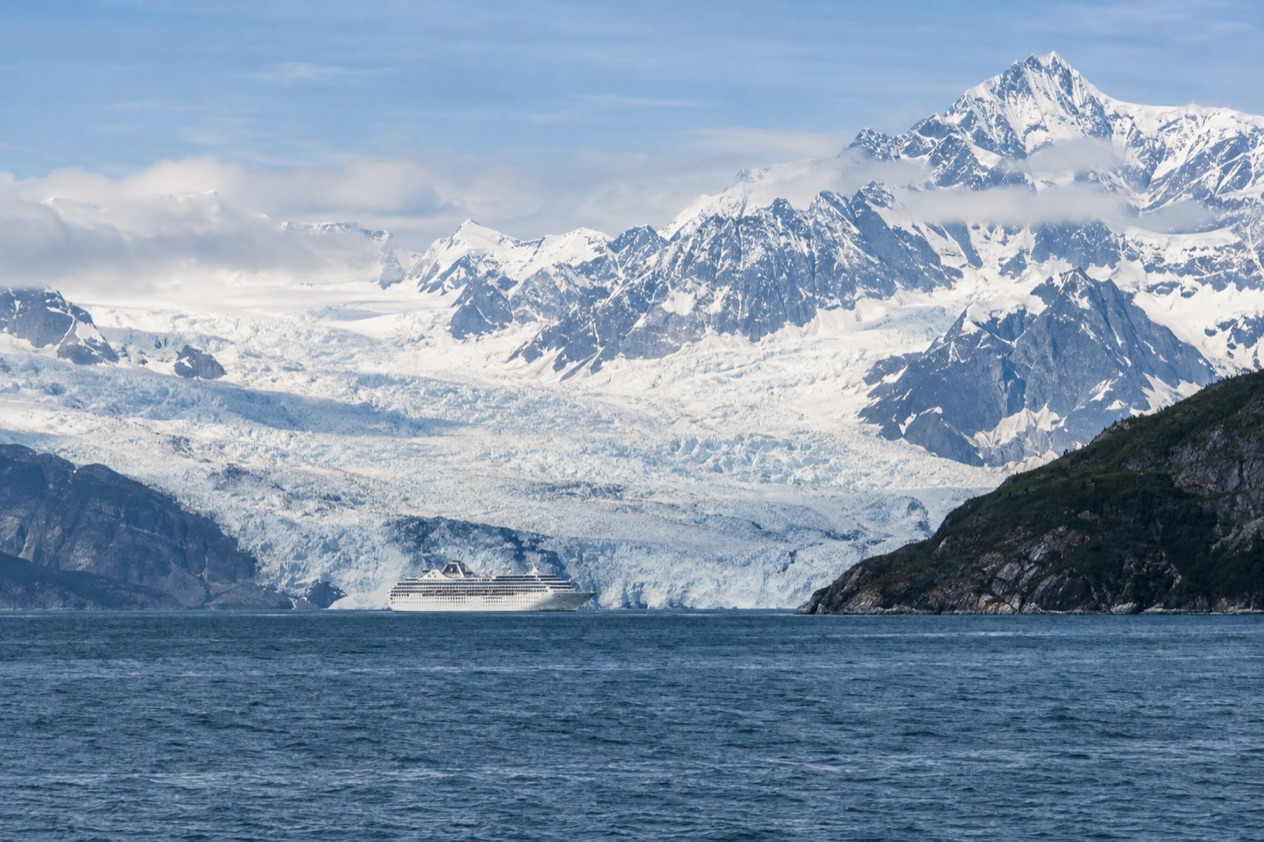
The ship slows in a bay where the water turns the color of milky jade, and the mountains come down to the shore in dark green rain forest. Somewhere ahead a wall of blue-white ice waits at the end of a long arm of water, and the loudest sound on deck may be the crack of a glacier letting go. A Glacier Bay cruise is a day spent entirely on the water inside a national park in Southeast Alaska, and it suits anyone who wants to see tidewater glaciers from a deck rather than from a trail.
Is visiting Glacier Bay cruises worth it?
Yes, for travelers who want to watch glaciers meet the sea and are happy to do it from a boat, with a naturalist on hand to explain what is in front of them. Glacier Bay National Park is mostly water, and the land around it is mountainous, wrapped in dense rain forest or alder thickets, with no roads or trails. The water is how the park is meant to be seen.
What sets this park apart from other glacier stops in Alaska is the way the visit is arranged. Cruise ship passengers do not go ashore here. Instead, National Park Service naturalists come aboard and share what they know over a day-long cruise through the bay. The glaciers are not a quick photo stop, because ships spend hours among them rather than passing a single face of ice.
The park is also a place where the story of ice is easy to read. Some of its glaciers reach saltwater and calve, a few others touch the sea only at high tide, and a handful are stable because of heavy snowfall in the Fairweather Mountains, which is a rarity in the world today. The park is part of a UNESCO World Heritage Site shared with neighboring parks, and a day on the bay makes that recognition easy to understand.
What to see at Glacier Bay cruises
The park is named for its abundant tidewater and terrestrial glaciers, and the whole cruise is an unfolding of them. The day’s rhythm comes from the changes in the ice, the water and the shoreline as the boat moves up the bay.
The tidewater glaciers
Seven tidewater glaciers flow into the bay: Margerie, Grand Pacific, McBride, Lamplugh, Johns Hopkins, Gilman and LaPerouse. A tidewater glacier ends in saltwater at sea level, and that is where the drama happens, because the ice face can shed pieces into the water. You may hear a sharp report before you see the ice fall, and the sound sometimes reaches the deck a moment after the splash.
Johns Hopkins Glacier is one of the more unusual stories here. Observations in 2012 recorded it advancing at 10 to 15 feet per day, an odd detail in a park where most ice is slowly retreating. Look at the face of any glacier and you are seeing ice estimated to be about 200 years old, which makes the cold blue wall a kind of slow-moving record of the past.
Icebergs and the wildlife on them
Near the glaciers the water fills with icebergs, and each one tells you something about where it came from. White bergs hold many trapped air bubbles, while blue bergs are dense and likely calved recently. Greenish-blackish ones may have broken off the bottom of a glacier, and dark-striped brown bergs carry rubble from the moraine.
Icebergs may last a week or more, which gives them time to become useful. Harbor seals haul out on them, and bald eagles, cormorants and gulls perch on top. You may see seals resting on the floating ice as the ship passes. Kayakers, who get much closer, sometimes hear the pop and sizzle of ancient air escaping from the ice, a sound called bergie seltzer.
The West Arm and the glacier areas
Typically two cruise ships per day travel up the West Arm of Glacier Bay and spend four or more hours in the glacier areas. That stretch is the reason people come, and the time spent there lets the ship turn slowly so both sides of the deck can see the ice. The naturalist on board points out the features that are easy to miss, from the color of the water to the scars on the mountainsides left by earlier ice.
The rest of the bay is part of the story too. The Little Ice Age reached its maximum extent here around 1750, when general melting began, and the long, deep bay is what the retreating ice left behind. Ice has shaped this region for at least seven million years, so the green shores beside the glaciers are young landscape by comparison.
Tour boats and smaller vessels
Not everyone arrives on a large ship. Tour vessels in the bay are smaller boats carrying 50 to 150 passengers, and most operate like small cruise ships as part of a longer Alaskan itinerary. Each summer the Glacier Bay Lodge also runs a daily tour boat through the bay, guided by a Park Ranger Naturalist, which gives visitors staying in the park a way onto the water.
Charter vessels can generally take up to six passengers and are rented to a single group, usually for custom multi-day trips. Kayakers travel under their own power, and the Day Boat drop-off service takes campers and their kayaks to two locations in the bay. Private sailboats, yachts, cabin cruisers and skiffs are also allowed to explore the bay.
Hours, tickets and rules
Private visitors pay nothing to enter the park, and the rules that matter most are about boats and camping rather than gates and turnstiles. The daily tour boat leaves from Bartlett Cove during the summer months, and the permit seasons are set by date.
| Item | Details |
|---|---|
| Park entrance for private visitors | No entrance fee |
| Daily tour boat | Departs from Glacier Bay Lodge in Bartlett Cove, summer months |
| Permit for all vessels entering the bay | Required June 1 through August 31 |
| Camping permit, Bartlett Cove Campground and backcountry | Required May 1 through September 30 |
| Bartlett Cove Campground | No reservations, first come, first served |
| Special use permit application | $50 |
Cruise ship passengers stay aboard and do not go ashore in the park. Sport hunting and trapping are allowed in Glacier Bay National Preserve but not in the park itself. The park’s mailing address is PO Box 140, Gustavus, AK 99826, and its phone number is 907 697-2230.
How to get to Glacier Bay cruises
No roads lead to Glacier Bay National Park, so it is reached by air or by sea. The park lies in Southeast Alaska, west of Juneau, and the water is the connection between the two.
By cruise ship
The number of cruise ships allowed in each day is limited by regulation, so the bay stays an uncrowded stretch of water rather than a procession of hulls. Passengers stay aboard, and the naturalists who come on board turn the passage into a guided day.
Smaller tour vessels follow a similar pattern. Most work as small cruise ships on a longer Alaskan itinerary, so the bay is one chapter of a trip rather than a separate outing.
By ferry from Juneau
The Alaska Marine Highway ferry travels between Juneau and Gustavus via the community of Hoonah twice weekly. Gustavus is the community on the park’s doorstep, and the park’s mailing address is there. The route gives travelers who are not on a cruise a way to reach the park by sea, with a stop in Hoonah along the way.
Staying in the park
In-park accommodations are at the Glacier Bay Lodge, which is also the departure point for the daily tour boat. Nearby lodges and bed-and-breakfasts in Gustavus are another option. Anyone planning to stay at the Glacier Bay Lodge or at the places in Gustavus should make reservations in advance. For campers, the Bartlett Cove Campground does not take reservations.
When to visit Glacier Bay cruises
The visit follows the summer season, when the daily tour boat runs from the lodge and a Park Ranger Naturalist guides it through the bay each day.
The glaciers themselves do not keep a schedule. Calving is a chance rather than a promise, and a day on the water may bring a loud fall of ice or only a quiet face and a drift of bergs. Icebergs vary from day to day, and the wildlife that uses them, such as harbor seals and the birds on top, may or may not be there when you pass.
A longer view of the bay explains why timing matters less than patience. The ice has been thinning and slowly receding over the last several decades, and recent research found that the bay has 11% less glacial ice than in the 1950s. A visit now is a look at a landscape in motion, and the heavy snowfall in the Fairweather Mountains keeps a few glaciers stable even as others pull back.
The wider picture adds weight to the trip. Of the more than 100,000 glaciers in Alaska, 95% are thinning, stagnating or retreating, and the rate of thinning is increasing. Seeing the ice in Glacier Bay, including the rare stable glaciers, gives that statistic a shape.
Tips for your visit
The time is spent looking, listening and talking with the naturalist, so it helps to arrive with questions about the ice, the icebergs and how the bay has changed.
Watch the water as well as the ice walls. The colors of the icebergs say something about where they came from, and the seals and birds resting on them are easy to miss while you stare at the glacier face. Take a moment to scan the shoreline too, where the rain forest and alder thickets climb the mountains with no road or trail in sight.
Combining the bay with a stay
Travelers who want more than a day can pair the cruise with time in the park itself. The Glacier Bay Lodge offers in-park accommodations and is where the daily tour boat departs, so the boat day and the stay fit together. Reservations should be made in advance at the lodge and at the nearby lodges and bed-and-breakfasts in Gustavus.
The twice-weekly ferry from Juneau, calling at Hoonah, links the park to a larger town and can anchor a longer Southeast Alaska itinerary. Juneau and Gustavus sit at either end of that water route.
Paddling and camping
Visitors who want to travel under their own power can kayak in the bay. The Day Boat camper drop-off service takes campers and their kayaks to two locations, and from there the water is yours. Paddlers who pass close to icebergs sometimes hear the fizzing release of trapped air, which is a very different experience from watching the ice from a ship’s rail.
Camping in the backcountry and at Bartlett Cove requires a permit, and the Bartlett Cove campground runs on a first come, first served basis. Boaters with private vessels have their own permit rules, and the park’s detailed boater information covers the specifics.
Good to know before you go
Glacier Bay is a big place, covering more than three million acres, and most of it is water, rain forest and mountains with no roads or trails. The park was established in December 1980, and the glaciers it protects are a record of ice that has shaped this region for millions of years.
For questions about a visit, the park can be reached by phone or mail through its Gustavus address.
Sources
- National Park Service, Glacier Bay National Park & Preserve, plan your visit: cruising (https://www.nps.gov/glba/planyourvisit/cruising.htm), checked October 11, 2026
- National Park Service, Glacier Bay glaciers (https://www.nps.gov/glba/learn/nature/glaciers.htm), checked October 11, 2026
- Wikipedia, Glacier Bay National Park and Preserve (https://en.wikipedia.org/wiki/Glacier_Bay_National_Park_and_Preserve), checked October 11, 2026
- National Park Service, Glacier Bay National Park & Preserve, plan your visit: permitsandreservations (https://www.nps.gov/glba/planyourvisit/permitsandreservations.htm), checked October 11, 2026