
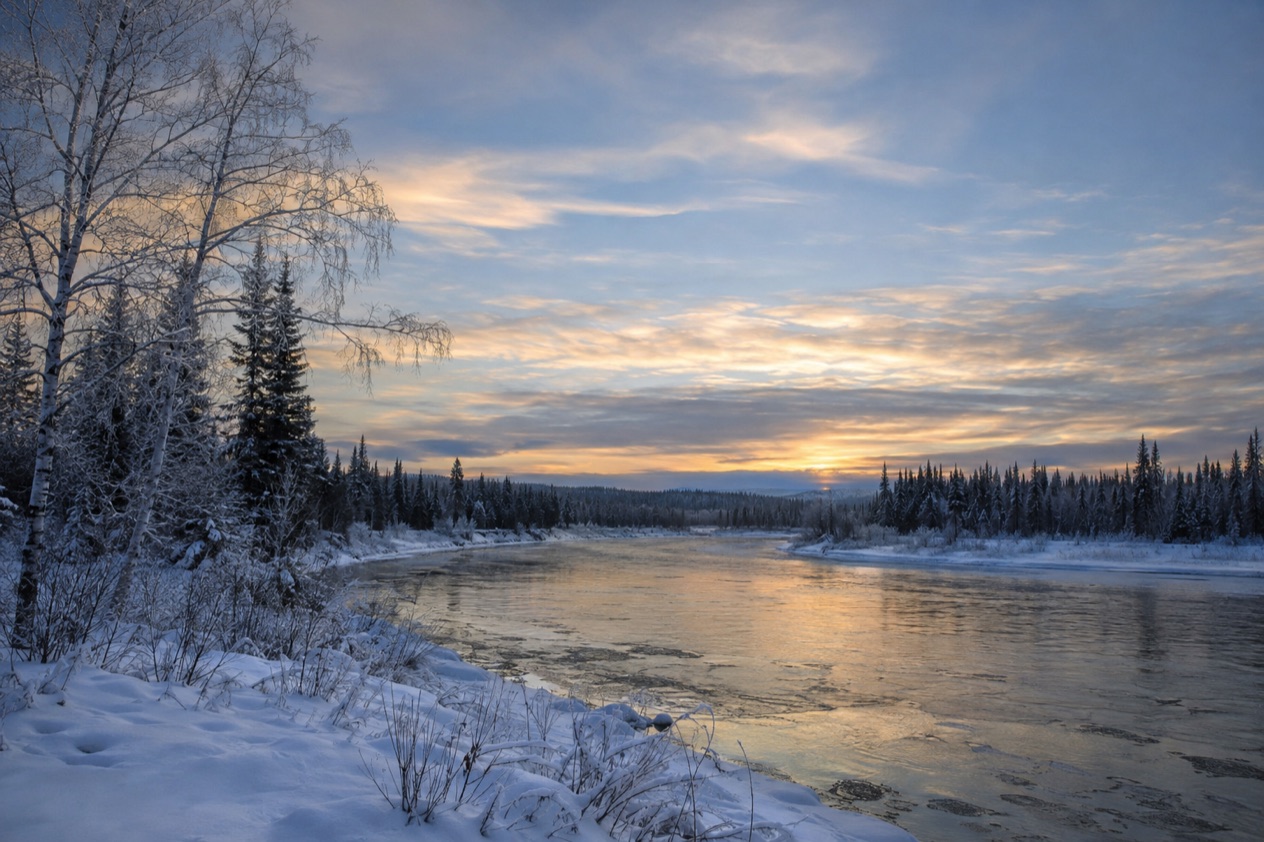
On a February afternoon in Fairbanks, the low sun turns the ice fog along the Chena River pink and gold, and sculptors in heavy bibs and mittens are already at work on blocks of clear ice, chainsaws whining in the cold. The days are stretching fast now, the nights are still long and dark enough for the aurora, and the town has the quiet, crunchy-snow feel of deep winter.
What is the weather like in Fairbanks in February?
February in Fairbanks is bitterly cold but dry, with bright days, light snowfall and daylight that is returning quickly after the dark of January.
| Month | Average high (°F) | Average low (°F) | Precipitation (in) | Days with precipitation | Daylight on the 15th |
|---|---|---|---|---|---|
| January | 0.6 | -17.2 | 0.61 | 2.1 | 5 h 02 min |
| February | 11.6 | -11.2 | 0.52 | 1.6 | 8 h 24 min |
| March | 24.9 | -3.4 | 0.40 | 0.8 | 11 h 34 min |
Mornings start well below zero, and the afternoon high only climbs into the low teens, so even the warmest part of the day is a cold one. Snow is light and falls on only a couple of days, which means most days are clear and still. Snowfall adds up to about ten inches over the whole month, enough to keep trails and the town white without burying anything.
The light is the real change. Daylight is much longer than in the depths of winter, so there is time for a proper outing in the middle of the day, and the sun sits low enough to throw long, soft shadows across the snow. After dark the sky is often clear, which is what aurora watchers hope for.
Dress in layers that you can add and shed: a warm base, an insulating middle and a windproof outer shell, plus serious boots, mittens and something for your face. Evenings out for the aurora are the coldest hours of the day, and standing still makes them feel colder.
What to do in Fairbanks in February
The big event of the month is Ice Alaska and the World Ice Art Championships, which begins in mid-February and, weather permitting, runs until the end of March. The contest is the largest of its kind in the world, with more than 100 sculptors from 30 countries every year.
Beyond the competition, February is a month for winter outings that Fairbanks businesses help arrange. Activities in town include aurora viewing, dog mushing, flightseeing, hot springs, museums, gold rush history and other winter activities, and local businesses guide visitors, plan adventures or supply the equipment you need.
Ice Alaska and the World Ice Art Championships
The championships are produced by Ice Alaska, a non-profit corporation started in 1989, and sculptors come to Fairbanks to compete in categories that include the Multi-block competition, where teams carve from many blocks at once. In the most recent Multi-block results, the Philippines took first place, Mongolia second and the USA third, a sign of how international the field is.
What you see is monumental clear ice shaped into animals, faces and abstract forms, often catching the low February sun in a way that makes them glow. Because the event begins in mid-February, the first weeks of the month are for the build-up and the later days are when the displays are in place around town. Ice Alaska can be reached toll-free at 1 (833) 4ICEART (442-3278) for details on the event.
Chasing the aurora
The aurora viewing season in Fairbanks runs roughly from August 21 to April 21, so February sits well within it. If the weather is clear and you stay at least three nights, it is highly likely that you will see the aurora, and the northern lights oval covers most of Alaska. Auroral activity tends to be stronger around the equinoxes, so February is a good but not the strongest time, and clear skies matter as much as anything.
Chena Hot Springs, a resort with its own aurora viewing season from late August to mid-April, offers a winter aurora viewing tour lasting 5 hours, open to riders at least 2 years old. A day pass to its Pool House lets you soak in hot water while the cold air steams around you.
| Activity | Details | Price |
|---|---|---|
| Chena Hot Springs aurora viewing tour | 5 hours, riders at least 2 years old | $125 per person |
| Chena Hot Springs Pool House day pass | Adults | $20 |
| Chena Hot Springs Pool House day pass | Children | $17 |
Dog mushing and winter days
Dog mushing is one of the activities listed among Fairbanks tours, and in Alaska sled dogs traditionally pull side by side in pairs rather than in a fan shape. The sleds are typically the built-up type, with a high rail on each side. Watching a team leave the line in the cold, with a clatter of paws and then silence, is one of the pictures of an Alaskan winter.
Museums and gold rush history fill the indoor side of the list when the cold is too sharp for lingering outside. Explore Fairbanks can be reached at (907) 456-5774 for help with plans.
A two-day itinerary for Fairbanks in February
Day 1. Start late and let the day warm up as much as it will, since mornings are the coldest hours. Spend the middle of the day on the ice art around town, when the low sun is at its highest and the sculptures glitter, and stop in a café for something hot and a bowl of soup. Daylight lasts a little over eight hours, so keep the outdoor wandering for the bright stretch.
In the afternoon, head to the championship grounds or any other displays of ice art, and take your time with the details of the carving. Eat a hearty early dinner at a local restaurant, then wrap up warmly for the evening. If it is cloudy, a museum visit makes a good indoor plan for the same hours.
Day 2. Make this the aurora-and-hot-springs day. Go to Chena Hot Springs for the daytime, soak in the Pool House while snow gathers on your hair, and stay into the evening for the aurora viewing tour, which lasts 5 hours. The aurora is a chance, never a promise, and clear skies make the difference.
If the sky stays cloudy, the hot water and a warm meal still make the day worthwhile. Plan a slow morning after a late night, with a long breakfast and no early start.
Is Fairbanks busy in February?
February is a winter month in Fairbanks, built around the aurora season and the ice art events rather than around the long days of summer. The ice art begins in mid-February and runs to the end of March, so visitors with that event in mind arrive from the middle of the month on.
Fairbanks is Alaska’s second-largest city and works as a gateway to the Interior and Arctic, with flights from Chicago, Dallas, Denver, Minneapolis and Seattle-Tacoma. The pace in town is calm, with people bundled up and moving between warm indoor places.
What to pack for Fairbanks in February
Pack for temperatures that stay well below freezing all day, with a focus on layers and extremities.
- Insulated, waterproof boots, because snow is on the ground and standing for aurora watching is cold.
- Warm base layers, to keep the cold out before the mid-layers do their work.
- A windproof, insulated outer jacket for the coldest evenings.
- Mittens, a hat and a face covering, since hands and cheeks feel the cold first.
- A swimsuit for the hot springs Pool House.
- Sunglasses, because low sun on snow is bright.
Good to know before you go
Daylight is short but growing, so plan outdoor sightseeing for the middle of the day and keep evenings for the aurora. Fairbanks International Airport has domestic flights operated by Alaska Airlines/Horizon Air, American Airlines, Delta Airlines and United Airlines. Fairbanks-based businesses can help you reach remote areas, guide you through town and supply equipment.
Fairbanks in February vs January and March
Moving the trip earlier to January means colder, darker days, with only about five hours of daylight in the middle of the month. The aurora season is open, but the ice art has not started, since the displays begin in mid-February. It suits travelers who want the deepest winter and the long nights.
Moving later to March brings milder afternoons, much longer daylight and less snowfall. The ice art continues until the end of March, weather permitting, and the aurora season still runs to roughly April 21. March works well if you want more time outdoors in daylight without leaving winter behind.
February sits between the two, with the ice art starting, the light returning and the nights still dark. Choose January for the darkness and March for the gentler days. Choose February for the balance.
Is February a good time to visit Fairbanks?
Yes, February is a good time for travelers who want real winter, with ice art, a chance at the northern lights and days long enough to be useful. It suits people who are comfortable in serious cold and enjoy soaking in hot springs while the air steams around them.
It is a poorer fit for anyone who wants warmth, midnight sun or long open days on the water, since the midnight sun belongs to summer. On arrival, sort out your cold-weather layers first, then see the ice art in the bright middle of the day and save the evenings for the aurora. What makes February in Fairbanks distinct is the overlap of a dark, aurora-ready night sky with sculptors carving ice under a sun that is climbing back day by day.
Sources
- NOAA NCEI, U.S. Climate Normals 1991-2020, monthly (https://www.ncei.noaa.gov/access/services/data/v1?dataset=normals-monthly-1991-2020&stations=USW00026411), station Fairbanks Intl Ap, elevation 432 feet, checked October 11, 2026
- Computed from the date and the latitude of the place (sunrise equation, solar elevation -0.833 degrees), October 11, 2026
- University of Alaska Fairbanks Geophysical Institute, Aurora forecast (https://www.gi.alaska.edu/monitors/aurora-forecast), checked October 11, 2026
- Wikivoyage, Northern lights (https://en.wikivoyage.org/wiki/Northern_lights), checked October 11, 2026
- Wikipedia, Aurora (https://en.wikipedia.org/wiki/Aurora), checked October 11, 2026
- Visit Anchorage, northern lights viewing (https://www.anchorage.net/winter/things-to-do/northern-lights-viewing/), checked October 11, 2026
- Explore Fairbanks, winter events (https://www.explorefairbanks.com/events/winter-events/), checked October 11, 2026
- Chena Hot Springs Resort, activities (https://www.chenahotsprings.com/activities), checked October 11, 2026
- Visit Anchorage, dog sledding (https://www.anchorage.net/winter/things-to-do/dog-sledding/), checked October 11, 2026
- Wikipedia, Dog sled (https://en.wikipedia.org/wiki/Dog_sled), checked October 11, 2026
- National Park Service, Denali National Park & Preserve, plan your visit: kennels (https://www.nps.gov/dena/planyourvisit/kennels.htm), checked October 11, 2026
- National Park Service, Denali National Park & Preserve, plan your visit: winter activities (https://www.nps.gov/dena/planyourvisit/winter-activities.htm), checked October 11, 2026
- Ice Alaska, World Ice Art Championships (https://icealaska.com/), checked October 11, 2026
- Wikipedia, World Ice Art Championships (https://en.wikipedia.org/wiki/World_Ice_Art_Championships), checked October 11, 2026
- Explore Fairbanks, activities, attractions and tours (https://www.explorefairbanks.com/things-to-do/activities-attractions-and-tours/), checked October 11, 2026
- Explore Fairbanks, transportation (https://www.explorefairbanks.com/planning-tools/transportation/), checked October 11, 2026
- Alaska.org, dest fairbanks (https://www.alaska.org/destination/fairbanks), checked October 11, 2026
- Wikivoyage, Fairbanks (https://en.wikivoyage.org/wiki/Fairbanks), checked October 11, 2026
- Wikipedia, Climate of Alaska (https://en.wikipedia.org/wiki/Climate_of_Alaska), checked October 11, 2026
To plan your stay
- Things to Do in Fairbanks: Riverboat, Aurora, Chena Hot Springs and Day Trips
- Where to Stay in Fairbanks: Downtown, Birch-Wood Cabins, Chena Hot Springs and Denali Lodges
- Fairbanks from Anchorage: Denali Star Train, Road Conditions, Flights and Stops Along the Way
- Know Before You Go to Fairbanks: Midnight Sun, Aurora Season, Layers and Local Habits