
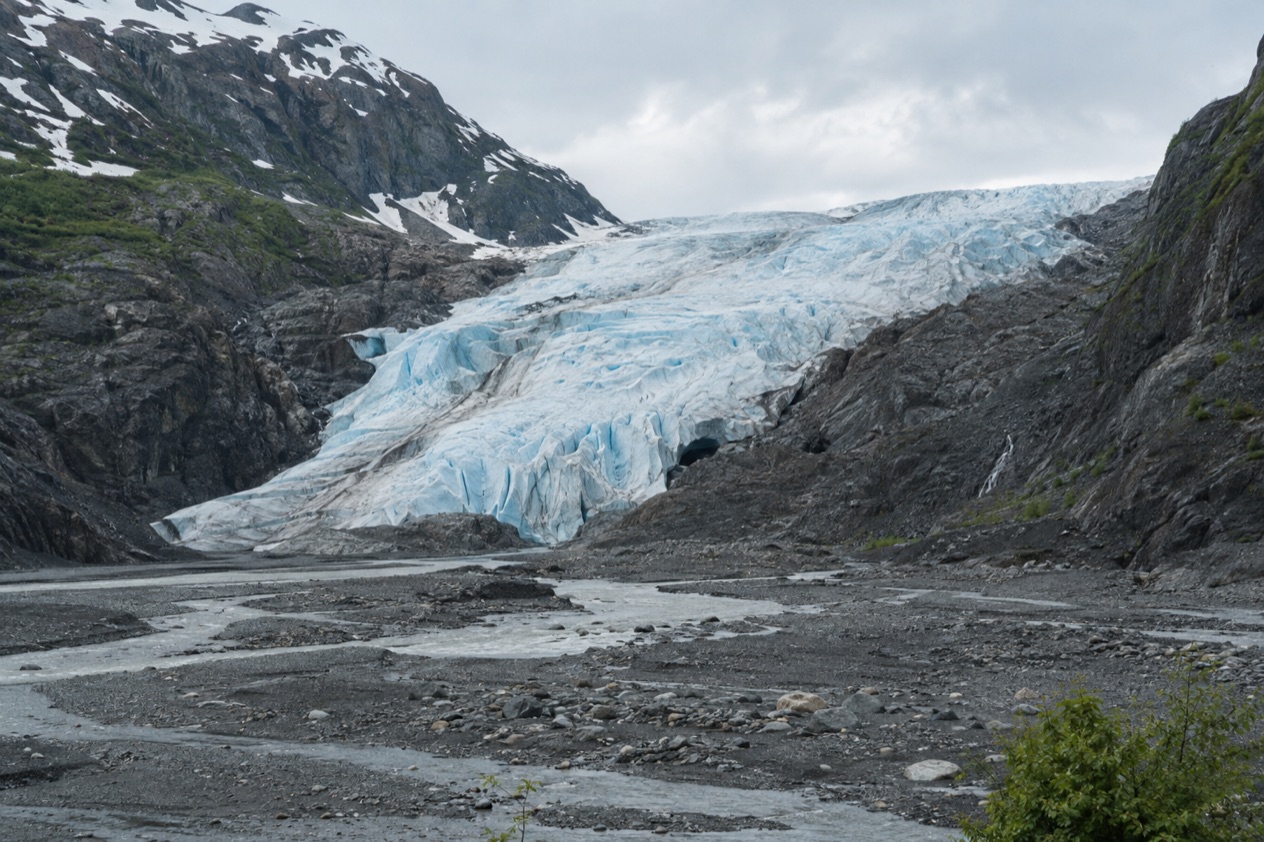
The road to Exit Glacier runs alongside a braided, milky river, and the valley around it opens wide and flat-bottomed, scooped out long ago by ice. Then the trees give way and a tongue of blue-white ice appears, with meltwater roaring somewhere underneath it. This is the glacier you can reach by road in Kenai Fjords National Park, and a visit means walking toward the ice, reading the landscape it has left behind and, for those who keep climbing, heading up toward the Harding Icefield.
Is visiting Exit Glacier worth it?
Yes, for anyone who wants to stand near a glacier on foot, without a boat or a plane, and who is happy to spend a few hours walking and looking. It suits curious people, hikers and anyone who likes a landscape that explains itself as you move through it.
Most of the park’s glaciers are seen from the water, because visitors primarily reach the park by boat along its coast. Exit Glacier is the exception.
A spur road off the Seward Highway leads to the only road-accessible portion of Kenai Fjords National Park, and from the parking area trails lead to the glacier’s terminus and up to the Harding Icefield. You do not just look at the ice from a distance. You walk the ground it uncovered, touch rocks it scratched and hear water working under it.
There is also a story of change here. Exit Glacier is retreating, and park scientists keep monitoring a recession they describe as accelerating. Signs and markers along the trail record where the ice used to be, so the walk becomes a lesson in time as well as a scenic outing. Visitors who like the idea of seeing a glacier that is visibly shrinking will find it hard to forget.
What to see at Exit Glacier
The visit unfolds in layers: the valley you drive through, the ground the ice has left bare, the glacier itself and the icefield that feeds it. Each has its own things to look for.
The Edge of Glacier Trail and the sounds of the ice
The Edge of Glacier Trail takes you close to the ice, and your ears go to work before your eyes do. You can hear meltwater rushing beneath the glacier, then gushing out across the outwash plain, a constant low rumble that changes with the weather and the time of day.
Look down as well. The rocks along the trail carry fine scratches and gouges called striations, left by the passage of ice or by gravel frozen into it. They are the glacier’s signature, a record of ice grinding across stone. A safety closure is in place from the toe of the glacier to the end of the canyon where Exit Creek opens onto the outwash plain, so the trail is where you take it all in.
Moraines and the retreating ice
At Exit Glacier, recessional moraines, the ridges of rock and gravel dropped as the ice pulled back, have been dated to show how the glacier has receded over time. Walking from the parking area toward the ice, you move through that timeline, from older, vegetated ground toward newly exposed rock.
The scale of the change is striking. Between 2013 and 2014 the glacier retreated about 187 feet, and monitoring continues. Visitors who pause at the marked dates tend to understand the numbers better than any sign can say.
The valley and the river on the way in
The drive is part of the sight. The road to Exit Glacier parallels the Resurrection River, a braided river system fed by meltwater from several glaciers flowing off the Harding Icefield, including Exit and Lowell Glaciers. The steep-sided, flat-bottomed U-shaped valley around you is the most prevalent erosional feature in Kenai Fjords, and it is evident on this drive.
Watch the river’s many channels braiding across gravel bars. A braided river tells you glacial water is nearby, carrying more sediment than a single channel can handle. That milky look is rock ground to powder by the ice.
The Harding Icefield Trail and Marmot Meadows
For those who want to go higher, the Harding Icefield Trail runs 3.9 miles from the trail register to the end of the trail. The icefield is the source of the glacier. Moist air coming off the Gulf of Alaska drops, on average, 60 feet of snow on it each winter, and that snow slowly compresses into ice.
A guided hike to Marmot Meadows along this trail runs daily during the summer season. Hoary marmots are among the animals that may be seen here, along with black bears, mountain goats and several kinds of owls. These are chances, not promises, and the park reminds visitors to be prepared for wildlife encounters and changing weather.
Hours, tickets and rules
Exit Glacier can be reached at any time of year, but how you get there changes with the snow. In the summer season the area has a full program of ranger walks, talks and a guided hike, and the table gives their times.
| Site | Open |
|---|---|
| Exit Glacier area | Accessible year-round. Once snow arrives, usually in mid-November, the road closes to cars and opens to snow machines, dogsleds, fat-tire bicycles and cross-country skiers |
| Ranger-led walks to the glacier | Summer season, daily at 10 am, 11 am, 1 pm and 2 pm, lasting 1 to 2 hours |
| Ranger Talk, Exit Glacier Pavilion | Summer season, 12:30 pm, lasting about 20 to 30 minutes |
| Guided hike to Marmot Meadows (Harding Icefield Trail) | Every day of the summer season at 9 am, lasting 3 to 4 hours |
Trails in Kenai Fjords National Park are open to foot traffic only, with no bikes or pets, and dogs and other pets are prohibited on trails at all times. At Exit Glacier, bikes and pets are also not allowed on trails past the parking lot.
The area from the toe of the glacier to the end of the canyon where Exit Creek meets the outwash plain is closed for safety. Permits are required in the park for special events, commercial activities or guiding, and research.
How to get to Exit Glacier
By road, and by one road only. The Seward Highway (AK-9) is the sole road that provides access to Kenai Fjords National Park, and a spur road off it leads to the Exit Glacier area. That spur is Herman Leirer Road, also called Exit Glacier Road, and it is currently open to automobile traffic.
The road is the way most visitors reach the park by land, since the rest of the park is primarily reached by water along its coast. Once you leave the highway, the drive runs along the Resurrection River through the glacier-carved valley, which is part of the experience.
Winter changes the arrangement. The road is closed to cars for the winter months and much of the spring, and with the arrival of snow, usually in mid-November, it opens instead to winter recreation. Beyond the state gate, reaching the Exit Glacier area means another 7 miles, with an additional mile to the overlook. Those are distances covered by snow machine, dogsled, fat-tire bike or skis.
Road status, closures and conditions for Exit Glacier Road appear on the park’s Current Conditions and Alerts page, which is the place to look for the latest word on the road itself.
When to visit Exit Glacier
The summer season is when the area is busiest and best equipped for visitors. Ranger walks start mid-morning and run into the afternoon, a talk takes place at the Pavilion around midday, and the guided hike to Marmot Meadows leaves first thing in the morning.
Parking is the bottleneck. In June, July and August the lot is limited, especially from 10:00 am to 3:30 pm, so the hours around those peak times are the ones most likely to be stretched.
Time of day also shapes the walk itself. Glaciers in temperate, high-melt regions like Kenai Fjords flow faster in summer than in winter, because basal slippage, ice sliding over wet bedrock, can account for up to 90 percent of the movement. The meltwater you hear gushing across the outwash plain is a sign of that season at work.
As autumn goes on, the key date is the first lasting snow. Usually in mid-November the road closes to cars, and the area turns into a winter playground for snow machines, dogsleds, fat-tire bikes and skiers.
The park stays open year-round, and Exit Glacier remains accessible, but the way you reach it changes completely. Winter also brings something the glacier needs: moist air off the Gulf of Alaska piles snow onto the Harding Icefield, the first step in a process that takes years to turn snow into glacial ice.
Spring is a closed-road season for cars as well. The road stays shut for much of it, so a spring visit to the glacier is shaped by that closure rather than by summer’s programs.
Tips for your visit
Plan around the ground you will cover. A walk to the glacier with a stop to listen, read the moraine markers and look for striations fills a good part of a morning or afternoon, and the ranger-led walks are built to carry you through exactly that. The Harding Icefield Trail is a different commitment, and the guided Marmot Meadows hike gives you a fixed starting time and a sense of how much of the day it takes.
Come prepared for the weather and for wildlife. The park describes itself as remote, rugged and unpredictable, and conditions near a glacier can shift. Black bears, hoary marmots, mountain goats and owls may be seen in the area, so keep your eyes open on the trail and your expectations flexible.
Leave pets and bikes behind. Neither is allowed on trails past the parking lot, so a dog cannot join you on the Edge of Glacier Trail. If you are traveling in summer, think about the parking window and arrive outside the busiest hours, or build your day around a ranger program.
If you want to stay close to the ice overnight, a 12-site, tent-only campground sits at the Exit Glacier Area. Camping, cabins and other lodging are also available both inside and outside the park.
Exit Glacier pairs naturally with the park’s other face. Visitors primarily reach the rest of Kenai Fjords by water along its coast, where Bear Glacier, the park’s largest, carries two distinct medial moraines. Seeing both a glacier on foot and a glaciated coast from the water gives a fuller picture of a park where nearly half the land is under ice.
Good to know before you go
The name tells a small story. Exit Glacier was named for serving as the exit on the first recorded crossing of the Harding Icefield in 1968, and the park around it was designated a National Park in 1980. The park holds over 600,000 acres, and nearly half of it is covered by ice. Winter brings the closure of the road to cars, and a cabin at the Exit Glacier area is available then.
| Fee | Amount | Who pays |
|---|---|---|
| Willow Cabin at Exit Glacier, winter only | $50 per night | Guests staying in the cabin |
Sources
- National Park Service, Kenai Fjords glaciers (https://www.nps.gov/kefj/learn/nature/glaciers.htm), checked October 11, 2026
- Wikipedia, Exit Glacier (https://en.wikipedia.org/wiki/Exit_Glacier), checked October 11, 2026
- National Park Service, Kenai Fjords National Park, plan your visit: conditions (https://www.nps.gov/kefj/planyourvisit/conditions.htm), checked October 11, 2026
- National Park Service, Kenai Fjords National Park, plan your visit: basicinfo (https://www.nps.gov/kefj/planyourvisit/basicinfo.htm), checked October 11, 2026
- National Park Service, Kenai Fjords National Park, plan your visit: fees (https://www.nps.gov/kefj/planyourvisit/fees.htm), checked October 11, 2026