
Standing at the Denali Visitor Center with a trail map in your hand, you can see where the lines on the paper stop and the spruce, tundra and river bars simply keep going. That is the first surprise of hiking here. The park offers a small network of marked trails near the entrance, the freedom to walk off-trail almost anywhere, and ranger-led Discovery Hikes that take you farther out than visitors go on their own.
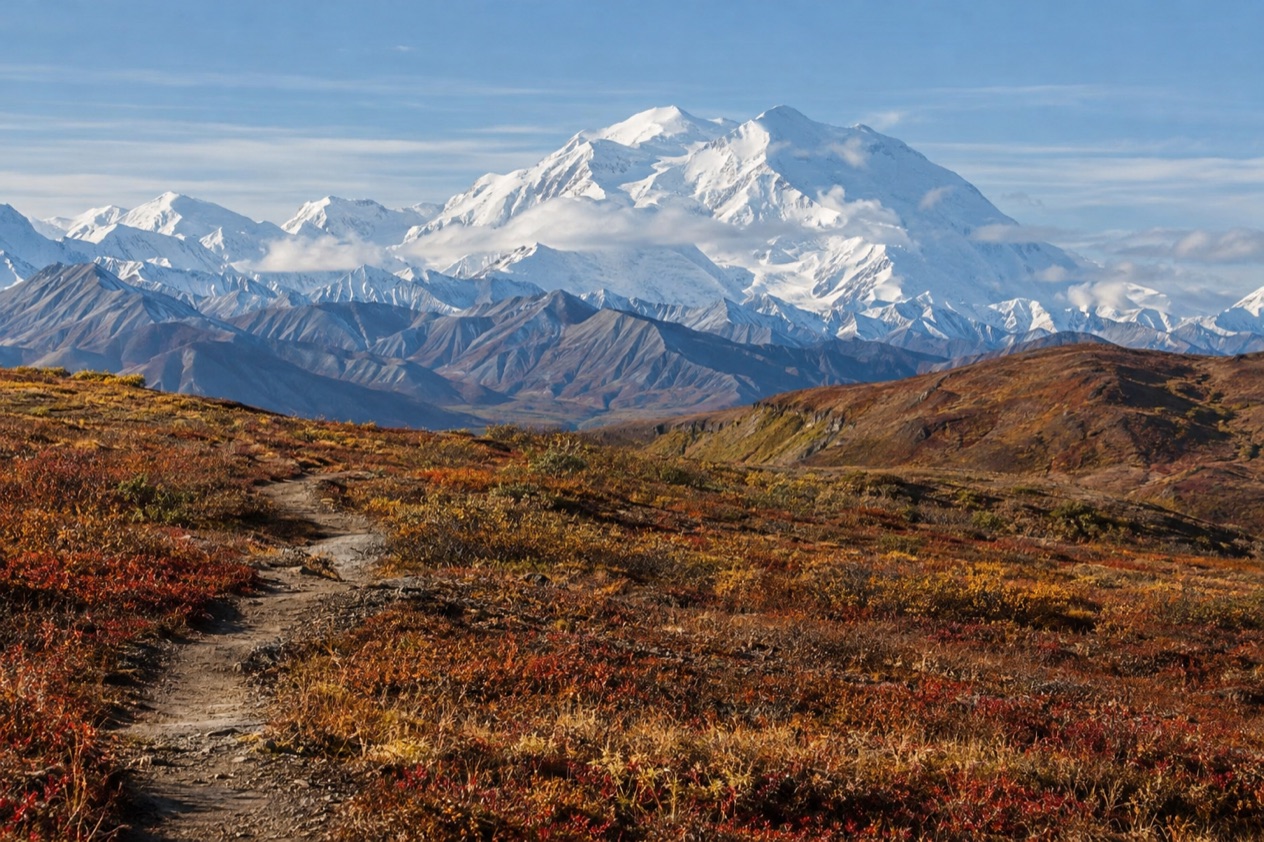
Where can you hike in Denali National Park?
You can hike on marked trails clustered around the Denali Visitor Center and the park entrance, along the Savage River, and out at Wonder Lake, or you can leave the trails altogether and walk across open country. Denali gives you two ways to do it: follow a marked trail, or head off-trail in nearly any direction you choose. Most of the marked trails are short, and they are largely centered on the visitor center.
That layout suits a first visit. You can start with a walk from the visitor center campus, see how the forest gives way to open ground, and decide afterward whether you want something longer. A few of the named trails are worth knowing before you lace up.
| Trail | Length (miles) | Where it runs |
|---|---|---|
| Triple Lakes Trail | 9.5 | Tsenesdghaas Na’ Trailhead near mile 231 of the George Parks Highway (Hwy 3) to the Denali Visitor Center Campus |
| Savage River Loop Trail | 2 | Alongside the Savage River at Mile 15 of the Denali Park Road |
Triple Lakes Trail
This is the longest trail in the park, and it links the highway trailhead with the visitor center campus. That makes it a true route from one place to another rather than a loop, so you will want to think about which end you start from and how you will get back.
Because it ties the highway to the visitor center, it also gives you a way to arrive at the park under your own power. Tell someone your plan before you set out, since the park asks everyone to hike with a companion and leave word of where they are going.
Savage River
The Savage River area sits at Mile 15 of the Denali Park Road, and a loop trail follows the river itself. Trail users on the Savage River Loop and the Savage Alpine Trail must keep to the group size limit of 12 people, so a big family reunion or club outing needs to split up.
A free bus called the Savage River Shuttle runs from roughly mid-May to mid-September from the park entrance. The shuttle carries up to two bikes at a time. There is no parking for RVs at Savage River, though Mountain Vista at Mile 13 has limited RV parking.
There is no cell service, water or food here, so bring what you need for the time you plan to spend. Camping is allowed only at Savage River Campground with a reservation, or in the backcountry with a backpacking permit. In the fall, the Denali Park Road closes to vehicles at Savage River whenever wintry weather sets in, sometimes as early as late September.
McKinley River Bar Trail at Wonder Lake
Out at Wonder Lake Campground, the McKinley River Bar Trail leads from the campground to the McKinley River. It is the kind of walk where the destination is a wide, open river bar, and where you feel how far you have come from the entrance area.
Mosquitoes plague this trail for most of the summer, so bring a head net. Pack it even if the morning looks breezy, because it is far easier to carry one you do not use than to walk without one when you need it.
Discovery Hikes with a ranger
Discovery Hikes are guided walks into parts of the park you would otherwise have to plan on your own. They begin in mid-June each year, with one hike each day through late summer, although the exact ending date varies. You sign up in person at the Denali Visitor Center, and every member of your party must be present when you do, with no exceptions.
Children under age 8 cannot sign up, and anyone under age 18 must be accompanied by an adult guardian. A waterproof jacket is required, and rain pants are always a good idea because you may be walking through wet vegetation. Once you are signed up, you receive a voucher for a reserved seat on the early transit bus.
| Discovery Hike detail | What to expect |
|---|---|
| Season | Mid-June through late summer, one hike each day |
| Sign-up | In person at the Denali Visitor Center, one or two days ahead |
| Bus | Reserved seat on the 8:00 am transit bus |
| Bus ride each way | Thirty minutes to two hours |
| Time on foot | Three to five hours |
| Whole day | Up to 10 hours |
Most hikes require buying a transit bus ticket, but there are always enough seats for Discovery Hikers. Plan on a full day, not a morning stroll.
Are there trails and what about the backcountry?
There are only a handful of trails, and beyond them Denali is wilderness with no trails, no designated routes and no backcountry campsites to guide you. The park is about the size of Vermont, and the trails that exist are mostly near the entrance and meant for day hiking rather than overnight backpacking. Unlike most parks that ask you to stay on the path, Denali also lets you explore a trail-less landscape.
That freedom comes with responsibility. You choose your own line across the ground, you decide where to turn around, and you carry everything you need. For visitors, that is exactly the appeal.
Off-trail day hikes using the bus
The park suggests a simple strategy for an off-trail day. Take an early transit bus into the park and scout the terrain from the road as you go. On the return toward the entrance, ask the driver to let you off at an area that looks appealing.
Getting back is just as direct. After your hike, return to the road and wave down any passing transit bus. Be prepared for the first bus or two to be full, and you might wait an hour for a ride, so leave yourself margin at the end of the day rather than planning to catch a particular departure.
There are no restaurants or amenities west of mile 3 on the Park Road, so off-trail hikers must carry adequate food and water. Surface water from streams and lakes should be both filtered and disinfected before you drink it. Plan your supplies for a longer day than you intend, since waiting for a bus is part of the equation.
Overnight trips and backcountry permits
Backcountry permits are free and required for overnight trips in the Denali backcountry. From mid-May to late September they are issued in person at the Backcountry Information Center on the Denali Bus Depot campus, no more than one day before your trip starts. In the fall, winter and spring, permits are available at the visitor center.
Every member of the backpacking party must attend a backcountry orientation before the permit is issued. Your permit specifies the backcountry unit where you must camp each night of your trip. In summer the entire park is divided into 87 sections, or units, and only a certain number of people can camp in a given unit each night, so your first-choice unit may not be open.
If you plan to use the Camper Bus, you will need the backcountry permit before you can get tickets at the Denali Bus Depot. Bear Resistant Food Containers are required from April 15 to September 30, so plan your food storage around them. With no trails and no marked campsites, route finding is entirely yours.
What should you know before you go?
Know that Denali is subarctic wilderness, where weather turns quickly, wildlife keeps its own space, and your safety rests mostly on your own preparation. The park asks every visitor to follow a handful of habits, and most of them cost nothing but attention.
Wildlife and bear safety
Visitors must keep wildlife wild and never feed or harass animals. Stay 300 yards from bears at all times. For other animals, the minimum distance is 25 yards, again at all times.
Bear spray is strongly encouraged for all hikers in Denali. If you are flying in without it, ask about it before you head to the trail, since it is part of how the park expects hikers to prepare. Every hiking plan here also benefits from a partner, because the park advises always hiking with at least one other person.
Weather, clothing and the ground underfoot
Snow can fall nearly any month of the year in Denali, even when the day starts warm. Hypothermia is always a factor in the subarctic, so dress in layers, preferably made of wool or synthetic material, and bring rain gear or an umbrella. A waterproof jacket is required on Discovery Hikes, and the same logic applies on any day out.
Falls cause more deaths in the park than anything else. Plan your route with the assumption that you will be walking through wet plants, and bring rain pants to match.
Water, plants and sharing your plans
Carry plenty of water. On a Discovery Hike, the park asks for at least two liters per person, and that is a sensible starting point for any long day. Drink from streams and lakes only after filtering and disinfecting.
There are no poison oak, sumac or ivy species in Denali, but some other plants can cause allergic reactions, such as cow parsnip. Before you leave, make sure someone else knows where you are going. In a place with no marked route to follow, that note could matter more than anything in your pack.
Good to know before you go
In an emergency, dial 9-1-1 and be prepared to give your location as Denali National Park. Cell phone coverage exists only within three miles of the park entrance, so a phone is not a safety plan once you are out on the trail.
Sources
- National Park Service, Denali National Park & Preserve, plan your visit: dayhiking (https://www.nps.gov/dena/planyourvisit/dayhiking.htm), checked October 11, 2026
- National Park Service, Denali National Park & Preserve, plan your visit: discovery hikes (https://www.nps.gov/dena/planyourvisit/discovery-hikes.htm), checked October 11, 2026
- National Park Service, Denali National Park & Preserve, plan your visit: backcountry (https://www.nps.gov/dena/planyourvisit/backcountry.htm), checked October 11, 2026
- National Park Service, Denali National Park & Preserve, plan your visit: safety (https://www.nps.gov/dena/planyourvisit/safety.htm), checked October 11, 2026
- National Park Service, Denali National Park & Preserve, plan your visit: savage river area (https://www.nps.gov/dena/planyourvisit/savage-river-area.htm), checked October 11, 2026
To plan your stay
- Best Time to Visit Denali National Park: Summer Buses, Fall Road, Winter Quiet and Weather by Month
- Where to Stay in Denali National Park: Park Entrance, Healy, Backcountry Lodges and Campgrounds
- Denali National Park from Anchorage: the Parks Highway, the Denali Star Train and Park Shuttles
- Know Before You Go to Denali National Park: Fees, Bus Season, Weather and Bears