
The first thing many visitors notice at the entrance area is the quiet: gravel underfoot, a faint smell of spruce, the hum of a free shuttle pulling away from the Denali Visitor Center, and the Alaska Railroad Depot a few steps off. Denali asks you to plan around its seasons, its single road and its wildlife. A handful of facts about fees, buses, weather and bears make the visit go smoothly.
What should you know before visiting Denali National Park?
Four things matter most: the park charges an entrance fee for visitors ages 16 and up, the bus service runs only in summer, the Denali Park Road can close when winter weather arrives, and food must be kept secure from bears. Everything else, from the layers you pack to where you pick up a backcountry permit, follows from those four.
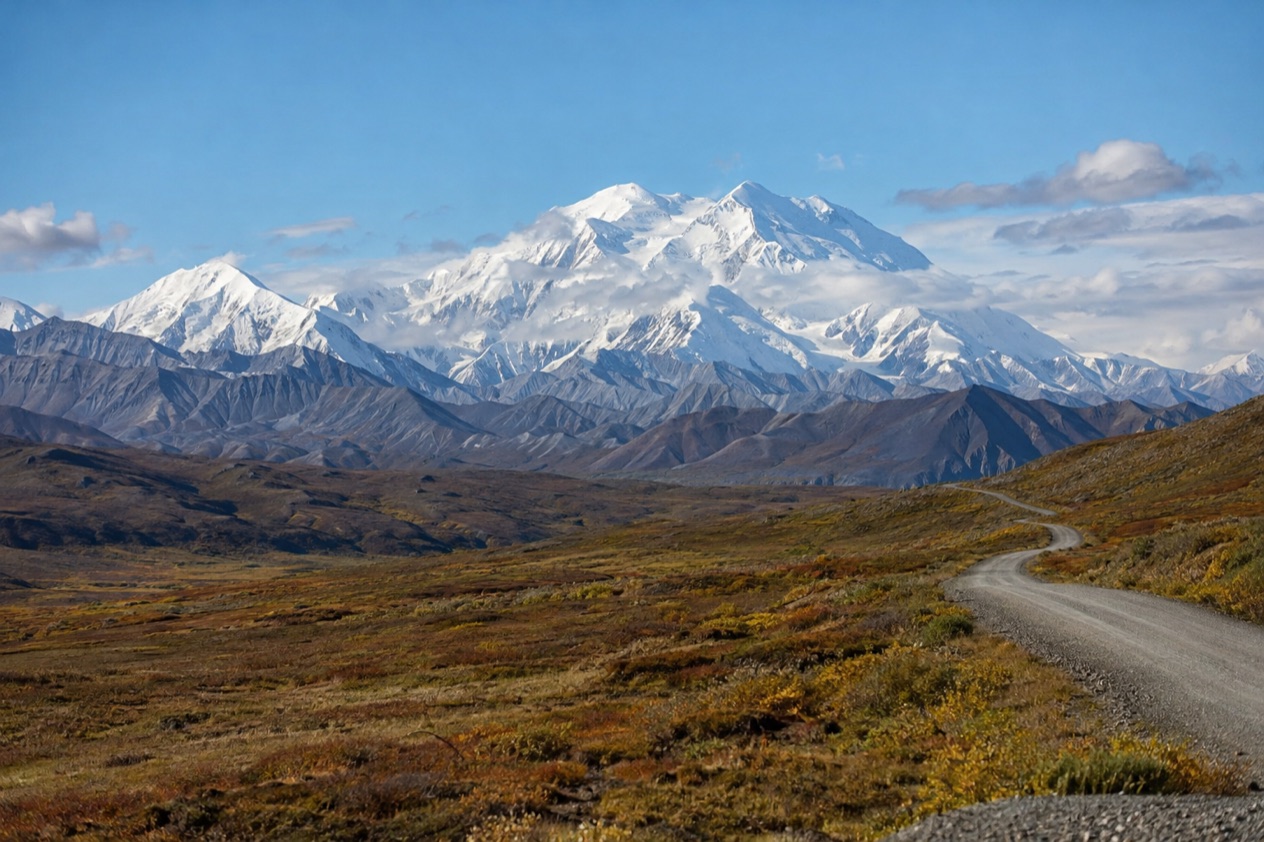
The season shapes the trip more than anything. Bus service generally runs from May 20 through mid-September, and most organized events happen in that same stretch, from mid-May through mid-September. Outside it, the park is a different place: quieter, colder, and run on the road’s mood. In fall 2026, weather permitting, personal vehicles can drive the Park Road as far as Teklanika, at mile 30, and the road stays open, weather permitting, through October 15 or until snow or ice closes it at Park Headquarters.
What usually surprises first-time visitors is how much the park depends on conditions you cannot control. The road may close at Mountain Vista (mile 13) or at Park Headquarters (mile 3) at any time because of winter weather, so a plan that counts on reaching a particular mile is a plan that can change overnight. The park also gives no refunds for inclement weather, which is worth keeping in mind when you book anything tied to a date.
A second surprise is how much there is to do near the entrance without going deep into the park. Three free summer shuttles circle the entrance area, and a ranger answers the phone daily, except on major holidays, from 9 am to 4 pm. Start there with questions about the day’s road and weather.
Fees, passes and reservations
Denali charges an entrance fee year-round, and it applies to everyone ages 16 and up. Children and teens 15 and under are free. If you already carry a valid Denali National Park Annual Pass or an America the Beautiful pass, you skip the entrance fee, and the pass covers you plus up to three other adults in your party.
Camping is where reservations come in. Reservations for Denali campgrounds can be made as early as December 1 of the year before your visit. Sites run around $25 to $50 per night. Wonder Lake Campground is closed through 2026 because of the Pretty Rocks Construction project, so it is not an option for a trip this season.
Overnight trips into the backcountry need a permit, and the permit is free. From mid-May to late September, you collect it in person at the Backcountry Information Center on the Denali Bus Depot campus, no more than one day before your trip starts. In fall, winter and spring, permits are available at the visitor center instead.
| Item | Who pays |
|---|---|
| Park entrance fee | Visitors ages 16 and up |
| Park entrance | Visitors 15 and under |
| Campground site | Campers |
| Backcountry permit | Overnight backcountry visitors |
Money, phones and getting online
Denali is in the United States, so prices and fees are in U.S. dollars.
Road conditions are one thing you can follow online. The Alaska Department of Transportation runs the Alaska 511 website, where road conditions are sorted into categories from Good, Fair, Difficult and Very Difficult up to Hazardous, Road Closure and No Winter Maintenance. The site also shows incidents and closures reported through Waze, and its map lets you add a camera to My Cameras by clicking a camera icon and then the My Cameras button.
Clocks matter too. Alaska uses its own time zone, nine hours behind UTC in standard time and eight behind during daylight saving time. The change happens on the second Sunday in March and again on the first Sunday in November, so a trip around early November can straddle it.
Getting around and staying connected
Around the entrance area, three free summer shuttles do the work: the Savage River Shuttle, the Riley Creek Loop Shuttle and the Sled Dog Demonstration Shuttle. All of them run daily in summer and are wheelchair accessible. The main stops are at the Denali Bus Depot and at the Denali Visitor Center, where the stop sits between the visitor center building and the Alaska Railroad Depot.
Bus service on the Park Road is a summer arrangement, generally from May 20 through mid-September. Once it ends, the road is the story.
In fall 2026, weather permitting, you can drive your own vehicle to Teklanika at mile 30, and the road is expected to stay open through October 15 or until snow or ice closes it at Park Headquarters. Closure can also come earlier at Mountain Vista or Park Headquarters, so the day’s conditions decide how far you go.
Before setting out on any Alaska road, look at the Alaska 511 website and its road condition categories. A road marked Difficult or Very Difficult tells you more about your day than a forecast does.
Weather, daylight and wildlife
Denali weather asks for layers. From spring to early fall, Alaska temperatures range from 50 to 70 degrees Fahrenheit, with possible rain and wind. The advice is to dress in layers and carry a backpack, so you can peel off a layer when the sun comes out and add one when it turns chilly or wet. The outer layer should be a fully waterproof, breathable shell with a hood.
The table gives the air at the Denali 27 N station, elevation 2225 feet. July is the warm, wet month, October is below freezing most of the day, and winter is deeply cold.
| Month | Average high (°F) | Average low (°F) | Precipitation (inches) |
|---|---|---|---|
| January | 13.8 | -5.3 | 0.79 |
| April | 38.4 | 20.1 | 1.06 |
| July | 64.1 | 47.0 | 5.10 |
| October | 32.1 | 17.5 | 1.45 |
Wildlife comes with rules. All three species of North American bears, black, brown (including grizzly) and polar, flourish in Alaska, and people in Alaska must keep all human sources of food secure from bears. Dangerous bear situations are reported to the Alaska Department of Fish and Game using its wildlife encounter form. Sightings are a chance, never a promise, so treat any animal you see as a bonus.
Local customs and etiquette
Alaskans dress for the weather, not the occasion. Fleece, a rain shell and sturdy boots are normal at a restaurant table as much as on a trail, and nobody will look twice at mud on your pants. Leaving the polished clothes at home is a way of fitting in.
The pace is unhurried. Plans bend to conditions, a closed road or a low cloud deck is met with a shrug and a second cup of coffee, and a friendly chat at the visitor center counter is part of the routine. Rangers and bus drivers tend to know the day’s road better than any website, and they are generally glad to be asked.
Respect for the land runs deep. Denali sits on the homelands of Alaska Native peoples, including Athabascan communities, and it is a good habit to think of the park as a living place rather than a backdrop.
With wildlife, give animals room, keep your voice down and your food put away, and resist the urge to crowd an animal for a photo. People here see that as basic courtesy, and a quiet, patient visitor is the one they remember kindly.
Good to know before you go
Seasons drive the practical details. Bus service ends in mid-September, the Park Road is expected to stay open through October 15 weather permitting, and Wonder Lake Campground remains closed through 2026.
Entrance passes should be in hand, whether an annual pass or an America the Beautiful pass, and the park gives no refunds for bad weather. One last habit is worth keeping: call the park ranger line between 9 am and 4 pm, outside major holidays, to ask about the road on the morning you plan to go.
Sources
- National Park Service, Denali National Park & Preserve, plan your visit: backcountry (https://www.nps.gov/dena/planyourvisit/backcountry.htm), checked October 11, 2026
- National Park Service, Denali National Park & Preserve, plan your visit: basicinfo (https://www.nps.gov/dena/planyourvisit/basicinfo.htm), checked October 11, 2026
- National Park Service, Denali National Park & Preserve, plan your visit: calendar (https://www.nps.gov/dena/planyourvisit/calendar.htm), checked October 11, 2026
- National Park Service, Denali National Park & Preserve, plan your visit: campgrounds (https://www.nps.gov/dena/planyourvisit/campgrounds.htm), checked October 11, 2026
- National Park Service, Denali National Park & Preserve, plan your visit: conditions (https://www.nps.gov/dena/planyourvisit/conditions.htm), checked October 11, 2026
- National Park Service, Denali National Park & Preserve, plan your visit: courtesy shuttle buses (https://www.nps.gov/dena/planyourvisit/courtesy-shuttle-buses.htm), checked October 11, 2026
- Wikipedia, Climate of Alaska (https://en.wikipedia.org/wiki/Climate_of_Alaska), checked October 11, 2026
- Alaska 511 (https://511.alaska.gov/), checked October 11, 2026
- Alaska Department of Fish and Game, Living with bears (https://www.adfg.alaska.gov/index.cfm?adfg=livingwithbears.main), checked October 11, 2026
- Alaska.org, what to wear (https://www.alaska.org/advice/what-to-wear-in-alaska), checked October 11, 2026
- Wikipedia, Alaska Time Zone (https://en.wikipedia.org/wiki/Alaska_Time_Zone), checked October 11, 2026
- NOAA NCEI, U.S. Climate Normals 1991-2020, monthly (https://www.ncei.noaa.gov/access/services/data/v1?dataset=normals-monthly-1991-2020&stations=USW00096408), station Denali 27 N, elevation 2225 feet, checked October 11, 2026
To plan your stay
- Best Time to Visit Denali National Park: Summer Buses, Fall Road, Winter Quiet and Weather by Month
- Things to Do in Denali National Park: Park Road Rides, Sled Dogs, Trails and Where to Eat
- Where to Stay in Denali National Park: Park Entrance, Healy, Backcountry Lodges and Campgrounds
- Denali National Park from Anchorage: the Parks Highway, the Denali Star Train and Park Shuttles