
At the Denali Visitor Center, the question comes up in a hurry: you are standing under the big windows, a ranger is pointing at the one road that leads into the park, and everyone around you wants to know how to get out onto it. Past the first stretch, there is no driving your own car. The answer is a bus, either a narrated tour bus or a non-narrated transit bus, and the choice shapes your whole day.
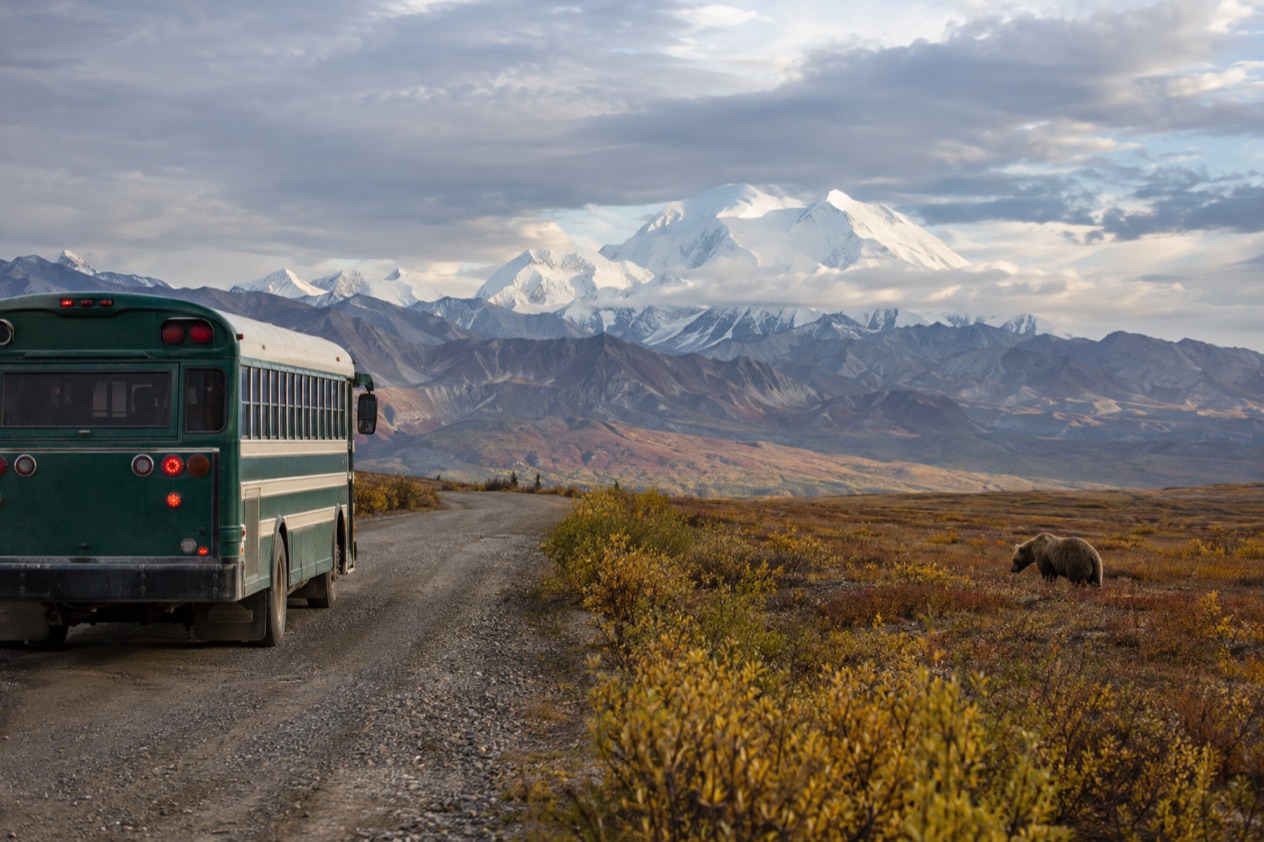
Which bus tours run in Denali National Park?
Two kinds of buses carry visitors along the Denali Park Road: narrated tour buses and non-narrated transit buses. Most sightseeing in the park is done on one or the other. All of them are run by a private company under contract, not by the National Park Service, so the buses are separate from the rangers, the visitor center and the entrance pass.
Bus trips are available only in summer, from mid-May through mid-September. Since today falls in October, that season has ended, and the road is now a place for walkers, skiers and snowshoers rather than buses. If you are planning ahead, think of the buses as a summer experience and build the rest of your trip around that window.
Narrated tour buses
A narrated tour bus comes with a driver who talks as you go, pointing out the landscape, the history of the road and the animals that may appear beside it. People who have never been to Alaska often like this format, because someone is there to say what you are looking at and why the ridge or the river bar matters.
Food is built in. Every narrated tour bus offers either a snack or a full lunch, so you do not have to plan a picnic for a long day on the road. You stay on the bus for the tour and look out the windows, while the driver and the other passengers help spot wildlife, which is always a chance and never a promise.
Non-narrated transit buses
The transit bus is the plain version: no running commentary, no meal included, just a ride into the park. What makes it distinctive is freedom. Passengers may get off and re-board anywhere along the restricted portion of the Denali Park Road, which turns the bus into a way to reach a stretch of tundra and walk it on your own.
That suits travelers who want to stop at a ridge, wander off to look at a river valley or take photographs at their own pace. The National Park Service offers tips on where Mount McKinley can be seen and how to photograph wildlife and wilderness, which are worth reading before you choose where to step off.
The road you can drive and the free shuttle
In summer, roughly late May through early September, private vehicles may drive the first 15 miles of the Denali Park Road, as far as Savage River. Beyond the Savage River Check Station, visitors must be on a bus, on a bicycle or on foot.
For a visit of half a day or less, Denali offers a free shuttle to Savage River. Free courtesy buses also stop at the Denali Visitor Center and travel along the same part of the road that you may drive yourself, and free shuttles serve the entrance area and the sled dog kennels. These are not bus tours into the deeper park, but they give you a taste of the road if your time is short.
How do they differ?
The main difference is what the bus gives you besides a seat: a narrated tour bus brings a driver who talks and a snack or lunch, while a transit bus is a ride you can leave and rejoin whenever you like. Everything else follows from that, including how you spend the hours and what you carry with you.
| Feature | Narrated tour bus |
|---|---|
| Commentary | Narrated along the road |
| Food | Snack or full lunch |
| Getting off | Stays on the bus for the tour |
| Operator | Private company under contract |
Narration and meals
On a narrated bus, the day is organized for you. The driver tells the story of the landscape, you eat what the tour provides and you keep your attention on the window. It is a good match for someone who wants the road explained and prefers not to think about logistics once the bus pulls out.
On a transit bus you bring your own plan. Because food is not part of that ride, think about what you will eat and drink before you board, and remember that the only restaurant in Denali is the Morino Grill, about thirty yards from the Denali Visitor Center. The Alaska Geographic Park Store sits next to it, so the area around the center is where you can gather what you need before leaving.
Getting off the bus
The transit bus is the one that lets you step out. You can disembark anywhere along the restricted portion of the road and climb back on a later bus, so the day can be a series of stops: a long look at a valley, a stretch of walking across open ground, a pause to watch for pika, marmots, Dall sheep or Arctic ground squirrels.
Those animals are exactly what the Denali Alpine Wildlife Project asks visitors to photograph, so a transit-bus day can double as a small piece of citizen science. The park is open to established trails and to off-trail hiking in the wilderness, and a rider who gets off the bus has the same choices as any hiker who sets out from the visitor center.
Which one suits which day
If your plan is to sit, look and listen, the narrated bus fits. If your plan is to stop, wander and take your time in one place, the transit bus fits. Some visitors will want the commentary on one day and the freedom on another, and both are run by the same private company.
Rangers add another layer around the buses. They offer Discovery Hikes that go off-trail, trail walks and campground talks, and many ranger-led activities occur in or begin from the Denali Visitor Center. Programs are also offered at the sled dog kennels, which makes a good pairing with a day on the road.
What should you know before you book?
Reserve ahead if your visit is short, remember that the buses run only in summer, and expect the road to end at Mile 43 because of a landslide. Those three points decide most plans, and each is worth a closer look before you commit to a day.
Reservations
Reservations for bus trips and campground stays in Denali are available beginning December 1 of the year before your trip. Advance reservations are strongly encouraged if you are visiting for less than 2 full days, which describes a lot of people who arrive by car or train and have only a night or two in the area.
The park’s own suggestion for the real minimum is one full day or part of two days, staying one night in the area. A longer stay gives you room to take a bus on a different day from your arrival, rather than squeezing everything into a single stop.
The road closure at Mile 43
The Denali Park Road is closed to all traffic at Mile 43 because of the Pretty Rocks landslide. That is the point to keep in mind when you read about the road: whatever bus you choose, the trip ends at the closure, and the road beyond it is not part of the experience.
Denali has just one road, so there is no alternate route to go around the closure. Plan the day around what lies before it, and treat anything farther along as unavailable.
Getting to the park and where you start
The only road entrance is at Mile 237 on Alaska Highway 3, the George Parks Highway, where the Denali Park Road begins. The entrance is 120 miles south of Fairbanks, and the nearest year-round community is Healy, 12 miles north of the entrance. The Alaska Railroad depot is a five-minute walk from the Denali Visitor Center.
The visitor center is the main National Park Service welcome and information center. It has day-use parking, with a small car lot and a separate RV lot, and a Baggage Claim next to it where you can leave bags for a few hours or several days. The park film Heartbeats of Denali, about 20 minutes and non-narrated, is a quiet way to begin before you board.
After the buses stop
Denali is open year-round, and from October to April visitors can explore by foot, ski, snowshoe, bike or more. Winter brings solace, tranquility and the challenges of extreme weather. Cyclists and pedestrians may travel on any part of the park road, though temporary closures occur because of wildlife activity.
Good to know before you go
Denali charges an entrance fee, and the park does not accept cash, so bring a card. Youth age 15 or younger are free and do not need an entrance pass. An annual pass holder must be present and show the physical pass and a valid photo ID to park staff.
| Fee | Amount | Who pays |
|---|---|---|
| Standard Pass (valid 7 days) | $15.00 | Visitors age 16 and older |
| Denali Annual Pass (valid 12 months, covers up to four adults) | $45.00 | Visitors who want a year of entry |
| America the Beautiful Resident Annual Pass | $80.00 | U.S. citizens and residents |
Sources
- National Park Service, Denali National Park & Preserve, plan your visit: visiting denali (https://www.nps.gov/dena/planyourvisit/visiting-denali.htm), checked October 11, 2026
- National Park Service, Denali National Park & Preserve, plan your visit: fees (https://www.nps.gov/dena/planyourvisit/fees.htm), checked October 11, 2026
- National Park Service, Denali National Park & Preserve, plan your visit: directions (https://www.nps.gov/dena/planyourvisit/directions.htm), checked October 11, 2026
- National Park Service, Denali National Park & Preserve, plan your visit: things2do (https://www.nps.gov/dena/planyourvisit/things2do.htm), checked October 11, 2026
- National Park Service, Denali National Park & Preserve, plan your visit: the denali visitor center (https://www.nps.gov/dena/planyourvisit/the-denali-visitor-center.htm), checked October 11, 2026
To plan your stay
- Best Time to Visit Denali National Park: Summer Buses, Fall Road, Winter Quiet and Weather by Month
- Things to Do in Denali National Park: Park Road Rides, Sled Dogs, Trails and Where to Eat
- Where to Stay in Denali National Park: Park Entrance, Healy, Backcountry Lodges and Campgrounds
- Know Before You Go to Denali National Park: Fees, Bus Season, Weather and Bears