
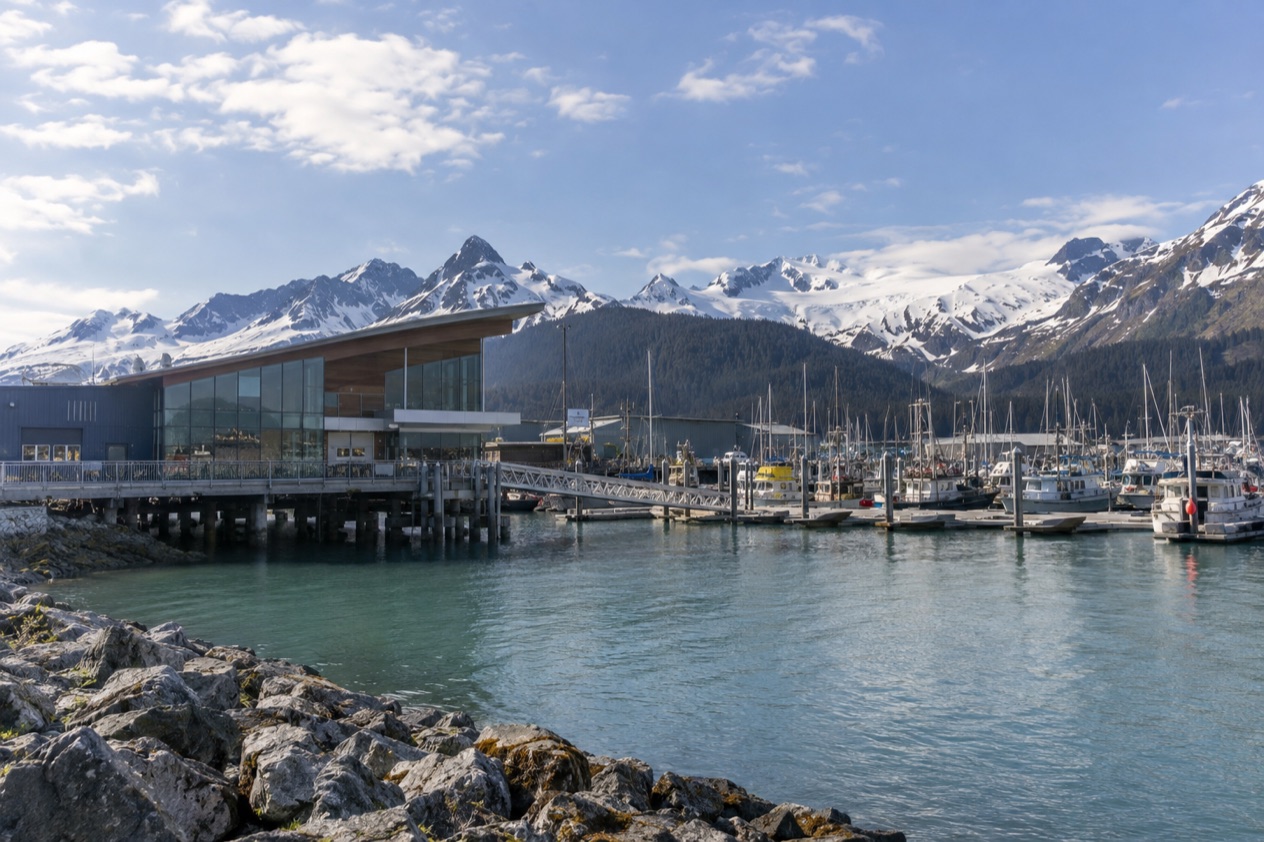
Walking up Railway Avenue in Seward, you reach a long building facing Resurrection Bay, with gulls calling overhead and the smell of salt water in the air. Inside, harbor seals glide past the glass, seabirds plunge into a tall pool, and keepers move between the tanks. It is an aquarium and a wildlife rescue center under one roof, a place for anyone in Seward who wants to see Alaska’s marine life up close.
Is visiting the Alaska SeaLife Center worth it?
Yes, for nearly anyone spending time in Seward, and especially for travelers who want to understand the animals of Alaska’s coast that are so hard to study from a boat deck. Water, rock and fog hide most of this wildlife. Here you meet it at arm’s length, with the context of the people who study and care for it.
What sets it apart from other places nearby is the double role. It is the state’s only public aquarium, and also Alaska’s only permanent marine mammal rehabilitation facility. A visit is therefore more than a walk past tanks.
Animals recovering from injury or illness are part of the story, and so is the research that goes on behind the exhibits. The center opened on May 20, 1998, on the shores of Resurrection Bay, and in September 2011 the Association of Zoos and Aquariums granted it accreditation, which places it in the top tier of such facilities.
The setting helps. Seward is a small port town, and the center sits on the water at the head of the bay, so the animals inside and the bay outside belong to the same picture.
A day on a boat tour and an hour here complement each other. One shows you the open water, the other explains what lives in it.
It suits curious adults, families with children who want to touch something wet and spiny, and anyone who likes learning how wildlife response actually works. It is also a good plan for a gray day in town, since the exhibits are indoors.
What to see at the Alaska SeaLife Center
Harbor seals and Steller sea lions
The marine mammal exhibits are the heart of the visit. Harbor seals and Steller’s sea lions live here, and watching them underwater is a different experience from spotting a dark head far off on a bay. You see how they turn, how they roll, how fast a large body moves through the water.
Spend time at the glass rather than passing through. Seals and sea lions are curious animals, and a patient visitor often sees behavior that a quick look misses, such as a slow lap around the pool or a close pass at eye level. The Marine Mammal Encounter is one of the special experiences the center offers for those who want to go deeper.
The seabird aviary and diving pool
The aviary for seabirds is built around a two-story diving pool, so you can watch birds above the surface and then follow them below as they dive. It is a way to see how these birds hunt and swim, something you rarely glimpse in the wild. The same space also holds a wolf eel and several species of large saltwater fish.
Look for the way the birds use their wings underwater and how quickly they return to the surface. The center also offers a Puffin Encounter, for those who want a closer look at the birds travelers hope to meet in Alaska. The wolf eel, with its heavy face and rocky den, is easy to miss if you only glance, so give the pool a second pass.
Touch tank, octopus and jellyfish
In a shallow touch tank, you can touch small marine invertebrates such as sea stars and sea urchins. It is the stop where children, and plenty of adults, linger longest. The animals are slow, textured and strange, and a gentle touch is all it takes to learn how different they feel from what the pictures suggest.
Nearby, the exhibits include moon jellyfish, which drift in soft, glowing circles, and Giant Pacific octopuses, which are famously hard to find because they tuck themselves into corners. Scan the tank slowly, since an octopus may be pressed against a wall or hidden behind a rock. An Octopus Encounter is offered as a special experience for visitors who want more time with one.
Alaska’s food fish
Seward is known for sportfishing, and the center’s exhibits of important Alaskan food fish put that reputation in context. Salmon, halibut, king crab and sablefish are all on display, the same species that feed communities along the coast and that fill the harbor’s fishing boats.
Seeing them alive makes the menus in town more meaningful. The salmon in particular are a good reminder that these fish are part of a larger system of rivers, bays and open ocean, a system the center’s research and education work try to explain.
Wildlife response and the rookery livestream
The Wildlife Response Program rehabilitates marine mammals such as harbor seals and walruses. This is the part of the center that sets it apart from an ordinary aquarium, and it explains why the place feels like a working facility as much as an attraction. The animals you meet may have arrived in need of help.
The center also offers a livestream of the Chiswell Island Steller Sea Lion Rookery. It is a way to see wild sea lions on their island in real time, which pairs well with the animals you have just watched in the pool. You can follow it before or after a visit.
Hours, tickets and rules
Tickets, donations and memberships are all handled through the center’s website, so the planning starts there rather than at a window on the day. The center is a nonprofit, a 501(c)(3), operating under the legal name Seward Association for the Advancement of Marine Science, and what you pay supports the rescue work and research as well as the exhibits.
Beyond general admission, the center offers special experiences: the Marine Mammal Encounter, the Octopus Encounter and the Puffin Encounter. These put you in closer contact with the animals than the public galleries do, and they are the choice for travelers who want something more personal than a walk-through. Education programs also run year-round, including Day Programs and overnight Nocturne Sleepovers under the Discovery Education banner.
On site, The Porthole Cafe handles meals and snacks, and the Discovery Gift Shop sits near the exit for souvenirs. Both are part of the visit, and the shop is a natural last stop after the galleries.
The center also hosts special events, among them Beers by the Bay and a Community Holiday Party, which show a side of the place that is more social than educational. Outreach programs can be presented in schools in the Anchorage, Mat-Su and Kenai Peninsula areas, so the center’s reach extends well beyond its own walls.
How to get to the Alaska SeaLife Center
The center is at 301 Railway Avenue in Seward, a small port city of about 2,700 people at the head of Resurrection Bay on the Kenai Peninsula in Southcentral Alaska. Seward is accessible from Anchorage, and that is the base travelers start from.
In summer, two public options connect Anchorage and Seward. The Alaska Railroad runs daily rail passage, and the Park Connection runs bus service twice daily. Their seasons are set, and outside those dates these particular services are not part of the plan.
| Service | Route | Season |
|---|---|---|
| Alaska Railroad | Anchorage to Seward, daily | May 13 to September 14 |
| Park Connection | Anchorage to Seward, twice daily | Mid-May to mid-September |
Once in Seward, the center sits in town on the shore of the bay, near the same streets as the historic downtown and the boat harbor. That makes it simple to pair a visit with the rest of the town. Downtown holds one of the largest public mural collections, so a stroll between the harbor and the center can be a pleasant part of the day.
When to visit the Alaska SeaLife Center
Any month can work for an indoor attraction, and the center keeps its Discovery Education programs going year-round. That makes it a reasonable choice whatever the weather in Seward is doing on a given day.
Summer is the season when the train and bus link from Anchorage runs, from mid-May to mid-September, and when travelers come to Seward for boat tours and Exit Glacier. The livestream of the Chiswell Island rookery is also a good way to connect the indoor visit to the wild coast.
Winter has its own appeal. A winter visitation guide counts it among the best times to visit Seward, and the center hosts events such as a Community Holiday Party, which gives the town a warm, local feel when the summer visitors have gone. Beers by the Bay is another event on the center’s calendar, and it is a different kind of evening than the usual aquarium visit.
For the exhibits themselves, the animals do not follow a schedule that a visitor can predict, so there is no single best hour. A calm, unhurried pace tends to reward you more than any particular time of day, especially at the seal and sea lion glass and the octopus tank.
Tips for your visit
Plan on a relaxed pace, because this is a place where the best moments come from standing still. Watch the seals through a full lap, wait for the octopus to shift, and follow a bird down the diving pool. Rushing from tank to tank makes the visit feel like a checklist, and the center rewards the opposite approach.
Families will find the touch tank the obvious draw, with sea stars and sea urchins a hand’s reach away. The special encounters add something more personal for older children and adults who want a closer look at the octopus, the puffins or the marine mammals. The Discovery Education programs, including the overnight Nocturne Sleepovers, are built for groups and young learners.
Combine the visit with the rest of Seward. The boat harbor and historic downtown are close, and the murals make a good walk.
Seward also has a strong reputation for sportfishing, and Exit Glacier, the only part of Kenai Fjords National Park reachable by road, lets you walk close to an active glacier or join a ranger-led walk. Pair the glacier with the center and you see both ends of the story, the ice that shapes the coast and the animals that live along it.
For lunch or a break, The Porthole Cafe is on site, and the Discovery Gift Shop is the place for a keepsake. If you are traveling with a dog, remember that in Seward whether a dog can join an adventure varies throughout the trip, so plan the day with that in mind.
Good to know before you go
Buy tickets, make a donation or join as a member through the center’s website, and keep in mind that your admission supports a nonprofit that runs Alaska’s only permanent marine mammal rehabilitation facility. The animals here are on view for a reason, as ambassadors for the coast and as part of a working program, so treat the galleries with the quiet attention you would give a small museum.
Seward is a small town, and the center is one of its anchors. Combine it with the harbor, the murals and a walk on the shore, and the visit becomes a good part of a longer stay on the Kenai Peninsula, with public-use cabins and wilderness lodging nearby for those who go further afield.
Sources
- Alaska SeaLife Center, Seward (https://www.alaskasealife.org/), checked October 11, 2026
- Wikipedia, Alaska SeaLife Center (https://en.wikipedia.org/wiki/Alaska_SeaLife_Center), checked October 11, 2026
- Visit Seward, things to do (https://www.seward.com/things-to-do), checked October 11, 2026
- Wikivoyage, Seward (https://en.wikivoyage.org/wiki/Seward), checked October 11, 2026