
The first colectivos pull out of Oaxaca while the bakeries are still warming their ovens, and within half an hour the city gives way to agave fields, church towers and dusty roadside stands. The Central Valleys fan out in every direction, each road leading to a different kind of day: a ruined Zapotec capital on a hilltop, a village of weavers, a market that swallows an entire town, a cliffside of frozen waterfalls. Oaxaca is an easy base for all of them.
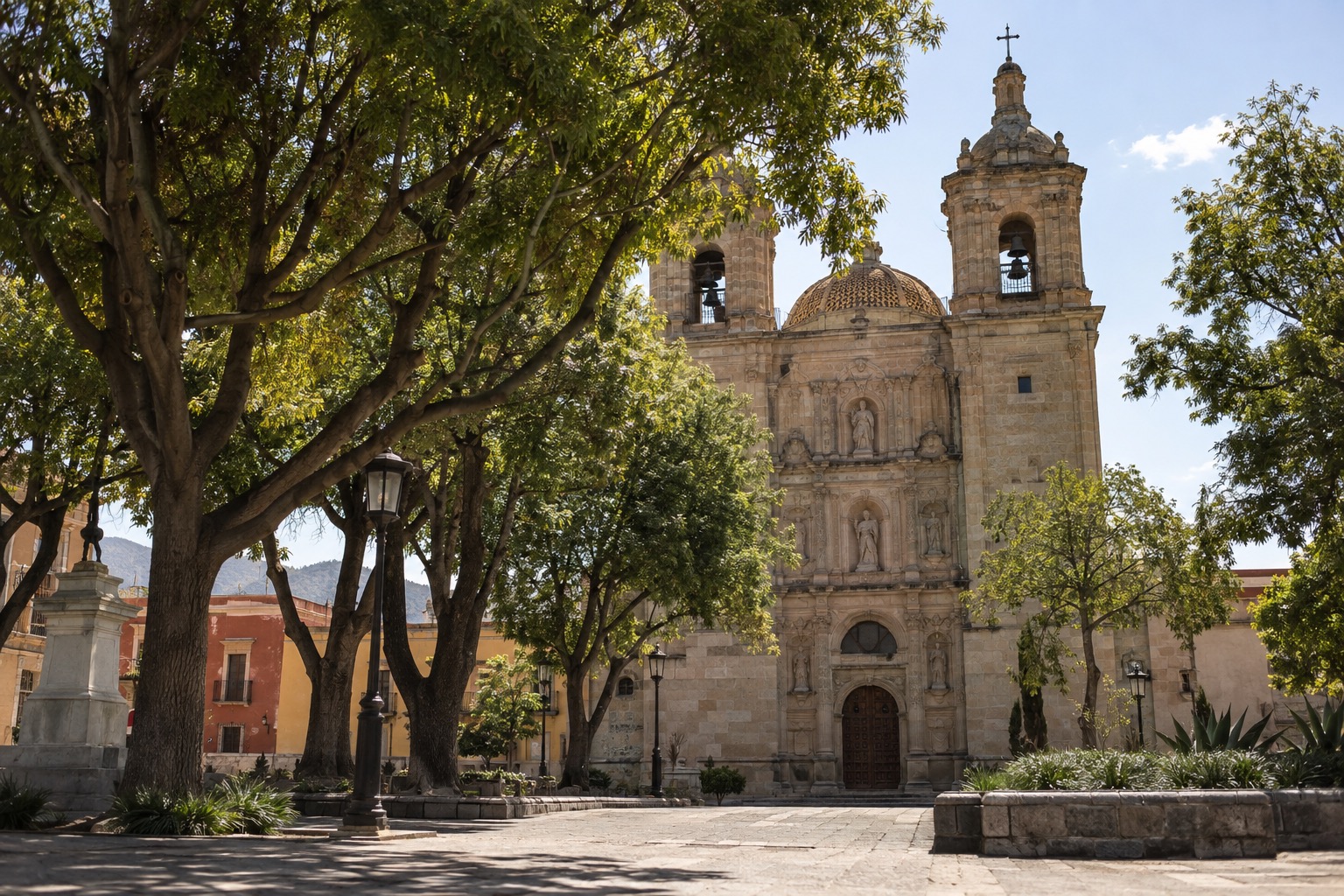
What are the best day trips from Oaxaca?
The best day trips from Oaxaca head east and south into the Central Valleys, where ruins, weaving villages, markets and mezcal distilleries sit within a morning’s travel of the city.
- Monte Albán, for the hilltop Zapotec capital and the views over the valley.
- Mitla and Teotitlán del Valle, for stone mosaics and hand-woven rugs on one road.
- Hierve el Agua, for mineral pools and petrified waterfalls on a cliff edge.
- Tlacolula Sunday market, for barbacoa, pan de yema and a crowd of villagers shopping.
- Mezcal palenques around Santiago Matatlán, for tastings at family stills.
The best day trips from Oaxaca
Monte Albán
Monte Albán is the closest of the big excursions. Count roughly 20 to 30 minutes up the hill by taxi or car, or take the local bus from near the center. The ruins crown a flattened mountaintop, and the sense of space is the point: temples and platforms laid out around an enormous plaza, with the valley dropping away on every side.
Go early after opening or in the late afternoon, when the sun is softer and the tour groups have thinned. A visit fits comfortably in a morning, and the site museum, with its original carved stelae, is worth a few minutes of the time you save. The zone has no food or drink stand of its own, so carry water, a hat and sunscreen.
History buffs and families with older kids will find it a good fit. The uneven surface and lack of shade make the plaza tough for wheelchair users to get around.
Mitla and Teotitlán del Valle
These two sit along Highway 190 and pair naturally. Teotitlán del Valle is the first stop, roughly 30 to 40 minutes from the city, and then comes Mitla, which you reach in about 45 minutes to an hour altogether. You can hop on second-class buses and shared colectivos at the baseball stadium or at the Central de Abastos, and they pass the turnoff for Teotitlán on the way.
Teotitlán is a village of family looms, where wool is dyed with plants and insects and rugs hang in courtyards. No entry fee is asked, but workshops expect you to watch the demonstration before you buy.
Mitla is another mood entirely, known for the geometric stone mosaics that cover its palace walls, with a church built right on top of an older platform. On the same road, the quieter hilltop ruins of Yagul, with a fortress above the valley, make an easy extra stop.
Do Mitla on a weekday morning to dodge weekend groups, and weavers are at work on weekday afternoons. The entrances sit low, and the stone flooring is uneven. It helps to have small bills on hand for colectivo fares and purchases, and ask artisans before you photograph them.
Hierve el Agua
Hierve el Agua is the longest of the classic trips, about an hour and a half to two hours each way. For the easiest option, take a bus or colectivo headed to Mitla, and from San Lorenzo Albarradas continue by local truck or taxi, but plenty of drivers head directly there from the city. The community that lives here manages the site and charges its own entrance fee when you get there.
What you come for is the view: mineral-rich springs spill over a cliff and have hardened into white formations that look like waterfalls caught mid-fall, above a deep green valley. The pools sit right at the edge, and the scene is best photographed from the trails along the rim.
With the long drive each way, this trip fills most of a day, and it pairs well with a stop in Mitla on the return. It suits anyone happy to trade road time for scenery.
Tlacolula Sunday market
Tlacolula lies on Highway 190 before Mitla, closer to the city, so the ride is about 45 minutes to an hour. At the baseball stadium, or at the second-class bus station, you can catch a bus marked Tlacolula or a colectivo. Sunday is the only day that counts: the market spills through the streets around the plaza and the Church of the Assumption.
Stalls sell local produce, pottery and woven baskets, and the air smells of barbacoa and fresh pan de yema. Show up with an appetite and head out early, around 8 to 10 a.m., ahead of the crowds and the midday heat. Many vendors begin packing up by mid-afternoon.
It is a trip for food lovers and market-goers. The aisles are narrow and packed, so wheelchairs and strollers struggle. Bring small bills and keep valuables close.
Mezcal palenques near Santiago Matatlán
Santiago Matatlán is also on Highway 190, about 45 minutes to an hour from the city by car, bus or colectivo. Many mezcal tours string several palenques together, which is a sensible way to see more than one in a day.
At these small family distilleries, horses or mules turn a stone wheel over roasted agave, and the mash ferments in wooden vats before it reaches the stills. You finish with samples of mezcal made in small batches from espadín and wild agave. At most palenques, you won’t pay to get in, and the tastings are generally free, since the hope is that you’ll consider buying a bottle.
Early in the day, the air is cooler, and the proprietors can spend more time talking. The dry months, November to April, bring easy roads. This is a trip for adults. Children may watch, though they may not taste, and the work areas contain open fires and floors that get slick. Bring cash to buy bottles directly, and ask before photographing workers.
A seasonal evening: cemetery vigils at Día de Muertos
For one night at the turn of October into November, the best excursion is barely out of town. From the center, Xoxocotlán and Santa María Atzompa sit roughly 20 to 30 minutes away, while Panteón General is no more than a 15-minute taxi ride away. Taxis, colectivos and special shuttles run on October 31 and November 1.
Graves glow with candles and marigolds, families sit with pan de muerto, fruit and mezcal, and music drifts between the rows. Xoxocotlán and Atzompa also have sand tapestries and flower arches. The principal vigils unfold on the night of October 31 and carry into November 1, and if you arrive after 9 p.m. and remain past midnight, you will find the altars fully lit. Some visits continue on November 2.
You can get in without paying, but a few altars run by the community request a donation. Ask before photographing people, keep your voice low and do not walk on the graves. Since these burial grounds get packed, smoke-filled, and dark, they are a poor fit for very young kids or anyone troubled by smoke and blaring music.
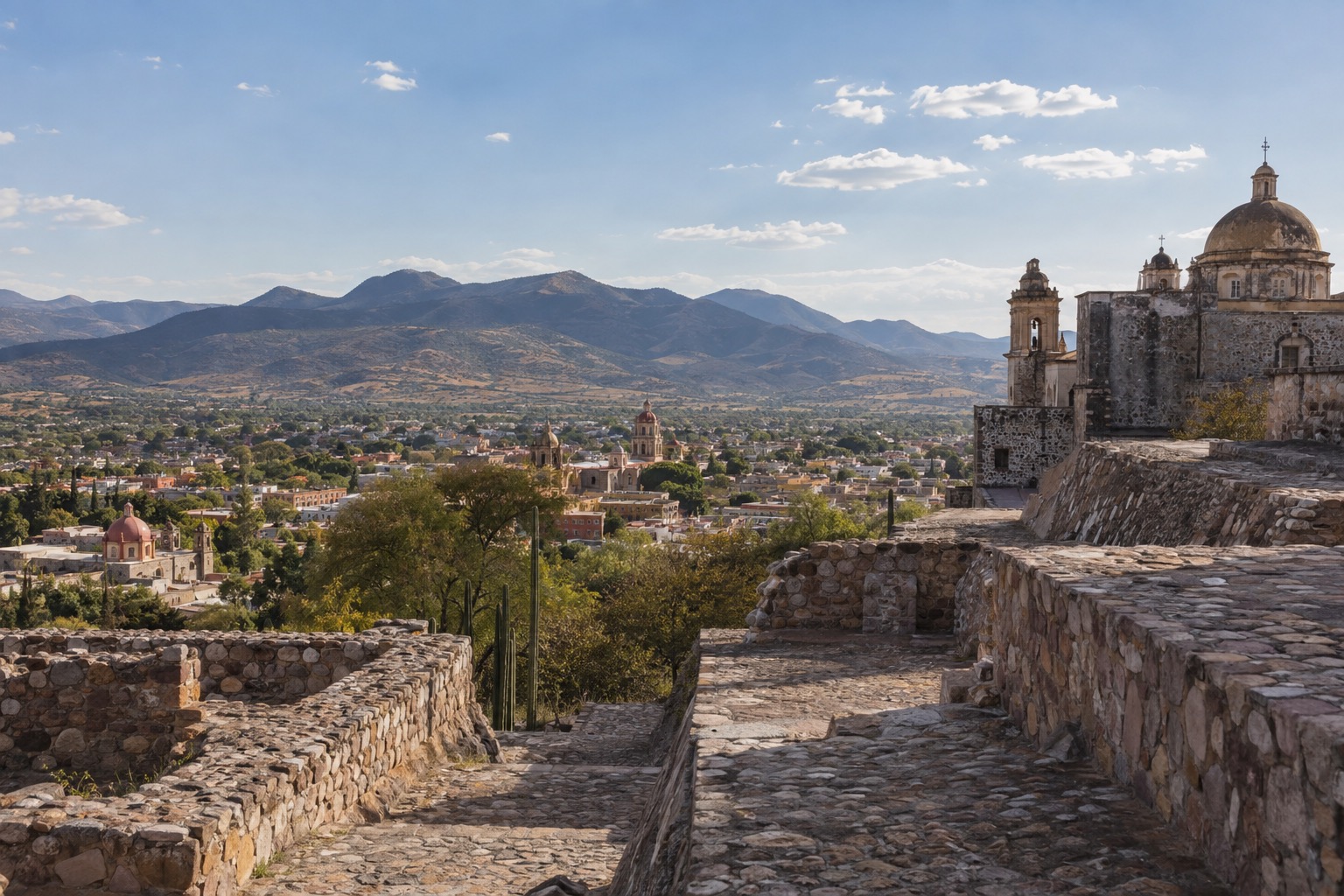
Day trips from Oaxaca compared
| Trip | Time each way | Best for | How to go |
|---|---|---|---|
| Monte Albán | 20 to 30 minutes | History, views | Car, taxi or local bus |
| Teotitlán del Valle and Mitla | 30 to 40 minutes to Teotitlán, 45 minutes to 1 hour to Mitla | Crafts and ruins | Bus or colectivo from the baseball stadium or Central de Abastos |
| Hierve el Agua | 1.5 to 2 hours | Scenery, mineral pools | Colectivo to Mitla, then local truck or taxi, or a direct driver |
| Tlacolula Sunday market | 45 minutes to 1 hour | Food and markets | Bus or colectivo marked Tlacolula |
| Mezcal palenques | 45 minutes to 1 hour | Tastings | Car, bus, colectivo or a mezcal tour |
| Día de Muertos vigils | 15 to 30 minutes | Culture, evening atmosphere | Taxi, colectivo or shuttle |
Choose by what you want to be doing at midday. Monte Albán is the quick one, easy to pair with a slow afternoon back in town. Mitla, Teotitlán and the mezcal stops share the same road and combine well, while Hierve el Agua deserves a day to itself. Tlacolula only makes sense on a Sunday.
Tour or on your own?
A tour makes sense where the driving is long or the stops are scattered. Hierve el Agua involves a final stretch on a local road, and mezcal tours often link several palenques that would be awkward to reach by bus. A guide also helps at the ruins if you want the history explained.
On your own, colectivos and second-class buses cover the Highway 190 towns cheaply and let you linger. Tlacolula, Teotitlán and Mitla are all easy this way, and Monte Albán has its own bus.
A rental car or a hired driver gives the most freedom for a day that mixes several villages. Before booking, check which stops a tour includes and how long you get at each, and carry small bills for fares and purchases either way.
Good to know before you go
The U.S. State Department rates the state of Oaxaca Level 2, Exercise Increased Caution, and places no restrictions on travel to Oaxaca City, Monte Alban, Puerto Escondido or Huatulco.
Cash in small bills goes furthest on these trips, since colectivos, market stalls, weavers and palenques mostly deal in pesos. The valley sits at altitude, so the sun is strong even on mild days, and rain tends to arrive as afternoon showers in the wetter months. The three archaeological sites below charge the same admission and keep the same hours.
| Site | Open | Admission |
|---|---|---|
| Monte Albán | Daily 8 a.m. to 5 p.m., last entry 4 p.m. | 210 pesos (105 for Mexican nationals and foreign residents) |
| Mitla | Daily 8 a.m. to 5 p.m., last entry 4 p.m. | 210 pesos (105 for Mexican nationals and foreign residents) |
| Yagul | Daily 8 a.m. to 5 p.m., last entry 4 p.m. | 210 pesos (105 for Mexican nationals and foreign residents) |
Sources
- INAH, Zona Arqueologica de Monte Alban (inah.gob.mx/zonas/94-zona-arqueologica-de-monte-alban), checked September 29, 2026
- UNESCO (whc.unesco.org/en/list/415) ; INAH, Monte Alban ; chronologie corrigee le 03/10 (relecture Fable)
- INAH, lugares.inah.gob.mx (Mitla), via Fable re-read of 03/10/2026
- INAH, Zona Arqueologica de Yagul (inah.gob.mx/zonas/zona-arqueologica-de-yagul), checked September 29, 2026
- INAH, Museo de las Culturas de Oaxaca Santo Domingo (inah.gob.mx/museos/museo-de-las-culturas-de-oaxaca-santo-domingo), checked September 29, 2026
- U.S. Department of State, Mexico Travel Advisory, State of Oaxaca (travel.state.gov, date issued May 29, 2026), checked October 3, 2026
- official tourism site
- municipality
- Servicio Meteorologico Nacional (CONAGUA), normales climatologicas 1991-2020, estacion 20079 (Oaxaca, Oaxaca De Juárez), checked September 29, 2026
- sunrise-sunset.org, sunrise and sunset on the 15th of the month, checked September 8, 2026
To plan your stay
- Best Time to Visit Oaxaca: Weather, Día de Muertos, Rainy Season and Festivals
- Where to Stay in Oaxaca: Historic Center, Jalatlaco, Xochimilco and the Pacific Beaches
- Oaxaca Airport to City: Taxi and Car Rides to the Historic Center, Jalatlaco and Xochimilco
- Know Before You Go to Oaxaca: Fees, Cash, Getting Around and Local Customs