
In the late afternoon, the Parroquia’s bells ring out and the Jardín Principal comes alive with families, guitar-tuning mariachis, and vendors offering balloons plus cones of fruit with chile. San Miguel de Allende is a walking town of cobbled streets, rooftop terraces and courtyards full of bougainvillea. It suits couples, culture lovers and anyone who likes to spend a day wandering between a church, a gallery and a long lunch.
What are the best things to do in San Miguel de Allende?
The best things to do here are mostly on foot: wander the historic center, climb to a rooftop at sunset, then step out of town for hot springs, gardens and a pre-Hispanic site.
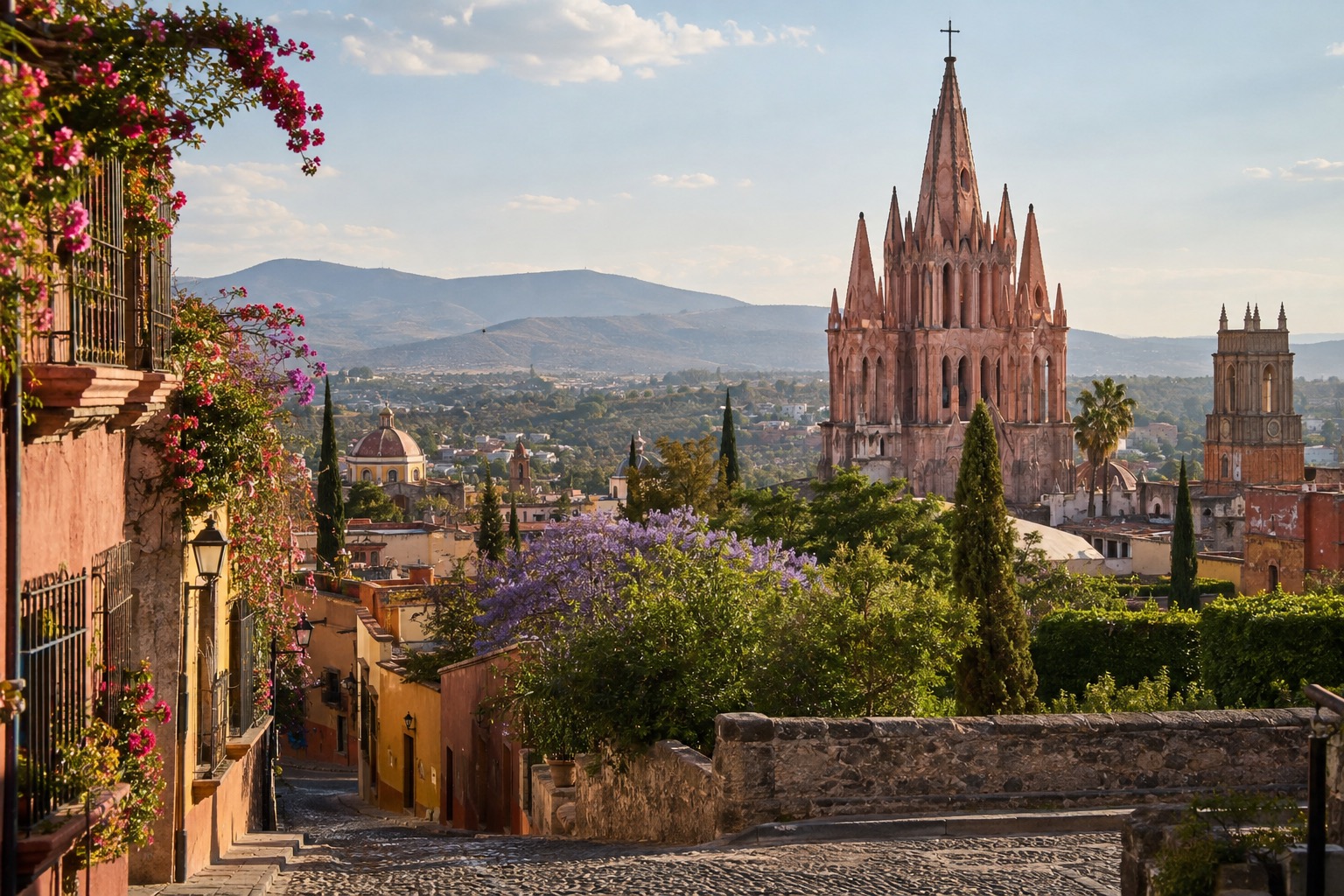
- Stand in the Jardín Principal beneath the pink towers of the Parroquia, the heart of town life.
- Get lost in the cobbled streets of the Centro Histórico, with their colonial facades and hidden courtyards.
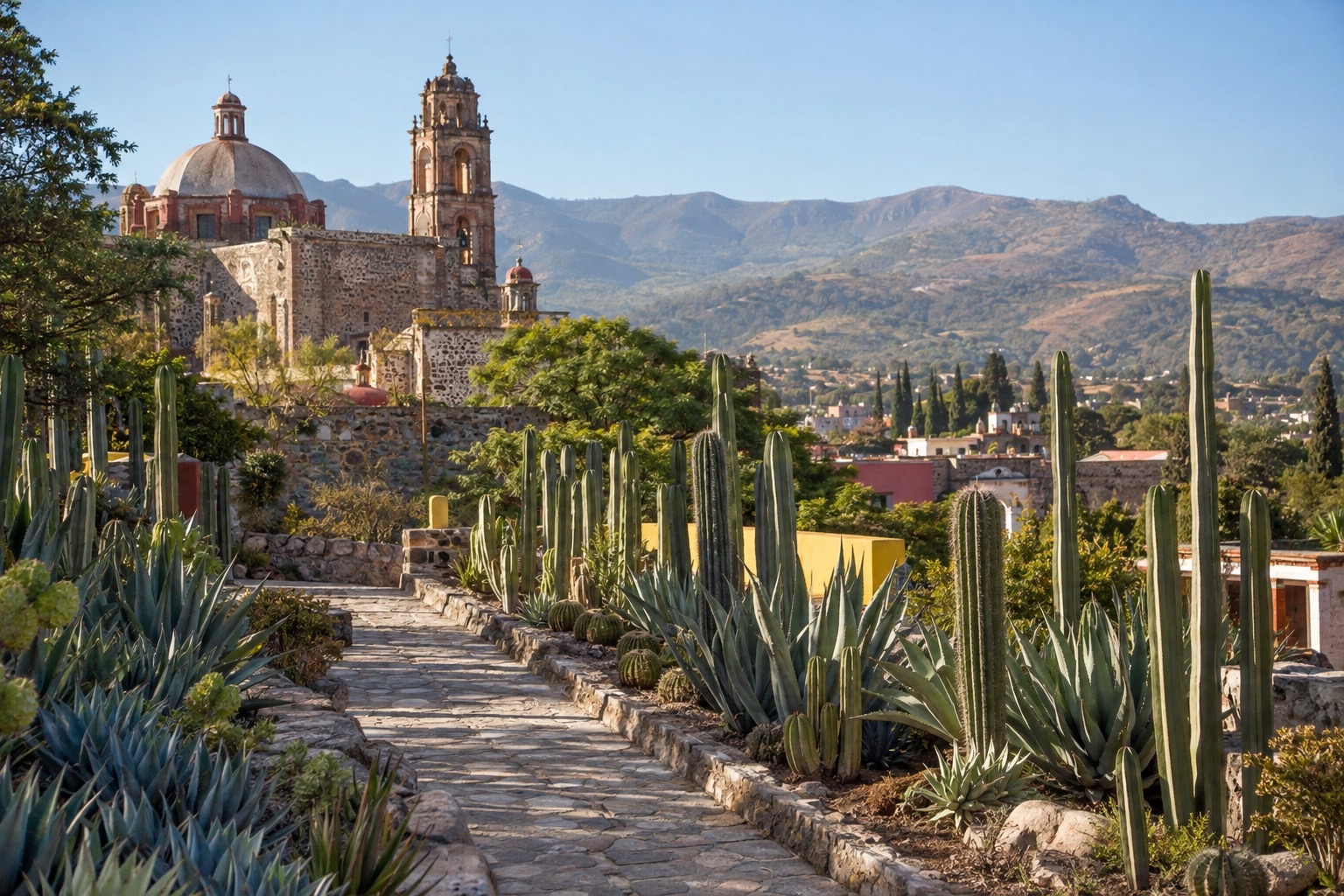
- Wander through El Charco del Ingenio’s botanical garden, home to rare cactus and succulents.
- Settle into the warm waters at one of the hot-spring parks on the route to Dolores Hidalgo.
- Visit Cañada de la Virgen for a look at an ancient ceremonial site in the hills.
- Take a day trip to Guanajuato or Dolores Hidalgo.
- Eat your way through the town, from market tacos to rooftop dinners.
- End the day with a drink on a terrace facing the church.
Sights and landmarks in San Miguel de Allende
The Parroquia and the Jardín Principal
The pink neo-Gothic towers of the Parroquia de San Miguel Arcángel rise over the Jardín Principal, the town’s main plaza, and they are the image everyone carries home. The façade looks almost like a fairy-tale castle, and it is prettiest when the late light turns the stone rose-colored.
The plaza is the town’s living room. Benches under trimmed laurel trees, shoe-shiners, ice cream sellers and street musicians keep it busy from morning to well after dark. Everything of interest sits within a few minutes on foot, so it makes a natural starting and ending point for any day.
A good plan is to arrive early for quiet photographs of the church, then return in the evening when the square becomes a social stage. A rooftop terrace with a view of the towers is the best seat for the sunset hour.
The Centro Histórico on foot
The historic center is a grid of steep cobbled streets lined with colonial facades in ochre, terracotta and deep blue. Most through-traffic is kept away from the area around the Jardín Principal, which makes strolling pleasant. Behind heavy wooden doors you catch glimpses of courtyards with fountains, galleries and little boutiques.
Many of the buildings are restored mansions now serving as hotels, restaurants and art studios. Wander without a map for an hour and you will pass craft shops, small chapels and cafés tucked into old patios.
Wear sturdy, comfortable shoes, because the stones are uneven and the hills are steep. The walk back uphill is slower than the way down, so build in a coffee stop.
Cañada de la Virgen
Cañada de la Virgen, out in the countryside beyond town, is an archaeological site whose ceremonial structures rest in a quiet valley. It rewards visitors who like ruins with space around them and a sense of the ancient landscape behind the colonial town.
After walking close to a kilometer, a shuttle operated by the state culture institute takes you over the last stretch. The site is best visited in the morning, when the light is soft and the hillside is cooler. It suits curious travelers and families with older children who enjoy a bit of walking.
| Site | Open | Admission |
|---|---|---|
| Cañada de la Virgen | Tuesday to Sunday, 10 a.m. to 6 p.m. (last entry 4 p.m.) | 100 pesos adults, 25 pesos children, free for visitors from the surrounding indigenous communities |
Neighborhoods beyond the center
Guadalupe is a hillside neighborhood northwest of the center, with narrow lanes and colorful houses and a quieter, more local feel. San Antonio, to the west, has wider streets, small parks and an expat-residential calm. Atascadero sits on the outskirts with sweeping views over the town. Each is worth a wander if you want to see how people live away from the main plaza, and each is handy for a stay if the center feels too busy.
Outdoor things to do in San Miguel de Allende
El Charco del Ingenio
El Charco del Ingenio is a botanical garden and nature reserve on the edge of town, founded as a civil association in 1991. Its trails pass through dry-country landscape and a large collection of Mexican cactus and succulent species, many of them rare or endangered.
It is a calm contrast to the cobbles of the center, with birdsong, wide views and plenty of shade-free paths. Go in the morning for the best light and the most birds, and bring a hat. It suits walkers, plant lovers and anyone needing a break from crowds.
| Site | Open | Admission |
|---|---|---|
| El Charco del Ingenio | Daily, 9 a.m. to 5 p.m. | 100 pesos general, 50 pesos students, teachers and seniors with ID, free for children under 10 |
Hot-spring parks
Several hot-spring parks, all fed by the same aquifer, sit a short drive out of town on the road toward Dolores Hidalgo. Expect pools of different temperatures set in gardens, a favorite way to spend a slow afternoon.
They suit couples and families alike. Go on a weekday if you can, since weekends draw local crowds. Take a taxi or a rented car, and bring a towel and sandals.
Rooftops, viewpoints and open-air strolls
A rooftop terrace is one of the great pleasures here, giving views of the Parroquia and the town as the light fades. Hotels and restaurants with terraces fill up around sunset, so claim a table early.
For a wider view, the hillside neighborhood of Atascadero looks over the whole town. Guadalupe offers a gentler walk through colorful lanes, with the downhill stroll to the Jardín taking about 10 to 15 minutes.
Day trips from San Miguel de Allende
Guanajuato
Guanajuato is the other colonial star of the region, a university city of tunnels, steep alleys and candy-colored houses stacked in a ravine. You can spend the day among its theaters, the Alhóndiga, the Mercado Hidalgo and the famous narrow Callejón del Beso.
The city is livelier and more local than San Miguel, with students filling the plazas and estudiantina groups singing in the evening. Start early, since there is much to see, and wear shoes made for climbing. It suits travelers who like energetic, layered cities.
Dolores Hidalgo
Dolores Hidalgo is known as the cradle of Mexican independence, the town where the call to rebellion was raised. Its main plaza and parish church anchor a walkable center with a small-town feel.
It is famous for ice cream in unusual flavors sold from stands on the plaza, and for hand-painted Talavera-style ceramics. The road there passes the hot-spring parks, so the two combine well in one outing.
Hot springs and countryside villages
The countryside around town holds small villages, ranches and craft workshops, along with the hot-spring parks on the Dolores Hidalgo road. A relaxed day can combine a soak, a long country lunch and a stop at a pottery studio.
This kind of outing suits travelers who prefer a slow pace to a packed list of sights. A taxi or rental car makes it easy to hop between stops.
What to eat in San Miguel de Allende
Eating in San Miguel runs from taco stands and market stalls to chef-driven restaurants in restored mansions. The Bajío region is known for hearty, corn-based cooking, and you will find enchiladas, carnitas, pozole and fresh tortillas alongside creative modern Mexican menus.
Street snacks are a pleasure: elote and esquites with lime and chile, churros, fruit cups, and paletas in flavors like mango or rose. Markets are the place for a cheap, filling breakfast, with fresh juices, chilaquiles and hot coffee.
For a sit-down meal, rooftop restaurants add views of the Parroquia, and many courtyards serve long lunches under fig and lemon trees. Pair dinner with a mezcal or a margarita, and finish with a cajeta dessert, the local goat’s-milk caramel.
Things to do in San Miguel de Allende at night
Evenings center on the Jardín, where street musicians, strollers and families gather as the church towers light up. The area around it has a lively scene of bars and restaurants, especially on weekends.
Rooftop bars are a favorite way to watch the town glow, with mezcal cocktails and live guitar. Mariachis may serenade a table or a couple strolling the plaza, and cafés stay open for late desserts.
Quieter options exist too. Guadalupe is noticeably calmer at night, with fewer bars, and San Antonio and Atascadero have almost no nightlife at all. If you stay there, taxis or ride-hailing back uphill after dinner make the evening easier.
Things to do in San Miguel de Allende with kids
Children tend to enjoy the Jardín most, with its balloons, pigeons, ice cream and musicians, and the open space to run while adults sit on a bench. El Charco del Ingenio makes a good nature outing, with trails and cactus to spot, and children under 10 enter free. The hot-spring parks are another family favorite, with pools in garden settings. Cañada de la Virgen suits older kids who like ruins and a bit of walking.
Keep in mind that the town sits at altitude, the sun is strong, and the cobbles and hills tire small legs and make strollers awkward. Plan breaks, bring hats and water, and consider a base in San Antonio, which suits families with its wider streets and parks.
Good to know before you go
The U.S. State Department rates the state of Guanajuato at Level 3, Reconsider Travel.
The historic center is highly walkable, and most attractions are a few minutes apart on foot, while taxis and ride-hailing help for the hillside neighborhoods. Del Bajío International Airport is about 1.5 hours away by car.
Lodging ranges from boutique hotels in restored mansions to guesthouses and rental casitas, and a room with a rooftop terrace adds views of the Parroquia at sunset. Outside the center, arrange airport transfers or a rental car ahead if you stay in Atascadero, where taxis are less frequent.
Sources
- INAH, Zona Arqueologica Canada de la Virgen (inah.gob.mx/zonas/zona-arqueologica-canada-de-la-virgen), checked September 29, 2026
- INAH, meme page, checked September 29, 2026
- El Charco del Ingenio, official site (elcharco.org.mx), tarifs affiches December 2024, checked September 29, 2026
- US Department of State, Mexico Travel Advisory (travel.state.gov), advisory of May 29, 2026, checked September 29, 2026
To plan your stay
- Best Time to Visit San Miguel de Allende: Weather by Month, Crowds and Festivals
- Where to Stay in San Miguel de Allende: Centro, Guadalupe, San Antonio and Atascadero
- San Miguel de Allende in January: Weather, Cool Nights, Hot Springs and What to Do
- San Miguel de Allende in February: Weather, Valentine's Season and Things to Do