
On a Sunday morning in the Zócalo, the cathedral bells ring over a square where families wander, vendors sell balloons and the smell of fresh tortillas drifts from the side streets. Mexico City layers Aztec ruins, colonial churches, great museums and some of the best eating in the Americas on top of one another. It is a city for people who like to wander, look closely and eat well.
What are the best things to do in Mexico City?
The best of Mexico City comes down to its museums, its ancient and colonial history, its boats and markets, and a table that rewards every meal.
- Stand in the Zócalo and visit the Templo Mayor, where the Mexica capital lies under the modern city.
- Spend a morning at the Museo Nacional de Antropología, the best introduction to Mexico’s ancient cultures.
- Walk the Avenue of the Dead at Teotihuacan, the pyramid city outside town.
- Ride a trajinera through the canals of Xochimilco with a mariachi boat alongside.
- Browse Coyoacán’s plazas and market, and visit Frida Kahlo’s Casa Azul.
- Eat your way through tacos al pastor, tamales and market fondas.
- Cheer on masked wrestlers at Arena México on a lucha libre night.
Sights and landmarks in Mexico City
The Zócalo and Templo Mayor
The Zócalo, officially the Plaza de la Constitución, is the city’s main square, with the Metropolitan Cathedral on one side and the National Palace on another. Inside the palace, Diego Rivera’s murals trace the sweep of Mexican history. The square is huge and open, and it hosts concerts, protests and national celebrations.
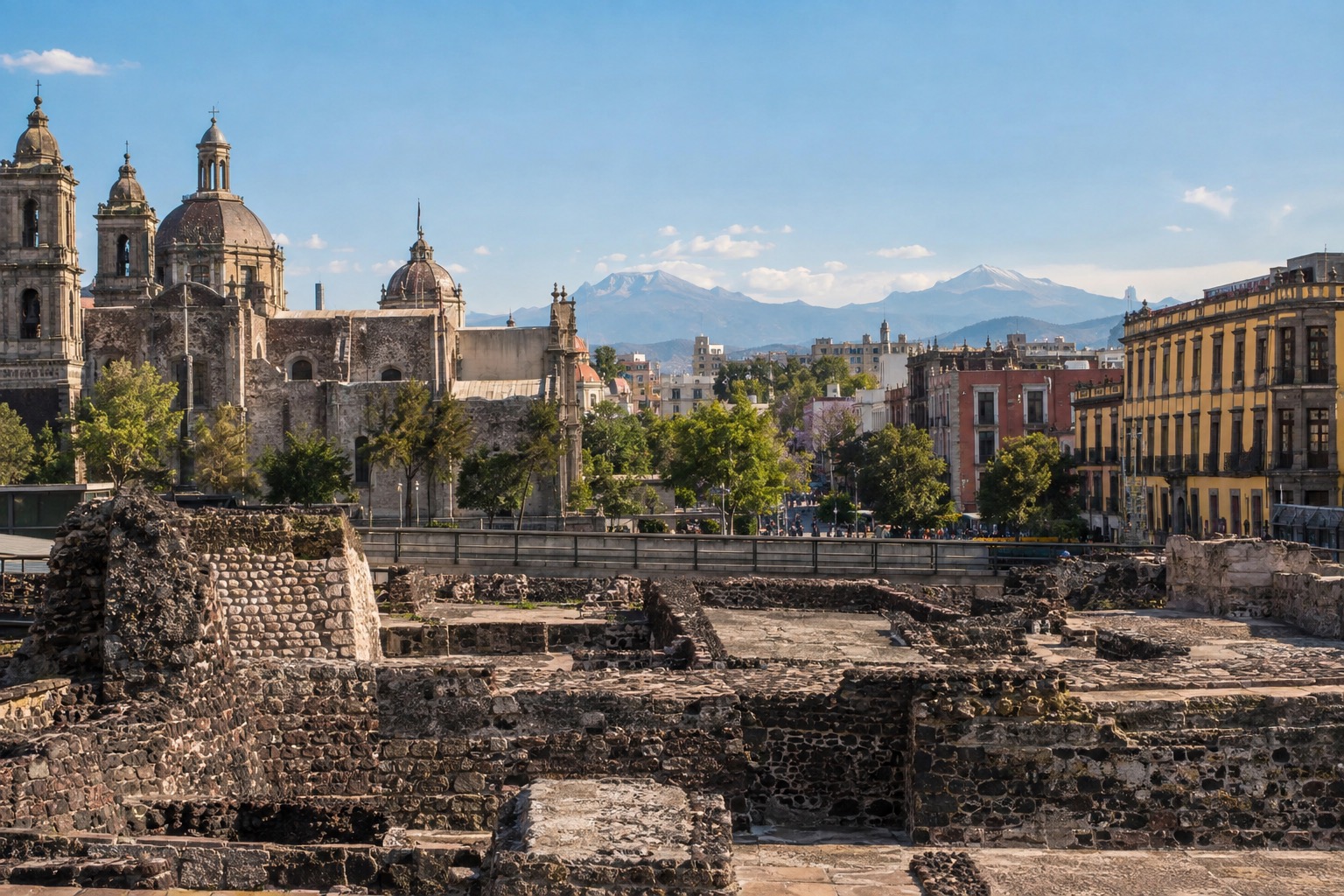
Just behind the cathedral, the Templo Mayor shows what stood here before the Spanish arrived. The ruins belong to Tenochtitlan, the Mexica capital, and the adjoining museum holds the carved stones and offerings pulled from the site. You walk along raised paths above the foundations, which makes the scale easy to grasp.
The entrance is on Seminario Street beside Plaza Manuel Gamio, and the Zócalo Metro station on Line 2 drops you a few minutes away. Pair the visit with a walk through the surrounding streets of the historic center.
Museo Nacional de Antropología
This is the museum to give a full morning. Its halls are arranged around a vast courtyard with a great concrete umbrella and a fountain, and each room is devoted to a different culture, from the first settlers to the Maya, the Aztecs and the peoples of Oaxaca and the Gulf Coast.
It stands on Paseo de la Reforma in the Chapultepec Polanco area. Choose a few halls and give them time instead of trying to see everything. The Mexica hall, with its famous Sun Stone, draws the longest pauses.
Chapultepec Castle
The castle crowns a hill in Chapultepec Park and has housed the national history museum since 1939. Its rooms follow Mexican history from the conquest of Tenochtitlan through the Revolution, and the restored apartments, gardens and terraces look out over the city and down Reforma.
The climb to the top is steep, though a small train runs from the park entrance. The castle is less busy before noon.
| Site | Open | Admission |
|---|---|---|
| Templo Mayor | Tue to Sun, 9 a.m. to 5 p.m. | 210 pesos |
| Museo Nacional de Antropología | Tue to Sun, 9 a.m. to 6 p.m. | 210 pesos |
| Chapultepec Castle | Tue to Sun, 9 a.m. to 5 p.m. | 210 pesos |
| Museo Frida Kahlo (Casa Azul) | Closed Mondays, online timed tickets only | 320 pesos |
More to see in the center
The Palacio de Bellas Artes, beside the Alameda Central, is the city’s great marble opera house. Its interior carries murals by Rivera, Orozco and Siqueiros, and it is the home stage of the Ballet Folklórico de México. Even from the sidewalk, the white dome and the lit facade make a good stop.
The Metro and Metrobus reach most of the historic center and the museum district, and a rechargeable card works at the turnstiles. Walking between the Zócalo, Bellas Artes and the Alameda is easy and rewarding.
Outdoor things to do in Mexico City
Chapultepec Park
Chapultepec is the city’s big green lung, and on weekends it fills with picnicking families, balloon sellers and joggers. Besides the castle and the anthropology museum, there is a lake where you can rent pedal boats and a botanical garden with quiet paths.
Take Metro Line 1 to Chapultepec station or walk in from Paseo de la Reforma. The castle sits in the first section of the park. Going early on a weekday keeps the crowds thin, and you can string the museums and the lake into one unhurried day.
Xochimilco’s canals
In the south of the city, Xochimilco’s canals wind between chinampas, the raised garden plots that fed the Aztec city. You hire a colorful flat-bottomed trajinera by the dock, and the boat is rented by the hour for the whole group, not per person. Other boats drift by selling food, and mariachi boats pull alongside for a song.
From central Mexico City, take Metro Line 2 to Tasqueña, then the Tren Ligero to Xochimilco station. A taxi or Uber also works, and driving takes roughly 45 minutes to an hour and a half depending on traffic.
Weekends are livelier, with music and families on every boat, while weekdays are calmer and better for a relaxed ride. Bring small bills for the boat, the food and the musicians, and agree on the price before boarding.
Coyoacán’s plazas and market
Coyoacán feels like a village inside the city, with cobbled lanes, shaded plazas and bougainvillea over garden walls. Plaza Hidalgo and Jardín Centenario sit beside the church of San Juan Bautista, and the market is known for tostadas and churros. The weekend crowd brings craft stalls and street food.
From central Mexico City, take Metro Line 3 to Coyoacán station, or a taxi or Uber for about 20 to 30 minutes. The neighborhood is pleasant in the morning and late afternoon, and Casa Azul is a short walk from the market.
Casa Azul sells tickets only online for a set time slot, with no box office, and the slots can sell out days ahead. It also opens late on Thursday evenings for its Noches Azules.
Day trips from Mexico City
Teotihuacan
Teotihuacan was a pre-Hispanic city of more than 100,000 people at its peak, and it became a UNESCO World Heritage Site in 1987. You walk the broad Avenue of the Dead beneath the Pyramid of the Sun and the Pyramid of the Moon, then visit the Temple of Quetzalcoatl and the Palace of Quetzalpapalotl with its carved columns.
An ADO bus leaves from Terminal del Norte for the archaeological zone, or you can drive via the Mexico-Pachuca highway. The trip takes about 1 to 1.5 hours by road. The site is open daily from 8 a.m., so an early start gives you the quietest light.
Climbing the two big pyramids is prohibited, so you view them from ground level. There is little shade and the ground is uneven, so bring water, a hat and sunscreen. It suits history lovers and families with older children, but it is not ideal for people with limited mobility.
Puebla and Cholula
Puebla is a city of tiled facades, baroque churches and kitchens that gave Mexico mole poblano. In the historic center you can see the cathedral, the Biblioteca Palafoxiana and the gilded Capilla del Rosario. Nearby Cholula is home to the Great Pyramid, a vast mound topped by a small church with the volcanoes behind it.
An ADO bus runs from TAPO or Terminal del Norte to Puebla CAPU in about 2 to 2.5 hours. From Puebla, a local bus or taxi reaches Cholula in about 20 to 30 minutes.
The steps up to the church at Cholula are steep and the altitude can tire you, so go slowly. Try mole poblano in the center, and chiles en nogada if you travel between July and September, when they are in season.
Tepoztlán
Tepoztlán is a mountain town under dramatic cliffs, with a craft market along the main street and the Ex-Convento de la Natividad at its heart. The big draw is the hike up to the Tepozteco pyramid, a steep, rocky climb of about an hour that ends with a view over the valley.
A bus from Terminal del Sur (Taxqueña) takes about 1.5 to 2 hours. Weekdays avoid the weekend crowds, and an early start on the trail beats the heat and the afternoon rain.
The path is not suited to people with mobility issues or young children. Bring water, wear sturdy shoes, and check that the archaeological site is open, since it may close on Mondays or in bad weather.
Taxco
Taxco climbs a hillside in white houses and red roofs, crowned by the pink-stone Parroquia de Santa Prisca. You wander cobblestone streets, visit the Casa Borda and shop for silver in the zócalo and the lanes around it.
An ADO bus from Terminal del Sur takes about 2.5 to 3 hours. Go in the morning, when the light hits the church and the town is quieter. The streets are steep with many steps, so it is not ideal for limited mobility, but the white Volkswagen taxis will carry you up the hills. Bring pesos in cash, since some small shops and food stalls do not take cards.
What to eat in Mexico City
Eating in Mexico City starts at the taco stand, where a trompo of marinated pork turns for tacos al pastor with pineapple, onion and cilantro. Tacos de suadero, carnitas and tripe each have their loyal crowds, and a squeeze of lime and a spoon of salsa finish them.
Mornings belong to tamales wrapped in corn husk, sipped with atole, and to chilaquiles in red or green sauce. Markets such as Coyoacán’s serve tostadas piled with ceviche or tinga, and fondas offer a set lunch of soup, rice and a stew. Quesadillas, huaraches and elotes fill in between meals.
The day trips add their own classics, mole poblano and chiles en nogada in Puebla, and back in the city churros dipped in thick chocolate close many evenings. To drink, try fresh aguas frescas, a mezcal tasting or a cold michelada.
Things to do in Mexico City at night
Night in Mexico City is loud, colorful and often starts with lucha libre. Arena México in the Doctores neighborhood hosts fights several nights a week, with Tuesday, Friday and Sunday the usual fight nights. Masked luchadores fly off the ropes while the crowd shouts, and vendors outside sell masks.
Take the Metro to Centro Médico (Line 3 or 9), or a taxi or Uber. Buy tickets in advance from the official box office or Ticketmaster, and bring cash for masks, snacks and drinks. The noise and crowds may not suit very young children.
Quieter evenings might mean a performance at the Palacio de Bellas Artes, home to the Ballet Folklórico, or a stroll through the lit Zócalo. On Thursday evenings, Casa Azul opens late for its Noches Azules. Late tacos and mezcal bars fill the rest of the night.
Things to do in Mexico City with kids
Children love Chapultepec Park, where they can ride pedal boats on the lake and take the little train up the castle hill. The wide paths and lawns give them room to run, and the anthropology museum’s big courtyard fountain is a favorite pause.
Xochimilco is another hit, with colorful boats, music and snacks floating past, and groups and families share one boat. Lucha libre suits families with older kids who enjoy the show, but the volume can be too much for little ones.
Keep the altitude and distances in mind, since the city sits high and the sun is strong. Plan one big outing a day, carry water and hats, and use taxis or the Metro between far-apart sights. Teotihuacan works best for older children because of the sun and the uneven walking.
Good to know before you go
The Metro and Metrobus cover most of the historic center and museum district, and a rechargeable card works at the turnstiles. The main airport, the AICM, sits inside the city east of the center and the Metro serves it at Terminal Aérea, while the newer Felipe Ángeles airport lies north near Zumpango.
Pesos in small bills help at markets, boats and small shops. The U.S. State Department rates Mexico City Level 2, Exercise Increased Caution, the same baseline level as most of the country.
| Fee | Amount | Who pays |
|---|---|---|
| Templo Mayor, Antropología, Chapultepec Castle, Teotihuacan | 210 pesos | General admission |
| Same sites | 105 pesos | Mexican nationals and foreign residents |
| Museo Frida Kahlo (Casa Azul) | 320 pesos | General admission |
Sources
- INAH, Zona Arqueologica Templo Mayor (inah.gob.mx/zonas/zona-arqueologica-templo-mayor), checked September 29, 2026
- Sistema de Informacion Cultural (sic.gob.mx), MNA sheet of 28/07/2026, checked October 3, 2026
- INAH, Museo Nacional de Antropologia, checked September 29, 2026
- INAH, Museo Nacional de Historia, Castillo de Chapultepec (inah.gob.mx/museos/museo-nacional-de-historia-castillo-de-chapultepec), checked September 29, 2026
- INAH, meme page, checked September 29, 2026
- INAH, Zona Arqueologica de Teotihuacan (inah.gob.mx/zonas/23-zona-arqueologica-de-teotihuacan), checked September 29, 2026
- Museo Frida Kahlo, museofridakahlo.org.mx (« NO CONTAMOS CON VENTA EN TAQUILLA », entrada general $320) et boletos.museofridakahlo.org.mx, checked October 3, 2026
- U.S. Department of State, Mexico Travel Advisory (travel.state.gov, date issued May 29, 2026), checked October 3, 2026
- ADO
- INAH lugares.inah.gob.mx
- Secretaría de Turismo de la Ciudad de México
- Secretaría de Turismo de Puebla
- Secretaría de Turismo de Guerrero
- Frida Kahlo Museum
- Arena México
To plan your stay
- Best Time to Visit Mexico City: Dry Season, Rainy Summers, Día de Muertos and Festivals
- Where to Stay in Mexico City: Roma, Condesa, Polanco, Coyoacán and the Historic Center
- Mexico City Airport to City: Metro, Taxis and Travel Times to the Center, Roma and Polanco
- Know Before You Go to Mexico City: Getting Around, Money, Altitude and Local Customs