
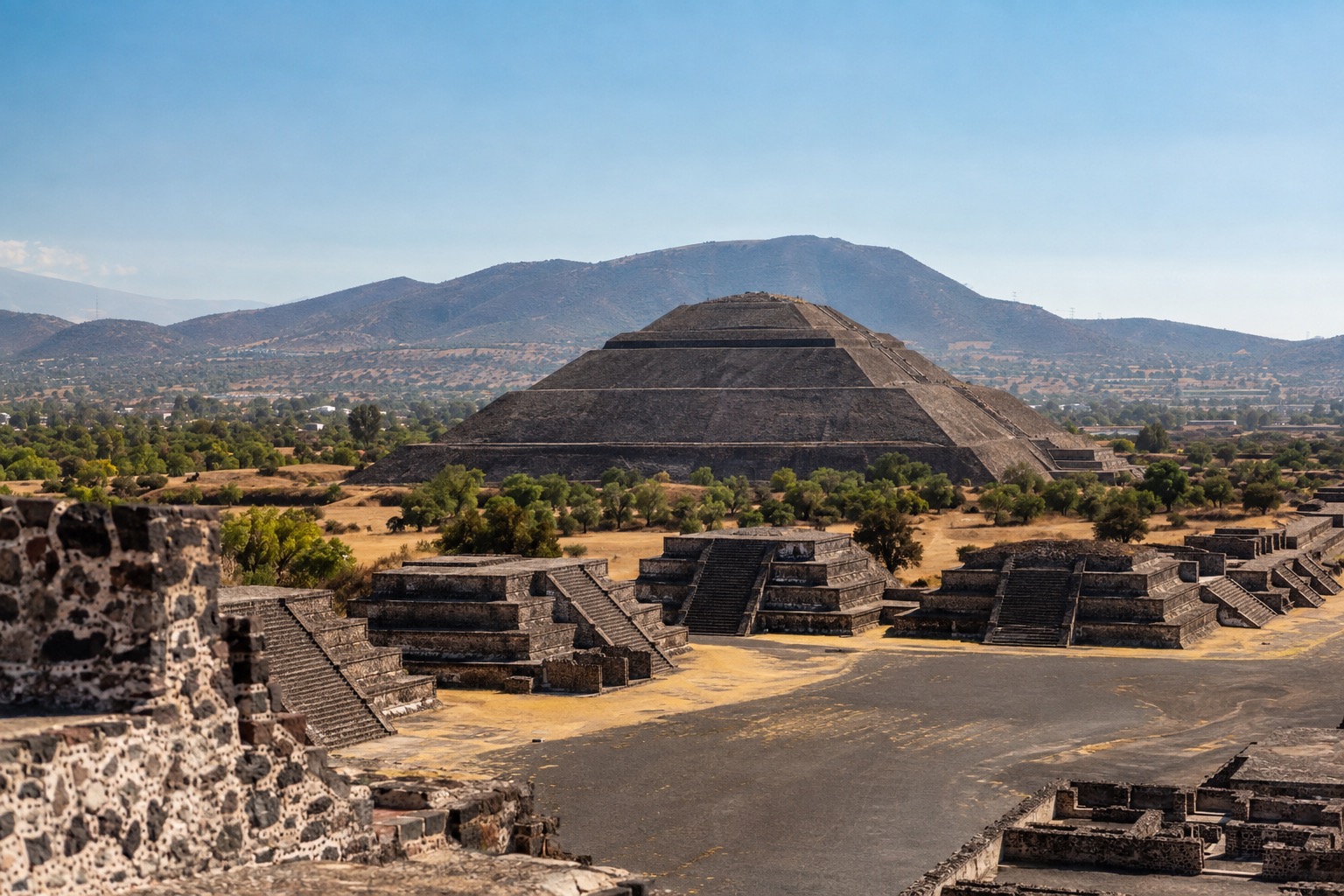
You come in across a wide, open plain, and the first thing that stops you is the line of the Avenue of the Dead running straight ahead, with the huge stepped shape of the Pyramid of the Sun on one side and the Pyramid of the Moon waiting at the far end. The ground is pale and dusty, the sky is enormous, and the whole place feels built for processions. Teotihuacan is an ancient city northeast of Mexico City, usually seen as a half-day or full-day outing, and it is a walking visit across open ground.
Is visiting Teotihuacan worth it?
Yes, it is worth it for anyone who likes to walk through a vast ancient place and stand at the foot of monuments on a scale few sites in the Americas can match. It suits history lovers, photographers and families with children who can handle a long, open-air stroll.
What sets it apart from the other pyramids near the capital is the city around the monuments. Cholula has its great mound crowned by a church, and the Templo Mayor sits in the middle of downtown, but Teotihuacan is a whole planned city of avenues, plazas and palaces that once held more than 100,000 people. Even the people who built it remain a puzzle, since archaeologists still debate who they were.
What to see at Teotihuacan
The Avenue of the Dead
This is the spine of the city, a broad ceremonial road that links the main monuments and gives the site its sense of order. The Aztecs, who found the city long abandoned centuries after its fall, gave it its name because they took the low platforms along its edges for tombs. They were in fact temples and residential compounds.
Walking it is the real way to take in the scale. The pyramids appear and shift as you move, and the long straight line makes distances hard to judge, so everything looks closer than it is. Wear a hat and bring water, because there is little shade along the way.
The Pyramid of the Sun
Rising in broad terraces, this is the largest structure at the site and one of the biggest pyramids in Mesoamerica. Its bulk is what you notice first, and from the base you get a sense of how much labor went into raising it with earth and stone.
Look at the clean geometry of the stepped faces and at how the pyramid anchors the whole avenue. The best views are from the avenue and from the neighboring plazas, where you can see it against the open sky. The site’s own rules on access to the structures are what govern the visit, so treat the pyramid as something to look up at and photograph from its base.
The Pyramid of the Moon and its plaza
At the northern end of the avenue, the Pyramid of the Moon is smaller than its neighbor but sits in a spot that frames it perfectly. Its plaza is lined with platforms, and the pyramid echoes the profile of the mountain behind it, a likely intention of its builders.
Stand in the plaza and look back down the avenue to see the whole city laid out in one line, with the Pyramid of the Sun rising off to the side. It is the view that most people remember, and it is calmer here than around the bigger pyramid.
The Temple of Quetzalcoatl and the Palace of Quetzalpapalotl
The Temple of Quetzalcoatl is known for its carved stone heads of the feathered serpent, which jut out from the walls in repeating rows. It is the best place on the site to see sculpted detail up close, and it shows that the city was as much about ritual art as monumental building.
The Palace of Quetzalpapalotl, near the Pyramid of the Moon, is a different experience. Its courtyard has carved pillars and traces of painted decoration, and it gives a feel for how the elite might have lived and gathered. Go slowly here, because the smaller details reward a closer look.
Hours, tickets and rules
The site opens every day of the week, from early morning to late afternoon, and visitors can still enter shortly before closing. Foreign visitors pay the general rate, while Mexican nationals and foreign residents of Mexico pay a discounted one.
| Site | Open | Admission |
|---|---|---|
| Teotihuacan | Daily, 8:00 a.m. to 5:00 p.m. (last entry 4:30 p.m.) | 210 pesos general; 105 pesos for Mexican nationals and foreign residents of Mexico |
Entry is free for Mexican nationals and foreign residents of Mexico on Sundays. Standing exemptions also apply to children under 13, visitors 60 and older, people with disabilities, and Mexican teachers and students with valid ID.
How to get to Teotihuacan
Teotihuacan lies about 25 miles northeast of Mexico City, which makes the capital the natural base. The visit is usually done as a half-day or full-day trip from there rather than an overnight stay.
Within the capital, the Metro and Metrobus network reaches most of the historic center and the museum district, so you can start your day from those areas. The main airport sits inside the city, east of the historic center, and the Metro serves it directly. A newer airport lies north of the city near Zumpango.
When to visit Teotihuacan
Go as early as the gates open. The morning light is soft on the pyramids, the plain is cooler, and the avenue is at its quietest before the tour groups arrive. With little shade on site, the midday sun can feel strong, and the last hour before closing is a good time for a slower walk.
The dry months from November through April suit the visit best, with afternoons in the low 70s to low 80s and very few rainy days. December and January are the driest. July and August bring rain on most days, usually as afternoon downpours, and September stays wet. October, with showers on about ten days, is a transition month with a mix of sun and passing rain.
Tips for your visit
Bring a hat, sunglasses, sunscreen and a water bottle, plus comfortable shoes for long stretches over uneven ground. A light rain jacket is useful in the wetter months. The site is open and exposed, so layers help when the morning is cool and the afternoon turns hot.
Plan a half day at minimum, and a full day if you want to take your time along the whole avenue. It is a lot of walking on open ground, which can tire young children and visitors with limited mobility, so pace the visit and rest between monuments.
Back in the capital, the Museo Nacional de Antropología in Chapultepec is a natural companion, since it puts the objects and the wider story of ancient Mexico in context. The Templo Mayor near the Zócalo shows a later chapter, the Mexica capital of Tenochtitlan.
Good to know before you go
The U.S. State Department rates Mexico City Level 2, Exercise Increased Caution, the same baseline level as most of the country.
Carry some pesos for admission and small purchases, keep your belongings close in crowded spots, and take the usual care you would in any busy tourist area. The site was inscribed on the UNESCO World Heritage List in 1987, which is part of why it draws visitors from all over the world.
Sources
- UNESCO World Heritage Centre, record 414 "Pre-Hispanic City of Teotihuacan" (whc.unesco.org/en/list/414), « Date of Inscription: 1987 », read via Chrome on September 29, 2026
- Wikipedia, "Teotihuacan", en.wikipedia.org, checked September 29, 2026
- common knowledge
- INAH, official for the Teotihuacan archaeological zone, inah.gob.mx/zonas/23-zona-arqueologica-de-teotihuacan, checked September 29, 2026
- INAH, inah.gob.mx/zonas-arqueologicas, checked September 29, 2026
- INAH, Zona Arqueologica Templo Mayor (inah.gob.mx/zonas/zona-arqueologica-templo-mayor), checked September 29, 2026
- Sistema de Informacion Cultural (sic.gob.mx), MNA sheet of 28/07/2026, checked October 3, 2026
- INAH, Museo Nacional de Antropologia, checked September 29, 2026
- INAH, Museo Nacional de Historia, Castillo de Chapultepec (inah.gob.mx/museos/museo-nacional-de-historia-castillo-de-chapultepec), checked September 29, 2026
- INAH, meme page, checked September 29, 2026
- INAH, Zona Arqueologica de Teotihuacan (inah.gob.mx/zonas/23-zona-arqueologica-de-teotihuacan), checked September 29, 2026
- Museo Frida Kahlo, museofridakahlo.org.mx (« NO CONTAMOS CON VENTA EN TAQUILLA », entrada general $320) et boletos.museofridakahlo.org.mx, checked October 3, 2026
- AICM, official site (aicm.com.mx), checked September 29, 2026
- U.S. Department of State, Mexico Travel Advisory (travel.state.gov, date issued May 29, 2026), checked October 3, 2026
- INAH lugares.inah.gob.mx
- Secretaría de Turismo de Puebla
- Secretaría de Turismo de Guerrero
- Frida Kahlo Museum
- Arena México
- Servicio Meteorologico Nacional (CONAGUA), normales climatologicas 1991-2020, estacion 09048 (Tacubaya Central (Obs), Miguel Hidalgo), checked September 29, 2026