
The first morning in Mexico City often starts with the clang of a tamale vendor’s recorded call, the smell of coffee drifting from a corner café, and the Zócalo slowly filling with people crossing the great square on their way to work. The city rewards a first visit that moves between its layers: the Aztec capital under the pavement, the colonial center, the big museums in the park and the leafy neighborhoods to the south. Three days is enough to taste all of them, with one day left for the pyramids outside town.
Is three days enough in Mexico City?
Three days is enough for a first visit, as long as you accept choosing and walking a lot. It suits travelers who want the essentials: the historic center, the big museums, one artistic neighborhood and one ancient site, without trying to see every museum in the city.
What it leaves out is the slower side of the city. With more time you could add Xochimilco and its painted boats, a night at the lucha libre arena, the colonial streets of Puebla and Cholula, silver-hung Taxco or the hiking village of Tepoztlán. Each of those makes a full day, and the city itself keeps giving back the longer you stay.
Day 1 in Mexico City
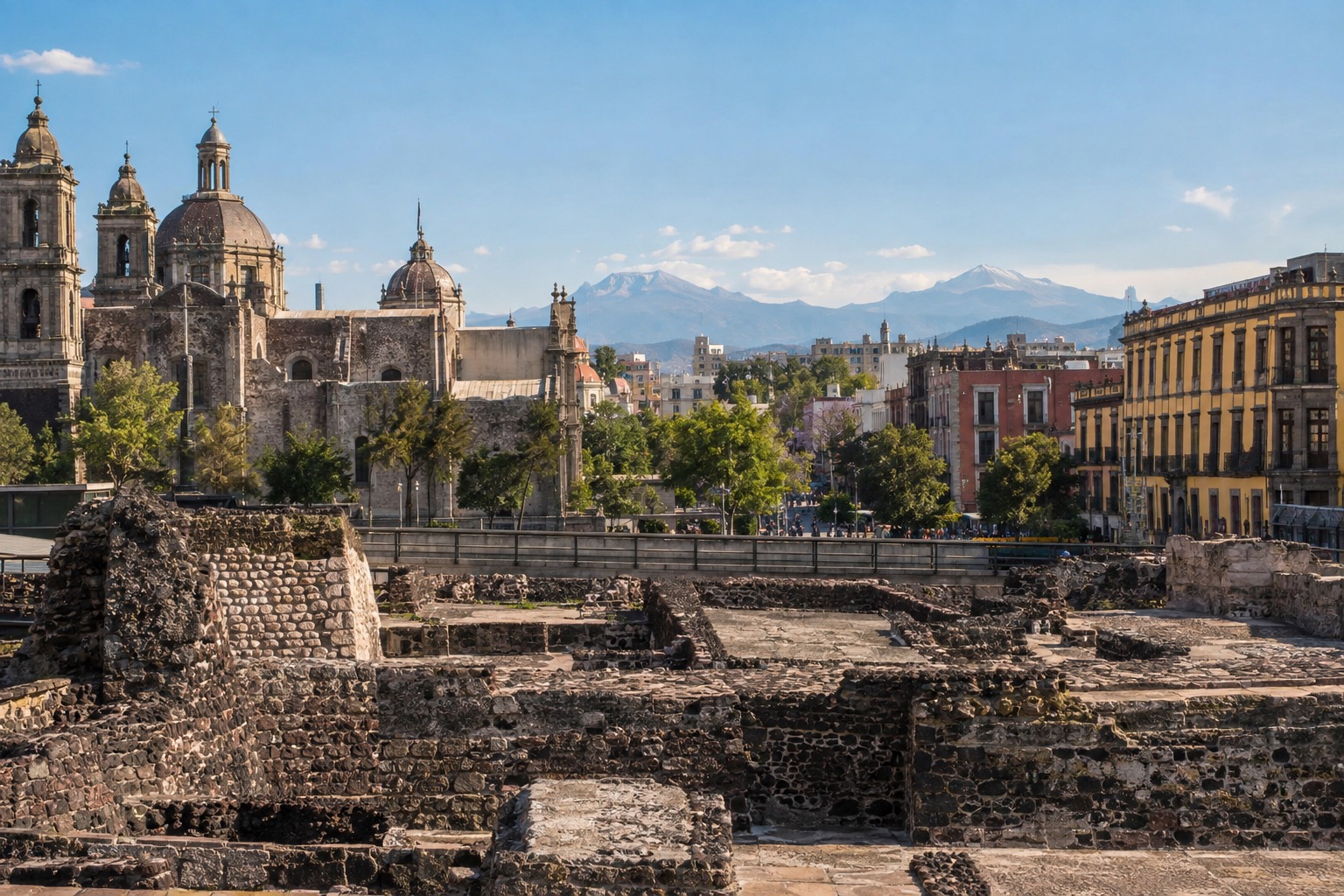
Begin at the Zócalo, the enormous central plaza bordered by the National Palace and the Metropolitan Cathedral, with Rivera’s murals waiting within. Directly behind the cathedral, the Templo Mayor reveals what remains of Tenochtitlan, the Mexica capital, while the museum next door houses offerings pulled from the earth.
Mornings are the calmer hours, before the square fills up. Take the Metro to the Zócalo station on Line 2 if you are coming from elsewhere, or simply walk if you are staying in the center.
| Site | Open | Admission |
|---|---|---|
| Templo Mayor (site and museum) | Tuesday to Sunday, 9 a.m. to 5 p.m., closed Monday | 210 pesos (105 pesos for Mexican nationals and foreign residents) |
After a lunch of tacos, tortas or a set-menu comida corrida in one of the old-town fondas, walk west along the pedestrian streets toward the Alameda Central. The Palacio de Bellas Artes sits at its edge, a marble opera house whose lobby murals by Rivera, Orozco and Siqueiros are reason enough to step inside. The walk takes a pleasant stretch of the afternoon if you stop for a coffee or a churro.
In the evening, stay downtown for dinner, or take a taxi or ride-hailing car to Arena México for lucha libre. Tuesday, Friday and Sunday are the usual fight nights, and the loud, joyful crowd, the masks and the acrobatics make it one of the most entertaining nights in the city. The Ballet Folklórico de México performs at Bellas Artes if you prefer a seat in the opera house.
Day 2 in Mexico City
Spend the morning in Chapultepec, the big park west of the center. The Museo Nacional de Antropología, with its 24 halls on Paseo de la Reforma, is the heart of the visit, and you will want a few unhurried hours for the Aztec, Maya and Oaxacan rooms. Arrive early, preferably on a weekday, then ride Metro Line 1 to Chapultepec station or enter on foot from Reforma.
Chapultepec Castle crowns the hill nearby and holds the national history museum, covering the story from the conquest through the Revolution. The climb is steep, though a small train runs up from the park entrance. Afterward, lunch can be a taco stop or a table in the Polanco restaurants just beside the park.
| Site | Open | Admission |
|---|---|---|
| Museo Nacional de Antropología | Tuesday to Sunday, 9 a.m. to 6 p.m., closed Monday | 210 pesos (105 pesos for Mexican nationals and foreign residents) |
| Chapultepec Castle (Museo Nacional de Historia) | Tuesday to Sunday, 9 a.m. to 5 p.m., closed Monday | 210 pesos (105 pesos for Mexican nationals and foreign residents) |
Spend the late afternoon and evening in Coyoacán, a village-like neighborhood of cobbled streets about 20 to 30 minutes from the center by Metro Line 3 or taxi. Walk through Plaza Hidalgo and the Jardín Centenario, look into the San Juan Bautista church, and graze on tostadas and churros in the market.
For Casa Azul, the home of Frida Kahlo, timed tickets are sold online and nowhere else (320 pesos for general admission), and on Thursday nights it keeps late hours for Noches Azules, so if it is on your list, plan accordingly. It is closed Mondays.
Day 3 in Mexico City
Give the third day to Teotihuacán, the pre-Hispanic city that once housed more than 100,000 people and is a UNESCO World Heritage Site. It takes about 1 to 1.5 hours each way by road, on an ADO bus from Terminal del Norte or by car along the Mexico-Pachuca highway.
You make your way along the Avenue of the Dead, with the Pyramid of the Moon and the Pyramid of the Sun overhead, and take in the Temple of Quetzalcóatl. Since scaling the pyramids is forbidden, you admire them from ground level.
| Site | Open | Admission |
|---|---|---|
| Teotihuacán | Daily, 8 a.m. to 5 p.m. (last entry 4:30 p.m.) | 210 pesos (105 pesos for Mexican nationals and foreign residents) |
There is little shade on the site and the ground is uneven, so water, a hat and sunscreen matter more than any guidebook. Leave early and you will be back in town for the late afternoon with a sun-soaked, pleasantly tired feeling.
For the last evening, head to the leafy streets of Roma, where Álvaro Obregón avenue has the densest run of restaurants and cafés. Dinner can be a long, slow affair of mezcal, regional dishes and a stroll under the trees afterward. It is a gentle way to close the trip, with the city’s lively but not overwhelming nightlife just outside the door.
Where to stay for three days in Mexico City
For this plan, the historic center or Roma make the best bases. The center puts the Zócalo, Templo Mayor and Bellas Artes on foot, with Metro lines 1, 2 and 3 close by, and offers hostels, restored colonial hotels and private apartments. Roma is leafy and walkable, with boutique hotels in early 20th-century buildings, and it reaches the Zócalo in about 10 to 20 minutes by car.
Condesa suits families and anyone who wants parks and quiet streets, while Polanco is the choice for polished, upscale stays beside Chapultepec and the museums. Coyoacán is the pick for a village feel and the Frida Kahlo Museum, though it sits farther from the center and the airport.
Getting around Mexico City in three days
Day 1 is mostly on foot between the Zócalo and the Alameda, with Metro Line 2 useful to reach the Zócalo. On day 2, Metro Line 1 takes you to Chapultepec, and Line 3 or a taxi gets you to Coyoacán in about 20 to 30 minutes. The Metro and Metrobús can get you to most of the museum district and historic center, and a rechargeable card is how you pay at the turnstiles.
Taxis and ride-hailing apps fill the gaps in the evening, such as the trip to Arena México. For Teotihuacán, the bus from Terminal del Norte is the simple route. From the airport, which sits east of the center and is served by the Metro at Terminal Aérea, allow 30 to 60 minutes by car to the center, depending on traffic.
Good to know before you go
The U.S. State Department rates Mexico City Level 2, Exercise Increased Caution, the same baseline level as most of the country.
Carry some pesos in small bills for markets, snacks and tips, since many stalls prefer cash. Keep the usual big-city habits, such as watching your phone on crowded Metro cars and using authorized taxis or ride-hailing apps. Most museums close on Mondays, so the best way to build the days is to put the Zócalo, parks and neighborhood walks there.
Sources
- INAH, Zona Arqueologica Templo Mayor (inah.gob.mx/zonas/zona-arqueologica-templo-mayor), checked September 29, 2026
- Sistema de Informacion Cultural (sic.gob.mx), MNA sheet of 28/07/2026, checked October 3, 2026
- INAH, Museo Nacional de Antropologia, checked September 29, 2026
- INAH, Museo Nacional de Historia, Castillo de Chapultepec (inah.gob.mx/museos/museo-nacional-de-historia-castillo-de-chapultepec), checked September 29, 2026
- INAH, meme page, checked September 29, 2026
- INAH, Zona Arqueologica de Teotihuacan (inah.gob.mx/zonas/23-zona-arqueologica-de-teotihuacan), checked September 29, 2026
- Museo Frida Kahlo, museofridakahlo.org.mx (« NO CONTAMOS CON VENTA EN TAQUILLA », entrada general $320) et boletos.museofridakahlo.org.mx, checked October 3, 2026
- U.S. Department of State, Mexico Travel Advisory (travel.state.gov, date issued May 29, 2026), checked October 3, 2026
- ADO
- INAH lugares.inah.gob.mx
- Secretaría de Turismo de la Ciudad de México
- Secretaría de Turismo de Puebla
- Secretaría de Turismo de Guerrero
- Frida Kahlo Museum
- Arena México
- Servicio Meteorologico Nacional (CONAGUA), normales climatologicas 1991-2020, estacion 09048 (Tacubaya Central (Obs), Miguel Hidalgo), checked September 29, 2026
- sunrise-sunset.org, sunrise and sunset on the 15th of the month, checked September 8, 2026
To plan your stay
- Best Time to Visit Mexico City: Dry Season, Rainy Summers, Día de Muertos and Festivals
- Where to Stay in Mexico City: Roma, Condesa, Polanco, Coyoacán and the Historic Center
- Mexico City Airport to City: Metro, Taxis and Travel Times to the Center, Roma and Polanco
- Know Before You Go to Mexico City: Getting Around, Money, Altitude and Local Customs