
The boat idles, the guide counts you down, and then you slip over the side into green water to find a spotted back as wide as a dinner table gliding beneath you, mouth open, taking in plankton. In Mexico this happens in two very different places: the warm Caribbean waters off Holbox, Isla Mujeres and Cancun, and the desert-framed Sea of Cortez at Bahía de los Ángeles. Summer is the time for both.
When is whale shark season in Mexico?
Mexico’s whale shark season is a summer event, and the national reserve authority says that on the Sea of Cortez side these sharks arrive in June and remain until December. That makes it the longest window of the two coasts, and it stretches well past the hottest months into the calmer start of winter.
On the Caribbean side the tours are best known in the heat of July and August, when the days are hot and sticky and the sea feels like bathwater. Mornings are usually the pleasant time to be out on the boat.
Afternoons bring clouds, and in these months rain often arrives as a stormy burst rather than a full gray day. These months also fall inside the Atlantic hurricane season, so a rough sea day or a canceled departure is part of the bargain.
| Place | Month | Avg high (°F) | Avg low (°F) | Sea surface (°F) | Rain days |
|---|---|---|---|---|---|
| Holbox | July | 93.2 | 68.7 | 81.2 | 11.7 |
| Holbox | August | 93.4 | 69.3 | 82.8 | 14.2 |
| Cancun | July | 94.6 | 77.0 | 85.0 | 9.2 |
| Cancun | August | 95.2 | 77.0 | 84.8 | 11.6 |
The rain in Holbox is a little heavier than in Cancun, and the nights on the island feel cooler. Either way the water is warm enough that a thin rash guard is more about sun and jellyfish than about cold.
Where to swim with whale sharks in Mexico
One is the Caribbean coast of Quintana Roo, where you can depart from Holbox, Isla Mujeres and Cancun, and the other is Bahía de los Ángeles, which sits on the Sea of Cortez in Baja California. They share the same rules of encounter and almost nothing else in atmosphere.
The Caribbean side: Isla Mujeres and Cancun
From Cancun and Isla Mujeres, boats head out in the early morning and spend the better part of the morning on open water. You sit in a small group with a guide, the spotter scans for a dorsal fin breaking the surface, and when a shark is found, swimmers take turns slipping in beside it. The guide goes in with you, and you never touch the animal.
This is the easiest option if you are staying in a Cancun hotel and want a day that fits around a beach holiday. You are picked up in the Hotel Zone or at a marina and back in time for a late lunch of ceviche or grilled fish.
Expect a lively boat, with other visitors in snorkel gear and a shared sense of nervous excitement before the first splash. A strong swimmer will be more comfortable than a nervous one, since the water is open and the sharks move steadily.
Bahía de los Ángeles on the Sea of Cortez
Bahía de los Ángeles is a quiet fishing village on the Baja California coast, with a bay dotted with islands and dry mountains falling to the water. According to the reserve authority, the whale shark appears in June and lingers until December, making it the spot to plan a longer travel season. The scenery here is the point as much as the sharks: pelicans, sea lions, and sunsets over the desert.
It suits travelers who like road trips and small-town stays, and who would rather watch the shark from a simple boat than share a crowded tour. The state of Baja California is rated Level 3 by the U.S. State Department, though the only travel restrictions named are in the Mexicali Valley and there are no additional restrictions elsewhere in the state. Tell your hotel or guide where you are headed and bring plenty of sun protection, because there is no shade on the water.
Whale sharks in Holbox
Holbox is the Caribbean setting most people picture, a sand-street island with no cars, painted murals, and boats that leave from the beach each morning. From the island, tours head out, and with a guide, swimmers slip into the sea alongside the shark and never touch it.
The island suits the experience. You arrive by a short boat ride from the mainland, spend your evenings eating lobster pizza or grilled fish at a table with sand under your feet, and wake early for the boat.
The pace is slow and the nights are quiet, so you are rested for the swim. Summer here means warm, humid days and showers that sweep in quickly, so a light rain jacket is more useful than an umbrella.
What you feel in the water is hard to forget. The shark is huge but calm, moving in a steady line, and the boat crew calls out when to jump and when to climb back aboard. Many people come back to the beach with little to say for the first few minutes. Families with confident swimmers do it too, though the open water suits teenagers and adults more than young children.
Is it safe to swim with whale sharks?
Plankton is what whale sharks eat, and one easy rule shapes the whole encounter: a guide accompanies swimmers into the water alongside the shark, and they do not touch it. That rule protects the animal and keeps the group together.
The practical risks are the ordinary ones of open-water days: strong sun, a choppy boat ride, and waves that can be bigger after a passing storm. Listen to your guide, stay with the group, and ask about sea conditions that morning. If the water looks rough, a boat may stay in port, and that is the right call.
As for the places themselves, the State Department rates Quintana Roo Level 2, exercise increased caution, due to terrorism and crime, and it rates Baja California Sur the same. Baja California, home to Bahía de los Ángeles, is rated Level 3, with restrictions only in the Mexicali Valley.
Good to know before you go
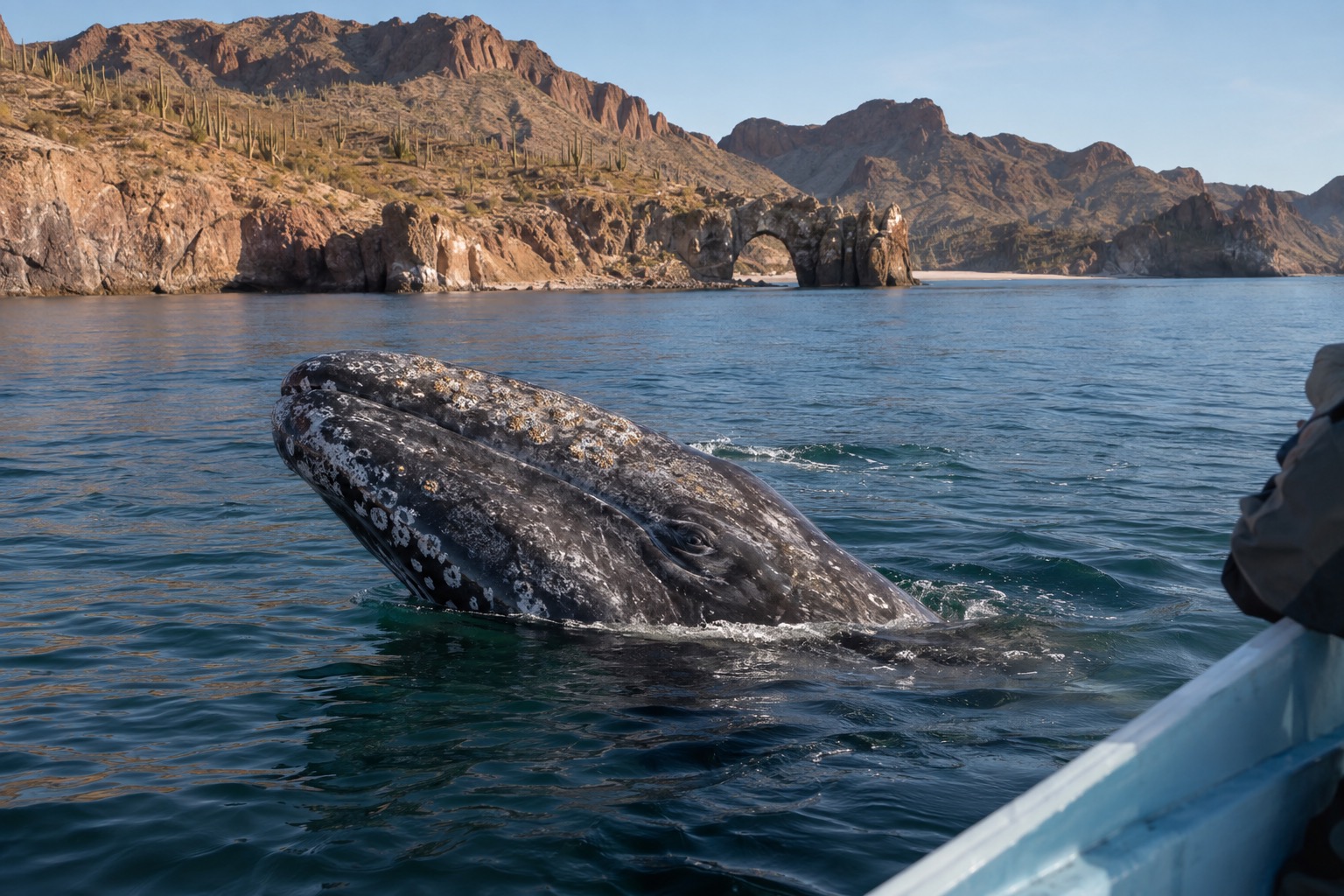
Both coasts fall in hurricane country in the summer months, the Caribbean following the Atlantic season, so leave a little slack in your itinerary in case a boat day is moved. Bring a hat, reef-safe sunscreen and some pesos for tips and small island meals. If summer does not fit your plans, winter has its own animal encounters: gray whales in the lagoons of Baja California Sur from mid-December to the end of April, and humpbacks off Los Cabos and Puerto Vallarta.
Sources
- CONANP (Comision Nacional de Areas Naturales Protegidas), "Inicia la temporada de avistamiento de ballena gris en la Reserva de la Biosfera El Vizcaino", gob.mx/conanp, checked September 29, 2026 (window confirmed over several seasons, including the 2025-2026 announcement)
- CONANP (Comision Nacional de Areas Naturales Protegidas), "Inicia la temporada de tiburon ballena en la Reserva de la Biosfera Bahia de los Angeles", gob.mx/conanp, checked September 29, 2026
- CONANP (Comision Nacional de Areas Naturales Protegidas), "Inicia la temporada de visitacion a los santuarios de Mariposa Monarca, periodo 2024-2025", gob.mx/conanp, checked September 29, 2026
- U.S. Department of State, Mexico Travel Advisory (main, level banner), travel.state.gov, read live via browser (protected by Cloudflare, direct fetching blocked with 403) on 29 September 2026
- U.S. Department of State, Mexico Travel Advisory, section "Risks in specific areas" / State of Guerrero, travel.state.gov, read live via browser on September 29, 2026
- U.S. Department of State, Mexico Travel Advisory, section "Risks in specific areas" / State of Baja California, travel.state.gov, read live via browser on September 29, 2026
- U.S. Department of State, Mexico Travel Advisory, section "Risks in specific areas" / State of Baja California Sur, travel.state.gov, read live via browser on September 29, 2026
- U.S. Department of State, Mexico Travel Advisory, section "Risks in specific areas" / State of Sonora, travel.state.gov, read live via browser on September 29, 2026
- U.S. Department of State, Mexico Travel Advisory, section "Risks in specific areas" / State of Michoacan, travel.state.gov, read live via browser on September 29, 2026
- U.S. Department of State, Mexico Travel Advisory, section "Risks in specific areas" / State of Quintana Roo, travel.state.gov, read live via browser on September 29, 2026
- U.S. Department of State, Mexico Travel Advisory, section "Risks in specific areas" / State of Mexico (Estado de Mexico), travel.state.gov, read live via browser on September 29, 2026
- U.S. Department of State, Mexico Travel Advisory (reissued May 29, 2026), section « Risks in specific areas », travel.state.gov/en/international-travel/travel-advisories/mexico.html, read via browser (Cloudflare blocks curl) on 29 September 2026
- Servicio Meteorologico Nacional (CONAGUA), normales climatologicas 1991-2020, estacion 23011 (Kantunilkin, Lázaro Cárdenas), checked September 29, 2026
- Open-Meteo Marine API, average 2015-2024, checked September 8, 2026
- Servicio Meteorologico Nacional (CONAGUA), normales climatologicas 1991-2020, estacion 23155 (Cancun, Benito Juárez), checked September 29, 2026
To plan your stay
- Best Time to Visit Mexico: Weather by Region, Crowds, Hurricane Season and Festivals
- Where to Stay in Mexico: Riviera Maya, Los Cabos, Puerto Vallarta, Mexico City and All-Inclusive Areas
- Getting Around Mexico: Buses, the Tren Maya, Taxis and Driving Your Own Car
- Mexico Travel Tips: Dollars, Tourist Tax, Tipping, Tap Water, Driving and Safety by State