
Once night falls, a cluster of students wearing black capes and tights meets on a stairway of stone, tunes guitars and mandolins, then starts off with a crowd following behind them through the alleys, singing while they walk. That is Guanajuato in an evening: a compact colonial city folded into a narrow valley, where walking is the way to see everything. It suits couples, solo travelers and anyone who likes culture, history and a town that comes alive at night.
Where is Guanajuato and what is it like?
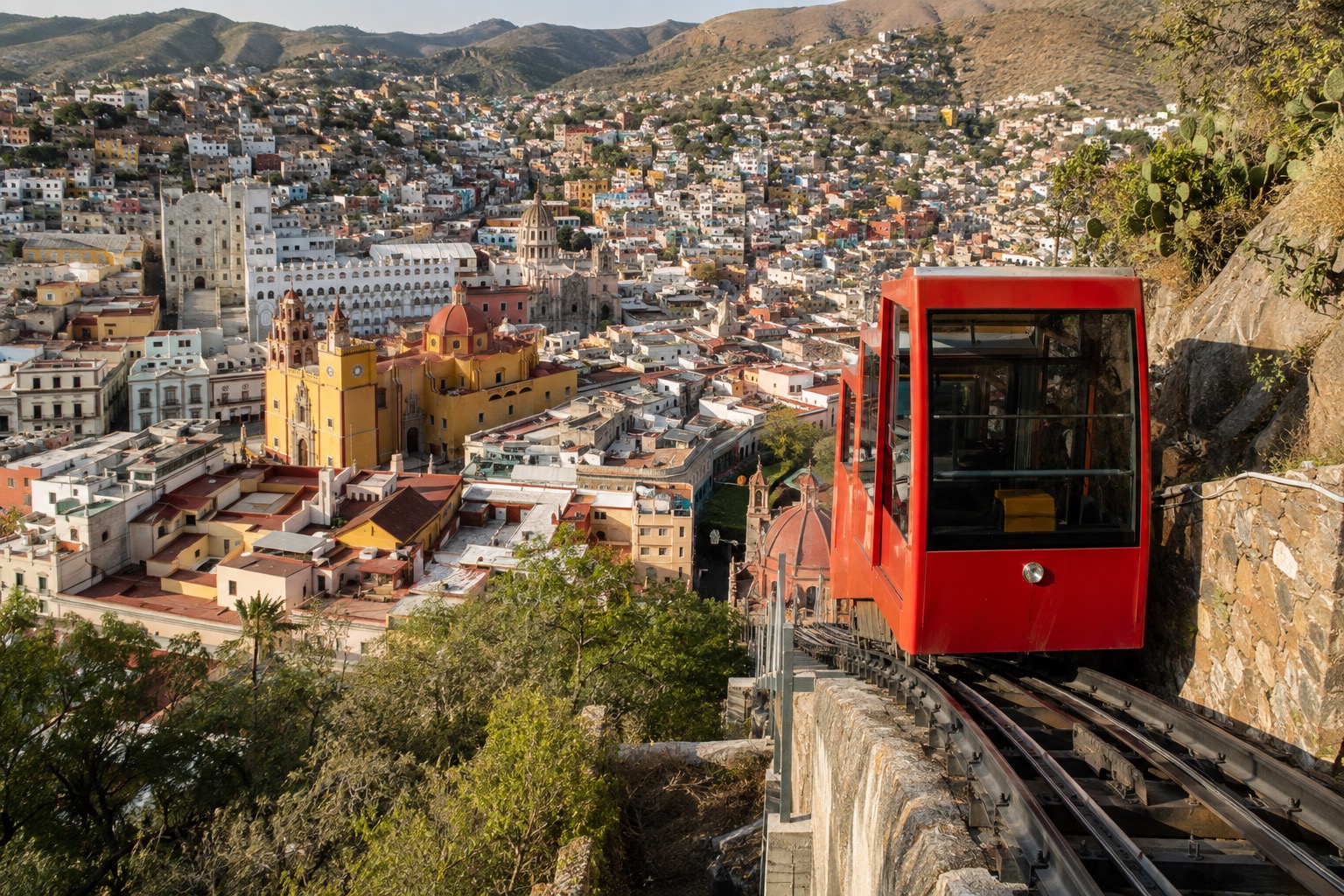
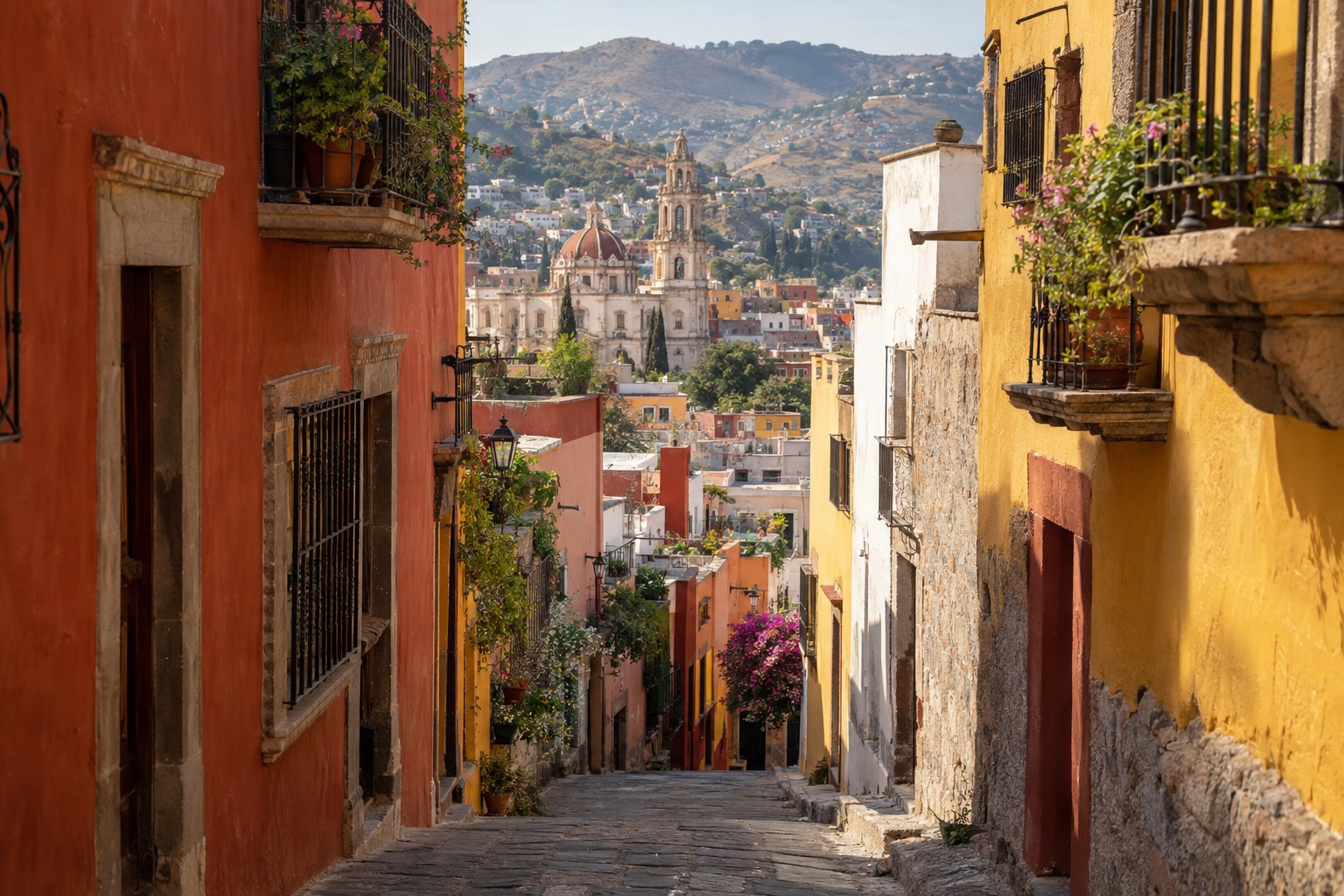
Guanajuato is a hillside colonial city in central Mexico, far from any coast, with San Miguel de Allende on the road toward the east and the airport at Silao a short drive away. There is no beach and no resort strip here, only a tight knot of cobblestone streets, small plazas and churches climbing the slopes.
The pace is walking pace, and the evenings are lively, with bars, estudiantinas and a student crowd keeping the center noisy late on weekends. Culture-minded couples and short-stay visitors tend to love it. Families who need quiet, or anyone who wants easy parking and a car at the door, may find the center tiring.
What is there to do in Guanajuato?
The reasons to come are the walkable historic core, the night-time music tradition, a handful of museums with real stories behind them, and a day out into the surrounding hills. Unlike its neighbors, Guanajuato is built on slopes and tunnels, so even a short stroll turns into a small adventure.
Evenings with the callejoneadas
The callejoneada is the signature experience. Student minstrels in traditional dress lead a procession through the alleys at night, stopping at corners and tiny squares to sing, tell jokes and pass around stories, and everyone who wants can fall in behind them.
It works best on a weekend evening, when the center is at its liveliest, and it suits almost any traveler who enjoys music and a bit of theater. The alleys are steep and uneven, so comfortable shoes matter more than anything else you bring.
Museums and sites with a story
The city’s museums are unusually vivid. One occupies a former granary that was the stage for the first major clash of the War of Independence, and the other is the famous mummy museum, a long-standing curiosity of the town. Both are quick, memorable visits that fit between walks. Farther out, Cañada de la Virgen is a pre-Hispanic ceremonial center in the hills toward San Miguel de Allende, a half-day outing best done with a tour.
| Site | Open | Admission |
|---|---|---|
| Museo Regional de Guanajuato (Alhóndiga de Granaditas) | Thursday to Sunday, 10 a.m. to 4 p.m. | 65 pesos |
| Cañada de la Virgen | Tuesday to Sunday, 10 a.m. to 6 p.m. (last entry 4 p.m.) | 100 pesos adults, 25 pesos children |
A half-day beyond the center
If the colonial streets begin to run together, Cañada de la Virgen gives you something different, an archaeological site set in open country along the road to San Miguel de Allende. It adds a much older chapter to a city best known for its silver-era architecture.
Plan it for the morning and the early afternoon, since the site closes to new entries well before the gates shut. It suits travelers who like history in a quiet, open landscape, and a car or a taxi makes the logistics simpler.
How many days do you need in Guanajuato?
A long weekend is enough to feel the city, and a few more days let you slow down and add outings.
With a short stay, you can wander the center, take the funicular up to the El Pipila monument for the view over the rooftops, visit one or two museums and join a callejoneada one evening. Because everything sits within a few minutes on foot, nothing needs rushing.
With more time, add the hilltop village of Valenciana with its mine and church, the half-day to Cañada de la Virgen, and a day trip toward San Miguel de Allende. Leave a slow morning or two for cafés and the small plazas, which is where the city shows its character.
Where to stay in Guanajuato
The Centro Histórico is the natural base for culture-focused couples, solo travelers and short stays, with boutique hotels, converted colonial houses, hostels and apartments, but no all-inclusive resorts. Light sleepers should ask for a room away from the street, since the noise carries late on weekends. Paseo de la Presa is the calmer choice, an elegant residential area of restored houses with gardens, a short walk or cheap taxi from the center, and a good fit for couples, mature travelers and families.
Pastita, just south of the center, is a working-class neighborhood with family-run guesthouses and hostels, aimed at budget travelers and longer stays who want an authentic, less touristy feel. Valenciana is a quiet hilltop former mining village with hacienda-style inns, best with a car. San Javier, a modern suburb on the hills, has chain and business hotels with parking and bigger rooms, though walking to the sights is not practical from there.
How do you get to Guanajuato and get around?
Most visitors arrive through the airport at Silao, roughly 30 to 45 minutes by car from the center and the main neighborhoods, a little longer for Valenciana. From there, a taxi or a transfer takes you into town.
Once in the Centro, you get around almost entirely on foot, since many streets are pedestrian-only or too narrow for cars, and taxis only reach the edge. From Paseo de la Presa and Pastita, the center is a short walk, with local buses and shared taxis along the main road. Valenciana and San Javier are another matter: a car, taxi or hotel shuttle makes life much easier there.
When is the best time to visit Guanajuato?
Guanajuato rewards a visit in any season because its pleasures are mostly indoors and on foot, in the evenings and on the stairways. Weekends are the liveliest, with the most music and the biggest crowds in the alleys.
Choose the days around a festival if you want the city at full volume, and a midweek stay if you prefer quiet plazas. Note that the Museo Regional is closed Monday to Wednesday, which is worth keeping in mind when planning the week.
Good to know before you go
The U.S. State Department rates the state of Guanajuato at Level 3, Reconsider Travel.
Pesos are the easiest currency for museums, taxis and small cafés. The center is full of steep stairs and cobblestones, and some side streets and shortcuts are dimly lit at night, so a phone light and a word with your host about the best route home are useful habits. The city sits in the Mexican highlands, so there is no hurricane season to plan around.
Sources
- INAH, Museo Regional de Guanajuato Alhondiga de Granaditas (inah.gob.mx/museos/museo-regional-de-guanajuato-alhondiga-de-granaditas), checked September 29, 2026
- INAH, meme page, checked September 29, 2026
- INAH, Zona Arqueologica Canada de la Virgen (inah.gob.mx/zonas/zona-arqueologica-canada-de-la-virgen), checked September 29, 2026
- US Department of State, Mexico Travel Advisory (travel.state.gov), advisory of May 29, 2026, checked September 29, 2026 (date issued May 29, 2026)