
Around ten at night, a group of students in black capes and ribboned caps gathers near a church wall, tunes guitars and mandolins, and sets off up a lantern-lit alley with a crowd singing behind them. Guanajuato is a colonial silver town folded into a mountain ravine, with pastel houses stacked up the slopes and streets that dive underground. It suits travelers who like to explore on foot, linger in plazas and let the evenings run late.
What are the best things to do in Guanajuato?
The best things to do are mostly a matter of wandering: the alleys, the plazas, the viewpoint above town and a night behind a band of student minstrels.
- Follow a callejoneada through the lantern-lit alleys after dark, singing along if you know the words.
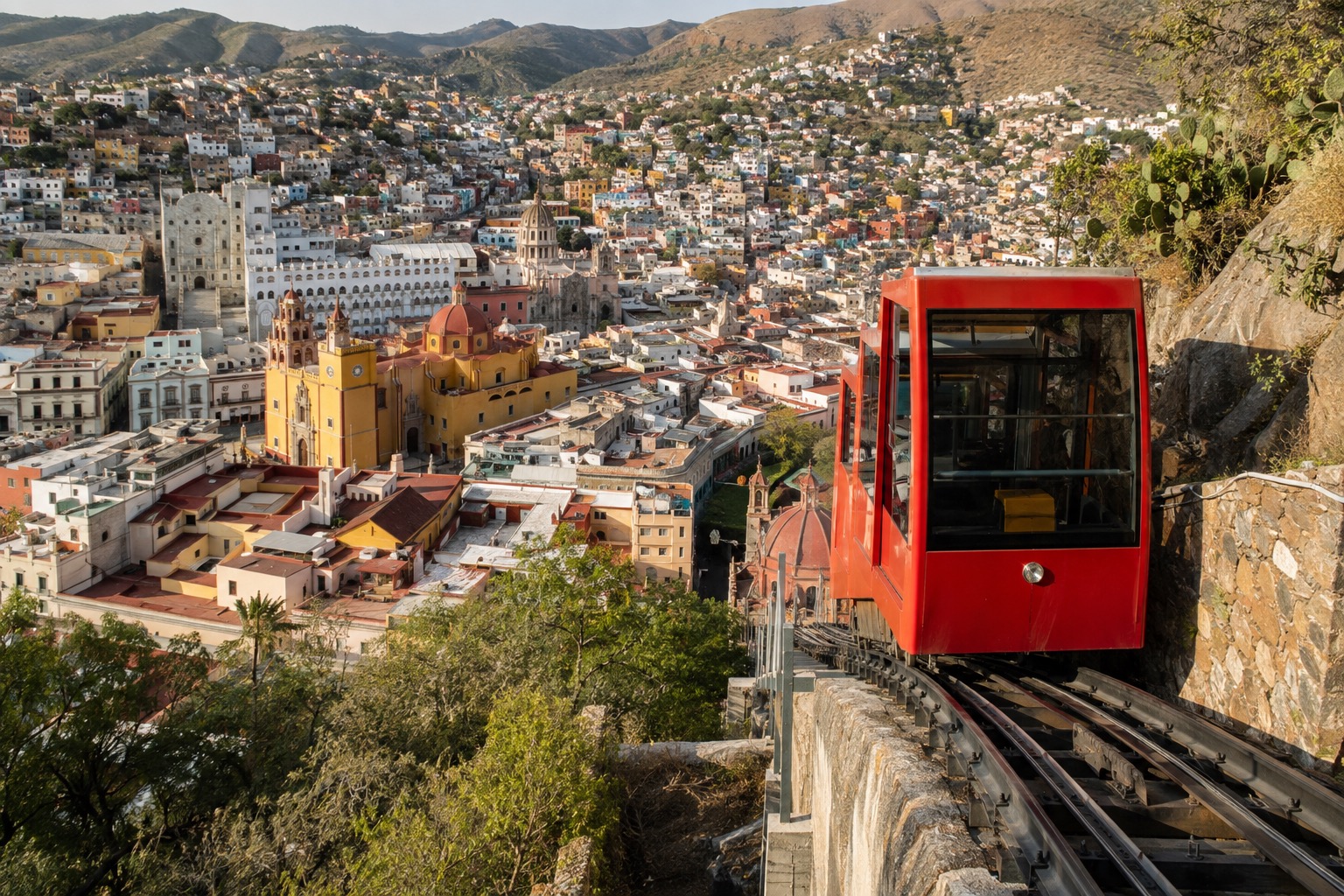
- Ride the funicular up to El Pipila for the view over the whole town.
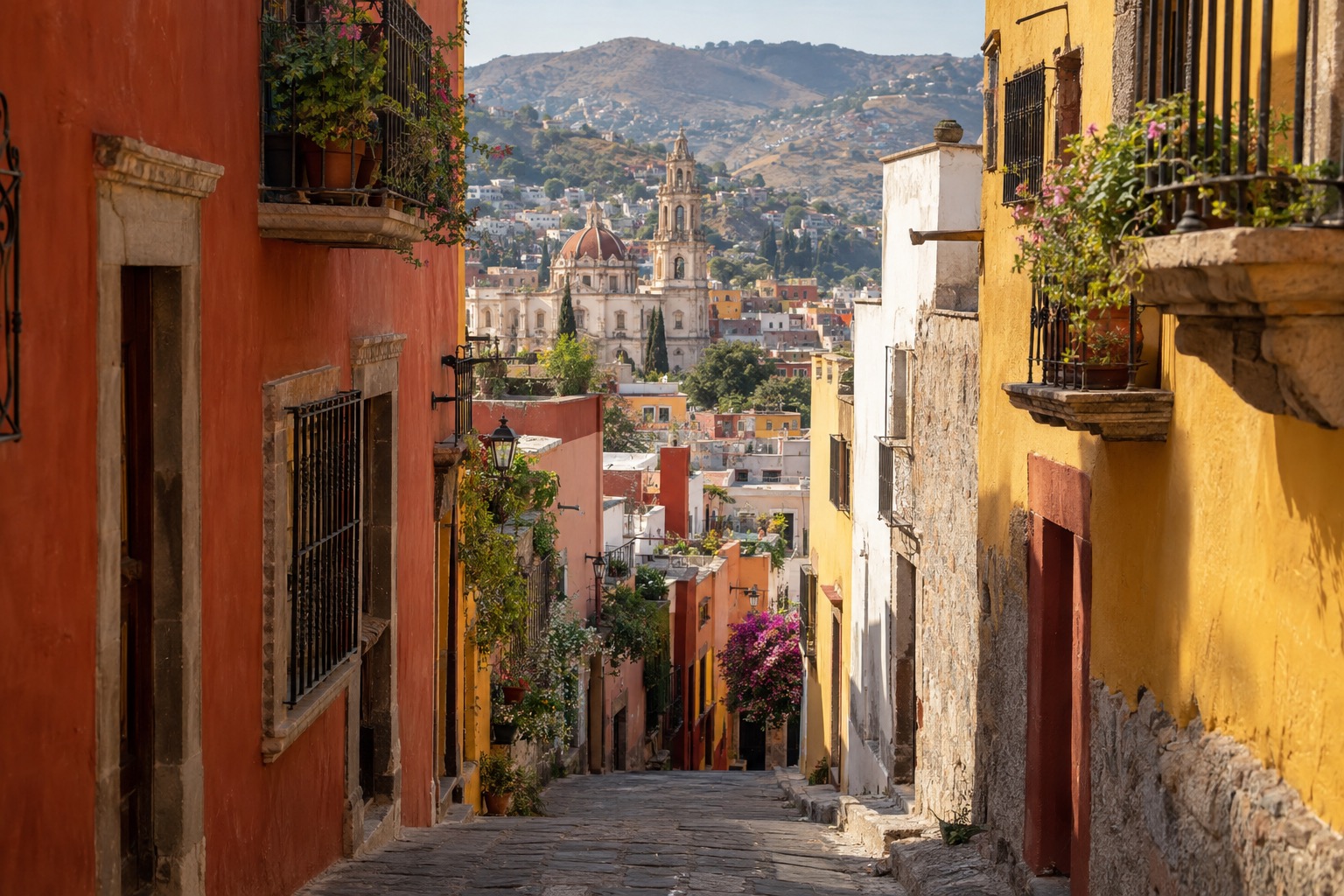
- Squeeze through the Callejón del Beso, the alley so narrow that balconies nearly touch.
- Visit the Alhóndiga de Granaditas, a fortress-like granary with a dramatic past.
- Look at the Museo de las Momias, a strange and famous curiosity.
- Sit in the Jardín de la Unión and watch the town go by in front of the Teatro Juárez.
- Take a day trip to Dolores Hidalgo or San Miguel de Allende.
Sights and landmarks in Guanajuato
Most of Guanajuato’s landmarks sit within a short walk of each other in the center, strung along narrow streets that climb, dip and turn without warning. Plan on stairs, cobblestones and frequent stops to look up at yet another church dome.
The Alhóndiga de Granaditas
This stout stone building, one of Mexico’s earliest neoclassical structures, was the site of the first major battle of the War of Independence in 1810. Later it served as a granary, a prison, a courthouse and a school before becoming the Museo Regional de Guanajuato in 1958. Inside you find regional history, archaeology and art, arranged around a big central courtyard.
Give it a relaxed hour or two. The painted murals on the staircase are a highlight, and the building’s thick walls make it a cool refuge on a hot afternoon. It suits anyone curious about how Mexico’s independence story began, and it is an easy walk from the center.
| Site | Open | Admission |
|---|---|---|
| Museo Regional de Guanajuato (Alhóndiga de Granaditas) | Thursday to Sunday, 10 a.m. to 4 p.m. (closed Monday to Wednesday) | 65 pesos |
Teatro Juárez and the Jardín de la Unión
The Teatro Juárez faces the Jardín de la Unión with an ornate facade and lion-flanked steps, and it is the postcard heart of town. The little triangular garden in front, shaded by trimmed laurel trees, is where students, families and musicians cross paths from late afternoon on.
Come when the light turns golden and take a café table at the garden’s edge. Walking up the theater’s steps for a photo is a small ritual, and the surrounding streets lead to churches, bookshops and ice cream stands within minutes.
Museo de las Momias
The Museo de las Momias displays naturally mummified bodies exhumed from the local cemetery, a longstanding curiosity of the town. Faces frozen in expressions and clothing still clinging to the bodies make it unsettling and oddly fascinating. Mexicans have a long, unsqueamish relationship with death, and the museum fits that tradition.
It is not for everyone. Some visitors find it a highlight of the trip, others leave after a few rooms. Souvenir stands outside sell candy skulls and mummy figurines, which tells you how comfortably the town wears its reputation.
Alleys, churches and the Diego Rivera house
The Callejón del Beso is a narrow alley and a stop on the walking tours that wind through the hillside streets. Legend says two lovers talked from facing balconies close enough to kiss, and couples still pose there. Nearby, the yellow Basilica of Our Lady of Guanajuato rises over the Plaza de la Paz, ringed by mansions built on silver fortunes.
Also worth a stop are the baroque Templo de la Compañía, the University of Guanajuato with its striking staircase, and the house museum where the painter Diego Rivera was born. Together they make a good loop for a slow morning on foot.
Outdoor things to do in Guanajuato
Outdoors in Guanajuato means climbing for views, strolling plazas and ducking into markets. The town sits in a bowl of hills, so almost every outing involves a staircase.
El Pipila and the funicular
A funicular climbs from behind the Teatro Juárez to the hilltop monument of El Pipila, overlooking the whole town. The ride is short and steep, and it deposits you at a terrace where the colored houses spill down the ravine in every direction. The statue honors a miner who became a hero of the independence struggle.
Go late in the afternoon, when the sun warms the facades, or stay until the lights come on. There are snack stalls and benches at the top. If you have energy, you can walk back down through the alleys, which is a lovely way to see neighborhood life.
Presa de la Olla and the city’s green spots
Higher up the hillside, the Presa de la Olla park has a small reservoir, shaded paths and paddle boats, a favorite with local families on weekends. It feels a world away from the crowded center, with space to walk and sit quietly.
Closer in, the Jardín de la Unión and the Plaza de la Paz serve as open-air living rooms. Benches, fountains and shade trees give you somewhere to rest between museums.
Markets and underground streets
The Mercado Hidalgo, in a grand iron-and-stone building, sells produce, sweets, leather goods and ceramics, with food counters upstairs and down. Come in the morning when stalls are at their busiest. Wander and taste, then leave with a bag of candied fruit or cajeta.
Guanajuato also has old mining tunnels turned into streets, where cars and pedestrians slip beneath the hills. Walking a stretch of them feels like stepping into a stone-lined time capsule, and they explain how the town fits so many people into such a tight valley.
Day trips from Guanajuato
The most popular day trips head east and south across the high plateau, toward ancient ruins, colonial neighbors and the cradle of independence.
Cañada de la Virgen
Cañada de la Virgen is on the road toward San Miguel de Allende, so it fits easily into a day that continues to that town. It is an Otomí archaeological site set in open, dry countryside, with structures aligned to the sky and the movements of the sun and moon. You walk the paths between the buildings with views over the surrounding valley.
It is quieter than the great Maya or Aztec sites, which is part of the charm. Go in the morning, bring a hat and water, and expect little shade. It suits history lovers and those who like a site to themselves.
| Site | Open | Admission |
|---|---|---|
| Cañada de la Virgen | Tuesday to Sunday, 10 a.m. to 6 p.m. (last entry 4 p.m.) | 100 pesos adults, 25 pesos children |
San Miguel de Allende
San Miguel de Allende is the polished neighbor, with a pink neo-Gothic parish church, rooftop bars, art galleries and courtyard restaurants. You reach it by bus or car along the same highway that passes Cañada de la Virgen, which makes pairing the two natural.
Spend the day in the Jardín Principal, the craft shops and the side streets. It is more international and more upscale than Guanajuato, so it makes a nice contrast. Late afternoon, with the church glowing, is the best time to be there.
Dolores Hidalgo
Dolores Hidalgo is where Father Miguel Hidalgo is said to have sounded the call for independence, and the main square and parish church carry that weight. The town also has a cheerful reputation for ice cream in unusual flavors, and vendors will happily hand you a sample of shrimp or avocado.
It is also known for Talavera-style painted ceramics, sold in workshops and shops around town. Go on a day when you want a relaxed outing with history, sweets and shopping rather than a long list of sights. Smaller options include the hilltop Cristo Rey monument, a pilgrimage point with wide views, and the old mining village of Mineral de Pozos, a ghost-town-turned-art-colony.
What to eat in Guanajuato
Eating in Guanajuato starts with enchiladas mineras, tortillas dipped in guajillo chile sauce, fried and heaped with potatoes, carrots, cheese and lettuce. They come from the mining past and show up in nearly every traditional restaurant.
Add pozole, tamales, gorditas stuffed with chicharrón or beans, and street snacks like fresh fruit with chile and lime. The Mercado Hidalgo is the place to graze, and its upstairs counters serve hearty plates in a lively setting.
For sweets, look for cajeta, the thick goat’s-milk caramel, and the colorful candy stalls around town. Guanajuato’s coffee shops also pour strong coffee and hot chocolate, handy for a break between climbs. Evenings bring tacos, elotes and churros from stalls near the plazas.
Things to do in Guanajuato at night
Nights here revolve around the callejoneadas, walking processions of student minstrels through the alleys, a Guanajuato tradition. Dressed in medieval-style costume, the estudiantinas play and sing while leading the crowd from plaza to plaza, telling jokes and stories along the way.
Sit at a café on the Jardín de la Unión to watch the evening gather, or listen for live music drifting from bars on the side streets. The University gives the town a young crowd, so places stay open late without feeling rowdy.
For something quieter, walk the lit-up alleys after dinner or go up to El Pipila and look at the glittering town below. Each autumn the Cervantino arts festival fills the theaters and plazas with performances.
Things to do in Guanajuato with kids
Kids tend to enjoy Guanajuato for the funicular ride, the tiny alleys and the sense that the whole town is a playground of staircases. Ice cream near the Jardín de la Unión is a reliable reward for tired legs.
The paddle boats at Presa de la Olla give children space to run, and puppet shows and small museums, including a traditional toy museum, add variety. The Museo de las Momias can frighten younger children, so think about whether yours will enjoy it.
Keep in mind that the town sits high in the mountains, so sun is strong and little ones may tire faster. Cobbled hills and stairs are hard on strollers, so a carrier is easier. Build in café stops and plaza breaks.
Good to know before you go
The U.S. State Department rates the state of Guanajuato at Level 3, Reconsider Travel.
The center is compact and best on foot, with taxis for the steeper climbs and buses for day trips to neighboring towns. Pesos are the currency you will use at markets and small shops. Travelers heading to the coast will find that hurricane and sargassum concerns do not apply here, since this is an inland highland town.
Sources
- INAH, Museo Regional de Guanajuato Alhondiga de Granaditas (inah.gob.mx/museos/museo-regional-de-guanajuato-alhondiga-de-granaditas), checked September 29, 2026
- INAH, meme page, checked September 29, 2026
- INAH, Zona Arqueologica Canada de la Virgen (inah.gob.mx/zonas/zona-arqueologica-canada-de-la-virgen), checked September 29, 2026
- US Department of State, Mexico Travel Advisory (travel.state.gov), advisory of May 29, 2026, checked September 29, 2026