
Kids line up at the edge of a cenote, toes curled over the limestone, staring into water so clear it looks like glass. Behind them, a parrot screeches from the jungle canopy and someone’s flip-flop is already floating away. Mexico gives families a lot of room to play, from the calm Caribbean shore to the cooler highlands, and the choices here start with the paperwork and end at the pool bar.
Do kids need a passport to go to Mexico?
Yes, if your family flies, every child needs their own passport, babies included. A birth certificate is not enough to board a plane to Cancun or Los Cabos.
Flying in and out
Most families arrive by air, and that is where the passport rule bites. Once you land, Mexico asks visitors for an immigration form, the FMM. On a flight, the airline normally handles the fee for you and the form arrives in digital form, as a QR code, after the passport is stamped. Keep that code handy on your phone until you leave.
A passport for a child under 16 is valid for five years, which is worth remembering if a card or book is sitting in a drawer. A first-time application is done in person at an acceptance facility, so start well before the trip.
Driving or taking a cruise
Families who cross by land or return by sea have a lighter requirement for the youngest travelers. Youngsters younger than 16 may reenter the United States by showing a birth certificate or another form of proof of citizenship, while teenagers who travel with a school or youth group receive that same treatment for a few more years.
A passport card is the other option for those trips. It is handy at land borders and on sea crossings, but it will not work for a flight. For a child under 16 a first card is the lower-cost choice, and it stays valid for five years.
| Passport card | Child under 16 | Adult |
|---|---|---|
| First card | 50 USD | 65 USD |
| Renewal | Apply again in person | 30 USD |
Best beaches in Mexico for families
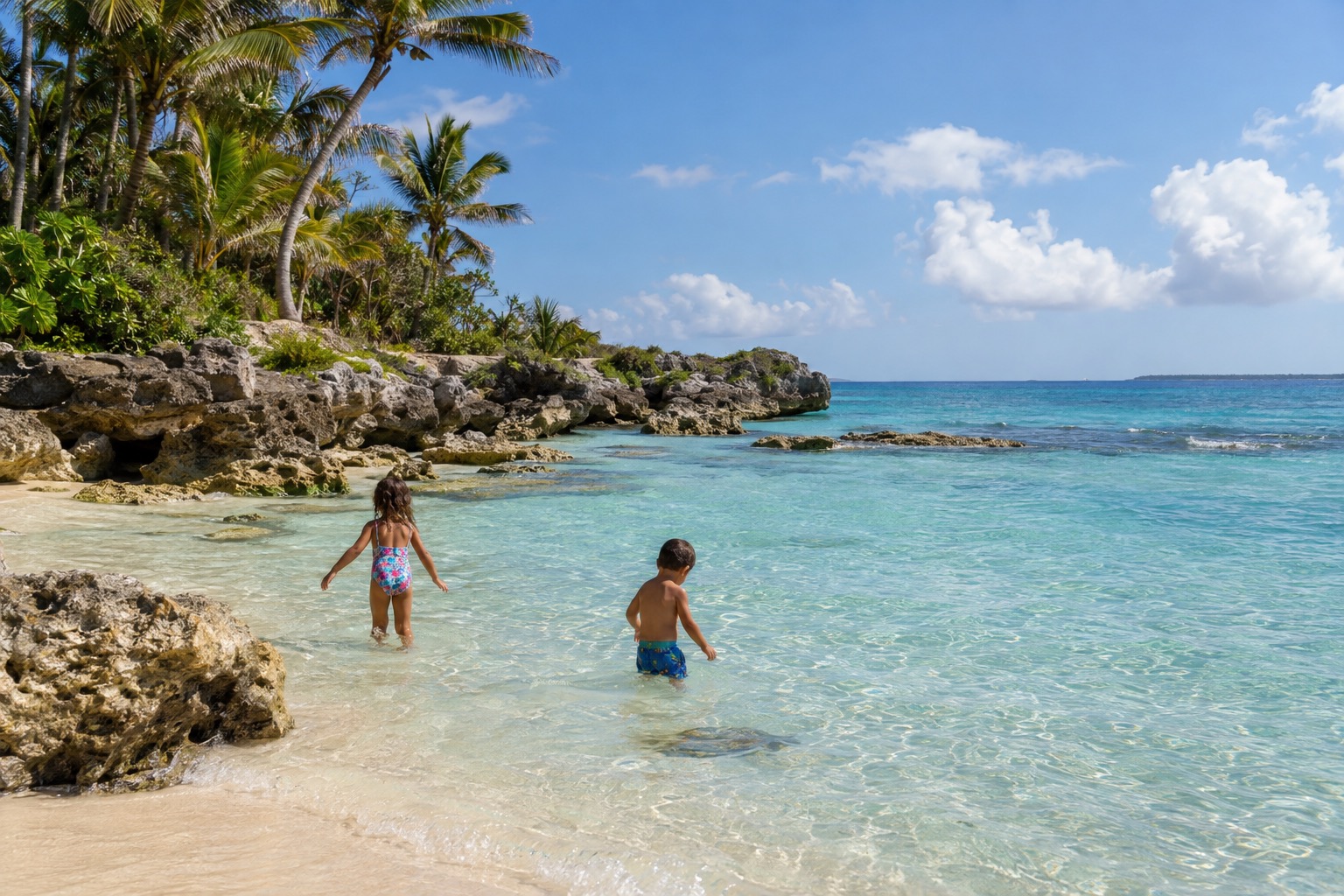
The Caribbean side is where most families land, since the water off Cancun, Playa del Carmen and Isla Mujeres is generally gentler than the open Pacific beaches of Los Cabos.
Cancun, Playa del Carmen and Isla Mujeres
On the Caribbean coast, the sand is pale and soft, the shallows are wide and toddlers can paddle without much drama. Isla Mujeres adds a slower pace, with golf carts puttering along and small beaches where children can hunt for shells. Playa del Carmen keeps a pedestrian street of ice cream stands and street musicians a short walk from the sand.
Water conditions change with the weather, so check the beach flags before anyone goes in. Summer brings warm sea, in the mid-80s, and a hot, humid day that suits an early swim and a long lunch in the shade. January is milder, with a sea still warm enough for most kids and cooler evenings.
One thing to plan around on this coast is seaweed. Sargassum can pile up on the beaches in some years, most often in early summer, and it is lightest in winter. The Atlantic forecasts help you see what is coming before you pick your dates.
Los Cabos and the Pacific side
Los Cabos is dramatic, with desert cliffs dropping to the sea and big surf on many open beaches. Families usually choose the sheltered coves and resort beaches rather than the wild stretches, and keep an eye on the flags. Mornings are best for sandcastles, when the sun is gentle and the crowds are thin.
A broad bay is home to Puerto Vallarta, which also offers a lengthy boardwalk, street performers, and an abundance of snack stands. Summer there means heavy, frequent rain, often in big afternoon downpours, while winter is drier and sunnier. Neither Los Cabos nor Puerto Vallarta has to deal with the seaweed that reaches the Caribbean.
Things to do in Mexico with kids
The classic family days on the Caribbean coast are cenotes, eco-parks, shallow-reef snorkeling and Maya ruins, and they fit together easily in one trip.
Cenotes
These natural sinkholes are the image most kids bring home: roots hanging down, light falling through a hole in the roof, tiny fish nibbling at the edges. Some are open to the sky, others are caves with stalactites. Children love the cool, quiet atmosphere after a hot morning on the road.
Go earlier in the day for fewer people and softer light. Bring water shoes, since rock steps can be slippery, and ask on the spot about swimming at each site, as rules differ from one cenote to the next.
Xcaret and Xel-Ha
These eco-parks are built for a full day. They mix snorkeling, river floats, animal encounters and evening shows, so there is something for a restless seven-year-old and a bored teenager alike. Xel-Ha leans toward the water, while Xcaret adds a bigger cultural program. They suit families who like to stay in one place and let the day unfold, and they tire small children quickly, so pace yourself with shade breaks and long lunches.
Reefs and ruins
Shallow reefs near the coast are an easy first snorkel for children who are comfortable in the water, with bright fish just beneath the surface. Maya ruins add a different kind of adventure. Kids can imagine ball games, temples and astronomers while walking stone paths and spotting iguanas sunning on the walls.
Visit ruins early, before the sun is high, and pair them with a swim afterward. In Mexico City and Oaxaca the climate is different: the capital is cool in January and rainy on most July days, so pack a light jacket and plan museums for the wet afternoons.
Best all-inclusive resorts in Mexico for families
When you want the best family resorts, four spots stand out: the Cancun Hotel Zone, Los Cabos, Riviera Nayarit, which lies north of Puerto Vallarta, and the Riviera Maya, a stretch that runs from Playa del Carmen to Tulum. Adults-only resorts are common in all four, so check that the one you pick welcomes children. Family properties tend to have kids’ clubs, splash zones and buffets where a picky eater can always find pasta or quesadillas.
What the rate covers
Usually, your room, meals, and drinks, plus non-motorized water sports, come with the standard rate. That makes days simple when children want a snack every hour, since nobody is counting pesos at the pool bar.
Common add-ons are spa treatments, top-shelf drinks, outings and a few à la carte restaurants. Since what’s offered varies by resort, check the inclusions before you decide, above all if you’re thinking of heading out to a cenote or an eco-park.
Choosing a coast
The Riviera Maya and Cancun put calm water, snorkeling and ruins close at hand. Los Cabos offers desert scenery, whale-watching boat trips in the right season and a more rugged shoreline. Riviera Nayarit is quieter, with a laid-back feel and jungle behind the beach.
Pick by what your children enjoy most. Pool-and-sand kids do well anywhere, while the explorers will be happier with the Caribbean’s cenotes and parks within reach.
Good to know before you go
Bring sun hats, reef-safe sunscreen and a stash of small bills for snacks and tips. Hurricane season follows the Atlantic calendar on the Caribbean coast and starts in mid-May on the Pacific side, so ask about weather policies when you book. Mexico City sits high, so children may feel winded on the first day and need extra water and a slow start.
Sources
- U.S. Department of State, "Compare a Passport Card and Book", travel.state.gov, updated on 28 September 2026, read live via browser on 29 September 2026
- Ley Federal de Derechos, art. 8-I (current text, APTA CE mirror, update 91), apta.com.mx ; supplemented by Instituto Nacional de Migracion, "Forma Migratoria Multiple Digital (FMMd)", gob.mx/inm, checked September 29, 2026
- U.S. Customs and Border Protection, « Western Hemisphere Travel Initiative », cbp.gov/travel/us-citizens/western-hemisphere-travel-initiative, checked September 29, 2026
- Servicio Meteorologico Nacional (CONAGUA), normales climatologicas 1991-2020, estacion 23155 (Cancun, Benito Juárez), checked September 29, 2026
- Open-Meteo Marine API, average 2015-2024, checked September 8, 2026
- Servicio Meteorologico Nacional (CONAGUA), normales climatologicas 1991-2020, estacion 09048 (Tacubaya Central (Obs), Miguel Hidalgo), checked September 29, 2026
- Servicio Meteorologico Nacional (CONAGUA), normales climatologicas 1991-2020, estacion 03005 (Cabo San Lucas, Los Cabos), checked September 29, 2026
- Servicio Meteorologico Nacional (CONAGUA), normales climatologicas 1991-2020, estacion 14339 (El Cuale, Puerto Vallarta), checked September 29, 2026
- Servicio Meteorologico Nacional (CONAGUA), normales climatologicas 1991-2020, estacion 20079 (Oaxaca, Oaxaca De Juárez), checked September 29, 2026
- University of South Florida, Optical Oceanography Lab, "Sargassum Watch System (SaWS)", optics.marine.usf.edu, checked September 29, 2026
To plan your stay
- Best Time to Visit Mexico: Weather by Region, Crowds, Hurricane Season and Festivals
- Where to Stay in Mexico: Riviera Maya, Los Cabos, Puerto Vallarta, Mexico City and All-Inclusive Areas
- Getting Around Mexico: Buses, the Tren Maya, Taxis and Driving Your Own Car
- Mexico Travel Tips: Dollars, Tourist Tax, Tipping, Tap Water, Driving and Safety by State