
Before sunrise on the Big Island, the road out of Kailua-Kona is nearly empty, the first coffee is steaming in the cup holder, and a pale light starts to show over the lava fields. A few hours later you can be standing at a crater rim wrapped in steam, under a waterfall in a jungle gorge, or on a black sand beach with a sleeping sea turtle. This is an island where one base serves many mornings, and the day trips run from active volcano to snowless-sounding, very cold mountaintop.
What are the best day trips from the Big Island?
The best day trips from the Big Island are the volcano, the great mountain, the waterfalls around Hilo, the historic Kona coast, the Kohala shore and the long black sand drive through Kau.
- Hawaii Volcanoes National Park, for steaming craters, lava tubes and a road that drops to the sea.
- Maunakea, for a sky full of stars and the strangest landscape on the island.
- Akaka Falls and Rainbow Falls, for a green, misty morning around Hilo.
- South Kona, for a place of refuge, a historic bay and farms that grow the famous coffee.
- The Kohala coast, for a heiau, a wide white beach and the sunniest weather on the island.
- Kau, for a black sand beach and a quiet corner of the national park.
The best day trips from the Big Island
Hawaii Volcanoes National Park
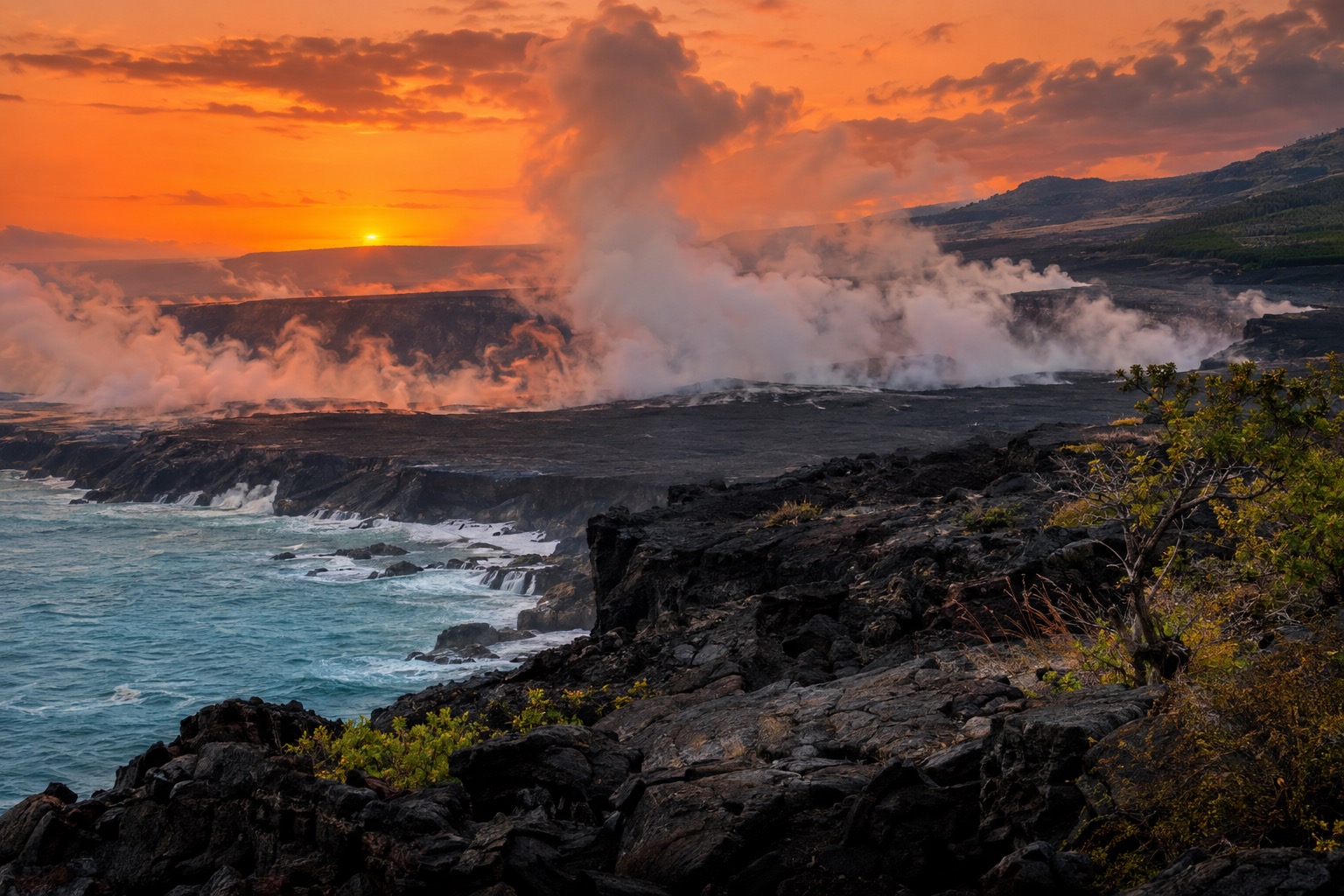
From Hilo, the park is only about 45 minutes away along Highway 11, but if you are coming from Kailua-Kona, plan on a two-hour drive or longer in each direction. That difference matters, so a Kona base usually means leaving early and treating the park as the whole day. You walk rim trails past steam vents, smell sulfur on the wind, and look down into the vast caldera of Kilauea.
Kilauea has been restless, with strong glow and spatter from its vents, so the park’s current conditions decide where you can stand and what you see after dark. Nahuku, the Thurston Lava Tube, is the easy favorite: a short, fern-framed walk into a tunnel left behind by lava. Chain of Craters Road then runs 18.8 miles down to the coast, crossing old flows and ending near the sea.
The summit area is cool and often rainy, so bring a layer even when Hilo is warm. Parking at Nahuku fills quickly, so go early in the morning or late in the afternoon. The place suits almost anyone, from families on short walks to hikers who want a full day on the trails.
Maunakea
The road up is the Daniel K. Inouye Highway, better known as Saddle Road, which crosses the high saddle between Mauna Loa and Maunakea and climbs steadily through lava country. It is paved and modern for nearly its whole length, and it takes you from rainy Hilo or sunny Kona into cold, thin air. The summit tops 13,796 feet, and the island’s weather changes completely on the way up.
Most visitors stop at the Visitor Information Station, which sits high on the slope and is open all day and into the evening. Stay there at least half an hour to adjust to the altitude and get a weather update before going further. After dark, the sky is the reason to come: there is almost no glow from towns, and the Milky Way spreads clearly overhead.
Above the station the road is for four-wheel-drive vehicles only, so a regular rental car stops there. A guided trip makes sense for the summit. Wear warm layers, even in the hottest months, because the evenings are bitterly cold. The mountain is sacred to Native Hawaiians, so keep voices low and stay on the paths.
Akaka Falls and the Hilo waterfalls
Hilo sits on the wet windward coast, which is exactly why its waterfalls run strong and the hillsides look so green. Akaka Falls plunges 442 feet into a gorge, reached by a loop path through bamboo, orchids and giant ferns. The walk is short and paved in parts, and it suits children and older travelers.
Rainbow Falls, in Wailuku River State Park right in Hilo, is a wide fall of 80 feet that tumbles over a lava ledge. On many mornings sunlight catches the mist and a rainbow hangs in it, so go earlier rather than later. Both stops are quick, which makes them a natural pair with a stroll through downtown Hilo and its farmers market stalls.
Rain can arrive at any hour on this side of the island, so a light jacket or poncho is a smarter bring than an umbrella. The trails can be slick after a downpour. Pair the falls with Hawaii Volcanoes National Park for a full day, since Hilo is the closest base for both.
South Kona: Honaunau, Kealakekua Bay and coffee farms
South of Kailua-Kona the road climbs into green coffee country, then drops toward the shore. The ancient refuge of Puuhonua o Honaunau holds a serene lava-shore expanse where carved figures of wood stand near a fishpond fit for royalty and a wall of stone that has endured for centuries. It is easy to spend a slow couple of hours walking the grounds.
Honu, the green sea turtles of Hawaii, often rest on rocks and sand nearby. They are listed as threatened under the Endangered Species Act, and NOAA asks you to stay at least 10 feet away, on land and in the water.
Kealakekua Bay State Historical Park marks the first extensive contact between Hawaiians and Westerners, with the arrival of Captain Cook in 1779. Every craft that enters the bay, including kayaks and paddle boards, has to have a State Parks permit, and no vessel holding one may land at the flat by the Captain Cook Monument.
The coffee farms on the slopes above are a gentle stop, with tastings and roasting demonstrations. Read the bag carefully: beginning in July 2027, a Kona label on a blend will have to contain at least 51 percent Kona beans, and until then the bar for blends is much lower. Look for bags marked 100 percent Kona if that is what you want.
The Kohala coast: Puukohola Heiau and Hapuna Beach
The sunniest stretch of the Big Island is the northwest shore, where lava fields spill down to turquoise bays and rain rarely falls. Puukohola Heiau, built around 1790 during the rise of Kamehameha I, sits on a hill above the water. It is where his cousin Keoua was slain in 1791, and the low stone walls carry a heavy sense of history, so visitors treat them with respect and do not climb on the stones.
Hapuna Beach is a few minutes away, a broad golden crescent that draws families with boogie boards and picnic coolers. The surf here can build quickly, especially in winter, so read the posted warnings and check the day’s surf and currents before heading in, and swim near a lifeguard wherever one is on duty. Weekends bring local families, and the beach feels lively without being cramped.
This is the easiest day trip from a resort base such as Waikoloa, since the sites are close together and the pace is relaxed. It works well as a half-day heiau and beach combination, followed by a late lunch in a nearby town. Bring a hat and plenty of water, as shade is scarce.
Kau: Punaluu and the Kahuku Unit
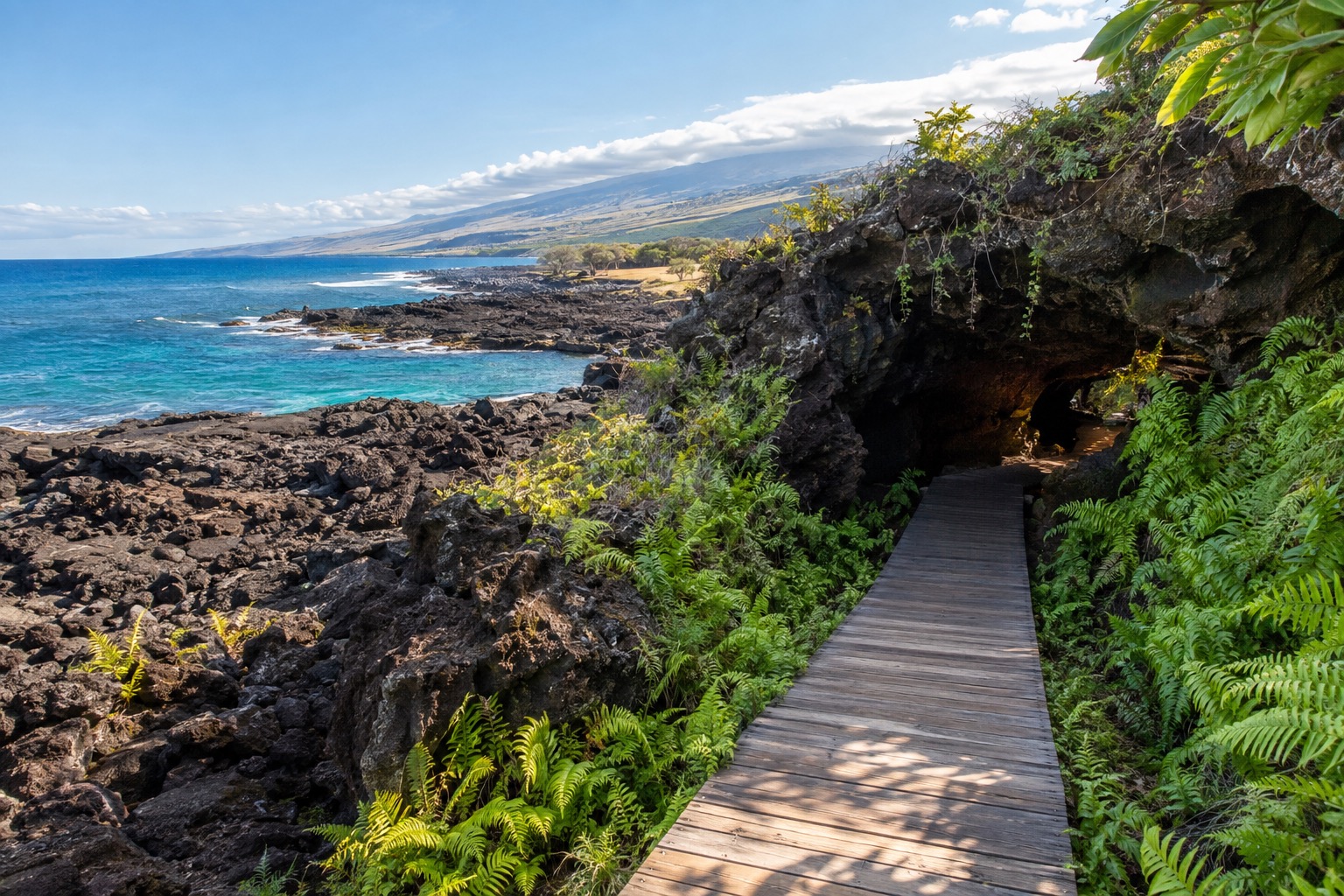
The long drive south along Highway 11 crosses lava plains and open ranch country toward Kau, a part of the island few visitors reach. Punaluu is the reward, a black sand beach where green sea turtles often rest at the edge of the sand. Keep your distance from them, and leave the sand where it is, since taking it from a public shoreline is prohibited under Hawaii law.
The Kahuku Unit of Hawaii Volcanoes National Park lies about 50 minutes south of the park’s main entrance, on the inland side of the highway near mile marker 70.5. It is open only Thursday through Sunday, so plan the day around that. Here you find hiking trails through old ranching relics and the lava flows of 1868 and 1887, and a guided two-mile hike called People and Land of Kahuku.
This route suits travelers who like quiet landscapes and wide-open views more than crowds. Start early, fill the gas tank before the long empty stretches, and pack lunch, since choices on the road are few. It pairs well with a visit to the main park for a long, full day.
| Site | Hours and admission |
|---|---|
| Hawaii Volcanoes National Park | $30.00 per private vehicle, covering up to 14 passengers |
| Nahuku (Thurston Lava Tube) | Lit daily, 8 a.m. to 8 p.m. |
| Kahuku Unit | Thursday through Sunday, 8 a.m. to 4 p.m., no entrance fee |
| Maunakea Visitor Information Station | Open daily, 9 a.m. to 9 p.m. |
| Akaka Falls State Park (non-residents) | $5.00 per person plus $10 per vehicle for parking |
| Puuhonua o Honaunau | $20.00 per private vehicle, $15.00 per motorcycle, $10.00 on foot or bicycle (age 16 and older), good for seven days |
| Puukohola Heiau | Free |
| Hapuna Beach (non-residents) | $5.00 per person plus $10 per vehicle for parking |
Day trips in the Big Island compared
| Trip | Time each way | Best for | How to go |
|---|---|---|---|
| Hawaii Volcanoes | Short from Hilo, long from Kona | Craters, lava tubes, a coastal drive | Rental car |
| Maunakea | A long climb on Saddle Road | Stars, high-altitude scenery | Four-wheel drive or a tour |
| Hilo waterfalls | Short hops around Hilo | Easy walks, green scenery | Rental car |
| South Kona | A modest drive south of Kailua-Kona | History, turtles, coffee | Rental car |
| Kohala coast | Close to Waikoloa resorts | A heiau and a beach | Rental car |
| Kau | A long drive past the national park | Quiet trails, black sand | Rental car |
Pick by base and by weather. Hilo makes the volcano and the waterfalls easy, while Kona and Waikoloa are closer to the dry coast and the historic sites. Save Maunakea for a clear evening, and give the long southern drive its own day rather than squeezing it into another.
Tour or on your own?
A tour makes sense for the places where driving is the hard part: the climb up Maunakea, where your rental car cannot go past the visitor station, and the long round trips from Kona to the volcano. Someone else behind the wheel means you can look out the window, and a guide adds stories about the land that signs do not.
Your own car suits everything else, from the Hilo waterfalls to the Kohala coast and the South Kona sites, because you set the pace and stay as long as you like. The island’s public bus is a slower way to get around and does not reach most of these places easily. Before booking a tour, check what it includes, where it starts, how long you spend at each stop, and whether the entrance fees are covered.
Good to know before you go
Everything is in U.S. dollars, and several state parks charge non-residents at the gate, so keep a card handy. The Central Pacific hurricane season runs from June 1 to November 30, so watch the forecast if you travel in those months, and remember that Maunakea’s cold and thin air can catch people off guard. Hotels and businesses add taxes to the bill.
| Fee | Amount | Who pays |
|---|---|---|
| State Transient Accommodations Tax | 11.00% | Guests, on lodging |
| County of Hawaii Transient Accommodations Tax | 3% | Guests, on lodging |
| General Excise Tax passed on by businesses | Up to 4.712% | Customers, on purchases |
Sources
- Hawaii Department of Taxation, Tax Announcement No. 2025-03 (Transient Accommodations Tax Law Changes from 2025 Legislative Session), files.hawaii.gov/tax/news/announce/ann25-03.pdf, checked September 24, 2026
- County of Hawaii, Department of Finance, Transient Accommodations Tax (TAT) page, hawaiicounty.gov/departments/finance/transient-accommodations-tax-tat (live returned HTTP 403 on request, read via Internet Archive Wayback Machine snapshot dated August 14, 2026, same official content), checked September 25, 2026
- Hawaii Department of Taxation, County Surcharge on General Excise and Use Tax page, tax.hawaii.gov/geninfo/countysurcharge/, checked September 25, 2026
- Federal Aviation Administration, CY2024 Commercial Service Enplanements (xlsx), faa.gov/airports/planning_capacity/passenger_allcargo_stats/passenger/arp-cy2024-commercial-service-enplanements.xlsx, checked September 24, 2026
- National Park Service, "Fees & Passes", nps.gov/havo/planyourvisit/fees.htm, read September 25, 2026
- National Park Service, "NPS Geodiversity Atlas – Hawaiʻi Volcanoes National Park", nps.gov/articles/nps-geodiversity-atlas-hawai-i-volcanoes-national-park-hawai-i.htm, read September 25, 2026
- U.S. Geological Survey, Hawaiian Volcano Observatory, "Kīlauea Volcano Updates", usgs.gov/volcanoes/kilauea/volcano-updates, read September 24, 2026
- University of Hawaiʻi at Hilo, Center for Maunakea Stewardship, "Important Things to Know", hilo.hawaii.edu/maunakea/visitor-information/important-things-to-know, read September 25, 2026
- University of Hawaiʻi at Hilo, Center for Maunakea Stewardship, "Maunakea Visitor Information Station", hilo.hawaii.edu/maunakea/visitor-information/station, read September 25, 2026
- Hawaiʻi Department of Land and Natural Resources, Division of State Parks, "ʻAkaka Falls State Park", dlnr.hawaii.gov/dsp/parks/hawaii/akaka-falls-state-park/, read September 25, 2026
- National Park Service, "Fees & Passes", nps.gov/puho/planyourvisit/fees.htm, read September 25, 2026
- National Park Service, "History & Culture", nps.gov/puhe/learn/historyculture/index.htm, read September 25, 2026
- Hawaiʻi Department of Land and Natural Resources, Division of State Parks, "Kealakekua Bay State Historical Park", dlnr.hawaii.gov/dsp/parks/hawaii/kealakekua-bay-state-historical-park/, read September 25, 2026
- Hawaiʻi State Legislature, Session Laws of Hawaiʻi 2024, Act 198 (H.B. No. 2298), Section 1, data.capitol.hawaii.gov/sessions/sessionlaws/Years/SLH2024/SLH2024_Act198.pdf, read September 25, 2026
- Hawaiʻi State Legislature, Session Laws of Hawaiʻi 2024, Act 198 (H.B. No. 2298), Section 1-2, data.capitol.hawaii.gov/sessions/sessionlaws/Years/SLH2024/SLH2024_Act198.pdf, read September 25, 2026
- NOAA Fisheries, "Viewing Marine Wildlife in Hawaiʻi", fisheries.noaa.gov/pacific-islands/marine-life-viewing-guidelines/viewing-marine-wildlife-hawaii, read September 25, 2026
- Hawaiʻi State Legislature, S.B. No. 3032, S.D. 1, H.D. 2 (2026), Section 1, data.capitol.hawaii.gov/sessions/session2026/bills/SB3032_HD2_.pdf, read September 25, 2026
- Hawaiʻi Department of Land and Natural Resources, Division of State Parks, "New Fees Go Into Effect at Hawaiʻi State Parks", dlnr.hawaii.gov/dsp/announcements/new-fees-go-into-effect-at-hawaii-state-parks-on-friday-october-9/, read September 25, 2026
- NPS, Day Hike Nahuku (Thurston Lava Tube), https://www.nps.gov/havo/planyourvisit/day-hike-nahuku.htm, checked September 25, 2026
- NPS, Hawaii Volcanoes National Park expands hours and increases access to Kahuku Unit, https://www.nps.gov/havo/learn/news/20220523-nr-kahuku-hrs.htm, checked September 25, 2026
- NPS, Hike and Explore the Park's Kahuku Unit in Kau, https://www.nps.gov/havo/learn/news/hike-and-explore-kahuku.htm, checked September 25, 2026
- NPS, Camping, https://www.nps.gov/havo/planyourvisit/camp.htm, checked September 25, 2026
- NOAA Fisheries, "Green Turtle", fisheries.noaa.gov/species/green-turtle, read September 25, 2026
- National Park Service, "Fees & Passes", nps.gov/puhe/planyourvisit/fees.htm, read September 25, 2026
- National Park Service, "Drive Chain of Craters Road", nps.gov/havo/planyourvisit/ccr_tour.htm, read September 25, 2026
- Hawaiʻi Department of Land and Natural Resources, Division of State Parks, "Wailuku River State Park", dlnr.hawaii.gov/dsp/parks/hawaii/wailuku-river-state-park/, read September 25, 2026
- Hawaiʻi Department of Land and Natural Resources, Division of State Parks, "Hāpuna Beach State Recreation Area", dlnr.hawaii.gov/dsp/parks/hawaii/hapuna-beach-state-recreation-area/, read September 25, 2026
- NPS, Directions, https://www.nps.gov/havo/planyourvisit/directions.htm, checked September 25, 2026
- Hawaii Department of Transportation, New phase of Daniel K. Inouye Highway opens Oct. 10 2017, https://hidot.hawaii.gov/highways/new-phase-of-daniel-k-inouye-highway-opens-oct-10-2017/, checked September 25, 2026
- USGS, November 27-December 10, 2022 Eruption of Mauna Loa, https://www.usgs.gov/volcanoes/mauna-loa/science/november-27-december-10-2022-eruption-mauna-loa, checked September 25, 2026
- NOAA NCEI, monthly normals 1991-2020, station USW00021510
- NOAA NCEI, monthly normals 1991-2020, station USW00021504
- NOAA NCEI, monthly normals 1991-2020, station USC00511303
- NOAA NCEI, monthly normals 1991-2020, station USC00518422
- NWS Honolulu / Central Pacific Hurricane Center, « 2026 Central Pacific Hurricane Season Outlook », weather.gov/hfo/hurricaneOutlook2026, checked September 24, 2026