
Mornings on the Kona side start with the smell of roasting coffee drifting up from the hillside farms, while in Hilo the day opens under gray skies, with rain on the tin roofs and farmers setting up their tables downtown. Evenings are just as different, with sunset crowds along the seawall in Kailua-Kona and a cool, quiet hush in the ohia forest near the volcano. The Big Island is large enough that where you sleep shapes the whole vacation, so the choice of base matters.
What is the best area to stay in the Big Island?
For a first visit, Kailua-Kona is the easiest base, for pure beach time the Kohala Coast resorts are the natural pick, for a lower-key and more local stay Hilo works well, and for a night near the volcano a cabin in Volcano Village is hard to beat. Families usually lean toward the Kohala Coast or Kona, while the closest thing to nightlife is the Kailua-Kona waterfront.
The island has two personalities. The west side is dry, sunny and made for the beach, and the east side is green, wet and close to waterfalls and the national park. Many travelers split their stay between a sunny coast and a night or two on the other side.
The best areas to stay in the Big Island
Kailua-Kona
Kailua-Kona is a working waterfront town with a seawall promenade, open-air restaurants, shops and a busy pier where fishing boats and snorkel cruises come and go. Sunsets draw people outdoors every evening, and this is the one place on the island where you can stroll to dinner and a drink without getting in the car. The climate is dry and warm, with very little rain through the year.
Lodging runs from older oceanfront condos and apartments with kitchens to small inns and mid-size hotels. The airport is on the same side of the island, a short drive from town, which makes arrival and departure days simple. From here you can reach the historic sites and coffee country along the coast, though most outings still need a rental car. A tip: the town has more rocky shoreline than sandy beach, so if swimming from your doorstep matters, check how the particular property meets the water before booking.
Kohala Coast and Waikoloa
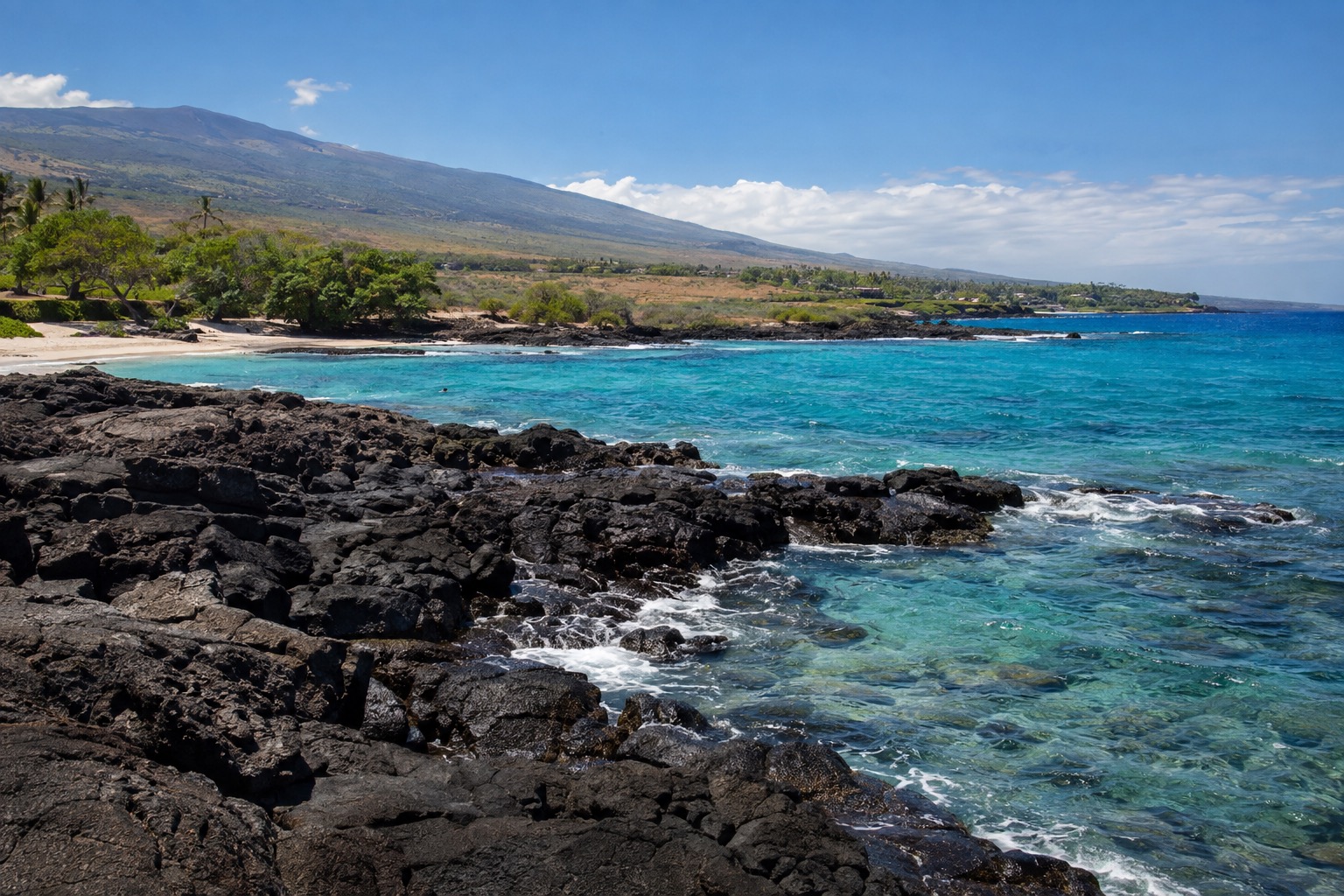
North of Kona, the Kohala Coast is black lava fields broken by pale crescents of sand and large resorts with lagoons, pools and golf courses. It is the sunniest, driest stretch of the island, and its beaches are the reason people come. Hapuna Beach is one of the island’s best-loved sandy stretches, and Waikoloa has its own shops and restaurants within easy reach of the resorts.
Expect full-service resorts, some with extensive grounds and activities for children, plus condo complexes and vacation rentals with full kitchens. It suits families, couples on a beach-first vacation and anyone who wants to park the car for a few days. The trade-off is that evenings are quiet and most meals happen on the resort property or a short drive away. One thing to keep in mind: swells build along plenty of coasts in winter, so find out what beach sits in front of your resort and, the way residents do, check the posted signs along with that day’s surf and currents before you head in, and only swim beside a lifeguard where one is stationed.
Hilo
Hilo is the island’s most lived-in town, with a farmers market, old wooden storefronts, a bayfront and plenty of rain, which is exactly what keeps the gardens and waterfalls so lush. Rainbow Falls and Akaka Falls sit within easy reach, and the town feels like Hawaii going about its day rather than a resort stage set.
Lodging here is modest and personal: guesthouses, bed-and-breakfasts, older hotels along the bay and apartments. It suits budget-minded travelers, food lovers and anyone planning to spend days at the national park, which is about a 45 minute drive from town. Hilo has its own airport, handy if you fly in on the east side.
A tip: pack a rain jacket and treat showers as part of the scenery. Days often start gray and brighten later.
Volcano Village
Tucked in fern forest at around 4,000 feet, Volcano Village sits minutes from the entrance to Hawaii Volcanoes National Park. Mornings are cool and misty, nights call for a sweater, and the crater glow can light the sky after dark. It is a place for early starts, quiet evenings and a few good restaurants.
Lodging is mostly small: cottages, inns, cabins and vacation rentals, often with a fireplace or wood stove. It suits hikers, couples and anyone who wants to see the park before the day-trippers arrive. Nightlife is essentially absent, and you will want a car, since the village is a long drive from both airports. A tip: one or two nights is usually enough here, then move on to a sunnier coast for beach days.
The Big Island areas compared
| Area | Best for | Feel | Getting around |
|---|---|---|---|
| Kailua-Kona | First visit, nightlife | Lively waterfront town, dry and sunny | Walkable core, car for outings |
| Kohala Coast and Waikoloa | Beaches, families | Resort coast, quiet evenings | Car, or resort shuttles and walking |
| Hilo | Budget, local life, waterfalls | Rainy, green, small-town | Car, with the town center on foot |
| Volcano Village | Volcano visits, hiking | Cool, misty forest, very quiet | Car |
The trade-offs are simple. Beach resorts give you sun and ease but little local flavor, while Hilo and Volcano Village give you character and rain jackets but no beach at the door. Kona sits in between, with a lively evening scene and a drier climate, and it asks you to drive for the best sand.
How to choose your hotel in the Big Island
Start with how you like to spend a day. A full-service resort covers meals, pools, activities and beach in one place, which suits families and travelers who want few decisions. A condo or vacation rental with a kitchen gives more space and flexibility, especially for longer stays, and is easy to find in Kona and on the Kohala Coast.
Look closely at the shoreline. Some resorts have a sandy beach or a protected lagoon, while others face rocky lava coast and offer pools instead. Ask where the nearest good swimming spot is, and remember that surf depends on the season and the side of the island.
Winter holidays, spring break and summer family weeks fill the resorts, so book early for those periods. Big events, such as the triathlon in Kona in October, can tighten availability in town. Families and travelers with limited mobility should ask about stairs, distance from the room to the beach and the lay of the grounds, since some resorts are very spread out.
Before booking, check noise from nearby roads or restaurants, whether parking is included, and how far you are from the places you most want to visit. Splitting a stay between two areas saves a lot of driving, but each move eats part of a day, so two bases are plenty.
Good to know before you go
Most visitors land at Kona or Hilo, and a rental car is the usual way to reach lodging from either airport. Everything is paid in U.S. dollars, with no passport or visa needed from the mainland. Taxes are added to the room rate, and these are the main ones.
| Fee | Amount | Who pays |
|---|---|---|
| State Transient Accommodations Tax | 11.00% | Guests, on the room rate |
| County of Hawaii Transient Accommodations Tax | 3% | Guests, on the room rate |
| General Excise Tax pass-on (County of Hawaii) | Up to 4.7120% | Guests, added by the business |
Sources
- Hawaii Department of Taxation, Tax Announcement No. 2025-03 (Transient Accommodations Tax Law Changes from 2025 Legislative Session), files.hawaii.gov/tax/news/announce/ann25-03.pdf, checked September 24, 2026
- County of Hawaii, Department of Finance, Transient Accommodations Tax (TAT) page, hawaiicounty.gov/departments/finance/transient-accommodations-tax-tat (live returned HTTP 403 on request, read via Internet Archive Wayback Machine snapshot dated August 14, 2026, same official content), checked September 25, 2026
- Hawaii Department of Taxation, County Surcharge on General Excise and Use Tax page, tax.hawaii.gov/geninfo/countysurcharge/, checked September 25, 2026
- Federal Aviation Administration, CY2024 Commercial Service Enplanements (xlsx), faa.gov/airports/planning_capacity/passenger_allcargo_stats/passenger/arp-cy2024-commercial-service-enplanements.xlsx, checked September 24, 2026
- National Park Service, "Fees & Passes", nps.gov/havo/planyourvisit/fees.htm, read September 25, 2026
- National Park Service, "NPS Geodiversity Atlas – Hawaiʻi Volcanoes National Park", nps.gov/articles/nps-geodiversity-atlas-hawai-i-volcanoes-national-park-hawai-i.htm, read September 25, 2026
- U.S. Geological Survey, Hawaiian Volcano Observatory, "Kīlauea Volcano Updates", usgs.gov/volcanoes/kilauea/volcano-updates, read September 24, 2026
- University of Hawaiʻi at Hilo, Center for Maunakea Stewardship, "Important Things to Know", hilo.hawaii.edu/maunakea/visitor-information/important-things-to-know, read September 25, 2026
- University of Hawaiʻi at Hilo, Center for Maunakea Stewardship, "Maunakea Visitor Information Station", hilo.hawaii.edu/maunakea/visitor-information/station, read September 25, 2026
- Hawaiʻi Department of Land and Natural Resources, Division of State Parks, "ʻAkaka Falls State Park", dlnr.hawaii.gov/dsp/parks/hawaii/akaka-falls-state-park/, read September 25, 2026
- National Park Service, "Fees & Passes", nps.gov/puho/planyourvisit/fees.htm, read September 25, 2026
- National Park Service, "History & Culture", nps.gov/puhe/learn/historyculture/index.htm, read September 25, 2026
- Hawaiʻi Department of Land and Natural Resources, Division of State Parks, "Kealakekua Bay State Historical Park", dlnr.hawaii.gov/dsp/parks/hawaii/kealakekua-bay-state-historical-park/, read September 25, 2026
- Hawaiʻi State Legislature, Session Laws of Hawaiʻi 2024, Act 198 (H.B. No. 2298), Section 1, data.capitol.hawaii.gov/sessions/sessionlaws/Years/SLH2024/SLH2024_Act198.pdf, read September 25, 2026
- Hawaiʻi State Legislature, Session Laws of Hawaiʻi 2024, Act 198 (H.B. No. 2298), Section 1-2, data.capitol.hawaii.gov/sessions/sessionlaws/Years/SLH2024/SLH2024_Act198.pdf, read September 25, 2026
- NOAA Fisheries, "Viewing Marine Wildlife in Hawaiʻi", fisheries.noaa.gov/pacific-islands/marine-life-viewing-guidelines/viewing-marine-wildlife-hawaii, read September 25, 2026
- Hawaiʻi State Legislature, S.B. No. 3032, S.D. 1, H.D. 2 (2026), Section 1, data.capitol.hawaii.gov/sessions/session2026/bills/SB3032_HD2_.pdf, read September 25, 2026
- Hawaiʻi Department of Land and Natural Resources, Division of State Parks, "New Fees Go Into Effect at Hawaiʻi State Parks", dlnr.hawaii.gov/dsp/announcements/new-fees-go-into-effect-at-hawaii-state-parks-on-friday-october-9/, read September 25, 2026
- NPS, Day Hike Nahuku (Thurston Lava Tube), https://www.nps.gov/havo/planyourvisit/day-hike-nahuku.htm, checked September 25, 2026
- NPS, Hawaii Volcanoes National Park expands hours and increases access to Kahuku Unit, https://www.nps.gov/havo/learn/news/20220523-nr-kahuku-hrs.htm, checked September 25, 2026
- NPS, Hike and Explore the Park's Kahuku Unit in Kau, https://www.nps.gov/havo/learn/news/hike-and-explore-kahuku.htm, checked September 25, 2026
- NPS, Camping, https://www.nps.gov/havo/planyourvisit/camp.htm, checked September 25, 2026
- NOAA Fisheries, "Green Turtle", fisheries.noaa.gov/species/green-turtle, read September 25, 2026
- National Park Service, "Fees & Passes", nps.gov/puhe/planyourvisit/fees.htm, read September 25, 2026
- National Park Service, "Drive Chain of Craters Road", nps.gov/havo/planyourvisit/ccr_tour.htm, read September 25, 2026
- Hawaiʻi Department of Land and Natural Resources, Division of State Parks, "Wailuku River State Park", dlnr.hawaii.gov/dsp/parks/hawaii/wailuku-river-state-park/, read September 25, 2026
- Hawaiʻi Department of Land and Natural Resources, Division of State Parks, "Hāpuna Beach State Recreation Area", dlnr.hawaii.gov/dsp/parks/hawaii/hapuna-beach-state-recreation-area/, read September 25, 2026
- NPS, Directions, https://www.nps.gov/havo/planyourvisit/directions.htm, checked September 25, 2026
- Hawaii Department of Transportation, New phase of Daniel K. Inouye Highway opens Oct. 10 2017, https://hidot.hawaii.gov/highways/new-phase-of-daniel-k-inouye-highway-opens-oct-10-2017/, checked September 25, 2026
- USGS, November 27-December 10, 2022 Eruption of Mauna Loa, https://www.usgs.gov/volcanoes/mauna-loa/science/november-27-december-10-2022-eruption-mauna-loa, checked September 25, 2026
- NOAA NCEI, monthly normals 1991-2020, station USW00021510
- NOAA NCEI, monthly normals 1991-2020, station USW00021504
- NOAA NCEI, monthly normals 1991-2020, station USC00511303
- NOAA NCEI, monthly normals 1991-2020, station USC00518422
- NWS Honolulu / Central Pacific Hurricane Center, « 2026 Central Pacific Hurricane Season Outlook », weather.gov/hfo/hurricaneOutlook2026, checked September 24, 2026