
LISBON · IS IT SAFE? · THE CITY-LEVEL ANSWER
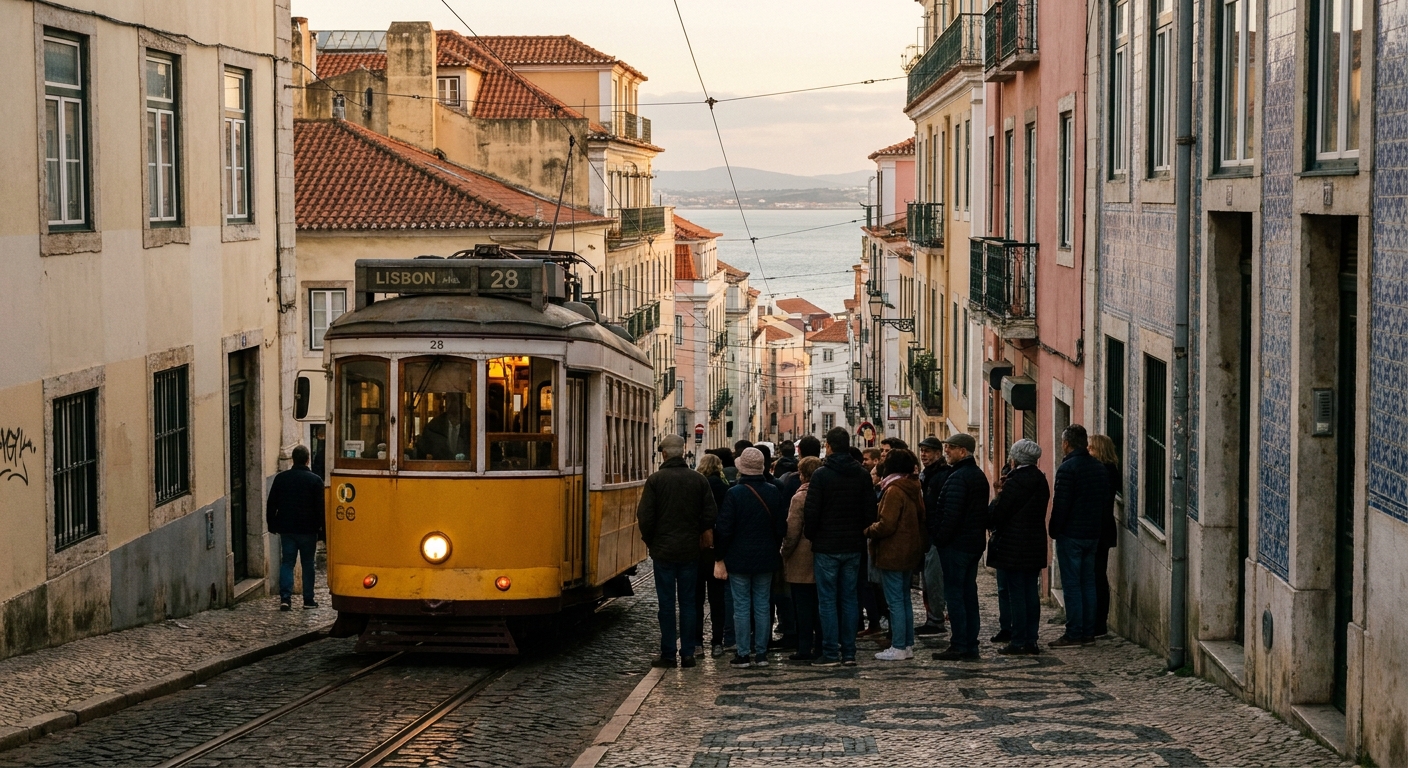
Lisbon’s safety file is short and very specific. The crime that reaches visitors is theft by hand, and it gathers in the places already on your itinerary: the crush on tram 28, the escalators at Baixa-Chiado, the ticket queue at the Santa Justa lift, the terrace table where a phone sits beside the coffee. Then there is the part nobody photographs: polished limestone on a wet slope, a tram filling a lane with no sidewalk, a car turning across a crossing without slowing. National questions, from the advisory tier to tap water, sit on the Portugal safety guide.
SAFETY AT A GLANCE · LISBON
Keep the bag zipped in any crowd, put grip on your shoes for wet calçada, and what remains is the ordinary night-time arithmetic of a European capital.
URBAN RISK: THEFT BY HAND · URBAN INJURY: SLIPS AND SLOPES · ADVISORY TIER: SEE THE COUNTRY PAGE
Perspective: the two habits that cover most of Lisbon are a zipped bag worn in front and rubber soles. Everything else on this page is detail.
Think twice before: walking a steep, wet, unlit stairway home after a night in Bairro Alto. The stone is the reason, not the neighborhood.
Emergency and tourist police information: official · full sources at the end of this guide
On this page
- Is Lisbon safe for visitors?How safe Lisbon is, city level
- Pickpockets in LisbonTram 28, the Metro and terrace tables
- Which streets and hours to avoid in LisbonThe quiet stretches after midnight
- The cobbles, hills and tramsCalçada, slopes, rails and crossings
- Scams in LisbonThe Baixa street offer of hash
- Emergency numbers and theft reports112, tourist police, cards, passport
How safe is Lisbon?
The advisory tier, the peace-index standing and the pharmacy-and-tap-water basics belong to the country and are covered as such. In Lisbon the question narrows to hands in crowds and feet on stone. Porto’s version reads differently, mostly because its hills are fewer and its tourist crush is concentrated in one riverfront.
The city keeps the habits of a capital that trusts itself. People walk back from dinner in Chiado without thinking about it, the Cais do Sodré ferry hall fills with commuters at seven in the morning, and no central quarter closes itself to visitors by daylight. Alfama, Mouraria and Graça are residential neighborhoods with laundry over the lanes, not zones.
So the local file contains theft in transport and queues, a handful of streets that empty out late, an old paving surface that behaves badly in rain, trams sharing lanes with pedestrians, and one persistent street approach in Baixa. Each of those is below, with the place and the hour attached.
Pickpockets in Lisbon: tram 28, the Metro and terrace tables
The pattern is dull and consistent. Tram 28 fills to standing at Martim Moniz and stays that way past the Sé, and the doorway crush is where bags open. The long escalators at Baixa-Chiado do the same work standing still. Add the ticket queues at monuments, the sunset scrum at Portas do Sol and Santa Catarina, Praça do Comércio when a cruise ship has emptied, and the Feira da Ladra flea market on Tuesdays and Saturdays.
The approach is contact without conversation. Someone stumbles into you on the step. A folded jacket or map appears at chest height. A group boards ahead of you and stops dead in the doorway while the tram pulls away. On café terraces the loss is quieter: a phone left face-down next to the espresso, a bag hung on the chair back with its flap toward the pavement.
Front-zipped bag worn across the chest in any crowd. Phone in a front trouser pocket, on the table only while in use. One card and a little cash out, the rest and the passport left at your accommodation. Outer pouches carry sunscreen and nothing that matters. Tickets, tipping and couvert etiquette live on the Lisbon know-before-you-go page.
Streets and hours in Lisbon where residents change route
Nothing in central Lisbon is off-limits. What decides a late walk is lighting and how many other people are on the street. After midnight the stretches that go empty are the ones worth skipping: the riverside parking areas either side of Cais do Sodré, the unlit stairways linking Bairro Alto down to Baixa once the bars thin out, Parque Eduardo VII in the dark, the long pavements under the Ponte 25 de Abril at Alcântara.
Around Martim Moniz, Intendente and the upper end of Rua do Benformoso, the late-night atmosphere thins and street dealing is visible. The same square feeds half the neighborhood by day and is one of the better-eating corners of the city. Alone at two in the morning, plenty of residents take the lit avenue instead, and that is a reasonable thing to copy.
Lisbon’s physical risks: calçada, slopes, tram rails and crossings
Calçada portuguesa, the hand-laid limestone paving, is the city’s signature and its most reliable way of putting a visitor on the ground. Decades of shoes polish it to a shine, and rain turns the shine into something close to ice. The bad combination is a busy descent: Rua do Alecrim toward Cais do Sodré, the pitch of Calçada do Combro, the steps below the miradouros. Rubber soles beat leather and beat smooth-soled trainers. Walk the rougher strip by the gutter, hold the rail on the escadinhas, and zigzag when the grade turns silly.
Tram rails sit flush in the stone and get just as slick. Cross them at an angle, and keep stroller and bike wheels out of the groove. In the narrow lanes of Alfama and Graça the tram takes the full width. The doorway recesses cut into the walls are where you stand while it passes, and the driver’s bell is the only warning on offer. Tuk-tuks and delivery scooters use those same lanes with less ceremony.
At crossings, drivers turning across the stripes often keep rolling, and mopeds read a red light as a suggestion. Avenida da Liberdade has long crossings and a bus lane that runs against American instinct. Look at the driver’s face rather than the signal. Anyone collecting a car on the way out of town will find the rest in the car guide.
Drug sellers in Lisbon: the hash offer in Baixa
In Baixa the standard approach comes from men posted near Rossio, Praça da Figueira, the foot of the Santa Justa lift and along Rua Augusta. They fall in beside you and murmur an offer of hashish or cocaine. What gets sold in those transactions is not the substance named, and buyers report herbs, soap and worse.
The response costs nothing: no eye contact, no reply, same walking pace. The follow rarely lasts more than half a block. It feels menacing the first time and functions as a pitch working volume. Inflated tuk-tuk quotes and ATM screens offering to convert your dollars are the other two, both handled on the country page.
Nights out in Lisbon: Bairro Alto, Cais do Sodré and the way home
Bairro Alto operates as a street party with bar service. Rooms sell drinks in plastic cups, the crowd stands in the lanes, and the density builds well after midnight. Cais do Sodré takes the later half of the night, with the pink-painted Rua Nova do Carvalho as its spine. A crowd that tight reproduces tram 28 conditions, with everyone paying less attention.
Alcohol plus gradient is the local injury. The route home from Bairro Alto runs downhill over the smoothest stone in the city, often still wet from a bar hose. Keep one hand free for a wall or a rail. Keep your own glass with you rather than parked on a windowsill while you talk.
Settle the ride home before the last round. Apps and licensed taxis both work, ranks sit around Cais do Sodré and Restauradores, and the walk down from Bairro Alto into Baixa stays populated late. Odd-hour flights are a separate problem, solved on the airport-to-city page.
Emergency numbers in Lisbon and what to do after a theft
112 reaches police, ambulance and fire, and operators handle English. For a stolen bag or phone, the PSP tourist police post at Palácio Foz on Praça dos Restauradores takes reports from visitors. Ask for the report number before you leave the desk, because your insurer will want it and a claim without it goes nowhere.
Then the phone, in order: block the cards through your bank’s app or its 24-hour line, lock and locate the handset from your own account, change the passwords that lived on it. Doing this from your accommodation’s wifi beats doing it standing on Rua Augusta with one eye on the crowd.
A stolen passport is consular business, and the US Embassy in Lisbon issues replacements. Check its consular pages for what to bring and how appointments are booked, since those requirements shift and nothing written here substitutes for them. Keep a photo of the data page somewhere that is not the stolen phone.
Lisbon safety: common situations and what prevents them
Nearly all of it occurs in two conditions: a crowd pressed into a small space, or a slope with worn stone underfoot.
| Situation | What tends to happen | What prevents it |
|---|---|---|
| Tram 28, standing room | A bag is opened in the doorway crush at a stop | Bag zipped, worn across the chest, phone in a front pocket |
| Ticket queue, Santa Justa or a monument | A back-pocket phone leaves while you read the sign | Nothing of value in back pockets or outer pouches |
| Terrace in Chiado or Rossio | Phone off the table with a newspaper over it | Phone in the pocket, bag strap around a knee |
| Wet calçada on a descent | Feet slide out on polished limestone | Rubber soles, the rough strip by the gutter, a rail on the steps |
| Narrow lane with tram rails | A tram arrives with the lane’s full width and no sidewalk | Doorway recesses, cross rails at an angle |
| Zebra crossing, Avenida da Liberdade | A turning car or moped keeps rolling | Watch the driver rather than the signal |
| Baixa, a murmured offer of hash | A half-block follow and a fake product | No eye contact, no reply, same pace |
The last word
Lisbon asks for grippy shoes and a bag that zips before it asks for any vigilance at all. After that the practice is small and repeatable. Phone off the terrace table. Hand on the bag in the tram doorway. Eyes on the driver, not the light. The rest of the city’s small print, from couvert to Metro tickets, sits on the know-before-you-go page.
The local precaution becomes visible once you look for it: residents in rubber soles taking a slope diagonally, keeping to the rough strip by the gutter, one hand on the rail of the escadinhas, stepping into a doorway before the tram bell sounds. Copy that, keep the bag shut in a crowd, and Lisbon stays what it looks like from Senhora do Monte at dusk, a steep and lit and crowded capital where dinner ends with a walk home.
Sources & data for this guide
- Advisory tier and national framework · our Portugal safety guide, sourced to the US State Department · checked Sep 6, 2026
- Emergency number 112 for police, ambulance and fire · official EU and Portuguese public information · checked Sep 6, 2026
- PSP tourist police post, Palácio Foz, Praça dos Restauradores · Polícia de Segurança Pública public information · checked Sep 6, 2026
- Replacement passports and appointments · US Embassy Lisbon consular pages · confirm before you travel, requirements change
- Tram 28 route, funiculars, Metro stations and the Feira da Ladra market days · Carris and Metropolitano de Lisboa · checked Sep 6, 2026
- Where crowds press, which stairways go dark and how calçada behaves in rain are editorial observation from repeated visits. We hold no theft statistics by street and do not pretend otherwise.
- Re-checked each season alongside the country advisory.