
PORTO · AIRPORT TO CITY · FRANCISCO SÁ CARNEIRO
Passport control ends and the first real decision of the trip is a few steps later: platform or pavement. Francisco Sá Carneiro sits north of the city, tied to it by a metro line that starts under the terminal, a signed taxi rank outside arrivals, and roads that behave differently at eight in the morning than at midnight. Neither choice is wrong. What ruins arrivals is doing the preparation at the kerb, with a phone almost out of battery and a suitcase in the rain. The city waiting at the other end, its tiers and its stairs, is described in our Porto guide.
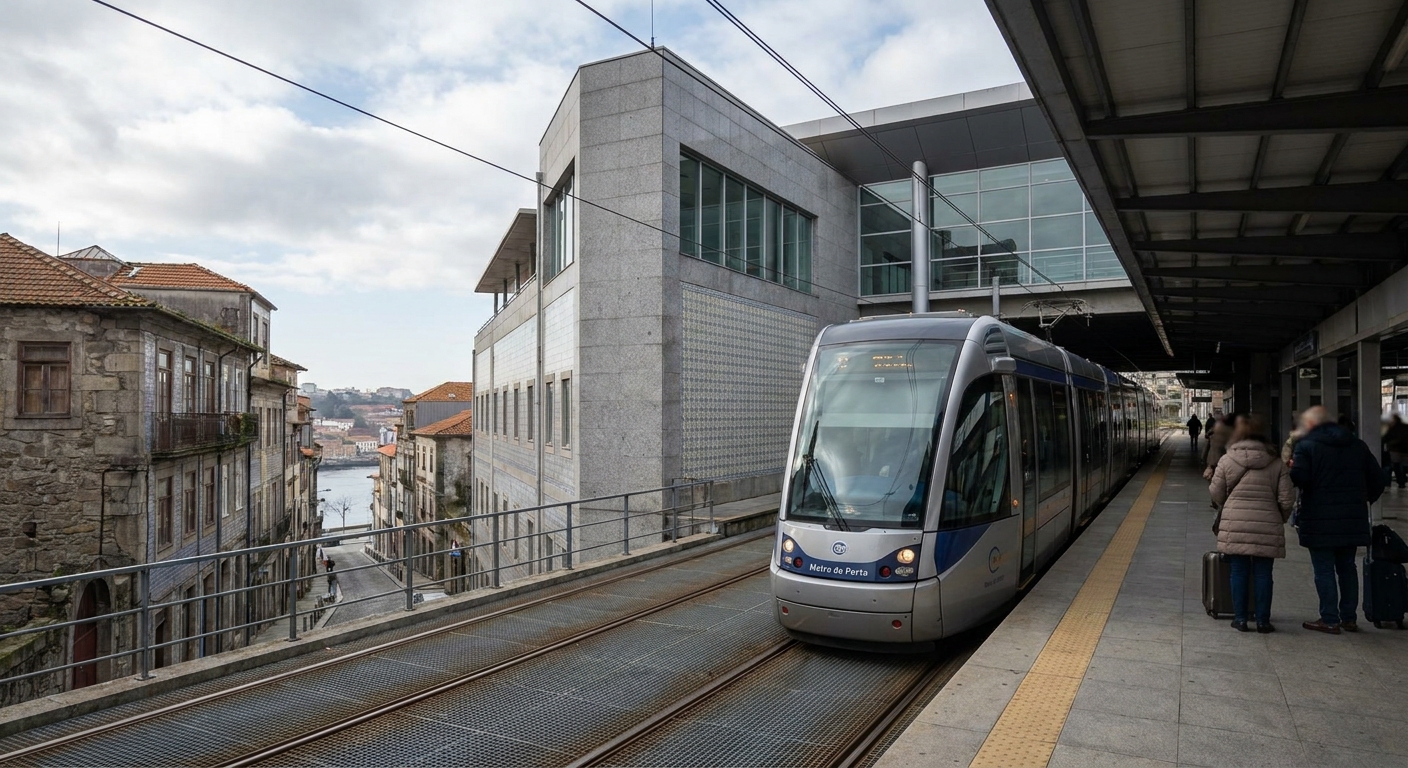
THE RIDE IN · PORTO AIRPORT
Load an Andante card and take the airport metro line, or walk out to the metered rank, and book anything else before you fly.
METRO FROM THE TERMINAL · METERED TAXIS OUTSIDE ARRIVALS · NO CAR FOR THE CENTER · BIGGER MARGIN GOING BACK
Go for: the metro when you travel light and land inside service hours, and the rank outside arrivals when you have bags, a hill address, or a child who has stopped negotiating.
Think twice before: collecting a rental car on arrival if the first nights are in the historic center, and before assuming the ride back takes what the ride in took.
Transport: Metro do Porto and ANA Aeroportos · fares, timetables and taxi tariffs left with the operators · sources dated at the end
On this page
- The cheapest way into the centerPorto airport metro: line, Andante card, changes
- A door-to-door ride with luggageTaxis and ride-hailing at Porto airport
- Something booked before I flyShuttles, private transfers and rental cars
- All the options in one tableMetro, taxi, transfer: which one for your arrival
- Getting back on departure dayPorto to the airport: margin and rush hour
- Landing late, or arriving with kidsNight arrivals and travel with children
Porto airport to the city center by metro: the line, the Andante card, the changes
The metro station is part of the airport complex, at the end of the arrivals walkway, and the airport line runs from there into the middle of Porto before continuing east to Campanhã, where the mainline trains stop. One ride, no traffic lights. For the other lines, including the one that serves São Bento and crosses the upper deck of the Dom Luís I to Vila Nova de Gaia, you change at Trindade, the point where the network crosses itself.
Tickets are not sold on board. You buy a rechargeable Andante card from the machines beside the platform, load a fare for the zone covering the airport, which is an outer one and priced above a short city hop, and validate the card against the reader before going down. The machines take coins and cards and run in English. Validate once, at the start, and keep the card somewhere you can reach with both hands full.
Service has a first and a last departure, published by Metro do Porto, so a delayed evening landing can meet a line that has already stopped. The other variable is the last hundred meters: some central stations hand you an escalator, others a staircase, and a hill on top of that. Andante zones and the rest of the country’s ticket types are set out in Getting Around Portugal.
Taxis and ride-hailing at Porto airport
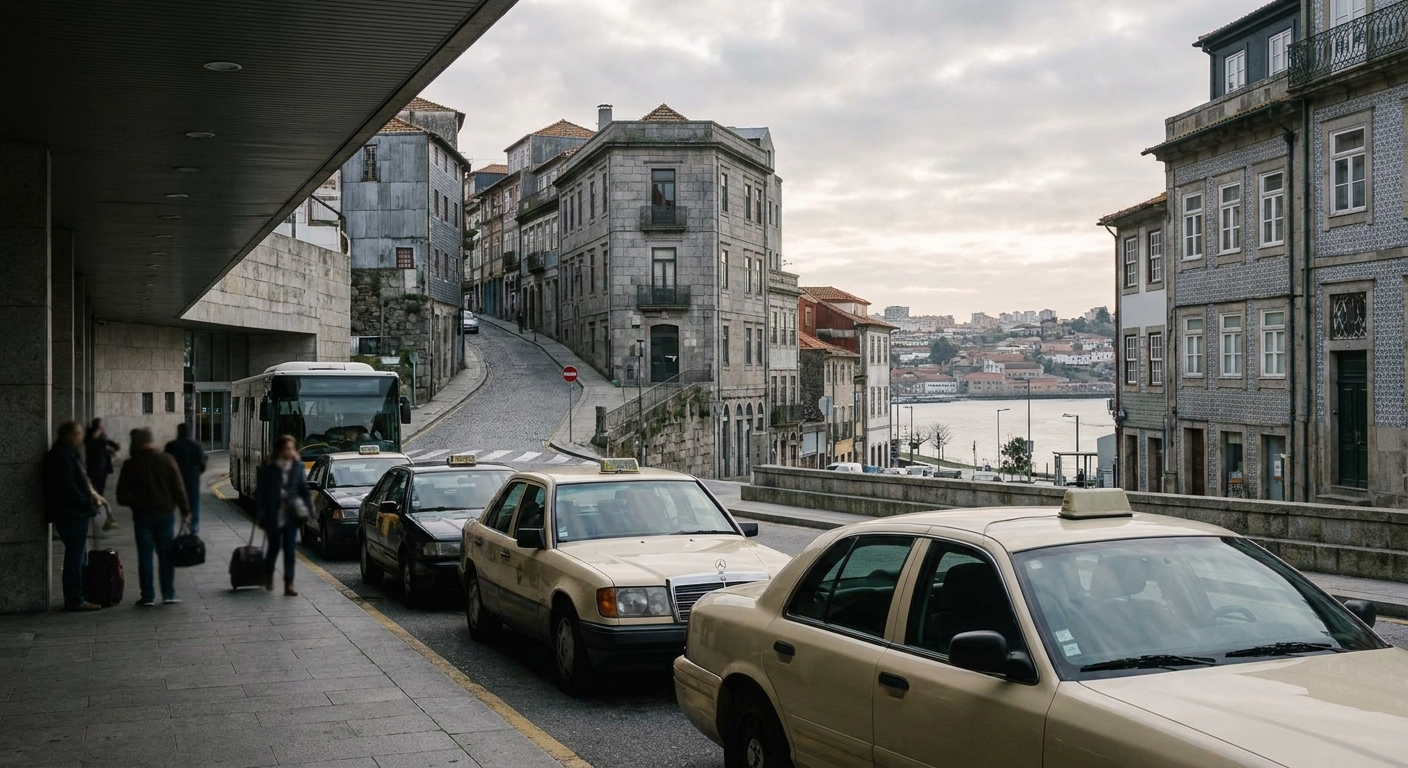
The taxi rank is signposted outside the arrivals hall and the cars work on the meter. Have the address written down, door number and neighborhood included, because street names repeat across the metropolitan area and a driver reading a line of text is faster than a driver reading your phone at the kerb. Supplements for night hours, weekends and luggage are posted inside the car.
Ride-hailing works from a marked pickup zone rather than the rank, which means a short walk and a plate number to match. Install the app, add a payment method and test it at home, since airport wifi and a foreign SIM both choose their moment to fail. If your address ends in a stairway, and plenty do here, ask to be dropped at the nearest street a car can turn in. Which bank you sleep on changes the shape of this ride, and our neighborhood guide weighs Ribeira, Baixa, Gaia and Foz.
Hotel shuttles, private transfers and rental cars at Porto airport
Some properties in Gaia, in Foz and around the Boavista business grid run their own pickups, and a number of apartment operators resell a fixed-price car. The mechanics are always the same: send the flight number, get the meeting point in writing, reconfirm the day before travel.
A shared shuttle waits for the flight cluster and drops guests in its own order, which turns a straight run into a tour of somebody else’s hotel list. That is tolerable at eleven in the morning and much less so with a sleeping child on your shoulder.
A booked private car is the option that survives a delayed night landing without improvisation, because the driver follows the flight and the price was agreed weeks earlier. Request a child seat at booking rather than at the kerb. Put the return leg in the same reservation while you are there, since departure morning is the moment nobody wants to spend on the phone.
Collecting a rental car at the terminal makes sense when the trip leaves town immediately, for the Douro or for the north. It makes very little sense when the first nights are in the historic center, where parking is scarce and the car becomes a problem to store. Automatics, tolls and the electronic transponder are covered by Renting a Car in Portugal, and the argument for picking the car up on the way out runs through day trips from Porto.
Fake drivers and off-meter offers in the arrivals hall
Anyone offering a ride inside the terminal, before the doors, is not the official rank. A polite no and a walk to the signed line outside settles it. Taxis run the meter. App rides show the fare in the app before the door opens. A round number quoted for the center with the meter switched off is the one to decline, without drama and without assuming the worst about the next person who speaks to you. Ordinary station-crowd caution is handled in our Porto safety page.
What to sort out before you fly: the app, the address, the card, the coins
Do the fiddly parts at home. Write the address on paper as well as in the phone, with a cross street and the neighborhood name. Download the transport and ride-hailing apps while your own wifi is still doing the work. Find out whether your accommodation has a staffed desk, a key box or someone who has to be met, because that answer decides what time you can afford to land.
Carry a little cash for the ticket machine and for the driver whose card reader is having a bad evening. Contactless is widely accepted here, though not always at the exact counter where you need it. Plugs, SIM cards and the rest of the pre-departure list run in know before you go, and country-level planning starts at our Portugal hub.
Porto Airport to the city center: metro vs taxi vs private transfer
| Option | Travel time | Have ready | When the metro is the wrong choice |
|---|---|---|---|
| Metro | Fixed by timetable, indifferent to road traffic | Andante card loaded and validated, destination station written down | A landing after the last departure, or four suitcases and a stairs-only exit |
| Official taxi | Quickest on clear roads, slowest in the morning peak | Written address, meter running, card or cash | A group needing two cars, or a child seat you assumed would be there |
| Ride-hailing app | The same roads as the taxi | App installed, payment added, data or terminal wifi | A dead phone, no roaming, or a driver circling the pickup zone |
| Hotel or apartment shuttle | Set by the operator, plus any wait for other guests | Flight number sent ahead, meeting point in writing | Delays past the last scheduled pickup, or a property that runs none |
| Private transfer | Door to door, no changes | Booking confirmation, name board agreed, seats requested | Improvising it at the terminal on the day |
| Rental car | Counter queue first, road second | Licence, credit card in the driver’s name, toll decision made | Three nights in the historic center with nowhere to park |
Timings here stay qualitative on purpose. Metro headways, taxi tariffs and airline counter hours are published by the operators and change through the year; the two worth looking up before you fly are the first and last metro departures and your airline’s check-in window.
Porto to the airport on departure day: how early to leave
Departure day runs on a different clock. Morning traffic funnels onto a small number of river crossings and radial avenues, and the check-in desk closes when the airline says so. Build the margin around the worst plausible version of the journey rather than the easy one you had coming in.
The metro’s advantage on that morning is that its clock is a timetable. A taxi is faster on an open road and slower than anything else on a blocked one. Leaving from Gaia or Foz adds the crossing or the run along the river before the airport road even starts, and a public holiday, a match at the Dragão or a strike day adds more.
If a driver is taking you, set the pickup against the flight rather than against breakfast, and confirm it the night before. If the metro is taking you, look up the departure station in advance and find out whether it offers a lift, an escalator or a flight of steps with a suitcase in each hand. A clean exit at the end of a short city stay is sequenced in our three-day Porto plan.
Late-night arrivals at Porto Airport, and arriving with kids and heavy bags
A late landing shortens the list. The metro stops for the night at a published hour, reception desks thin out, and what remains is the metered rank outside arrivals or a car booked in advance that follows the flight. Tell your accommodation the arrival time in writing and get a named answer about who opens the door after midnight.
With small children, seats and stairs decide everything. A child seat is not something to count on at the rank, so request one when you book a private car. A folded stroller handles a metro escalator better than two wheeled cases do. Families building the wider trip get a fuller briefing in Portugal with kids, and we ran the same arrival exercise for the capital in Lisbon airport to the city center.
The last word
On the way in, the airport line comes up out of its tunnel for a few minutes of low houses, eucalyptus and warehouse roofs before the city closes over it again. That stretch is your first look at the north of Portugal, and it is worth lifting your head for, suitcase between the knees, instead of wrestling with a data plan that has not woken up yet.
Buy the card, write the address down, walk past whoever offers you a ride before the doors. Then keep the card in your wallet. On departure morning the only thing left to remember is which platform, which is about as much thinking as the ride out deserves in a city that will spend your legs on everything else.
Sources & data for this guide
- Airport metro station, fare zones and Andante ticketing · Metro do Porto (official) · checked Sep 6, 2026
- Terminal layout, taxi rank and ride-hailing pickup point at Francisco Sá Carneiro · ANA Aeroportos de Portugal (official) · checked Sep 6, 2026
- Onward rail connections at Campanhã and São Bento · CP Comboios de Portugal · checked Sep 6, 2026
- Editorial note: no fares, journey times, timetables or taxi tariffs appear on this page on purpose. They move, and the operators publish them. The sequencing advice, the departure-day margin and the luggage notes are editorial judgment from ground reporting.