
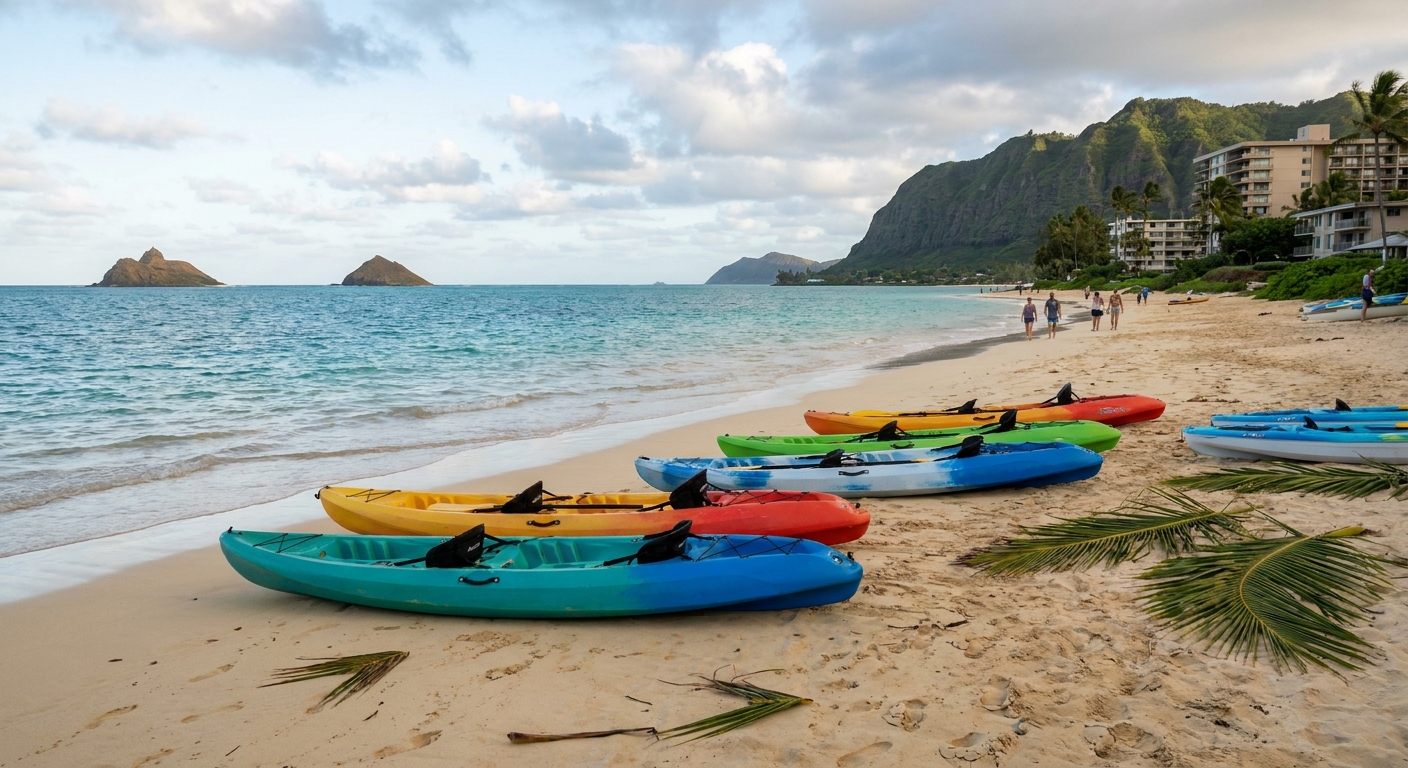
Early in the morning, kayaks slide across the shallow turquoise water of Kailua Bay while the trade winds fill the sails of windsurfers, and the two Mokulua islets sit on the horizon like a postcard that actually moves. Kailua is a relaxed beach town on Oahu’s windward coast, a world away from Waikiki. It suits travelers who would rather paddle, walk and eat at a neighborhood café than watch a resort skyline.
Where is Kailua and what is it like?
Kailua sits on Oahu’s windward, or east, coast, on the other side of the Koolau mountains from Honolulu, with Lanikai just south along the same bay. It is a residential beach town more than a resort, with quiet streets, small shops and a long stretch of soft sand.
The pace is slow and local. People bike to the beach, stop for shave ice, and shop at weekend markets. The mountains behind the town catch the trade-wind clouds, so green slopes and passing showers are part of the picture.
It is a good match for families, couples and anyone who likes to spend a day on the water. If you want nightlife, high-rise hotels and a long list of restaurants within a short stroll, Waikiki will suit you better.
What is there to do in Kailua?
Kailua Beach and Lanikai
Kailua Beach is long and soft-sand, and it is the base for kayaking and windsurfing. You can rent gear nearby and spend the morning on the bay, or simply walk the length of the sand and watch the sails.
Next door, Lanikai Beach is a narrow residential strip reached by public beach-access paths between houses. It feels more like a neighborhood secret, with the islets framed right in front of you. Go early for the softest light. Read the posted warnings and the day’s surf and currents before you go in, swim near a lifeguard only where one is on duty, and give the monk seals and sea turtles that rest on the sand their distance.
The Mokulua islets
The two islets off the coast, Mokulua Nui to the north and the smaller Mokulua Iki, form a state seabird sanctuary. Wedge-tailed shearwaters nest there, and Hawaiian monk seals use the shores. Most visitors admire them from the beach or paddle out for a closer look.
If you land, you stay below the high-water mark, and the islets close from sunset to sunrise. Fires, dogs, camping and tents are banned. Keep a respectful distance from the seals and turtles you may meet along the way.
The marsh and the windward gardens
Behind the town, the Kawainui and Hamakua Marsh Complex is a Wetland of International Importance and the first Ramsar site in Hawaii. It is a quiet place for birdwatching and a reminder that Kailua is more than its beach.
Farther along the windward side, Hoomaluhia Botanical Garden spreads over 400 acres of lawns, trees and mountain views, a calm place for a picnic and a long walk. Kualoa Ranch, up the coast, covers 4,000 acres and runs tours of its film locations. The Nuuanu Pali Lookout makes an easy stop on the way back toward Honolulu.
How many days do you need in Kailua?
A long weekend gives you the essentials, and a week lets you settle into the town’s rhythm. In a short stay you can fit a morning paddle, a beach afternoon at Lanikai, and a drive up the coast to the gardens or the ranch.
With more days, add slow mornings at the market, a walk around the marsh, and day trips to Kualoa Ranch and the Nuuanu Pali Lookout. Many people also use Kailua as a calm base for seeing the rest of Oahu, then come home to a quiet evening.
Where to stay in Kailua
Kailua is mostly a town of vacation rentals and small stays rather than big resorts. Staying near Kailua Beach puts you close to the water sports and the town’s cafés, which suits active travelers and families.
Lanikai, just to the south, is quieter and residential, a good fit for couples who want to walk to the sand at dawn. Stays here carry Hawaii’s 11% state transient accommodations tax plus Oahu’s 3% county tax, which is worth remembering when you compare rates.
How do you get to Kailua and get around?
Most visitors arrive from Honolulu, driving over the Koolau range. From Waikiki, the Nuuanu Pali Lookout is about 30 minutes away and Kualoa Ranch about 50 minutes, traffic permitting, so Kailua sits within easy reach of the main resort area.
Once in town, walking and biking cover the beach and the center. TheBus serves the area, with an adult fare of $3.00 that includes 2.5 hours of transfers and is capped at $7.50 a day. A car is the easiest way to reach the gardens and the ranch up the coast.
When is the best time to visit Kailua?
May through October is the sunnier, warmer stretch, with afternoon highs in the low to mid-80s and the fewest rainy days, which makes it the best window for the beach and the water. September and October are among the warmest months.
November and December bring the most rain, with showers on about ten days in November, and the trade winds push cloud onto the windward side. Winter is cooler, in the high 70s, and still pleasant for walks and gardens, though beach days can be interrupted by showers.
Summer family weeks and the winter holidays are the busy times. Spring and early fall are calmer, with warm days and fewer crowds on the sand.
Good to know before you go
The Central Pacific hurricane season runs from June 1 to November 30, so a trip in those months falls inside it. No passport or visa is needed. Windward weather means a rain jacket is handy at any time of year, and the trade winds keep the beach breezy.
| Fee | Amount | Who pays |
|---|---|---|
| State transient accommodations tax | 11% | Guests staying in Kailua |
| Oahu county tax | 3% | Guests staying in Kailua |
Sources
- Hawaii DLNR, Division of Forestry and Wildlife, Oahu Offshore Islet Seabird Sanctuaries (dlnr.hawaii.gov/wildlife/sanctuaries/oahuoffshoreislets), checked September 25, 2026
- U.S. Fish & Wildlife Service, « United States Celebrates World Wetlands Day », February 2005 (fws.gov/story/2005-02) ; Ramsar site 1460, checked September 25, 2026
- Hawaii Tourism Authority, Go Hawaii, Windward Coast Oahu (gohawaii.com/islands/oahu/regions/windward-coast), checked September 25, 2026
- HVCB, map Driving Times from Waikiki (gohawaii.com, edition 2010), checked September 25, 2026
- NWS Honolulu (HFO), Climate of Hawaii
- NOAA Fisheries, Viewing Marine Wildlife in Hawaii, checked September 25, 2026
- Hawaii Department of Taxation, Announcement 2025-03 ; City and County of Honolulu, OTAT FAQ, checked September 25, 2026
- TheBus, fares effective January 7, 2024, checked September 25, 2026
- NWS Honolulu / Central Pacific Hurricane Center, « 2026 Central Pacific Hurricane Season Outlook », weather.gov/hfo/hurricaneOutlook2026, checked September 24, 2026
- NOAA NCEI, monthly normals 1991-2020, station USC00513117, checked September 8, 2026
All our pages
When to go
- Best Time to Visit Kailua: Weather by Month, Beach Seasons, Crowds and Events
- Kailua in January: Weather, Winter Swells, Beach Days and a Two-Day Plan
- Kailua in February: Weather, Windward Beaches and What to Do
- Kailua in March: Weather, Windward Beaches and What to Do
- Kailua in April: Weather, Beach Days and a Two-Day Plan
- Kailua in May: Weather, Beach Days and What to Do
- Kailua in June: Weather, Beach Days and What to Do
- Kailua in July: Weather, Beach Days and What to Do
- Kailua in August: Weather, Beach Days and a Two-Day Plan
- Kailua in September: Weather, Swimming, Things to Do and a Two-Day Plan
- Kailua in October: Weather, Beach Days and What to Do
- Kailua in November: Weather, Beach Days and What to Do
- Kailua in December: Weather, Calm Beaches, Winter Swells and What to Do