
At night on the Big Island, the glow over Kilauea’s crater turns the sky above the park a dull orange, and people stand at the rim in fleece jackets, quiet, waiting for the next burst of spatter. By day the same island has coffee farms on green slopes, black lava fields running down to turquoise bays, and a snowy summit you can see from the beach. It is the biggest, wildest and least crowded of the main islands, made for travelers who would rather drive and explore than lie by one pool.
Where is the Big Island and what is it like?
The Big Island is the southeasternmost and youngest of the Hawaiian islands, the one still growing, with five volcanoes making up its body. Two towns anchor it: Kailua-Kona on the dry west coast, and Hilo on the wet east side. The resort strip of the Kohala coast lies between them to the northwest, and Volcanoes National Park sits to the south.
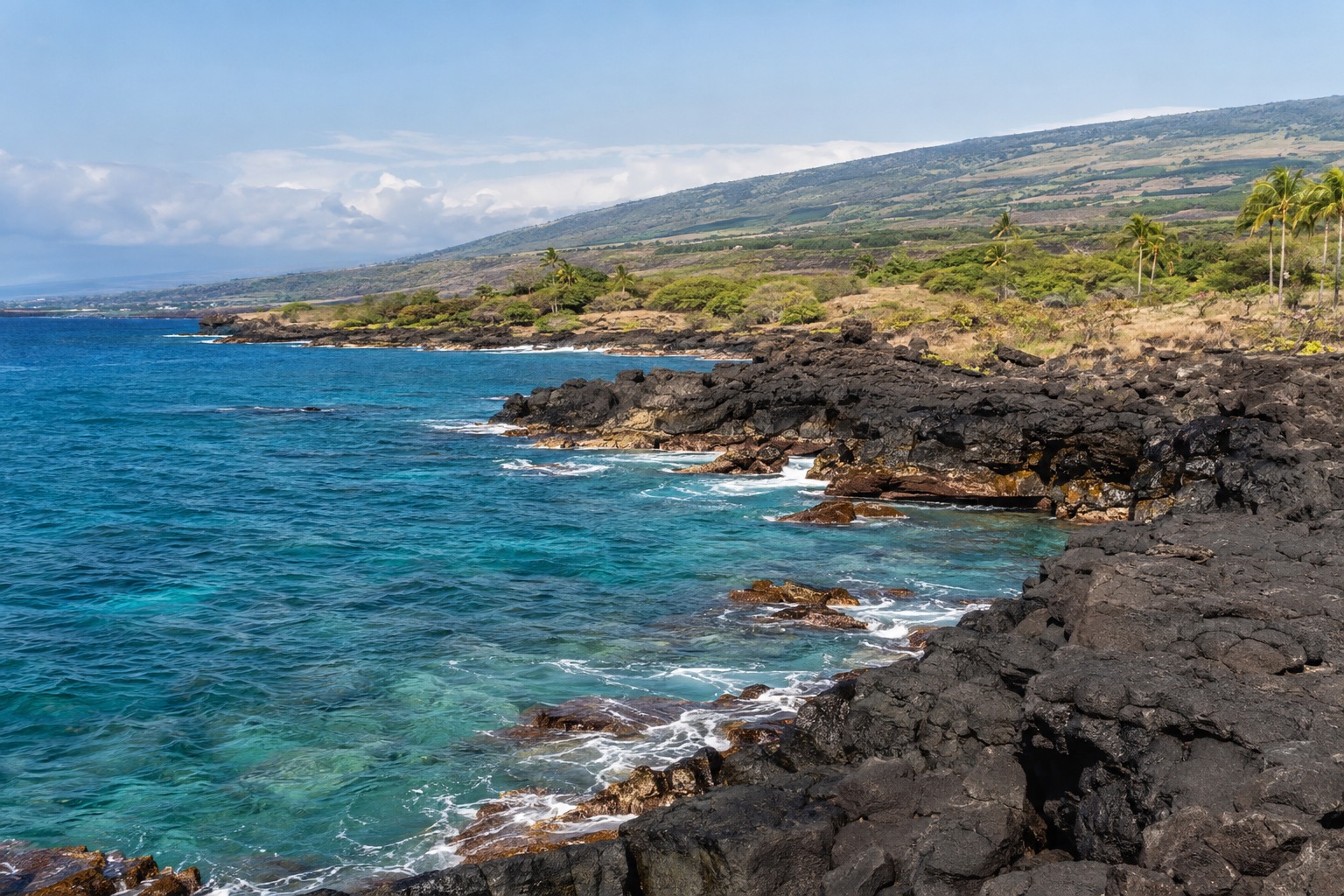
The island changes character every few miles. The west is sunny, rocky and sparse, with snorkeling bays and sunset dinners. The east is jungle, with rain-fed waterfalls, orchid nurseries and a small-town Hilo that still feels like old Hawaii.
Distances are long and the pace is unhurried. Visitors who love road trips, hiking, stargazing and quiet beaches will be happy here. Those who want nightlife and a walkable resort scene may find it spread too thin.
What is there to do in the Big Island?
What sets the island apart from its neighbors is scale and raw geology: you can go from a lava crater to a rain forest to a cold mountain summit in a single day. Four reasons draw most people.
Hawaii Volcanoes National Park
This is the headline act. Kilauea is currently at an elevated alert level, with strong glow and intermittent spatter from its vents, so the crater rim after dark is a main event. Cool, often drizzly air at the rim means a jacket is useful even when the coast is hot.
Chain of Craters Road winds down toward the sea past old lava flows and steam vents, and the lit walk through the Nahuku lava tube is a short, easy favorite. The park is about a 45 minute drive from Hilo and a long drive of two hours or more from Kona, so many visitors give it a full day.
| Site | Open | Admission |
|---|---|---|
| Hawaii Volcanoes National Park | Open daily | $30.00 per private vehicle (up to 14 passengers) |
| Nahuku (Thurston Lava Tube) | Lit 8 a.m. to 8 p.m. | Included with park entry |
| Kahuku Unit | Thursday to Sunday, 8 a.m. to 4 p.m. | Free |
Maunakea and the stars
Maunakea rises close to fourteen thousand feet, and the drive up the Saddle Road, between it and Mauna Loa, is a scenic trip in itself. The visitor station sits high on the mountain and is open through the evening, which is why people come for sunset and stargazing, with the whole Milky Way spilling overhead once the light fades.
The thin air is the thing to respect. A pause at the visitor station helps the body adjust, and beyond it only four-wheel-drive vehicles are allowed. Bring warm layers, because it is cold up there year-round, even after a beach morning.
Kona coast: coffee, bays and history
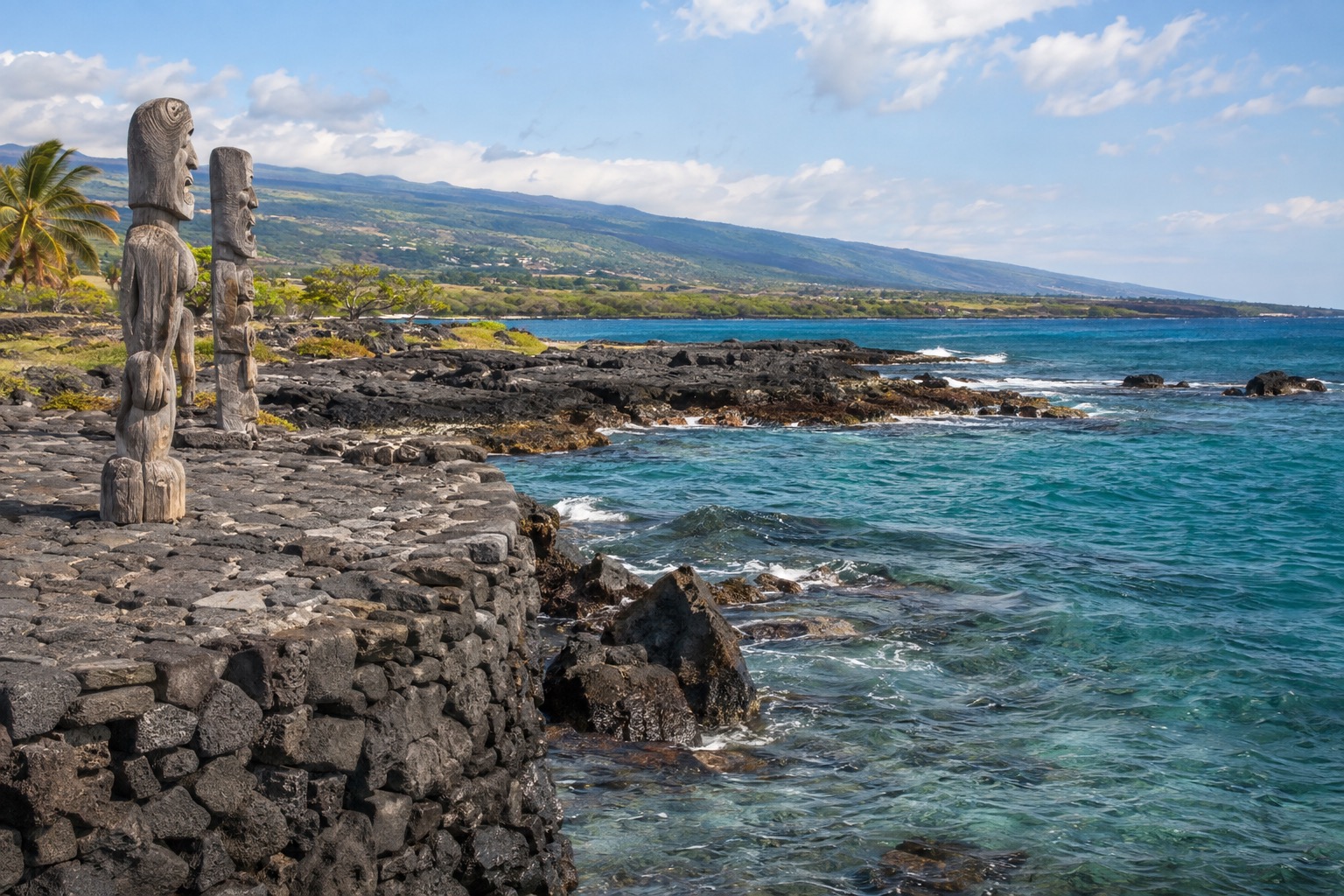
South of Kailua-Kona the coffee belt climbs the slopes, with small farms offering tastings of Kona coffee under shady trees. Farther down the coast, Kealakekua Bay is a snorkeling destination where Captain Cook first landed, and Puuhonua o Honaunau is a restored place of refuge, with carved wooden figures beside the water.
Boats and kayaks in Kealakekua Bay need a State Parks permit. Honu, the green sea turtles, rest on beaches and swim in the bays, and they deserve a respectful distance on land and in the water.
| Site | Open | Admission |
|---|---|---|
| Puuhonua o Honaunau National Historical Park | Daily | $20.00 per vehicle, $10.00 on foot or bicycle (age 16 and older) |
| Puukohola Heiau National Historic Site | Daily | Free |
Hilo, waterfalls and the Hamakua side
Hilo is green, rainy and relaxed, with a farmers market, old storefronts and a bay that looks toward the mountains. Rainbow Falls drops into a pool on the edge of town, and on many mornings a rainbow forms in its mist. Akaka Falls, a short drive up the coast, plunges into a deep, fern-lined gorge.
Both are quick stops that fit between a market breakfast and a drive to the volcano. Showers are likely here at any time of year, so a light rain jacket belongs in the day bag.
| Site | Open | Admission |
|---|---|---|
| Akaka Falls State Park | Daily | $5.00 per person plus $10 per vehicle (non-residents) |
| Rainbow Falls, Wailuku River State Park | Daily | $5.00 per person or $10 per vehicle (non-residents) |
How many days do you need in the Big Island?
A week is the comfortable answer, and five days is the least that does the island justice. The distances between the coasts are what eat the time.
With a short stay, choose a side: Kona and the Kohala coast for beaches, snorkeling and one night on Maunakea, or Hilo and the volcano for waterfalls and lava glow. With a week, you can do both, base yourself on each side for a few nights, and add the Kahuku Unit of the national park, Punaluu’s black sand beach with its resting turtles, and a slow morning at a coffee farm. Longer stays leave room for hiking in the park and extra beach days.
Where to stay in the Big Island
The Kohala coast, around Waikoloa, is resort country: sunny, dry and polished, with big pools and white-sand beaches close at hand. Kailua-Kona suits those who want a harbor town with restaurants, shops and sunset views, and it is the most practical base for snorkeling and coffee country.
Hilo has a quieter, more local feel and puts you close to waterfalls and the volcano. The village of Volcano, at the edge of the park, offers cottages and bed-and-breakfasts for people who want to watch the crater glow at night and sleep nearby. Lodging includes state and county transient taxes, listed in the closing section.
How do you get to the Big Island and get around?
Two airports serve the island. Kona International Airport, on the dry west coast, is the busier of the two, and Hilo International Airport serves the east. Pick the one nearer to where you plan to stay, since the island is large.
Getting around means driving. The park is about a 45 minute drive from Hilo, and from Kailua-Kona it takes roughly two to three hours depending on the route, either south along the coast or across through Waimea and Hilo. The Saddle Road crosses between the two big mountains and is now a modern highway. Public transit is limited, so most visitors rent a car.
When is the best time to visit the Big Island?
Late spring and early fall, roughly May and June and then September and October, bring sunny, warm days on the west coast with fewer crowds than the winter and summer peaks. The drier, hotter season runs from May to October, and the wetter, cooler one from November to April.
Which side you visit matters more than the month. Kona and Waikoloa stay dry and sunny nearly all year. Hilo gets heavy rain in every month, and the park at the crater rim is cool and damp even in summer. Winter, from December through February, brings the holiday crowds, while summer fills with families.
The Central Pacific hurricane season runs from June 1 to November 30. October, then, falls inside it, though the island is rarely hit.
Good to know before you go
Bring layers: the coast is hot, the volcano is cool and Maunakea is cold. Keep your distance from sea turtles, leave lava rock and black sand where you find them, and treat sacred sites with respect. Hawaii’s transient accommodations tax and the county tax are added to hotel bills, and parks charge non-resident visitors separately.
| Fee | Amount | Who pays |
|---|---|---|
| State transient accommodations tax | 11.00% of rental proceeds | Guests in lodging |
| County of Hawaii transient accommodations tax | 3% of rental proceeds | Guests in lodging |
| Non-resident state park fee | $10 per vehicle and $5 per walk-in visitor | Non-resident visitors |
Sources
- Hawaii Department of Taxation, Tax Announcement No. 2025-03 (Transient Accommodations Tax Law Changes from 2025 Legislative Session), files.hawaii.gov/tax/news/announce/ann25-03.pdf, checked September 24, 2026
- County of Hawaii, Department of Finance, Transient Accommodations Tax (TAT) page, hawaiicounty.gov/departments/finance/transient-accommodations-tax-tat (live returned HTTP 403 on request, read via Internet Archive Wayback Machine snapshot dated August 14, 2026, same official content), checked September 25, 2026
- Hawaii Department of Taxation, County Surcharge on General Excise and Use Tax page, tax.hawaii.gov/geninfo/countysurcharge/, checked September 25, 2026
- Federal Aviation Administration, CY2024 Commercial Service Enplanements (xlsx), faa.gov/airports/planning_capacity/passenger_allcargo_stats/passenger/arp-cy2024-commercial-service-enplanements.xlsx, checked September 24, 2026
- National Park Service, "Fees & Passes", nps.gov/havo/planyourvisit/fees.htm, read September 25, 2026
- National Park Service, "NPS Geodiversity Atlas – Hawaiʻi Volcanoes National Park", nps.gov/articles/nps-geodiversity-atlas-hawai-i-volcanoes-national-park-hawai-i.htm, read September 25, 2026
- U.S. Geological Survey, Hawaiian Volcano Observatory, "Kīlauea Volcano Updates", usgs.gov/volcanoes/kilauea/volcano-updates, read September 24, 2026
- University of Hawaiʻi at Hilo, Center for Maunakea Stewardship, "Important Things to Know", hilo.hawaii.edu/maunakea/visitor-information/important-things-to-know, read September 25, 2026
- University of Hawaiʻi at Hilo, Center for Maunakea Stewardship, "Maunakea Visitor Information Station", hilo.hawaii.edu/maunakea/visitor-information/station, read September 25, 2026
- Hawaiʻi Department of Land and Natural Resources, Division of State Parks, "ʻAkaka Falls State Park", dlnr.hawaii.gov/dsp/parks/hawaii/akaka-falls-state-park/, read September 25, 2026
- National Park Service, "Fees & Passes", nps.gov/puho/planyourvisit/fees.htm, read September 25, 2026
- National Park Service, "History & Culture", nps.gov/puhe/learn/historyculture/index.htm, read September 25, 2026
- Hawaiʻi Department of Land and Natural Resources, Division of State Parks, "Kealakekua Bay State Historical Park", dlnr.hawaii.gov/dsp/parks/hawaii/kealakekua-bay-state-historical-park/, read September 25, 2026
- Hawaiʻi State Legislature, Session Laws of Hawaiʻi 2024, Act 198 (H.B. No. 2298), Section 1, data.capitol.hawaii.gov/sessions/sessionlaws/Years/SLH2024/SLH2024_Act198.pdf, read September 25, 2026
- Hawaiʻi State Legislature, Session Laws of Hawaiʻi 2024, Act 198 (H.B. No. 2298), Section 1-2, data.capitol.hawaii.gov/sessions/sessionlaws/Years/SLH2024/SLH2024_Act198.pdf, read September 25, 2026
- NOAA Fisheries, "Viewing Marine Wildlife in Hawaiʻi", fisheries.noaa.gov/pacific-islands/marine-life-viewing-guidelines/viewing-marine-wildlife-hawaii, read September 25, 2026
- Hawaiʻi State Legislature, S.B. No. 3032, S.D. 1, H.D. 2 (2026), Section 1, data.capitol.hawaii.gov/sessions/session2026/bills/SB3032_HD2_.pdf, read September 25, 2026
- Hawaiʻi Department of Land and Natural Resources, Division of State Parks, "New Fees Go Into Effect at Hawaiʻi State Parks", dlnr.hawaii.gov/dsp/announcements/new-fees-go-into-effect-at-hawaii-state-parks-on-friday-october-9/, read September 25, 2026
- NPS, Day Hike Nahuku (Thurston Lava Tube), https://www.nps.gov/havo/planyourvisit/day-hike-nahuku.htm, checked September 25, 2026
- NPS, Hawaii Volcanoes National Park expands hours and increases access to Kahuku Unit, https://www.nps.gov/havo/learn/news/20220523-nr-kahuku-hrs.htm, checked September 25, 2026
- NPS, Hike and Explore the Park's Kahuku Unit in Kau, https://www.nps.gov/havo/learn/news/hike-and-explore-kahuku.htm, checked September 25, 2026
- NPS, Camping, https://www.nps.gov/havo/planyourvisit/camp.htm, checked September 25, 2026
- NOAA Fisheries, "Green Turtle", fisheries.noaa.gov/species/green-turtle, read September 25, 2026
- National Park Service, "Fees & Passes", nps.gov/puhe/planyourvisit/fees.htm, read September 25, 2026
- National Park Service, "Drive Chain of Craters Road", nps.gov/havo/planyourvisit/ccr_tour.htm, read September 25, 2026
- Hawaiʻi Department of Land and Natural Resources, Division of State Parks, "Wailuku River State Park", dlnr.hawaii.gov/dsp/parks/hawaii/wailuku-river-state-park/, read September 25, 2026
- Hawaiʻi Department of Land and Natural Resources, Division of State Parks, "Hāpuna Beach State Recreation Area", dlnr.hawaii.gov/dsp/parks/hawaii/hapuna-beach-state-recreation-area/, read September 25, 2026
- NPS, Directions, https://www.nps.gov/havo/planyourvisit/directions.htm, checked September 25, 2026
- Hawaii Department of Transportation, New phase of Daniel K. Inouye Highway opens Oct. 10 2017, https://hidot.hawaii.gov/highways/new-phase-of-daniel-k-inouye-highway-opens-oct-10-2017/, checked September 25, 2026
- USGS, November 27-December 10, 2022 Eruption of Mauna Loa, https://www.usgs.gov/volcanoes/mauna-loa/science/november-27-december-10-2022-eruption-mauna-loa, checked September 25, 2026
- NOAA NCEI, monthly normals 1991-2020, station USW00021510
- NOAA NCEI, monthly normals 1991-2020, station USW00021504
- NOAA NCEI, monthly normals 1991-2020, station USC00511303
- NOAA NCEI, monthly normals 1991-2020, station USC00518422
- NWS Honolulu / Central Pacific Hurricane Center, « 2026 Central Pacific Hurricane Season Outlook », weather.gov/hfo/hurricaneOutlook2026, checked September 24, 2026
All our pages
Things to do
- Things to Do in the Big Island: Volcanoes, Black Sand Beaches, Kona Coffee and Day Trips
- Day Trips from the Big Island: Volcanoes, Maunakea, Waterfalls and the Kona Coast