
PORTUGAL · THE ROAD TRIP GUIDE · CHAVES TO SAGRES
Portugal hands a road-tripper a great deal of country in a small frame. In one trip the view through the windshield can move from Atlantic fishing towns to terraced vineyards above the Douro, from the cork oaks and whitewashed hill towns of the Alentejo to the cliffs at Cape St. Vincent, the southwestern tip of the mainland. Motorways link the big cities, so the best hours of each day go to the smaller national roads, the village detours and the stops.
The mechanics are gentler than they look from home. Portugal’s road authority recognizes a US license, and rental companies must fit every car with a toll device you can switch on at the counter. Book the towns you’ll sleep in, collect the car on the day you leave the first city, and check the day’s driving on a map app each morning.
THE ROAD TRIP AT A GLANCE · PORTUGAL
Pick the route for its scenery, book the towns you’ll sleep in, and switch on the rental’s toll device at the counter before the first electronic gantry.
LISBON TO PORTO · DOURO · EN2 · ALENTEJO · ALGARVE · PLAN BY THE TOWN YOU SLEEP IN
Go for: coast, vineyards and hill towns inside one compact country, motorways between the cities and slow national roads for the good parts.
Think twice before: driving into historic centers such as Lisbon’s hills or Porto’s riverside, or turning down the toll device on a rental, since electronic-only motorways have no booths.
Tolls: Infraestruturas de Portugal · Lei 37/2024 · Limits and licenses: Código da Estrada, IMT · Douro and Évora: UNESCO · full sources at the end
On this page
- Which route for a first road trip?Lisbon to Porto, the Douro, the Alentejo and the Algarve
- Driving the EN2 end to end738 km from Chaves to Faro
- Is driving in Portugal hard?Right-hand traffic and speed limits in mph
- Tolls in a rental carGantries, the rental device and the toll-free A22
- Can I drive on a US license?The 15-year and under-60 conditions, the 185-day permit
- Dropping the car in another cityOne-way fees by company
Plan the trip by the town where each day ends. Choose a route for what it shows you, book beds in its arrival towns, and let the driving fill the gaps between them. For day-by-day versions, our 7-day itinerary and 10-day itinerary lay the same roads out night by night.
Best road trip in Portugal
For a first trip, the classic line links Lisbon and Porto, and it wins on variety through the windshield: the palaces and wooded hills of Sintra, the walled lanes of Óbidos, the Atlantic at Nazaré, the university town of Coimbra, the canals of Aveiro. Pick two or three of them as overnight towns and treat the rest as stops on the way. Collect the car as you leave Lisbon and hand it back on arrival in Porto.
Upriver from Porto, the drive through the Douro Valley is one long view: narrow, curving roads follow the river between terraced vineyards, and wine estates, the quintas, receive visitors along the way. Those slopes sit in the Alto Douro Wine Region, inscribed by UNESCO in 2001, whose property covers 24,600 hectares (about 60,800 acres) of terraced vineyard. Its buffer zone of 225,400 hectares is nine times that size, and UNESCO itself calls it difficult to manage. Book a night in the valley itself, so the quinta visits never compete with a drive back to Porto.
South of Lisbon the scenery opens up. The Alentejo is the country’s great open interior of plains, cork oaks and whitewashed hill towns such as Évora and Monsaraz. Évora came through the great earthquake of 1755 mainly undamaged, when the same shock destroyed much of Lisbon and many other Portuguese towns, and its golden-age city is still standing to be walked through. Farther on, the Algarve coast runs west to Sagres and Cape St. Vincent, where the resorts give way to cliffs. Pairing this run with the Lisbon to Porto line usually means a one-way rental, so price the drop-off fee first.
Estrada Nacional 2 road trip
The Estrada Nacional 2 runs 738 km (about 459 miles) from Chaves in the north to Faro in the south, across 35 municipalities. Travelers drive it end to end as a road trip of its own, north to south through the interior, far from the coastal routes. The kilometer marker where it starts in Chaves is a photo stop in its own right, so give the first morning time for it.
Plan it like the shorter routes, by the town where each night ends. Choose the overnight stops along the road first, then read the day’s driving off a map app the morning you set out. The interior villages and detours are where the hours go, so days with fewer kilometers and more stops suit this road best. Finishing in Faro puts you on the Algarve coast, with Lagos on the way west toward Sagres.
Is it easy to drive in Portugal?
Yes, for most American drivers. Portugal drives on the right, and traffic circles turn counterclockwise, as in the US. Our Portugal driving guide goes deeper on the day-to-day rules of the road.
Limits are posted in kilometers per hour. For a passenger car without a trailer, the general limits are 50 km/h (about 31 mph) in towns, 90 km/h (about 56 mph) on ordinary roads outside towns, 100 km/h (about 62 mph) on roads reserved for cars and motorcycles, and 120 km/h (about 75 mph) on motorways. Off the motorway, watch for the drop from 90 to 50 each time a national road enters a village.
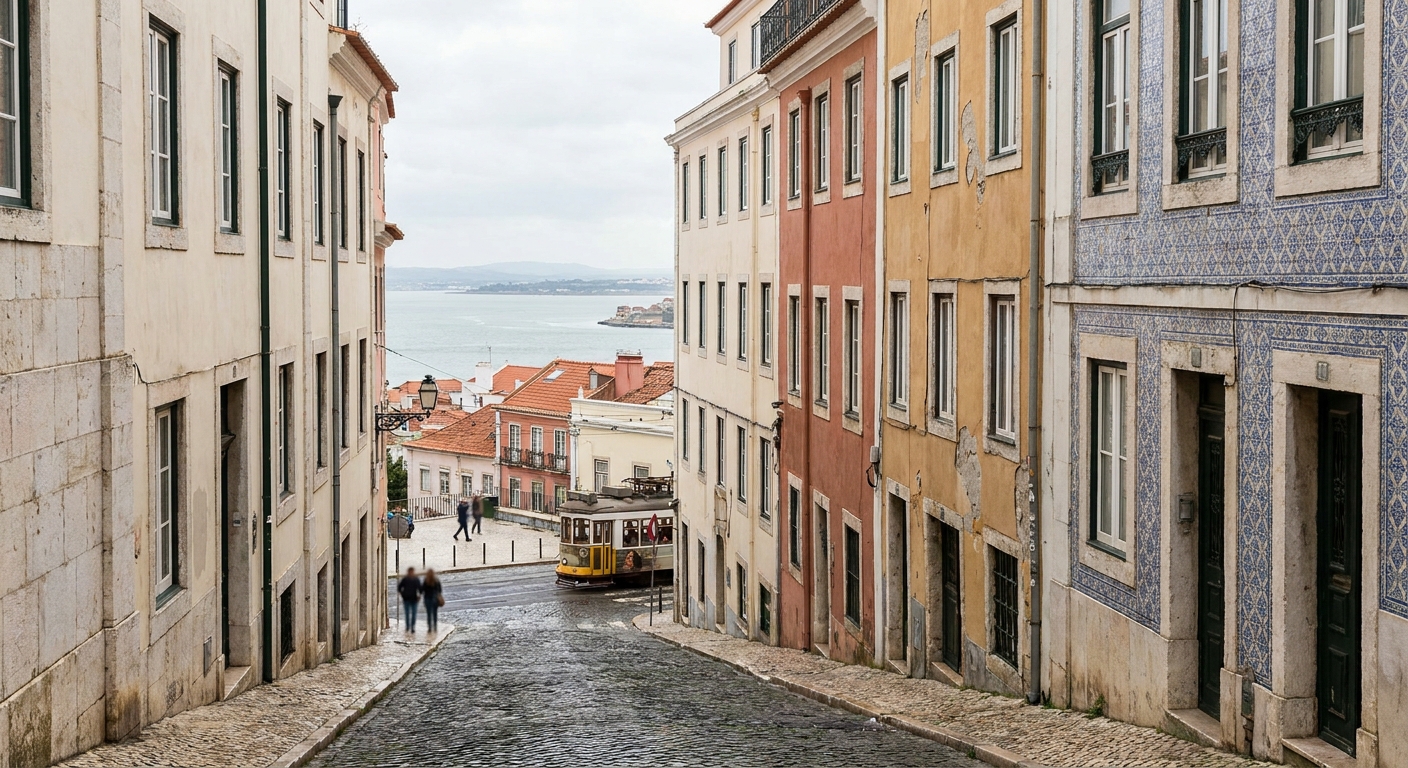
Historic city centers such as Lisbon’s hills, Porto’s riverside or Sintra’s old town are hard to drive and harder to park in. Many travelers pick up the car on the day they leave a city and return it before arriving in the next one. Book the rental around those arrival cities, with the car covering only the stretches between them, and use our car rental guide for the booking itself.
Mainland Portugal is compact, and motorways link its big cities. Map apps give driving times live, and those times hold on the motorway. They stop holding once you turn onto the smaller national roads, the village detours and the stops, where a road trip spends far more of its time than on the distance itself. Read an app’s figure as the motorway minimum and build the day around the stops.
Portugal toll roads with a rental car
Since January 1, 2025, tolls are no longer charged on the A22 across the Algarve, nor on the A4 Transmontana and Marão tunnel, the A13 and A13-1, the A23, the A24, the A25 and two stretches of the A28. For an Algarve leg, the A22 now costs nothing to drive.
Other motorways are signed as electronic-toll-only. There are no booths and no stopping on them: gantries over the road detect the car as it passes, and a panel near each gantry shows the fee. Nothing on the road asks you for payment, so settle the question at the rental counter before the first gantry.
Rental companies must fit each car in their fleet with an on-board toll device and subscribe to a toll payment system. Customers can opt in at the counter. Opt in at pickup, then ask how the charges reach your card and whether the company adds a fee of its own.
Without a device, Portugal’s toll portal describes post-payment for a Portuguese-plated car: electronic tolls get paid afterward at a CTT post office, a Payshop agent or a Multibanco ATM. Charges become payable 48 hours after passing and are due within 15 working days, with €0.32 per trip in fees, capped at €2.56 per payment. Ask the rental company whether that route applies to its cars before you decline the device.
Motorways with traditional toll barriers still take payment at the booth, in cash or by bank card. Via Verde is the small windshield box that lets a car roll through the green-marked lanes without stopping. Keep out of those green lanes unless your car carries one.
Driving in Portugal with a US license
Portugal’s road authority, the IMT, lists the United States among the OECD countries whose driving licenses are recognized, because it signed the 1949 or 1968 road traffic convention. Such a license is valid in Portugal as long as it is valid, was issued or last renewed no more than 15 years ago, and its holder is under 60. An international driving permit counts when shown together with the national license it supports, and it allows a non-resident to drive for the first 185 days after entering Portugal. Check the issue or renewal date printed on your license before you fly, and pack the card itself.
One-way car rental in Portugal
Picking a rental car up in one city and dropping it in another is possible with the major rental companies, usually against a one-way fee set by each company. That fee is the price of combining two routes, such as Lisbon to Porto followed by the Douro, or a Lisbon pickup that ends on the Algarve. Compare it across several companies for your exact pickup and drop-off cities, weigh it against driving back to the start, and fold the result into your budget with our Portugal trip cost guide.
Sources & data for this guide
- Toll-free motorways since Jan 1, 2025 · Lei n.º 37/2024 of Aug 7, 2024, Diário da República, 1st series no. 152, arts. 2 and 4 · checked Sep 24, 2026
- Electronic-only tolls, rental toll devices (Decreto-Lei 84-C/2022), post-payment and manual payment · Portal PT Tolls, Infraestruturas de Portugal · checked Sep 24, 2026
- Speed limits and license validity · Código da Estrada (Decreto-Lei 114/94), 28th consolidated version (Lei 24/2025), arts. 27 and 125, via pgdlisboa.pt · checked Sep 24, 2026
- US license recognition · IMT, page on OECD and CPLP licenses, imt-ip.pt · checked Sep 24, 2026
- EN2 length and municipalities · Government of Portugal release, Oct 19, 2025, portugal.gov.pt · checked Sep 24, 2026
- Alto Douro Wine Region (no. 1046) and Historic Centre of Évora (no. 361) · UNESCO World Heritage Centre · checked Sep 24, 2026
- Driving times between cities · no primary source we could read publishes them · map apps give them live · checked Sep 24, 2026
- Route descriptions, one-way rentals and city-center driving are editorial orientation; toll systems and rental terms change · check with your rental company when you book.
To plan your stay
- Best Time to Visit Portugal in 2027: Weather, Crowds and the Sea, Month by Month
- Where to Stay in Portugal: Bases by Region, Nights and Car Needs
- Getting Around Portugal: Trains, Buses, Airports and When to Rent a Car
- Things to Know Before Going to Portugal: Couvert Charges, Dinner Hours and Calçada Shoes